
Maltese Cross Ranch: Roosevelt's Dakota Foothold
A Cross-Shaped Dream Takes Shape
The Maltese Cross Ranch, located seven miles south of Medora on the Little Missouri River, was never meant to be Roosevelt's final western home or his most beloved ranch. It was, instead, his first tangible commitment to the frontier—the physical and financial foundation upon which all his subsequent Dakota ventures would rest. Named for the distinctive brand burned onto the cattle's hides (a cross with four equal points, resembling the symbol of an ancient military order), the ranch represented a calculated business investment made almost impulsively during a hunting trip in September 1883 that had fundamentally altered Roosevelt's understanding of himself and what he wanted from life. It was the moment when the dude from New York became a rancher.
The scale of the operation was modest compared to the great cattle empires of Montana and Wyoming, which would suit Roosevelt's temperament for deliberate escalation. When Roosevelt invested his fourteen thousand dollars in partnership with Sylvane Ferris and Bill Merrifield in September 1883, the ranch comprised perhaps 450 head of cattle grazing on the open range—a respectable beginning, but hardly the massive herds that might make a man wealthy beyond measure. The principal asset was land—not owned but held by water rights and by the customary claim to the range that actual use conferred upon a ranching outfit. In the open-range ranching system of the 1880s, an outfit didn't need to own the grassland. It simply needed the cattle to graze it, the will to work them, the knowledge to manage them through seasons and hardship, and enough capital to survive the inevitable lean years and bad luck that tested all frontier enterprises.
Merrifield and Sylvane Ferris, the brother of Roosevelt's hunting guide Joe Ferris, were the two men who would actually manage the ranch's day-to-day operations while Roosevelt was absent in New York pursuing his political career. They were experienced frontier cattlemen with a reputation for competence and honesty in a time and place where dishonesty among hired managers was not uncommon. Merrifield in particular was known as an accomplished horseman and hunter—a man who understood cattle and the business of ranching and possessed the practical skills to execute it effectively. Roosevelt, providing capital from a distance, trusted these men with the operation completely. His role was investor and occasional visitor who came west to participate in roundups and hunting trips, not active day-to-day rancher. Yet the Maltese Cross remained his anchor to the Badlands, the place he would return to when eastern life became unbearable or unfulfilling, and the foundation upon which he would build his larger Dakota dreams—the Elkhorn Ranch where he would find the solitude and self-knowledge he truly sought.

Roosevelt named his first ranch the Maltese Cross, for the brand its cattle wore. From a modest log cabin, he set out to become a Badlands cattleman. (Theodore Roosevelt Collection, Harvard College Library)
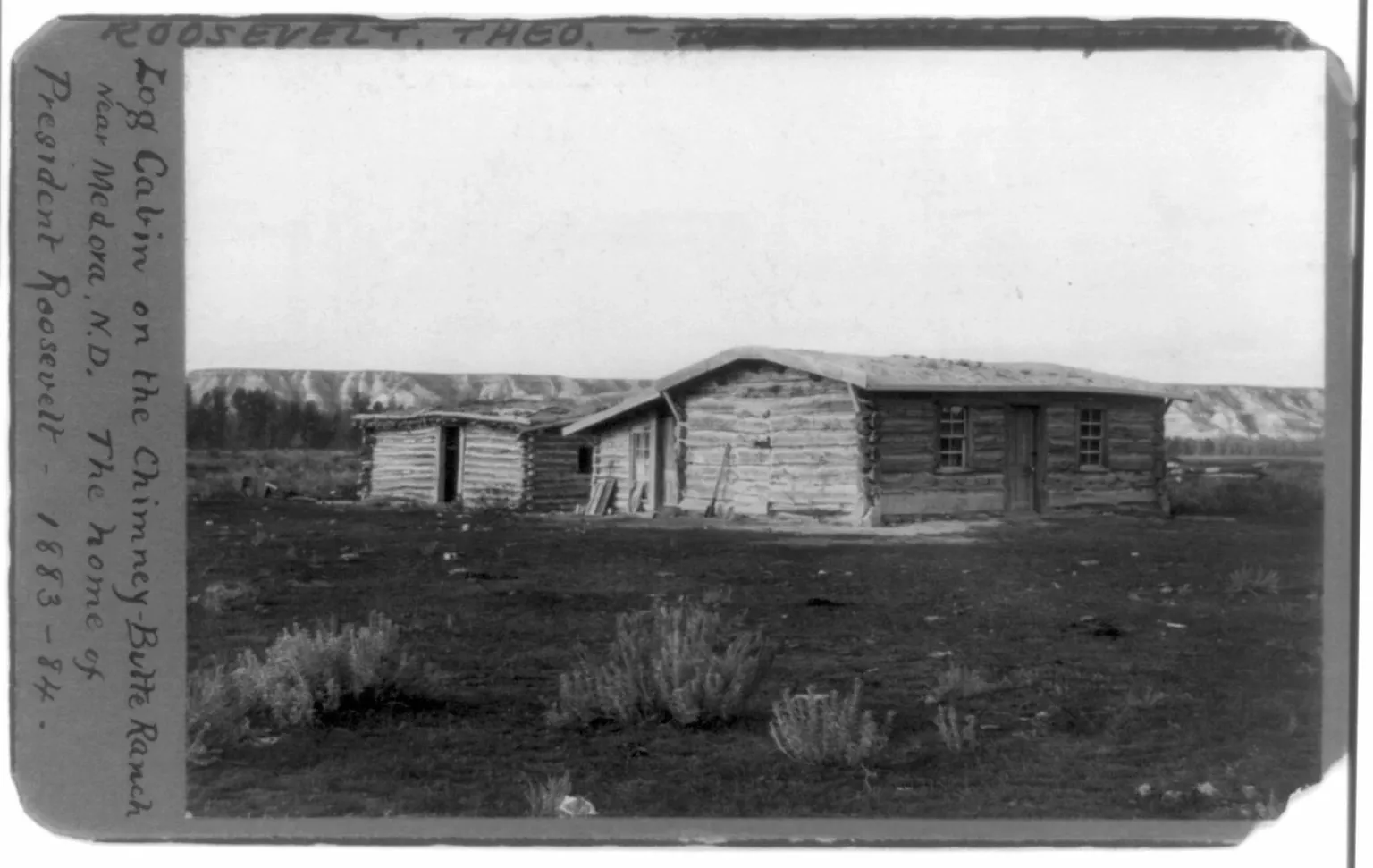
The cabin was plain but comfortable by frontier standards — three small rooms—kitchen, living room, and bedroom—plus a sleeping loft, even a rubber bathtub Roosevelt shipped from the East. (Library of Congress)
The Log Cabin and Frontier Simplicity
Roosevelt's principal dwelling at the Maltese Cross was a simple log cabin—the kind of structure that had become standard on the frontier. Built from ponderosa pine logs, the cabin was small, roughly finished, heated by a fireplace, and furnished only with the bare necessities. It was a dramatic contrast to the comfortable rooms Roosevelt inhabited in his family's New York brownstone. Yet when he was in Dakota, the cabin represented something precious: a refuge from the demands of eastern society, a place where life could be stripped to essentials, where a man could live according to his own principles rather than the expectations of others.
This very simplicity held a powerful appeal for Roosevelt. The Badlands taught him that comfort could be abandoned without catastrophic loss. A man needed shelter, warmth, food, and useful work. Everything else was ornament. This lesson—that essential living was not only possible but somehow more authentic than the elaborate comfort of wealthy eastern homes—would shape Roosevelt's thinking for the rest of his life. Even when he later occupied the White House, Roosevelt maintained a philosophy of relative simplicity and hard work that stood in stark contrast to the aristocratic opulence he had inherited.
The cabin that Roosevelt occupied at the Maltese Cross still survives. Theodore Roosevelt National Memorial Park was established in 1947 (redesignated a national park in 1978), and in 1959 the cabin was relocated to the South Unit visitor center at Medora, where it remains today—a modest log structure preserved as a tangible reminder of Roosevelt's frontier years. Visitors can see the actual space where the young rancher ate, slept, and read books by firelight while the wind howled outside. The cabin's very ordinariness speaks to the authenticity of Roosevelt's frontier experience. This was not a luxury retreat or a vacation home. It was a working ranch dwelling, and Roosevelt lived in it as a working rancher would, not as a wealthy man playing at frontier life.
The Business of Open-Range Ranching
The economics of open-range ranching in the 1880s were deceptively complex, mixing speculative enthusiasm with genuine hardship and the constant risk of catastrophic loss. A rancher like Roosevelt didn't need to own land—the public domain could be grazed by anyone. What he needed was an initial capital investment to purchase cattle, the labor to manage them, and the knowledge to keep them alive through the harsh Dakota winters.
Each cowboy required at least six good horses to perform his work effectively. A good horse might cost thirty to fifty dollars—a substantial sum in 1880s dollars. The cattle themselves cost money: Roosevelt was purchasing animals ready to breed, at prices determined by weight, age, and condition. Then there were the supplies: salt, hay for winter feeding (though on the open range, cattle were expected to forage even in deep snow), tools, equipment for branding and moving cattle. And there were the human costs: wages for cowboys, supplies to sustain them, food that couldn't be hunted or grown on the ranch.
The business model relied on several assumptions, all of which would prove dangerously fragile. First, it assumed that cattle prices would remain stable or rise. Second, it assumed that the open range would remain open—that the land wouldn't be fenced, claimed, or withdrawn from cattle use. Third, and most critically, it assumed that the weather would cooperate—that winters would be survivable, that drought wouldn't parch the grasslands, that the climate would permit cattle to survive on range grass.
In 1883 and 1884, these assumptions seemed reasonable. The market for beef was strong. Prices were good. The range seemed unlimited. Cattle multiplied rapidly, and a modest initial herd could grow substantially within a few years if losses were kept minimal. Roosevelt, observing the apparent success of established ranchers and the limitless grasslands surrounding his cabin, became convinced that the frontier offered genuine opportunity for profit and growth. He was not entirely wrong—but he was dangerously optimistic about the sustainability of the system.

On the open range, cattle grazed unfenced across vast grasslands, rounded up twice a year. Roosevelt poured much of his inheritance into the risky, weather-dependent business. (Theodore Roosevelt Collection, Harvard College Library)

Roosevelt rode the roundups alongside his men, earning their respect through sheer doggedness — once staying in the saddle for some forty hours straight. (Theodore Roosevelt Collection, Harvard College Library)
Cowboys, Roundups, and the Rhythm of Ranch Work
The actual work of ranch management followed seasonal rhythms that had developed over decades of open-range cattle operation. In spring, when calves were born and cattle began to disperse across the vast grasslands, the roundup began. Ranchers from multiple outfits would gather, along with their cowhands, to collect cattle and separate them according to brand. This required skill, horsemanship, and the kind of coordination that only experience could teach.
The roundup was hard, dangerous work. A cow with a newborn calf would charge a horse and rider with ferocious intent. A steer separated from the herd would run frantically in any direction. Horses would stumble in badlands coulees. Cowboys were thrown, kicked, and gored with surprising frequency. The work demanded all-day effort, in all weather, for weeks at a time. A typical roundup in the spring might bring together a hundred cowboys from dozens of ranches, working from dawn until the light failed, pushing cattle across rough country, separating calves for branding, marking new animals for a rancher's herd.
Between roundups, the work was steady but less intense. Cowboys watched for strays, fixed fencing, maintained equipment, checked water sources and salt licks, and maintained constant vigilance against rustlers and predators. A cowboy on the Maltese Cross would ride the range for days at a stretch, covering fifty or more miles a day, looking for cattle that had wandered, found water, or fallen into trouble. In winter, the work intensified as cowboys had to ensure that cattle could reach grass beneath snow and were not dying of cold and starvation.
Roosevelt participated in this work, at least when he was present at the ranch. He rode with the cowhands, shared their work, and attempted—with middling success—to match their skills at horsemanship and cattle handling. He was not a natural at the work, but his willingness to do it alongside hired cowhands earned their respect. There was something about Roosevelt's approach that appealed to frontier men: he was clearly out of his element, clearly struggling, but he kept trying. That was sufficient for respect on the frontier.
Partners and Managers: Sylvane Ferris and Bill Merrifield
The success of the Maltese Cross depended almost entirely on the competence and integrity of Sylvane Ferris and Bill Merrifield. These two men were responsible for the daily management of the cattle, the hiring and supervision of cowboys, the purchase and care of horses, and the entire execution of the ranching operation while Roosevelt was absent in New York serving in the State Assembly or pursuing his political ambitions. Their reputation for honesty and capability was essential, because Roosevelt was essentially writing them a check and entrusting them to manage thousands of dollars of his inheritance. In the frontier West of the 1880s, where distance and communication were limited, such trust was often betrayed. A dishonest manager could embezzle funds, sell cattle and pocket the proceeds, or simply abandon the ranch entirely. Roosevelt's willingness to trust Ferris and Merrifield spoke to his character and his reading of character—a reading that proved accurate.
Sylvane Ferris was Joe Ferris's younger brother—quieter and more contemplative than his outgoing sibling, perhaps more serious in temperament, but equally competent in the world of frontier cattle ranching. Merrifield was known throughout the Little Missouri Valley as an exceptional horseman and a man of sound judgment about cattle behavior and range conditions. Both men had established themselves as reliable figures in the frontier community and enjoyed the respect and trust of their peers. When Roosevelt proposed the partnership, he was choosing men whose judgment and honesty he had come to respect through his hunting trips and early visits to the Badlands, and his trust proved amply justified. The Maltese Cross, under Ferris and Merrifield's capable management, developed into a successful operation that generated modest but real profits in the good years before the winter of 1886-87 destroyed the entire industry.
This partnership model—the eastern investor providing capital and receiving monthly reports, while experienced frontier men handled the actual day-to-day work—became increasingly common in the western cattle industry during the 1880s. It allowed educated, ambitious men like Roosevelt to participate in western ranching without possessing the years of practical frontier experience that the business demanded. Yet the model also created significant potential for mismanagement, fraud, and dishonesty. Dishonest partners could steal cattle, misappropriate funds, or simply abandon operations entirely. Roosevelt was exceptionally fortunate in his choice of partners. By all contemporary accounts, Ferris and Merrifield were honest, capable, and genuinely committed to making the ranch succeed and honoring Roosevelt's investment.

Roosevelt trusted the ranch's daily operation to two capable partners, Sylvane Ferris and Bill Merrifield, who ran the Maltese Cross while he came and went from the East. (Theodore Roosevelt Collection, Harvard College Library)
A Foundation for Greater Ambitions
As 1884 progressed and the seasons turned through their cycles, the Maltese Cross remained Roosevelt's initial western investment, but it was increasingly clear that it would not be his final or most important one. The ranch was adequate for its purpose, and it was proving profitable in those early years, but it was also relatively small and not perfectly suited to Roosevelt's temperament or ambitions. It was too close to Medora and its distracting bustle of commercial activity and social obligations. The Marquis de Mores's development had created a town full of strangers and transients. Roosevelt wanted a more remote location where he could live with greater solitude and reflection, a place where he could focus on developing larger cattle operations and pursuing his own vision of ranch life.
Even as the Maltese Cross was taking shape and the initial herds were grazing on the open range, Roosevelt was conceiving a larger vision—a second, more ambitious ranch operation in a more remote and beautiful part of the Badlands country, far from the town and closer to the wild heart of the landscape. This new venture would bear the name Elkhorn, and it would become the place Roosevelt truly considered home during his Dakota years—a refuge from the compromises and conventions of eastern life. The Elkhorn would represent his fuller commitment to the frontier experience. Yet the Maltese Cross remained significant and valuable, a testament to his initial commitment and a continuing asset that generated income even as he pursued larger ambitions and represented his most tangible stake in the frontier.
The Maltese Cross Ranch, while ultimately overshadowed by the larger and more remote Elkhorn operation, represents an essential chapter in Roosevelt's western story and a turning point in his life. It was his first foothold on the frontier, the financial and psychological anchor that bound him to Dakota and made possible all that followed. Without the Maltese Cross—without that initial fourteen-thousand-dollar investment made during a hunting trip in the autumn of 1883, without the commitment to partnership with Ferris and Merrifield, without the decision to build cattle operations in the Dakota Badlands—Roosevelt might have returned to New York after his hunting trip and pursued an entirely different life trajectory. Instead, he had committed himself to the frontier, had invested his capital and his time and his ambition in the landscape, and the frontier had committed itself to remaking him from a frail, grieving eastern gentleman into a man of action and resilience.
Continue Reading
- The Badlands Years — Roosevelt's transformative time in Dakota Territory
- Elkhorn Ranch — Roosevelt's larger and more ambitious Dakota operation
- Theodore Roosevelt National Park — The Badlands landscape preserved and the Maltese Cross cabin as it remains today
Primary Sources at the TR Center
Explore original documents and resources related to the Maltese Cross Ranch in the Theodore Roosevelt Center Digital Library.
- Dakota and Ranching Encyclopedia — Full context on Roosevelt's western cattle operations and frontier experiences
- Badlands and Western Adventure Resources — Documents and essays on Roosevelt's transformative Dakota years
From the Archives
Explore original photographs, documents, and illustrations related to this topic in the Theodore Roosevelt Center Digital Library.
Recommended Reading
- Theodore Roosevelt in the Dakota Badlands: An Historical Guide by Clay Jenkinson (2006). ISBN: 0-9786267-0-2
- Roosevelt in the Bad Lands by Hermann Hagedorn (1921)
- The Rise of Theodore Roosevelt by Edmund Morris (1979). ISBN: 978-0-307-77782-9
- Theodore Roosevelt in the Badlands by Roger L. Di Silvestro (2011)