
Labor Day with Theodore Roosevelt
For Theodore Roosevelt, Labor Day was a day for speeches about work. He spent it at a Chicago picnic, a Vermont rail tour, the New York State Fair and a rain-soaked park in Fargo, North Dakota. His last one, in 1918, was at a shipyard launch in Newburgh, New York.
Key Facts
| First Labor Day | September 5, 1882, in New York City, organized by the Central Labor Union |
|---|---|
| A national holiday | President Grover Cleveland signed the law making the first Monday in September a national holiday on June 28, 1894 |
| First Labor Day as President | September 1, 1902, speaking at stop after stop in Vermont |
| Square deal line | "We must see that each is given a square deal, because he is entitled to no more and should receive no less." (Syracuse, 1903) |
| North Dakota Labor Day | Fargo, September 5, 1910 |
| Last Labor Day | Newburgh, New York, September 2, 1918, at a shipyard launch |
Lessons from the Cowpunchers
On Labor Day 1900, T.R. was Governor of New York and the Republican candidate for Vice President. He spent the day at the Chicago Labor Day picnic, speaking on the labor question to a crowd made up largely of wage-earners. William Jennings Bryan, the Democratic candidate for President, also spoke at Chicago's celebration that day.
T.R. praised the good done by labor organizations and trade unions, and described New York's eight-hour law for state workers and contractors. Then he reached back to his ranch years. "The first time I ever labored alongside of and got thrown into intimate companionship with men who were mighty men of their hands was in the cattle country of the Northwest," he said.
He also warned the crowd against fine words that went nowhere: "…a ton of oratory is not worth an ounce of hard-headed, kindly common-sense."
Speak Softly, on Labor Day
A year later, on Labor Day, September 2, 1901, Vice President Roosevelt spoke at the Minnesota State Fair. The speech was about national duties and foreign policy, not labor. It is remembered for one line: "A good many of you are probably acquainted with the old proverb: 'Speak softly and carry a big stick—you will go far.'"
Four days later, on September 6, President William McKinley was shot in Buffalo.
His First Labor Day as President
On September 1, 1902, his first Labor Day as President, T.R. spoke at one Vermont town after another, including Rutland, Bellows Falls, Middlebury and Proctor. At Rutland he said: "There is no holiday which should be more typically American, no holiday which should make our people think more seriously of their privileges, their rights and their duties than this holiday of Labor Day."
He kept coming back to one idea: everyone has to carry a share. "The law of successful national life is the law of work," he told Rutland. "Play when the chance comes, and when you do play, play hard, but do not make of the play a business." At Bellows Falls he put it simply: "He must pull his weight and a little more."
The tour went on through Massachusetts. Two days after Labor Day, on September 3, a trolley car struck his carriage in Pittsfield. Secret Service operative William Craig was killed. T.R. was bruised and later needed surgery on his leg.
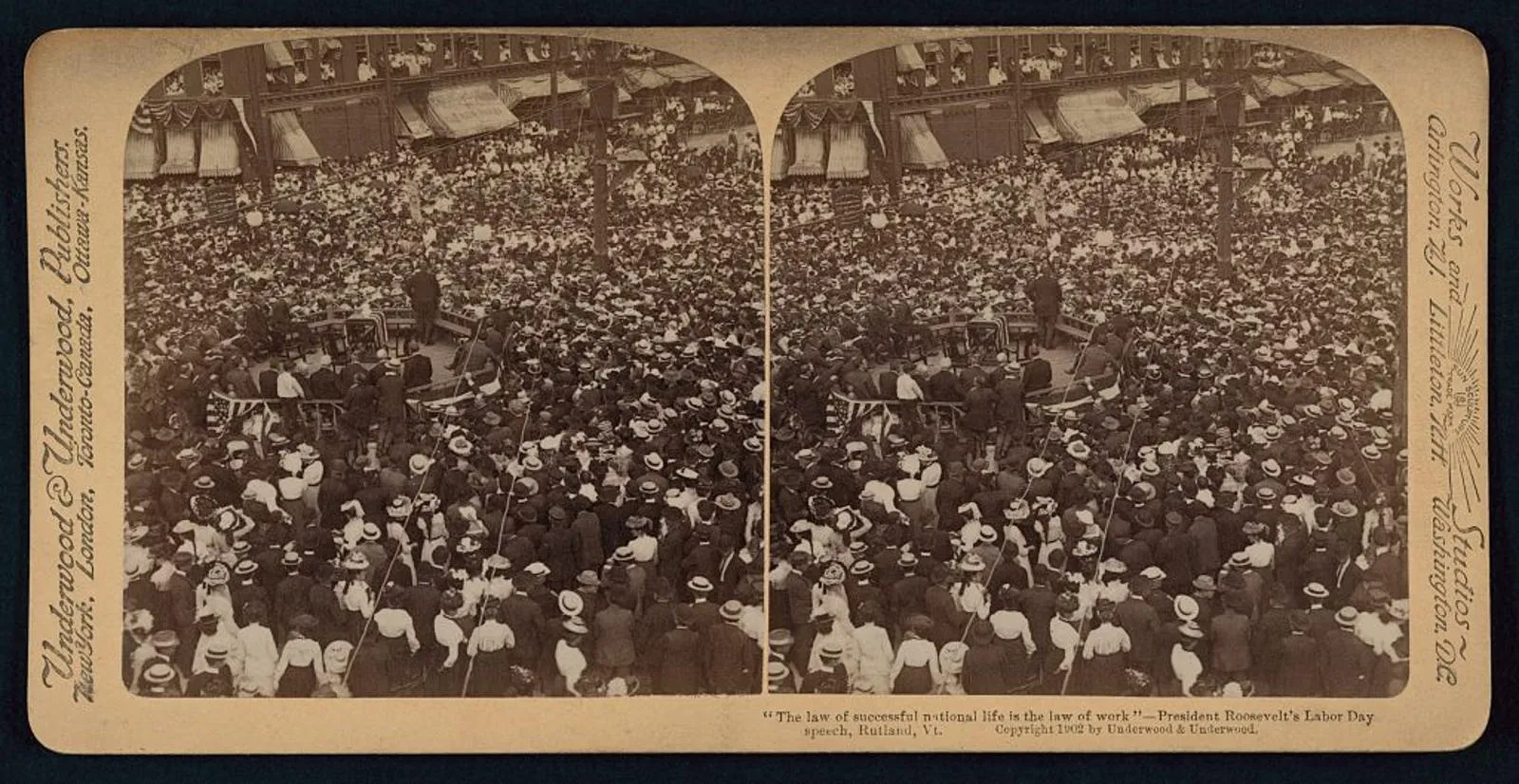
"The law of successful national life is the law of work" - President Roosevelt's Labor Day speech, Rutland, Vt. Stereograph, 1902. (Library of Congress)
A Square Deal at Syracuse
On September 7, 1903, T.R. gave a Labor Day speech at the New York State Fair in Syracuse. He left Oyster Bay on Sunday night, arrived in Syracuse at 9:30 the next morning, and spoke about the farmer and the wage-worker. Wire reports estimated 100,000 visitors and about 5,000 marchers in the labor parade.
The speech holds two lines that are still often quoted. One is about work itself: "Far and away the best prize that life offers is the chance to work hard at work worth doing…" The other, near the end of the speech, was about how the country should treat every citizen: "We must treat each man on his worth and merits as a man. We must see that each is given a square deal, because he is entitled to no more and should receive no less."
He left by special train at 10:30 that night, bound back to Oyster Bay.

President Roosevelt boarding the Mayflower for the Oyster Bay naval review on Labor Day, Sept. 3, 1906. William Rau, photographer. (Library of Congress)
Quiet Days at Sagamore Hill
Not every Labor Day meant a speech. In 1904, in the middle of his campaign for a full term, he spent the day at home. A wire report from Sagamore Hill said Labor Day "was celebrated at the president's home principally by the attendance on a baseball game." The town was closed, and the President spent the day "practically the same as any other day," with no visitors.
On Labor Day 1906, September 3, the Navy came to him. From the presidential yacht Mayflower, he reviewed dozens of warships of the Atlantic Fleet in Long Island Sound, "within hailing distance of his summer home," one newspaper reported. Navy Secretary Charles Bonaparte and Postmaster General George Cortelyou were aboard, and the morning's rain cleared before the review ended.
Labor Day in North Dakota
On Labor Day 1910, T.R. came back to North Dakota. He was on a western speaking tour, five days after his "New Nationalism" speech at Osawatomie, Kansas. In Fargo he spoke at the laying of the cornerstone of a library at Fargo College, then gave the Labor Day address to a crowd that overran Island Park.
His speech was called "Labor and Capital," and he opened it, "To-day — on Labor Day — I speak in one sense to those especially personally and vitally interested in the labor struggle…" One line sums up his argument: "Our basic problem in the twentieth century is to see that the marvelously augmented powers of production bequeathed to us by the nineteenth century be made to administer to the needs of the many rather than be exploited for the profit of the few."
The crowd sat through a heavy rainstorm to hear him. When he finished, a wire report said, a "small, poorly dressed man" pushed onto the platform, called him a liar and shouted that his expenses were "being paid by the people of the United States." T.R. took hold of the man and helped put him off the stage. The man vanished into the crowd.
Labor Day on the Campaign Trail
In 1912 T.R. ran for President as the Progressive Party candidate. Joseph W. Alsop, a Connecticut state senator, had invited him to Connecticut for Labor Day, and letters from that summer show him weighing Minnesota or Connecticut. Connecticut won. On September 2, his train made stops across Connecticut on the way to the State Fair at Charter Oak Park in Hartford, where he spoke despite the rain. From there he headed into Massachusetts and on west for a month of campaigning.
Two years later, on Labor Day, September 7, 1914, he was in New Orleans campaigning for Louisiana's Progressive candidates. An Associated Press report said he told a Labor Day picnic that labor unions were all right in principle and, led by the right men, worked toward a good end. That night he spoke at the French Opera House.
The Last Labor Day
T.R.'s last Labor Day came on September 2, 1918, four months before his death. His son Quentin had been killed in France on July 14, seven weeks earlier.
That day he went to the shipyard at Newburgh, New York, where thousands gathered for the launch of the yard's first ship, a 9,000-ton steel cargo ship named the Newburgh. He spoke to the shipyard workers there about their work for the war.
Did He Really…?
Did T.R. introduce the Square Deal on Labor Day 1903? Not quite. His Syracuse speech is a famous statement of the square deal, but he had already used the phrase in public that year, at the Grand Canyon on May 6 and at the Lincoln Monument in Springfield, Illinois, on June 4.
Was "speak softly and carry a big stick" a presidential speech? No. He said it as Vice President, at the Minnesota State Fair on Labor Day 1901. It wasn't a labor speech, and he called the line an "old proverb," not his own invention. His text also includes the ending many versions leave out: "you will go far."
Was he hurt in the Pittsfield trolley crash on Labor Day 1902? The crash happened two days after Labor Day. Labor Day was September 1, and the crash was September 3.
Was the 1910 cornerstone at the North Dakota Agricultural College? No. Accounts from 1910 place it at Fargo College.
Explore More
Timeline of T.R.’s Labor Days
Where he spent Labor Day, from Chicago to Fargo to a New York shipyard.
Arbor Day with Theodore Roosevelt
A governor's proclamation, Nebraska forests and a letter to every schoolchild.
Primary Sources
- The Strenuous Life (1900)
- Presidential Addresses and State Papers (1904)
- The New Nationalism (1910)
From the Archives
Letters, speeches and photographs about Labor Day from the Theodore Roosevelt Center’s digital library.
Recommended Reading
- The New Nationalism, Theodore Roosevelt (1910)