
New Year’s Day with Theodore Roosevelt
For Theodore Roosevelt, New Year's Day often meant a long line of people waiting to shake his hand, first in Albany and then at the White House. Other years found him on the Nile as a boy, on foot in Uganda, and wading Brazilian marshes on an all-day hunt.
Key Facts
| White House receptions | Eight as President, 1902–1909 |
|---|---|
| Biggest counted crowd | January 1, 1906: 9,052 "by actual count" (Associated Press); 9,072 by the White House's official figures |
| Governor of New York | Sworn in privately on December 31, 1898; public inauguration and reception on Monday, January 2, 1899 |
| The "8,513 handshakes" record | No 1907 newspaper found gives that number |
| On the trail | Uganda in 1910; Mato Grosso, Brazil, in 1914 |
A Boy Abroad on New Year's Day
Eleven-year-old Theodore greeted 1870 in Italy, on his family's long tour of Europe. His diary entry for the day begins: "We went to Sorrento. We went first round the old part of Naples and saw the market." The same entry records a carriage with three horses abreast and a donkey ride he called splendid.
Three years later the family was on the Nile. On New Year's Eve 1872, the 14-year-old wrote that four houseboats, "the Gazelle, Ibis, Rachel and Waterlily were moored side by side, while their inhabitants spent New Years Eve together in our boat." The spelling and punctuation are his own.
Twenty-Four and Running for Speaker
On the night of January 1, 1883, in Albany, the Democratic members of the New York Assembly picked Alfred C. Chapin of Brooklyn as their candidate for Speaker. "This challenge was responded to quickly by the Republicans, who nominated Theodore Roosevelt, of New-York, as their candidate for Speaker," the New-York Tribune reported. He was 24. The same day, Grover Cleveland was inaugurated Governor of New York.
The Democrats held the majority, so Chapin won the Speakership and T.R. became the Republican minority leader. A year later, on New Year's Eve 1883, he lost his party's caucus for Speaker. The Tribune reported the vote: "Mr. Sheard received 41 and Mr. Roosevelt 20 votes." Six weeks after that, on February 14, 1884, his mother and his wife Alice died.
A Governor Sworn In on New Year's Eve
T.R. did not become Governor of New York on New Year's Day. He took the oath privately in Albany shortly after noon on Saturday, December 31, 1898, before Secretary of State John Palmer, with his hand on a morocco-covered Bible. Palmer gave him the pen he had carried through the Civil War, and the New-York Tribune reported that T.R. first said he wanted it for his young son.
January 1, 1899, fell on a Sunday, so the public celebration waited until Monday, January 2. In extremely cold weather, the new governor was inaugurated in the Assembly Chamber and then held a public reception. A wire report from Albany said that "fully 6,000 people grasped Governor Roosevelt's hand and 2,000 more were unable to gain admittance."
On New Year's Day 1900 he greeted the public in the executive chamber from noon to 1 p.m. "Citizens in all stations of life called to pay their respects to the Chief Executive and wish him a happy new year," the New-York Tribune reported. A year later, on January 1, 1901, he spent his last morning as governor greeting callers, then welcomed his successor, Benjamin Odell, at the Capitol before Odell's inauguration in the Assembly Chamber. T.R. was by then Vice President-elect.
The Line at the White House
As President, T.R. opened the White House on New Year's Day, and anyone willing to wait in line could walk in and shake his hand. At his first reception, on January 1, 1902, he ordered the gates kept open until everyone in line had been received. A wire report from Washington said: "In all 8,100 persons filed through the White House and shook hands with the President."
The crowds kept coming. In 1903, the first reception after the White House renovation, the Evening Star said callers were enjoying "for the first time the sight of the improvements and changes." A registering machine at the front door counted 6,650 people, and the paper put the total at "probably 7,000." In 1904 the President shook hands with 6,711 callers, the St. Louis Republic reported. His last reception as President, on January 1, 1909, was counted by machine: "the automatic counter showed that 6,053 people had shaken the President's hand," the Evening Star reported.
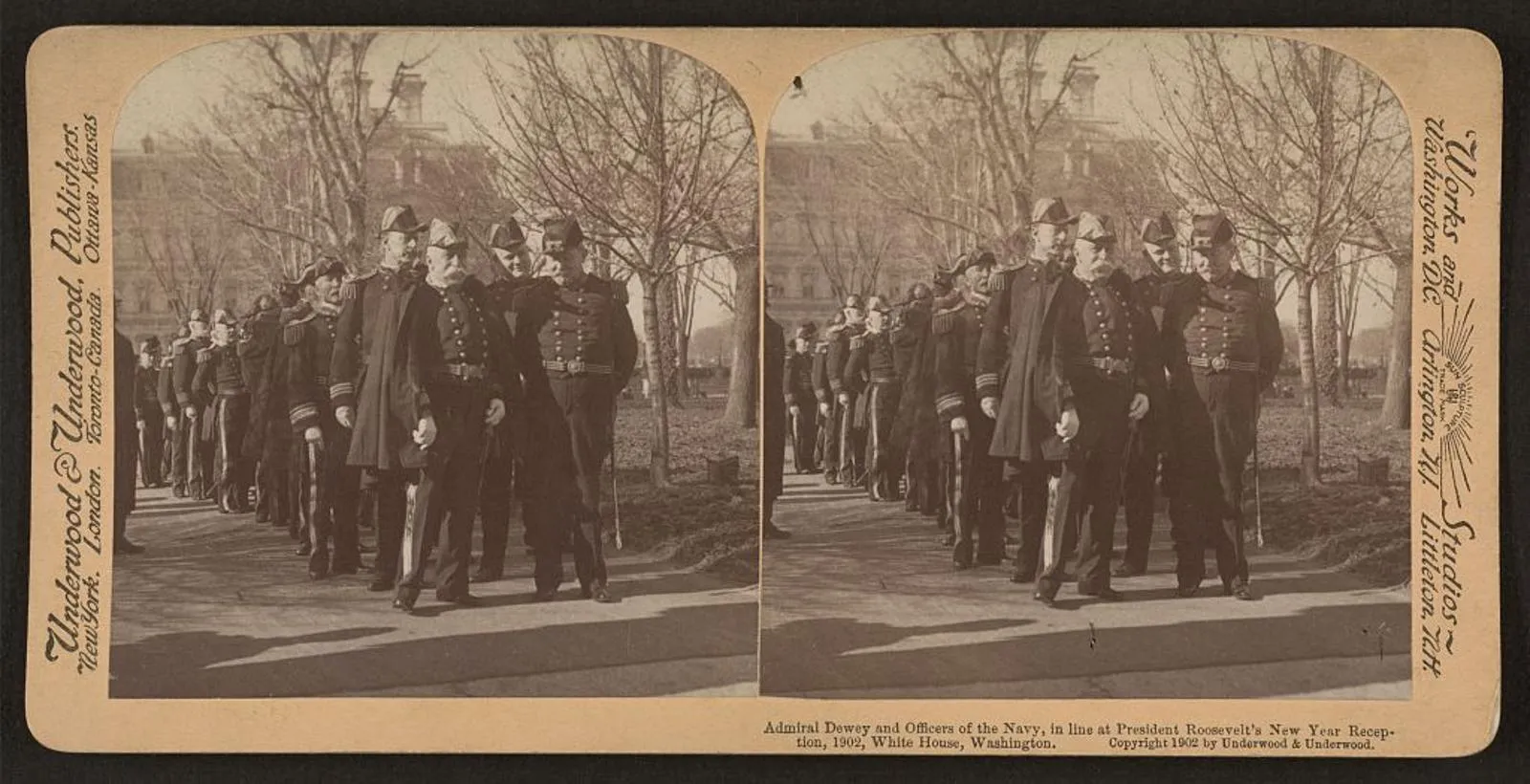
"Admiral Dewey and officers of the Navy, in line at President Roosevelt's New Year reception, 1902, White House, Washington." Underwood & Underwood stereograph. (Library of Congress)

"General public being admitted to White House for New Year's reception," between 1900 and 1910. George Grantham Bain Collection. (Library of Congress)
The Biggest Day: 1906
The largest crowd anyone counted came on Monday, January 1, 1906. Vice President Charles Fairbanks led the line at about 11:15 a.m., and the reception ended at 2:44 p.m. "By actual count 9,052 persons shook the President's hand," the Associated Press reported. The White House's official figures, printed in the Washington Times, put it at 9,072.
Either way, it was more than 9,000 people in a single afternoon. The Associated Press called it "one of the largest receptions in the history of the White House." The year before, when New Year's Day fell on a Sunday and the reception moved to Monday, January 2, 1905, the Associated Press later put the count at 7,115.
Did He Really Shake 8,513 Hands?
A popular story says T.R. set a world record by shaking 8,513 hands on New Year's Day 1907, and Guinness World Records lists it as the most handshakes by a head of state. No newspaper from 1907 that has been found gives that number. Reports that day disagreed widely: the Evening Star gave an official count of 5,063 callers, the Associated Press said about 8,500, and the Washington Times reported "nearly 10,000," with the President shaking hands at the rate of forty a minute.
What the papers do show is that 1906, not 1907, had the biggest counted crowd of his presidency, more than 9,000. The 1907 reception had its lighter moments, too. The Associated Press reported that a little girl carried a great white teddy bear past the receiving party and drew a hearty laugh from the crowd in the Blue Room.
New Year's on the Trail
A year after leaving the White House, T.R. began 1910 on foot in Uganda, marching with his African expedition from Kampala toward Lake Albert. "At noon on January 5th, 1910, we reached Butiaba, a sandspit and marsh on the shores of Lake Albert Nyanza. We had marched about one hundred and sixty miles from Lake Victoria," he wrote in African Game Trails.
Four years later he was in the Mato Grosso of Brazil, near the São João ranch, on the expedition that would take him down the River of Doubt. "Next morning, January 1, 1914, we were up at five and had a good New Year's Day breakfast of hardtack, ham, sardines, and coffee before setting out on an all-day's hunt on foot," he wrote in Through the Brazilian Wilderness. With Colonel Rondon, Lieutenant Rogaciano, Kermit and the ranch hands, he waded marshes up to his hips and twice swam bayous holding his rifle above the water.
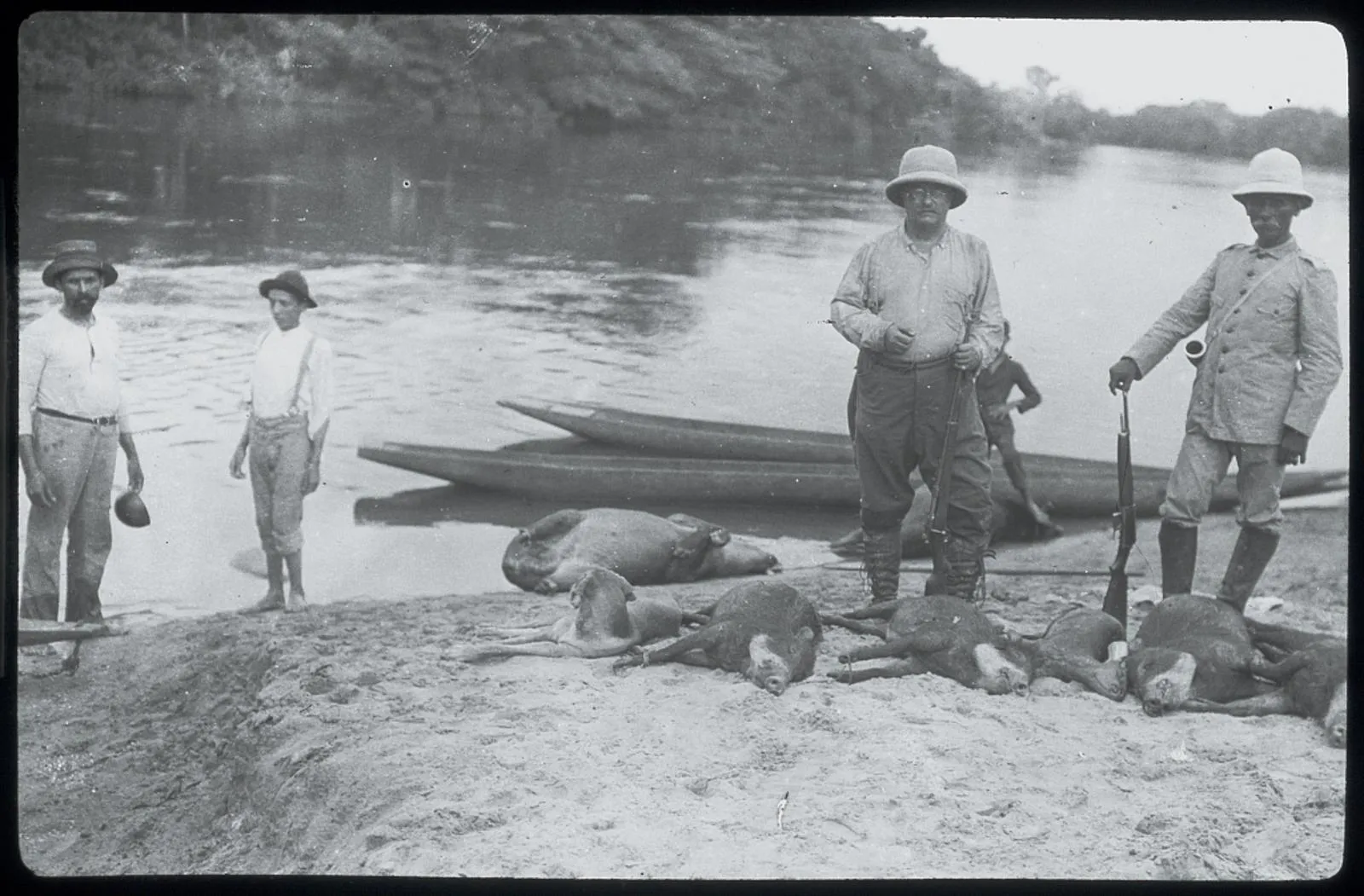
T.R. with Brazilian officer Cândido Rondon beside a river during the Roosevelt-Rondon Scientific Expedition to Brazil, 1913–1914. (Library of Congress)

"Theodore Roosevelt's residence, Sagamore Hill, Oyster Bay, N.Y.," 1912. (Library of Congress)
The Last New Year's Days
On New Year's Day 1915, a Washington paper reported that T.R., as honorary chairman of the American peace centenary committee, had cabled the British committee to mark a hundred years of peace between the United States and Great Britain since the Treaty of Ghent. The paper said he saw that century as an augury for the future.
By the end of 1917, all four of his sons were in uniform. Writing from Sagamore Hill on New Year's Eve, he told his sister Anna: "New Year's greetings, darling Bye; 1918 is hardly apt to be a happy New Year for any of us." Archie had won his captaincy at the front, he wrote, and Quentin's chief complaint was that he had not yet been allowed into the fighting.
A year later, T.R. was home at Sagamore Hill, back from Roosevelt Hospital at Christmas. He spent New Year's Day 1919 there. He died at Sagamore Hill early on January 6, 1919.
Explore More
Timeline of T.R.’s New Year’s Days
Where he spent January 1, from the Nile to the White House to Brazil.
Christmas with Theodore Roosevelt
Archie's secret tree, the Cove School, and his last Christmas.
Primary Sources
- Theodore Roosevelt’s Diaries of Boyhood and Youth (1928)
- Letters from Theodore Roosevelt to Anna Roosevelt Cowles (1924)
- Chronicling America newspapers (Library of Congress)
From the Archives
Cards, letters and photographs about New Year’s Day from the Theodore Roosevelt Center’s digital library.
Recommended Reading
- African Game Trails (1910)
- Through the Brazilian Wilderness (1914)