
TR the Athlete: A Life of Physical Vigor
Asthma to Iron Constitution: A Triumph of Will
Theodore Roosevelt was not born an athlete. As a child, he suffered from severe asthma that left him frail and weak. Doctors warned that his constitution was fragile. His family worried he might not live to adulthood. But young Theodore had a fierce determination. He would not accept physical weakness. Beginning in adolescence, he undertook a rigorous program of physical training—gym work, running, boxing, lifting. Over months and years, his body transformed. The weak, sickly boy became a vigorous young man. By adulthood, he was renowned for his physical prowess. The asthma never entirely disappeared, but it was controlled through relentless physical activity.
This personal transformation shaped Roosevelt's entire philosophy. He believed physical vigor could be achieved through will and effort. He believed weakness was a choice, not a fate. He believed that a nation of vigorous people was a strong nation. His own body was proof that asthma could be conquered, that weakness could be overcome.

Theodore Roosevelt as a young college student. The sickly, asthmatic boy remade himself through relentless exercise into a vigorous young man (Library of Congress).
Boxing: The Noble Art of Combat
Roosevelt was a serious amateur boxer throughout his life. He began boxing in his twenties and continued into his presidency. He was not a great boxer by professional standards, but he was competent and committed. He trained regularly, sparred with experienced boxers, and took the sport seriously. Around 1904, while president, he was struck in the eye by a boxer and suffered a retinal injury that eventually left the eye blind. The injury was kept secret for decades. He gave up boxing after the injury and took up jiu-jitsu instead.
Roosevelt valued boxing because it combined physical fitness with courage and character. A boxer had to be brave, disciplined, and willing to face pain. The sport demanded respect for an opponent and adherence to rules. It was not barbaric brutality but skilled combat governed by honor and tradition. Roosevelt's commitment to boxing influenced his broader views on physical education and national character.
The Wrestling and Jiu-Jitsu Years
In 1904, while serving as president, Roosevelt invited Yoshiaki Yamashita, a legendary Japanese jiu-jitsu master, to the White House. Roosevelt was fascinated by martial arts and wanted to learn jiu-jitsu. Over several months, Yamashita taught the president the fundamentals of the ancient art. Roosevelt was an enthusiastic if not particularly graceful student. He was in his mid-forties and heavier than the nimble Yamashita, but he applied himself with characteristic vigor.
Roosevelt was intrigued by a martial art that emphasized technique and leverage over raw strength—a philosophy that appealed to his analytical mind. The sessions were also private and limited in number. But they symbolized Roosevelt's openness to new forms of physical training and his belief that physical discipline transcended national boundaries.
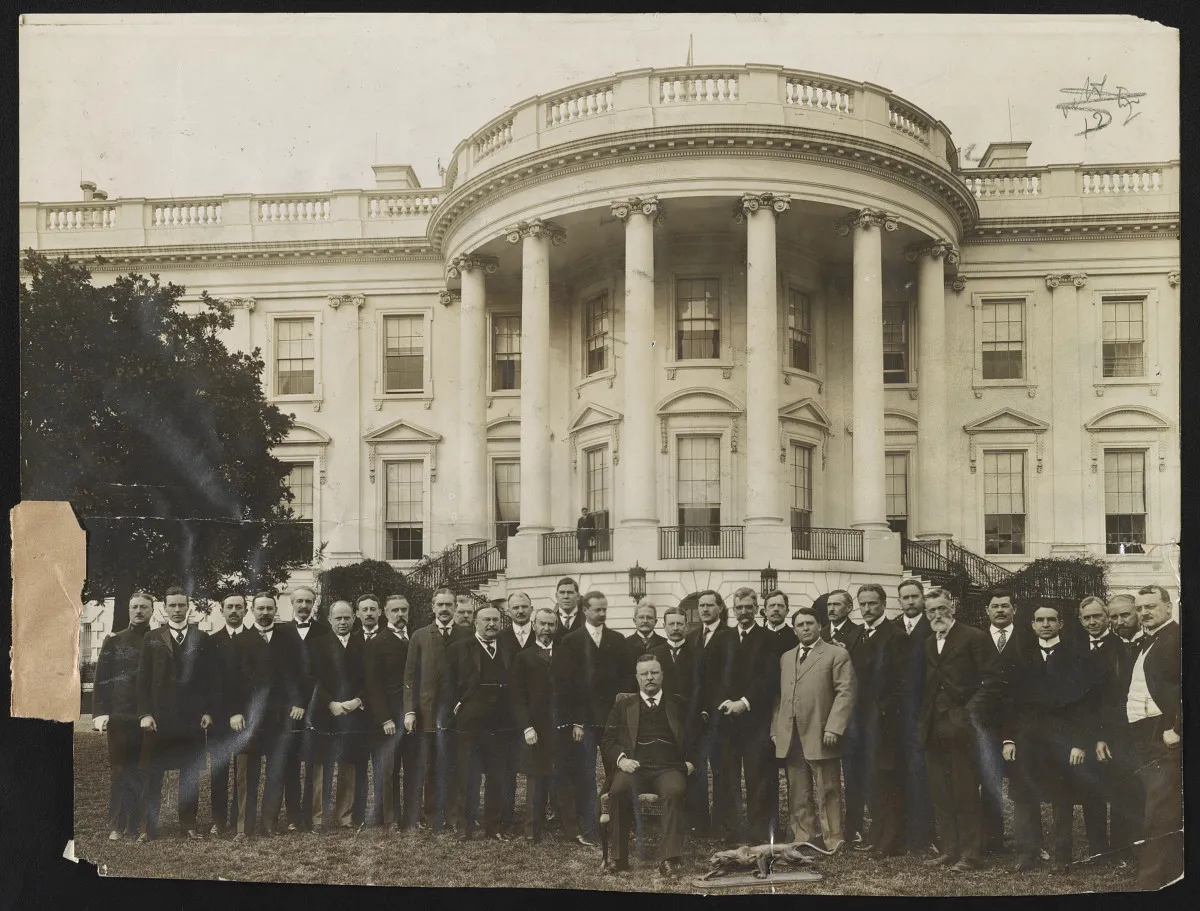
President Roosevelt with members of his informal 'Tennis Cabinet' on the White House lawn, the athletic friends and advisers who joined him for tennis and vigorous exercise (Library of Congress).
The Tennis Cabinet and Court Sports
Roosevelt loved tennis and played regularly throughout his presidency, often on the White House grounds. The press began referring to his closest advisors as the "Tennis Cabinet"—partly because they often joined him on the White House tennis court and partly because his athletic activities seemed to dominate his schedule. This was not entirely accurate; Roosevelt conducted serious government business and made consequential decisions. But the nickname reflected the reality that physical activity was woven into the fabric of his daily life.
Tennis was particularly appealing because it could be played into middle age with vigor intact. Roosevelt was not alone in this—tennis had become fashionable among the educated classes. But Roosevelt played with characteristic intensity, sometimes partnering with notable athletes or political figures, using the court as an informal setting for political conversation and relationship-building.
Horseback Riding and the Physical Life
Roosevelt was an excellent horseman, having learned to ride as a boy and having spent years in Dakota as a rancher. He continued to ride regularly throughout his life, often on the trails of Rock Creek Park in Washington, D.C. These rides were not casual outings. Roosevelt rode hard and long. He organized hiking and riding expeditions with his family and friends. He believed that the active outdoor life—riding, hiking, camping—was essential to physical and moral health.
His famous Rock Creek Park rides were sometimes extraordinary. His rides were not casual recreations; they were tests of physical endurance undertaken to prove that even a middle-aged man could maintain vigor through discipline and commitment.

Theodore Roosevelt on horseback. Riding was central to his physical life, from breaking horses in the Dakota Badlands to daily rides throughout his presidency (Library of Congress).
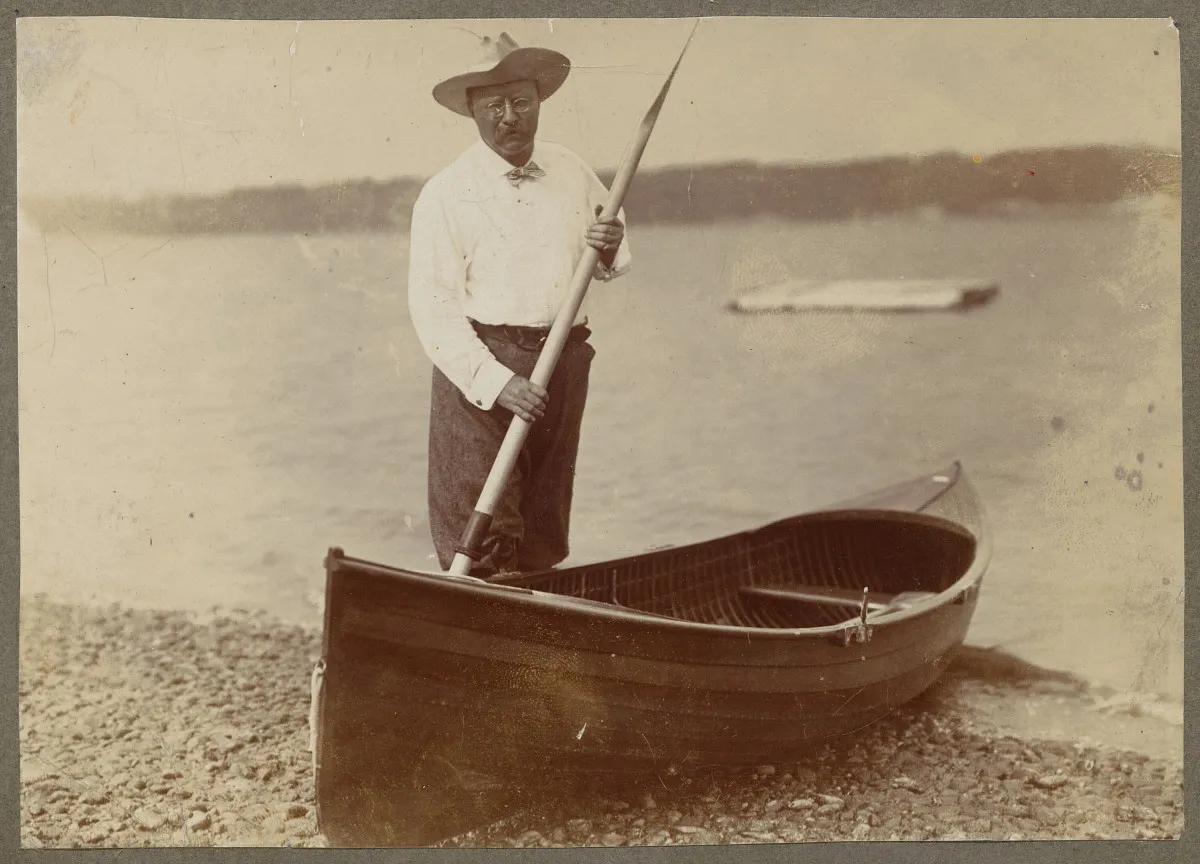
Theodore Roosevelt poling a boat at Oyster Bay. He rowed and swam vigorously in the waters near his Sagamore Hill home throughout his life (Theodore Roosevelt Collection, Harvard College Library).
Swimming and Water Sports
Roosevelt was also a strong swimmer, having learned early in life. He swam regularly in the cold waters of Rock Creek while president and off Oyster Bay at home. Swimming combined vigorous exercise with the pleasure of cold water and the frontier virtue of hardiness. Roosevelt believed that Americans should embrace outdoor water activities—swimming, boating, fishing—as part of a vigorous national culture.
The One Hundred-Mile Ride
One of the most famous episodes of Roosevelt's athletic life was the one-hundred-mile ride undertaken on January 13, 1909, shortly before he left the presidency. Roosevelt, then fifty years old, rode nearly one hundred miles across Virginia in a single day to prove the fairness of his own order requiring army officers to demonstrate their fitness in the saddle. The ride was covered extensively by the press and became legendary. Soldiers and equestrian enthusiasts marveled that a middle-aged president could undertake such a feat. Critics complained that it was reckless and undignified. But Roosevelt was characteristically indifferent to criticism. He had set a goal and achieved it, proving that age and office could not diminish vigor.

Roosevelt mounted for a ride. To answer critics of his fitness standards, in 1909 he rode roughly one hundred miles from Washington to Warrenton, Virginia, and back in a single day (Library of Congress).

A young Theodore Roosevelt outfitted for mountaineering. He preached 'physical culture' and the strenuous life as the foundation of individual and national strength (Library of Congress).
Physical Culture and National Strength
Roosevelt's athletic pursuits were not mere personal recreation. He believed that a nation of vigorous, athletic citizens would be stronger morally and militarily. He promoted physical education in schools, recommended that young Americans engage in strenuous outdoor activities, and believed that athletic training built character. He was skeptical of sedentary office work and sedentary life in general. Americans needed to be outdoors, doing hard physical labor, testing themselves against nature and each other.
This philosophy influenced American culture for decades. Schools adopted physical education programs. Youth organizations like the YMCA and Boy Scouts emphasized outdoor activities and physical training. The idea that physical vigor was connected to national greatness became embedded in American thinking. Roosevelt was not the only source of this cultural shift, but he was among the most powerful advocates.
Age, Decline, and the Strenuous Legacy
As Roosevelt aged, his physical capabilities declined naturally. He suffered from various ailments in his later years—rheumatism, eye problems, the general wear of decades of vigorous activity. Yet he continued to ride, hike, and engage in physical activity. He never fully retired from the strenuous life. Even in the months before his death in 1919 at age sixty, he continued to take walks and engage in outdoor activities.
Roosevelt demonstrated that the strenuous life was not limited to youth. A commitment to physical vigor could be maintained across the lifespan. The goal was not to be the strongest or fastest but to maintain discipline, commitment, and engagement with physical challenge. In this, Roosevelt embodied his own philosophy.
To learn more about Roosevelt's approach to physical culture and national vigor, explore the Theodore Roosevelt Center's extensive collections on his life and legacy.
Continue Reading
- The Strenuous Life — More on TR
- Fun Facts About TR — More on TR
Primary Sources at the TR Center
Explore original documents and resources related to this topic in the Theodore Roosevelt Center Digital Library.
- TR Center Digital Library — Primary source collection
From the Archives
Explore original photographs, documents, and illustrations related to this topic in the Theodore Roosevelt Center Digital Library.
Recommended Reading
- The Big Scrum by John J. Miller (2011). ISBN: 978-0-06-174450-1
- Theodore Roosevelt: A Strenuous Life by Kathleen Dalton (2007). ISBN: 978-0-307-42968-1
- Theodore Rex by Edmund Morris (2001). ISBN: 978-0-307-77781-2