
Theodore Roosevelt and Eugenics: 'Race Suicide' and the Science of the Era
Race Suicide and the Demographic Alarm of the Progressive Era
Roosevelt was obsessed with what he called “race suicide”—the idea that white, educated, native-born Americans were not reproducing fast enough, while immigrants and other populations reproduced at higher rates. This demographic anxiety was not unique to Roosevelt; it animated much of Progressive-era racial thinking. The concern was that if the “right people” didn’t have enough children, American civilization would be swamped by inferior stock. The logic was pseudo-scientific but felt urgent and real to those who embraced it: birth rates among the educated classes were declining while immigration from southern and eastern Europe was rising. This statistical reality was interpreted as an existential threat to American civilization itself.
Roosevelt wrote extensively about this concern in letters and speeches. He argued that educated women had a responsibility to bear children, that families with the right genetic stock should be larger, that society should implement policies to encourage reproduction among the fit. In a 1903 public letter he condemned what he called “willful sterility” as “the one sin for which the penalty is national death, race death.” He argued that the average family of the old native stock needed roughly four children for the population to hold its numbers.
He had six children himself and spoke approvingly of large families as expressions of civic virtue and biological responsibility. Motherhood, in his view, was not merely a personal choice but a patriotic duty for women of the right stock. In his telling, educated women who remained childless were failing in a duty to the nation — the “willful sterility” he denounced in print. Roosevelt saw large families as evidence of biological fitness and asserted that the survival of American civilization depended on ensuring that the right people reproduced more.
This anxiety about race suicide was intertwined with Roosevelt’s broader racial beliefs. The “right people” whose reproduction should be encouraged were implicitly white, educated, Anglo-Saxon Americans—the “old-stock” Americans descended from northern European stock. The “wrong people” whose reproduction should be discouraged were immigrants (especially from southern and eastern Europe), poor people, people of color, and people with disabilities or diseases believed to be hereditary. The logic of eugenics provided a pseudo-scientific framework for implementing these preferences. Eugenicists claimed they were simply applying scientific understanding to social policy. What they were actually doing was providing scientific legitimacy to existing racial prejudices.
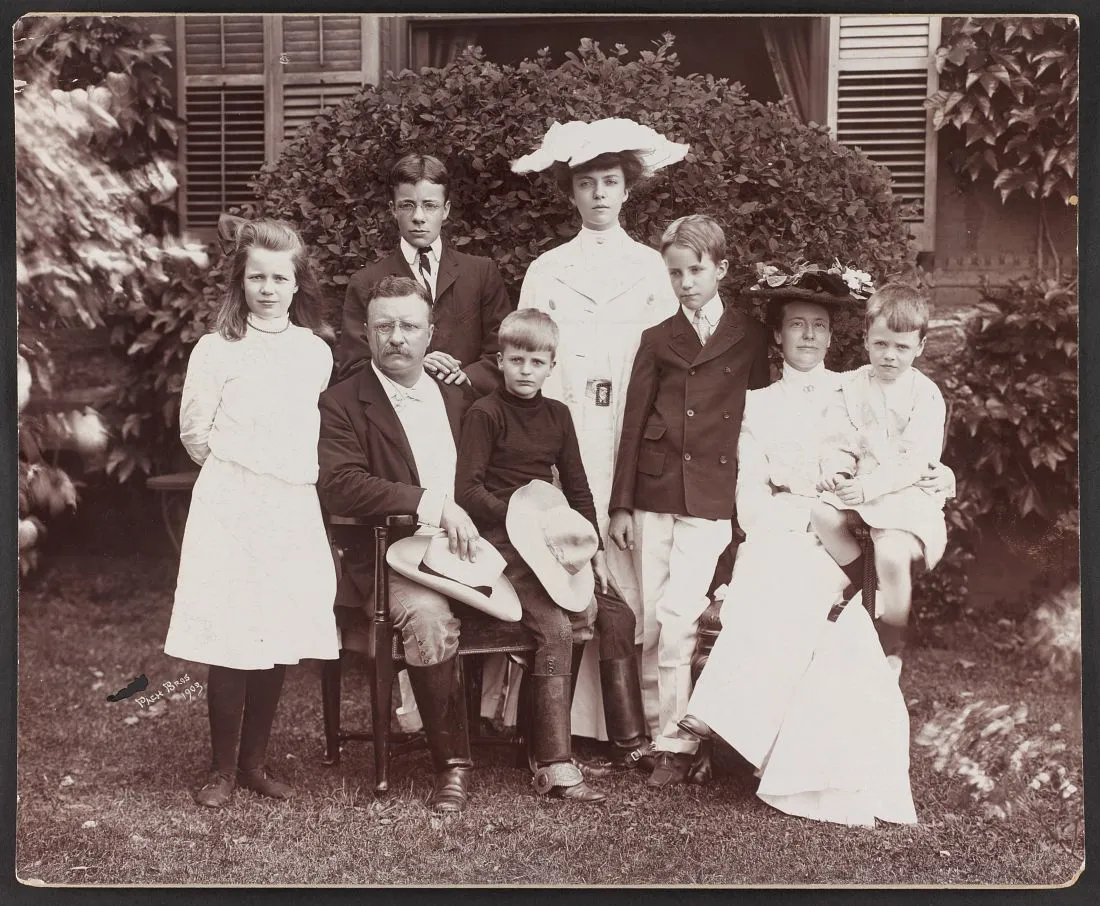
Roosevelt with his large family, 1903. His campaign against so-called 'race suicide' urged native-born white Americans to have more children — pronatalist rhetoric rooted in the racial anxieties of the eugenics era. (Library of Congress)

Roosevelt in 1905. Eugenics drew broad support from Progressive-era leaders who mistook it for cutting-edge science; Roosevelt shared their misplaced confidence in 'good breeding' as a path to national improvement. (Library of Congress)
Eugenics as Progressive Science: The Movement's Appeal
Eugenics emerged in the late 19th and early 20th centuries as a supposedly scientific approach to human improvement through selective breeding. The theory drew on Darwin's evolutionary framework, though it fundamentally misapplied evolutionary principles to human society. The eugenicists claimed that if humans could selectively breed animals for desired traits, the same principles could be applied to humans to eliminate hereditary diseases, improve intelligence, and enhance the racial stock. The logic seemed self-evident to believers: humans were animals, subject to the same biological laws as cattle and dogs. If you could improve a breed of cattle through selective breeding, why not improve the human race?
The movement attracted support from prominent progressives who believed they were applying science to social problems. If poverty, crime, alcoholism, and intellectual disability were hereditary conditions (as eugenicists claimed), then preventing their reproduction would be a rational policy approach—far more humane than allowing these conditions to perpetuate through successive generations. Universities established eugenics programs. Prominent scientists lent credibility to eugenics research. Progressive journals published articles advocating eugenics policies. Theodore Roosevelt corresponded regularly with Edward Ross, a sociologist and leading eugenics theorist, reinforcing Roosevelt’s convictions about race suicide and the need for eugenic policies. The movement had an aura of scientific legitimacy in the Roosevelt era, clothed in the language of modern science and rational reform.
The movement had genuine intellectual appeal to people who saw themselves as modern, rational, and committed to progress. Eugenics offered a way to think about social improvement through the lens of science rather than moral argument. For people like Roosevelt who distrusted sentimentality and prided themselves on hard-headed realism, eugenics seemed like enlightened policy. It combined several of his favorite themes: the importance of vigor and fitness, the need to maintain American racial character, the application of science to social problems, and the idea that society had obligations to shape the future through deliberate policy.
But the science was deeply flawed. The hereditary mechanisms the eugenicists proposed were based on crude understanding of genetics that predated modern molecular biology. They conflated social conditions with hereditary traits. They assumed that poverty, crime, and other social problems were inherent in certain peoples—rooted in inferior genetic stock—rather than products of social circumstance, economic conditions, or inequality. They built elaborate pseudo-scientific theories on foundations of prejudice and racial assumption, then presented these theories as objective scientific fact. Yet the eugenicists’ rhetoric about science and progress made their ideas seem modern and forward-looking to people like Roosevelt who prided themselves on rational thought and scientific understanding.
Roosevelt's Eugenic Beliefs and Their Expression
Roosevelt's eugenic thinking expressed itself in multiple ways. Most directly, he wrote and spoke about the need for the “right people” to have more children. He expressed concern about women in educated families choosing careers or remaining childless, viewing such choices as a form of race betrayal. He praised motherhood as a woman’s highest calling, particularly for women of good stock. In Roosevelt’s worldview, a talented woman choosing to pursue education, career, or a childless marriage was not exercising personal freedom. She was committing an act of biological irresponsibility toward the nation. He argued that society should reward large families among the fit through policy incentives and discourage reproduction among the unfit.
His concern with “race suicide” consumed much of his intellectual energy as he aged. Roosevelt corresponded extensively with Edward Ross, a sociologist developing systematic theories of race suicide, and these exchanges reinforced Roosevelt’s conviction that demographic decline posed an existential threat. He came to believe that the future of American civilization depended on ensuring that the right people—educated, vigorous, white Americans of good stock—reproduced at higher rates. This was not abstract theorizing to Roosevelt. It was a matter of national survival.
More specifically, Roosevelt supported immigration restriction partly on eugenic grounds. The immigrants flooding into America at the turn of the century came disproportionately from southern and eastern Europe, from peoples whom Roosevelt and many Americans regarded as racially and culturally inferior to northern Europeans. They were, in the language of the era, “less fit” peoples. Immigration restriction would prevent the genetic dilution of the American population. It would preserve what Roosevelt regarded as American racial character. His support for restrictive immigration policy was thus rooted partly in eugenic logic—preventing the introduction of inferior genetic material through foreign immigration. The American nation, from this perspective, needed to protect its racial stock from contamination by unfit outsiders.
Roosevelt endorsed the principle of preventing reproduction by people he considered hereditarily unfit. In a January 3, 1913 letter to the eugenicist Charles Davenport, he wrote that “society has no business to permit degenerates to reproduce their kind.” He returned to the subject in a 1914 article for The Outlook, “Twisted Eugenics.” He never campaigned for the state sterilization statutes that spread in the years after his presidency, but his stated position was direct: prevent reproduction among those he deemed “degenerate,” and encourage larger families among those he deemed fit.

Roosevelt, 1905. He praised 'good breeding stock' and warned of falling birth rates among the native-born — statements historians identify as part of the eugenic thinking of his era. (Library of Congress)

Roosevelt, 1911. The eugenic ideas embraced by Progressive-era elites were later carried to catastrophic ends — coercive sterilization laws and, ultimately, Nazi racial policy. (Library of Congress)
Eugenics After 1919
Roosevelt died in January 1919, before the eugenics movement reached its legislative peak. In the decades that followed, more than half the American states enacted compulsory sterilization laws, and the Supreme Court upheld Virginia’s statute in Buck v. Bell (1927). Tens of thousands of Americans were sterilized under these programs.
Nazi Germany’s 1933 sterilization law drew on American models — the historian Stefan Kühl, in The Nazi Connection (1994), documents that its framers cited U.S. state statutes as precedent. Under Nazi policy, hundreds of thousands of people deemed genetically unfit were sterilized, and eugenic ideology was joined to the racial doctrines that justified genocide: the systematic murder of Jews, Roma, people with disabilities, and other groups.
After World War II and the revelation of Nazi atrocities, eugenics was discredited. Geneticists rejected its scientific claims, and the state programs it had inspired were repudiated. Roosevelt did not live to see any of this — he died fourteen years before Germany’s sterilization law and long before the movement’s endpoint was visible. The record shows what he endorsed, in his own words, and what the ideas he endorsed later became.
The Coexistence of Contradictions: Meritocracy and Determinism
One of the most striking aspects of Roosevelt's thought is how he held fundamentally incompatible beliefs simultaneously. He believed profoundly in meritocracy—in the idea that talented individuals should advance based on ability and achievement regardless of their background or circumstances. He appointed capable men to office, promoted civil service reform based on competence rather than political patronage, and believed in opening opportunity to talented individuals. He believed that through effort, training, and the strenuous exercise of character, people could improve themselves and rise in the world. This was the optimistic face of Roosevelt’s progressivism: the notion that individual vigor and determination could overcome obstacles and achieve great things, that talent and hard work would find reward.
But alongside this meritocratic belief, Roosevelt held eugenic beliefs that fundamentally contradicted meritocracy. If human abilities and character were determined primarily by heredity, if inferior peoples were biologically incapable of achieving civilization, if the “right stock” needed to reproduce more to preserve American character—then merit, effort, and achievement became secondary to genetic inheritance. A person of inferior racial stock could not truly advance regardless of their talent or determination. They were constrained by their biology, by the accident of their birth. Success or failure in life was not primarily a matter of character and effort but of racial fitness.
Roosevelt did not seem to recognize this fundamental contradiction, or if he did, he did not see it as a problem. He believed both that talented individuals should rise through meritocratic competition and that heredity determined the capacity for civilization. He could appoint a Black judge based on merit (as he did with William D. Crum) while also believing that Black people as a race were inferior and incapable of the highest achievements. He could celebrate the strenuous life as open to all who had the courage and determination to embrace it while also believing that some people lacked the genetic capacity for strenuousness. These contradictions were not unique to Roosevelt—they ran through much of Progressive thought in the era. But they reveal a fundamental incoherence at the heart of eugenic ideology: it claims to be scientific while resting on racial prejudice, claims to reward merit while insisting that heredity determines destiny.

Roosevelt, 1908. His faith in individual character and merit sat uneasily beside a hereditarian determinism — a contradiction at the heart of his engagement with eugenics. (Library of Congress)
Mainstream Science of Its Era
The eugenicists Roosevelt read and corresponded with were not fringe figures. They were university professors, prominent scientists, and widely published Progressive intellectuals; universities offered courses in eugenics, and major journals carried its research. Roosevelt incorporated their ideas into his own writing on population and national policy.
Demographic panics recurred throughout the twentieth century. The eugenic answer to them was repudiated by geneticists on scientific grounds and, after 1945, by a world that had seen where it led. The American state sterilization programs were ended, and several states later issued formal apologies to the people sterilized under them.
Continue Reading
- Roosevelt's Complex Legacy — Understanding Roosevelt's achievements and his flaws
- Race and Theodore Roosevelt — Examining Roosevelt's racial views and their consequences
- Conservation Legacy — Roosevelt's progressive achievements in environmental protection
Primary Sources at the TR Center
Explore original documents and essays about Roosevelt's eugenic beliefs and their context in the Theodore Roosevelt Center Digital Library.
- Roosevelt's Complex Legacy Encyclopedia — Essays examining the darker dimensions of Roosevelt's beliefs and policies
- Progressivism and Reform in Roosevelt's Era — Context on how progressive ideals sometimes led to harmful policies
From the Archives
Explore original photographs, documents, and illustrations related to this topic in the Theodore Roosevelt Center Digital Library.
Recommended Reading
- Theodore Roosevelt and the Idea of Race by Thomas G. Dyer (1980)
- Theodore Roosevelt: A Strenuous Life by Kathleen Dalton (2007). ISBN: 978-0-307-42968-1
- The Bully Pulpit by Doris Kearns Goodwin (2013). ISBN: 978-1-4165-4786-0