
Theodore Roosevelt & Native Americans: Conservation, Conquest, and Complicated History
Arriving in a Changed Country
When Theodore Roosevelt stepped off the train at the Little Missouri station in September 1883, the wars for the northern Plains were only a few years past. In 1876 Lakota, Cheyenne and Arapaho warriors had defeated Custer’s command at the Little Bighorn. By 1883 the Lakota were confined to reservations, and that May the Army moved Sitting Bull to the Standing Rock Agency, about 150 miles east of the Badlands.
The buffalo were going too. The same autumn Roosevelt rode out after his first bison, Sitting Bull led about a thousand Standing Rock hunters onto the plains in what proved to be the last great hunt of the northern herd. For the Lakota and their neighbors the herds had meant food, shelter, clothing and ceremony. With them gone, families came to depend on government rations.
Roosevelt saw all this as the closing of the old frontier. He shared the common belief of his era that Native people were a vanishing race and that their dispossession, however sad, was the price of progress. In The Winning of the West, his four-volume history of frontier expansion, he described the conquest of Native lands as the triumph of a stronger civilization, and wrote of Native nations less as peoples defending their homes than as obstacles in the way.
He did not invent that story. It was the dominant account of American expansion in his time. But he told it with unusual energy and reach, and it shaped the policies he later carried out as President.

Sitting Bull, Hunkpapa Lakota leader whose people defeated Custer at the Little Bighorn in 1876. Roosevelt's writings cast Native resistance as doomed opposition to an inevitable white conquest. (David F. Barry, c. 1883, Wikimedia Commons)

Devils Tower above the pine forest of northeastern Wyoming.
Conservation and Native Homelands
As President, Roosevelt protected roughly 230 million acres of public land: 150 national forests, 51 federal bird reservations, 18 national monuments, 5 national parks and 4 national game preserves. Devils Tower, the Grand Canyon, the Petrified Forest and Mesa Verde all came under federal protection on his watch.
None of these places was empty. Devils Tower, which he named the first national monument in 1906, is sacred to many Plains nations, who know it by names such as Bear Lodge. Mesa Verde preserves the cliff dwellings of the ancestors of today’s Pueblo peoples. Across the West, the lines around new forests and preserves were drawn with little or no say from the nations who had lived, hunted and prayed in those places for generations, and new rules on hunting and grazing often fell hardest on them.
Roosevelt did not set out to harm Native people through conservation. But his vision of the West as a landscape to be managed by federal experts left little room for the nations already there. Both things are part of his record.
Boarding Schools and Allotment
Like most reformers of his day, Roosevelt believed Native Americans should be absorbed into white American society, giving up tribal life, language and religion. Federal policy pursued that goal on two fronts: schools and land.
The school system took Native children from their families, often to institutions hundreds of miles away. Richard Henry Pratt, founder of the Carlisle Indian Industrial School, summed up its philosophy in a paper delivered in 1892 at the National Conference of Charities and Correction in Denver: “Kill the Indian in him, and save the man.” Children were punished for speaking their own languages and forbidden to practice their religions. Roosevelt kept the federal Indian school system and its goal of assimilation. In his First Annual Message in 1901 he called for Indian schooling that was “elementary and largely industrial.”
The damage lasted generations. Federal reviews have documented it, from the Meriam Report of 1928 to the Interior Department’s Federal Indian Boarding School Initiative, whose second report in 2024 identified 417 federal schools and at least 973 children who died in the system. The Bureau of Indian Education still operates four off-reservation boarding schools.
The land policy was allotment. The Dawes Act of 1887, passed before Roosevelt’s presidency, divided reservations into individual parcels and sold the “surplus” to settlers. Senator Henry Teller of Colorado warned in the early 1880s that the real effect would be to strip Native people of their land. He was right: tribal landholdings fell from an estimated 138 million acres in 1887 to about 48 million by 1934.
Roosevelt embraced allotment. In his First Annual Message to Congress, on December 3, 1901, he wrote: “The General Allotment Act is a mighty pulverizing engine to break up the tribal mass. It acts directly upon the family and the individual.” In 1906 he signed the Burke Act, which delayed citizenship for allottees until their 25-year trust period ended but let the Secretary of the Interior issue a deed early to any allottee judged “competent and capable.” Deeded land could be taxed and sold, and much of it soon passed out of Native hands.
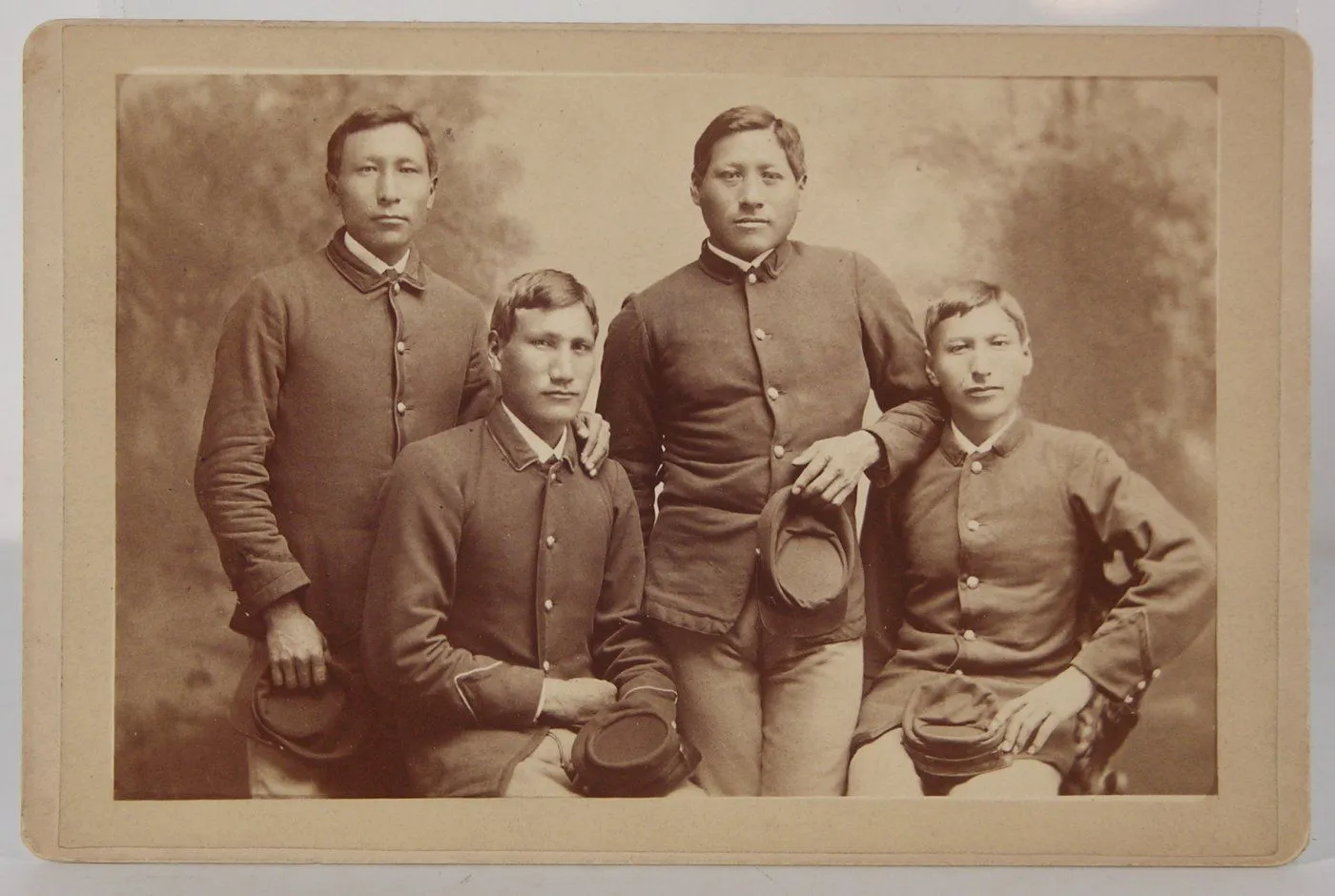
Native students in Euro-American uniforms, 1879, the year the Carlisle Indian Industrial School opened. Roosevelt backed the assimilation ideology behind such boarding schools, which suppressed Native language and culture. (Bonta & Curtiss, 1879)
Opening Reservation Lands
Allotment left millions of acres declared “surplus,” and Congress passed acts opening that land to homesteaders. As President, Roosevelt issued the proclamations that carried several of them out: the Rosebud Reservation in South Dakota in 1904 and again in 1908, the Uintah Reservation in Utah in 1905, and ceded lands on the Crow Reservation in Montana and the Wind River Reservation in Wyoming in 1906. Settlers registered by the tens of thousands, and land was handed out by lottery.
Native nations fought back in court. In 1901 the Kiowa leader Lone Wolf (the Younger) sued to stop the sale of Kiowa, Comanche and Apache lands in Oklahoma. The 1867 Medicine Lodge Treaty required the consent of three-fourths of the tribes’ adult men for any cession, and the government had never obtained it. In Lone Wolf v. Hitchcock, decided January 5, 1903, the Supreme Court ruled that Congress held “plenary authority” over tribal relations and could override treaty terms on its own. The decision cleared the way for openings like those Roosevelt proclaimed and shaped federal Indian law for decades.
Roosevelt believed he was dealing fairly. He relied on Indian Inspector James McLaughlin, who negotiated many land agreements with tribes over a federal career that ran from 1871 to 1923, and he pressed for honest agents in place of political appointees. In 1905 Francis Leupp, a journalist long involved in Indian affairs, became Roosevelt’s Commissioner of Indian Affairs. Leupp encouraged Native art in the schools and backed the hiring of the Ho-Chunk artist Angel De Cora to teach at Carlisle. None of this changed the direction of policy. The outcome, as the government’s own Meriam Report found in 1928, was not a prosperous class of Native farmers but lost land and deepening poverty.
Read more: Roosevelt and Indian Policy, year by year.
Leaders Who Pushed Back
Native leaders did not simply receive these policies. They negotiated, petitioned, sued and used every tool they had.
Quanah Parker, the Comanche leader, traveled to Washington again and again and negotiated grazing leases with Texas cattlemen that brought income to the tribes. In April 1905 he rode with Roosevelt’s hunting party on the Comanche reserve in Oklahoma.
Geronimo, the Chiricahua Apache leader, rode in Roosevelt’s inaugural parade in March 1905. Days later he asked the President to let his people go home to Arizona. Roosevelt refused. Geronimo died a prisoner of war at Fort Sill, Oklahoma, in 1909.
Lone Wolf carried the Kiowa case to the Supreme Court. Charles Eastman, the Dakota physician and writer, worked for the government in these years revising the Sioux allotment rolls and wrote some of the most widely read accounts of Native life of his time.
What Changed, and What Didn’t
Allotment ended in 1934. In 1975, sixty-six years after Roosevelt left office, the Indian Self-Determination and Education Assistance Act began returning control of programs and schools to tribal governments. Native nations have revived and taught their languages and pressed land and treaty claims that remain unresolved.
Roosevelt’s conservation legacy is real, and so is this one. The same President who protected 230 million acres called allotment “a mighty pulverizing engine to break up the tribal mass.” See both stories side by side in Same Years, Different Ground.
Continue Reading
- Roosevelt's Complex Legacy — Understanding the contradictions in his life and achievements
- Conservation — The protected lands and Roosevelt's environmental vision
- Theodore Roosevelt National Park — The badlands where Roosevelt experienced the western landscape
- Roosevelt and Indian Policy — His decisions as President, year by year
- Same Years, Different Ground — Roosevelt’s life beside the history of Native nations
- Quanah Parker and Geronimo — Two Native leaders who dealt with him directly
Primary Sources at the TR Center
Explore Roosevelt's writings on Native Americans and his conservation policies in the Theodore Roosevelt Center Digital Library.
- Roosevelt's Indian Policy — Documents and essays on his complicated relationship with Native peoples
- Conservation and Indigenous Lands — Scholarly analysis of how conservation policies affected tribal territories
From the Archives
Explore original photographs, documents, and illustrations related to this topic in the Theodore Roosevelt Center Digital Library.
Recommended Reading
- Theodore Roosevelt and Six Friends of the Indian by William T. Hagan (1997)
- This Indian Country by Frederick Hoxie (2012). ISBN: 978-1-101-59590-9
- Lakota America by Pekka Hämäläinen (2019). ISBN: 978-0-300-21595-3
- The Rise of Theodore Roosevelt by Edmund Morris (1979). ISBN: 978-0-307-77782-9