
Pine Knot: The Rustic Escape from Power
Acquiring the Refuge: Edith's Gift to Theodore
Edith purchased Pine Knot in 1905, during Roosevelt's second term as president, acquiring it as a place of respite for her husband—a rough workman's cottage on fifteen acres, bought for $280. The cabin was situated on that small parcel in the Virginia foothills, removed from cities and towns, surrounded by forest. It was neither large nor luxurious. It was, in fact, closer to a hunting lodge than to a house—a simple structure designed for people who wanted to be in nature rather than comfortable in civilization.
The timing of the purchase is significant. By 1905, Roosevelt had been president for four years and had begun to understand the toll that the office took on him. He needed escape. Sagamore Hill, though a place of rest and family, was still connected to the world—visitors came, reporters waited, political business intruded. Pine Knot offered something different: genuine isolation, the removal from obligation and expectation, a place where Roosevelt could be simply a man in nature rather than the President of the United States.
Edith understood her husband well enough to know what he needed. She gave him a gift that could not have been more perfectly calibrated to his temperament: a place where he could pursue his love of nature, where he could experience genuine solitude, where he could renew himself through contact with the wilderness. The purchase reflected Edith's intelligence and generosity—her recognition that Roosevelt's capacity to function as president depended partly on his access to spaces where he could recover his equilibrium.

The rustic Pine Knot cabin in the woods of Albemarle County, Virginia — the quiet weekend refuge Edith Roosevelt bought in 1905. (Theodore Roosevelt Collection, Harvard)

Theodore Roosevelt's Pine Knot cottage, a plain frame retreat with no running water or electricity, seen from the northeast corner. (Theodore Roosevelt Collection, Harvard)
A Humble Retreat: The Architecture of Simplicity
Pine Knot is remarkable primarily for its lack of pretension. The cabin is a simple two-story cottage: one large open room with a fireplace downstairs, with sleeping quarters above—and no kitchen at all; cooking was done outdoors or brought in. The structure is simple wood construction, designed for function rather than aesthetics. There is no electricity—light comes from kerosene lamps and candles. There is no running water—water must be carried from the spring. The furnishings are basic: simple beds, wooden chairs, a plain table. The decoration is minimal—a few paintings and photographs, shelves of books, hunting equipment and nature guides.
The lack of modern conveniences was not a limitation Roosevelt regretted—it was intentional. The whole point of Pine Knot was to strip away the complications of modern life and return to simplicity. Roosevelt could have had a luxurious cabin with electricity and plumbing installed. Instead, he and Edith chose to keep Pine Knot as it was: a structure where the primary activity was not sitting but moving, not entertaining but observing nature, not conducting business but resting from it.
The fireplace in the main room was the heart of the cabin. In the evenings, Roosevelt and Edith would sit by the fire, reading and talking. The simplicity of this scene—a president and First Lady sitting by a fire in a cabin without electricity—contrasts starkly with the formal dinners and official functions of Washington. It reveals Roosevelt's capacity to find contentment in simplicity, his genuine love of nature and of quiet time with his wife.
Birding and Nature Study at Pine Knot
Roosevelt's primary activity at Pine Knot was birding—observing and identifying the diverse bird species of the Virginia foothills. He kept meticulous field notebooks, recording species seen, describing their behavior and plumage, noting seasonal patterns. The cabin became a base for early morning walks through the surrounding forests, binoculars in hand, notebook ready to record observations. Roosevelt's love of birds was serious and scientific; he was not a casual birdwatcher but someone who studied birds with the intensity he brought to everything else.
The surrounding landscape of Pine Knot offered diverse habitat for birds and other wildlife. The cabin sat in a region of mixed forest—deciduous trees, some open fields, access to streams. This environmental diversity meant that Roosevelt could observe a wide variety of species from his base at the cabin. The notebooks from Pine Knot show his observations of warblers, thrushes, woodpeckers, hawks, and dozens of other species. His descriptions are precise and detailed, reflecting hours of patient observation.
Birding connected Roosevelt to the science and literature of ornithology. He read extensively about birds. He corresponded with ornithologists and bird experts. He contributed observations to scientific discussions about bird behavior and distribution. His serious engagement with birding was not merely recreational but intellectual—a way of combining his love of nature with his love of learning and systematic observation.
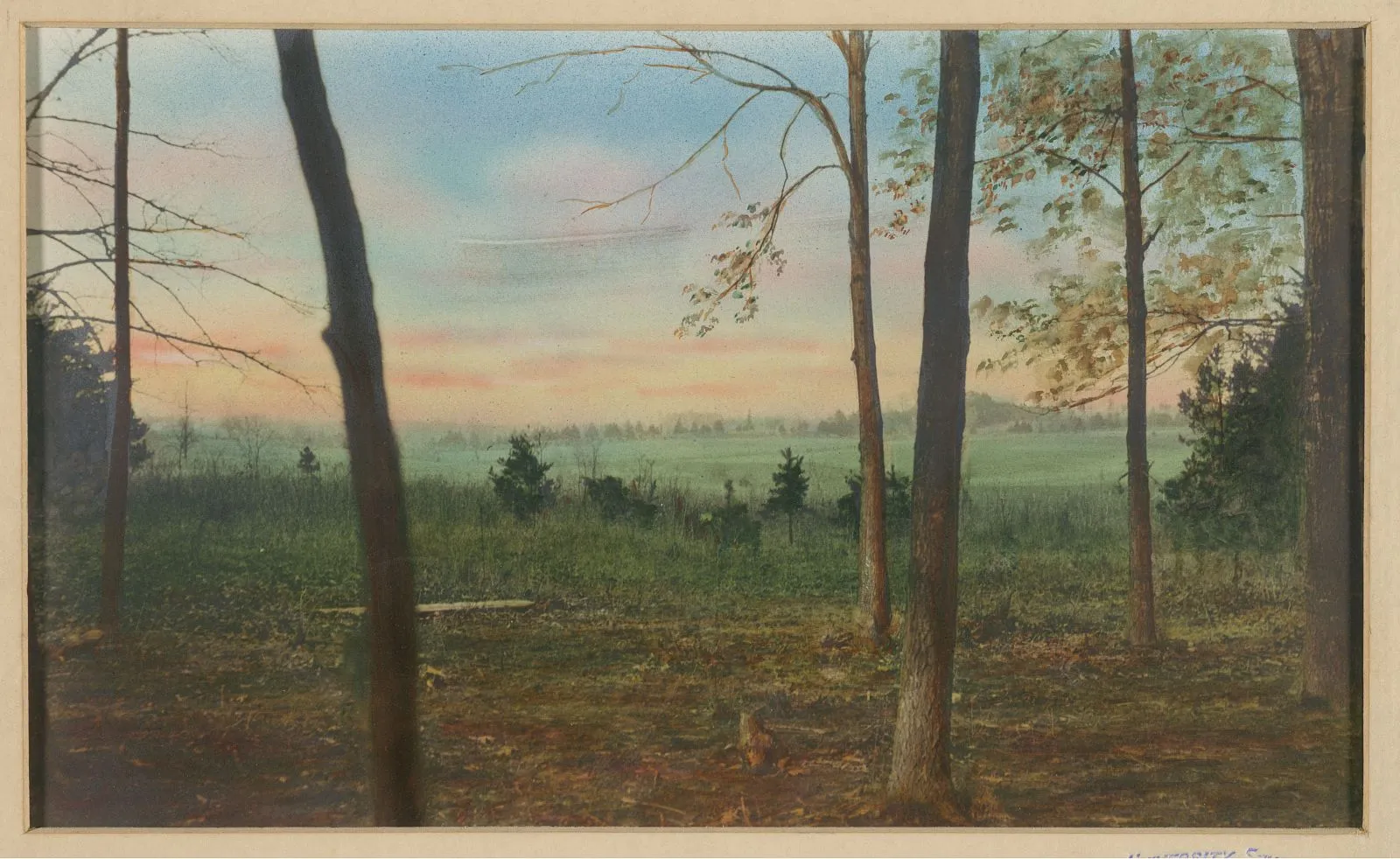
The Virginia countryside seen from the verandah at Pine Knot, where Roosevelt watched birds and escaped the pressures of Washington. (Theodore Roosevelt Collection, Harvard)

Archie Roosevelt and his dog Skip at Pine Knot in Albemarle County, Virginia, where the family found quiet escape from the capital. (Theodore Roosevelt Collection, Harvard)
Frequency and Significance: A President's Escape
Roosevelt visited Pine Knot several times during his presidency (accounts vary on the exact number)—not as frequently as one might wish, but as frequently as his schedule permitted. The visits typically lasted a few days. He would arrive with Edith, leave the presidency behind as much as possible, and immerse himself in birding, reading, and quiet time. The birding produced one of the property's most remarkable footnotes: in May 1907 Roosevelt recorded seeing passenger pigeons near Pine Knot—among the last credible sightings of the species by a trained observer—and in May 1908 the naturalist John Burroughs joined him there to help identify the local birds. The Secret Service maintained a discrete presence, but Roosevelt could move about the property with genuine freedom and privacy.
The rarity of the visits made them precious. Roosevelt looked forward to them intensely. He wrote about them to friends with evident satisfaction, expressing how much the escape from Washington meant to him. The visits served an important psychological function—they renewed him, reminded him of what mattered beyond politics, reconnected him to the natural world and to his wife without the formality and obligation that surrounded their life in the White House and at Sagamore Hill.
What made Pine Knot significant was not its frequency or its luxury but its existence. It represented Roosevelt's acknowledgment of his own human need for rest and renewal. It showed that behind the energetic, ambitious public figure was a man who needed escape, who valued simplicity, who found renewal in nature. The cabin testified to the inner life of a public figure so defined by action that we sometimes forget he had an interior world that required tending.
The Cabin Today: Preserving an Intimate Space
Pine Knot no longer belongs to the Roosevelt family. Edith retained the property until 1941, and it later passed through private hands; since 2001 it has been owned and cared for by the Edith and Theodore Roosevelt Pine Knot Foundation, which opens the cabin to visitors by appointment (see pineknot.org). Yet it remains, preserved much as it was during Roosevelt's time. The simple cabin still stands in the Virginia foothills, a testament to a president's need for escape, a physical reminder that even men of tremendous ambition and energy require spaces where they can be simply human.
The existence of Pine Knot complicates our understanding of Roosevelt. It prevents us from reducing him to a simple narrative of ambition and action. Yes, he was a man who loved power and pursued it relentlessly. But he was also a man who recognized his need for rest, who valued simplicity, who found his deepest contentment not in the excitement of politics but in the quiet observation of birds in a forest cabin. The contrast between the president who dominated the political world and the man who sat by a fire in a cabin without electricity reveals the complexity and contradiction that made Roosevelt himself.
Continue Reading
- Homes and Historic Places — Roosevelt's other significant residences
- Conservation — His philosophy of nature protection and outdoor living
- The Roosevelt Family — Edith's role in Roosevelt's life and spiritual renewal
Primary Sources at the TR Center
Explore Roosevelt's nature writings and field notes at the Theodore Roosevelt Center Digital Library.
- Roosevelt's Love of Nature — His writings on birds, wildlife, and wilderness experiences
- Roosevelt's Field Notebooks and Observations — His detailed ornithological records and nature journals
From the Archives
Explore original photographs, documents, and illustrations related to this topic in the Theodore Roosevelt Center Digital Library.
- Sagamore Hill front view — Exterior view of Roosevelt's homes
- Roosevelt family picture — Family portrait from Roosevelt era
Recommended Reading
- The Wilderness Warrior by Douglas Brinkley (2009)
- Theodore Rex by Edmund Morris (2001). ISBN: 978-0-679-45610-2