
Complete List of Theodore Roosevelt's Published Books
The 1880s: Foundations
- The Naval War of 1812 (1882) – His first book, a detailed naval history written while still a state legislator. It remains a standard work on the subject and established Roosevelt as a serious historical scholar.
- Hunting Trips of a Ranchman (1885) – Essays drawn from his years in the Dakota Badlands, combining adventure narrative with natural history observations.
- Thomas Hart Benton (1887) – A biography of the 19th-century senator, part of Roosevelt's effort to understand American political history and character.
- Essays on Practical Politics (1888) – Political essays reflecting on American civic life and institutions.
- Gouverneur Morris (1888) – A biography of the founding-era statesman, written for the American Statesmen series.
- Ranch Life and the Hunting-Trail (1888) – Sketches of cowboy and ranch life in the Badlands, illustrated by Frederic Remington.
- The Winning of the West: Volume I (1889) – The first volume of his monumental four-volume history of Western expansion, a work that occupied much of his intellectual energy in the 1880s and 1890s.
- The Winning of the West: Volume II (1889) – Published the same year as the first volume.
The 1890s: Expansion and War
- New York (1891) – A history of his native city, written for the Historic Towns series.
- The Wilderness Hunter (1893) – His fullest account of big-game hunting and wilderness life in the American West, combining sporting narrative with close natural history observation.
- American Big-Game Hunting (1893) – Essays on hunting expeditions and wildlife, edited with George Bird Grinnell for the Boone and Crockett Club.
- The Winning of the West: Volume III (1894)
- Hero Tales from American History (1895) – Sketches of American heroism, written with Henry Cabot Lodge.
- The Winning of the West: Volume IV (1896)
- American Ideals and Other Essays Political and Popular (1897)
- The Rough Riders (1899) – His famous account of raising and leading the First U.S. Volunteer Cavalry in the Spanish-American War, including the fight at San Juan Heights. Among the most widely read of all his books.
1900–1909: The Presidential Era
- Oliver Cromwell (1900) – A biographical study of the English statesman, first serialized in Scribner's Magazine.
- The Strenuous Life: Essays and Addresses (1900) – His most famous essay collection, published as he was becoming a national figure.
- Outdoor Pastimes of an American Hunter (1905) – Essays from his hunting experiences, combining adventure with natural history.
- Good Hunting (1907) – A book for young readers about hunting adventures and sportsmanship.
The Post-Presidency Years: 1910–1919
- African Game Trails (1910) – His account of the 1909–1910 Smithsonian-sponsored African safari, combining adventure narrative with natural history observation.
- African and European Addresses (1910) – Speeches delivered during his post-presidential travels, particularly his famous "Citizenship in a Republic" address at the Sorbonne.
- The New Nationalism (1910) – Essays outlining his progressive political philosophy and his vision for American reform.
- Realizable Ideals (1912) – The Earl Lectures, delivered at Berkeley in 1911, on practical philosophy and ethical living.
- History as Literature: And Other Essays (1913) – Essays on history, writing, and literature.
- Progressive Principles (1913) – Selections from his addresses during the 1912 Progressive campaign.
- Theodore Roosevelt: An Autobiography (1913) – His memoir, covering his early life through the presidency. It reveals his thinking about his own life and legacy, though it never mentions his first wife, Alice Lee.
- Through the Brazilian Wilderness (1914) – Account of his 1913–1914 expedition down an uncharted Brazilian river with his son Kermit. One of his most vivid adventure narratives.
- Life-Histories of African Game Animals (1914) – A two-volume scientific work on African wildlife, written with naturalist Edmund Heller.
- America and the World War (1915) – Essays on American foreign policy, written as World War I was raging in Europe and before American entry.
- A Book-Lover's Holidays in the Open (1916) – Essays on travel, hunting, and the outdoor life.
- Fear God and Take Your Own Part (1916) – Essays on preparedness and American duty during World War I.
- The Foes of Our Own Household (1917) – Essays written during World War I on political and patriotic themes.
- National Strength and International Duty (1917) – The Stafford Little Lectures, delivered at Princeton.
- The Great Adventure (1918) – Essays on action, duty, and American character, published near the end of his life.
- Letters to His Children (1919) – Published posthumously, edited by Joseph Bucklin Bishop; his affectionate, playful letters to his six children, long among his best-loved books.
Other Collections and Editions
Roosevelt's writings have also been gathered in major posthumous collected editions, most notably The Works of Theodore Roosevelt in the Memorial Edition (24 volumes, 1923–1926) and the National Edition (20 volumes, 1926), both edited by Hermann Hagedorn. These editions collect his books alongside hundreds of essays, addresses, and articles first published in periodicals such as The Outlook, where he served as a contributing editor after his presidency.
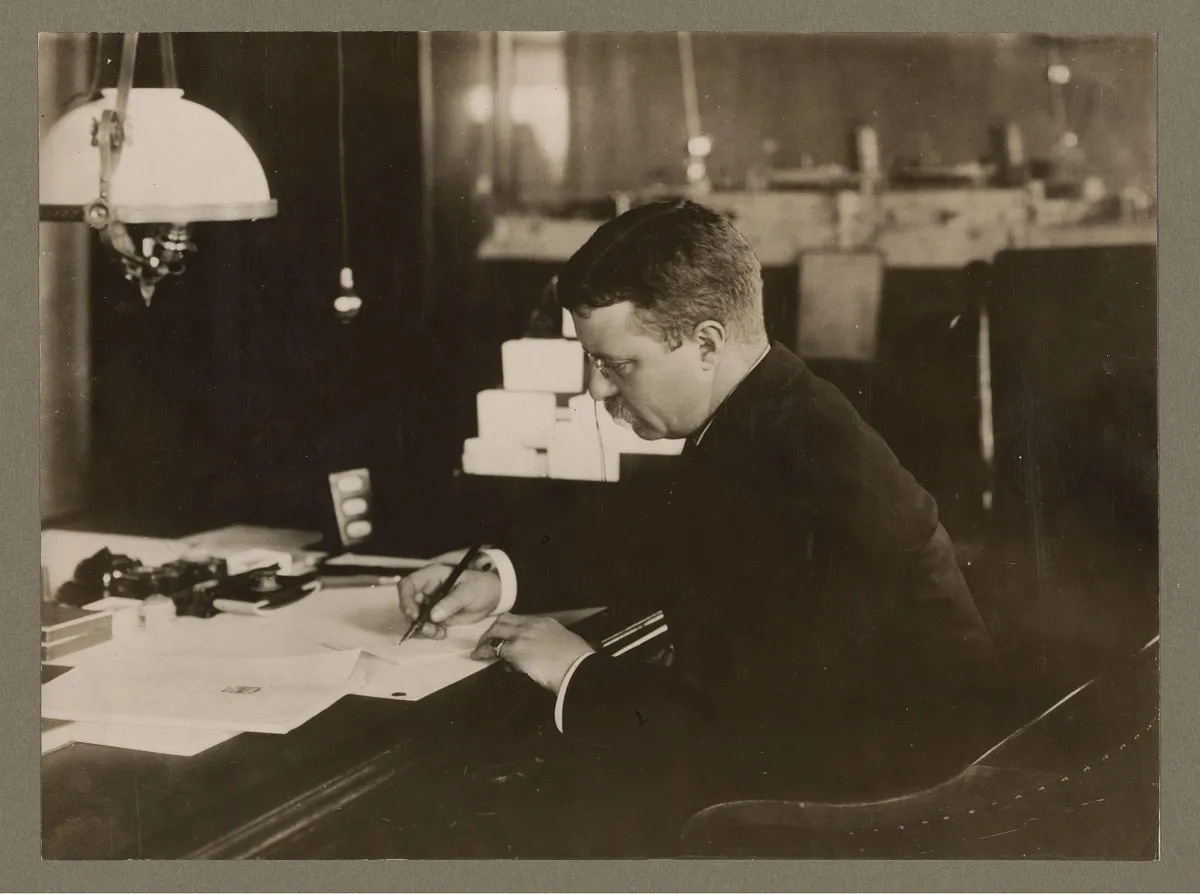
Theodore Roosevelt at work with pen and paper; across four decades he produced some 35 books and thousands of articles. (Theodore Roosevelt Collection, Harvard College Library)
Themes Across the Bibliography
Several themes run throughout Roosevelt's published works:
History and Biography: Roosevelt was fascinated by American history, particularly the history of Western expansion and the characters who shaped it. His biographies of Benton and Cromwell reveal his interest in understanding the forces that make or break great leaders.
Adventure and the Outdoors: His hunting and travel narratives constitute a large portion of his bibliography. These works reveal his deep knowledge of American wilderness and wildlife, and his conviction that direct experience in nature was essential to understanding America itself.
Political Philosophy: Especially in his essay collections, Roosevelt grappled with American political questions: the nature of citizenship, the duties of government, the balance between executive power and popular will, and the relationship between individual and nation.
The Strenuous Life: From his earliest writings to his last, Roosevelt preached the gospel of action, courage, and self-improvement. The conviction that life should be vigorous, purposeful, and engaged threads through all his work.
Most Significant Works for General Readers
The Strenuous Life (1900) remains the most accessible entry point for readers encountering Roosevelt's philosophy. It contains some of his most famous essays, including the title essay that defined his entire approach to life and governance. An Autobiography (1913) is essential reading for anyone wanting to understand Roosevelt's own account of his life and the forces that shaped him, though it notably omits or minimizes discussion of his first wife and the tragic period following her death. The Winning of the West (4 volumes) is Roosevelt's most ambitious historical work—still readable for those interested in American frontier history, though it reflects some of the attitudes of its era. African Game Trails (1910) combines adventure narrative with natural history observation and captures Roosevelt's passion for the outdoors and wildlife. For readers interested in his conservation philosophy, The New Nationalism (1910) and his presidential conservation messages and addresses are essential. His books on hunting—Hunting Trips of a Ranchman, American Big-Game Hunting, and Good Hunting—combine adventure narrative with practical instruction and reveal his deep knowledge of American wilderness and wildlife. Most of Roosevelt's major works remain in print and are available through the Theodore Roosevelt Center and major publishers.

Title page of The Strenuous Life (1903), among the most accessible entry points to Roosevelt’s writing. (Internet Archive)
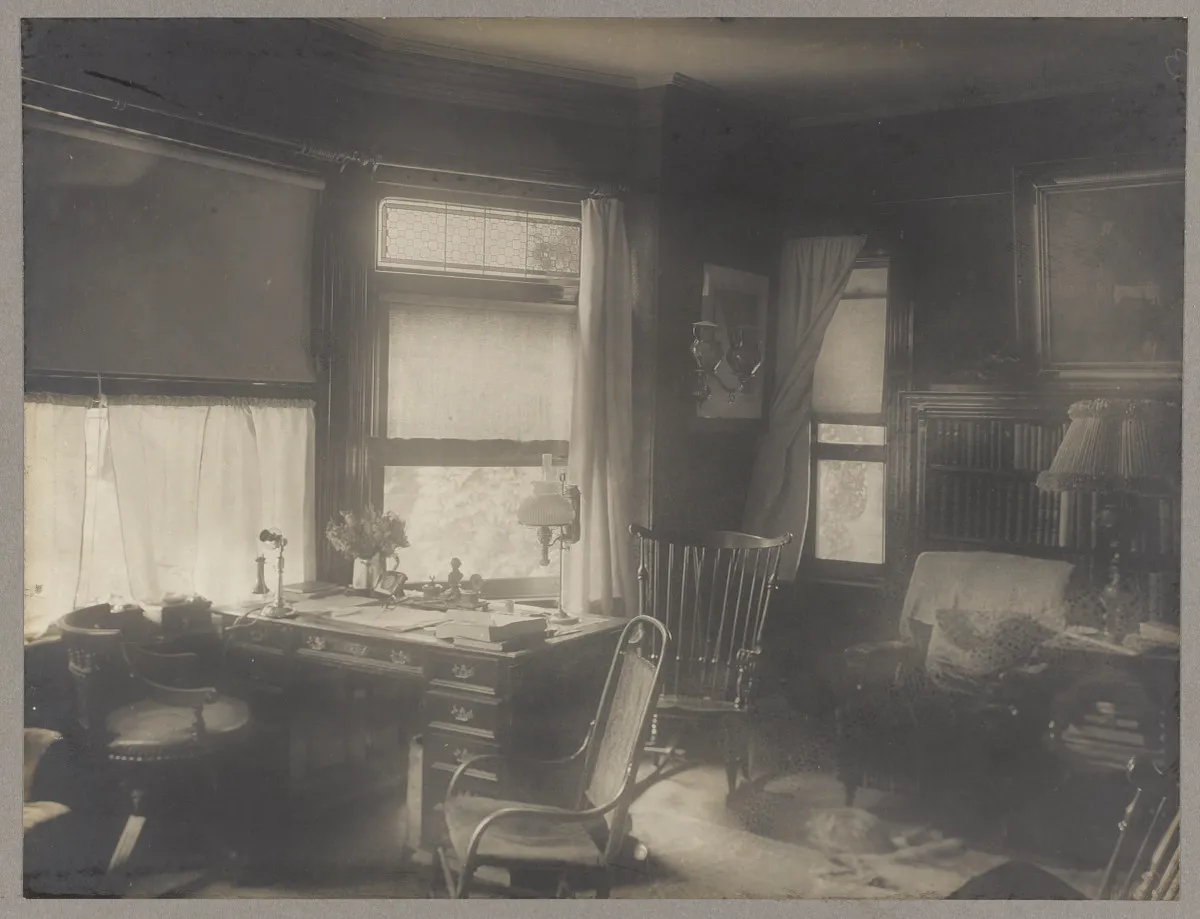
The study at Sagamore Hill, where Roosevelt read and wrote across every period and genre of his bibliography. (Library of Congress)
Organization by Period and Genre
Roosevelt's bibliography divides naturally by period. The early period (1880s) includes his foundational works: the naval history and his first essays on political themes. These establish his intellectual foundations and his emerging philosophy of history and leadership. The middle period (1890s–1905) includes his Western narratives and his more explicitly political writings—works that combine adventure, history, and reflection on American character. The late period (1910–1919) includes his autobiography, his more philosophical essays, and his works on citizenship and national character. This chronological organization reveals the development of Roosevelt's thinking as he moved from young scholar through active politician to elder statesman reflecting on his life and the nation's future. Each period reveals different Roosevelt interests and different aspects of his extraordinary intellect.
Learn More: The complete text of most of Roosevelt's published works is available online at the Theodore Roosevelt Center, where you can read his own words across all his subjects and interests.
Continue Reading
- The Autobiography of Theodore Roosevelt — Roosevelt's own account of his life, career, and beliefs
- A Roosevelt Reader — Essential essays and excerpts from his most important works
- Sagamore Hill — His home library that sustained his prolific writing
Primary Sources at the TR Center
Explore Roosevelt's published works and manuscripts in the Theodore Roosevelt Center Digital Library.
- Roosevelt's Books and Writings — Access to his complete published works
- Roosevelt's Reading and Writing — Scholarly essays on his intellectual life and authorship
From the Archives
Explore original photographs, documents, and illustrations related to this topic in the Theodore Roosevelt Center Digital Library.
Recommended Reading
- Theodore Roosevelt: A Literary Life by Thomas Bailey and Katherine Joslin (2018)