
The Boone and Crockett Club: Hunters Who Became Conservationists
George Bird Grinnell: The Naturalist Co-Founder
Theodore Roosevelt had come to love hunting by the time he founded the Boone and Crockett Club. His years in Dakota had filled him with the experience of pursuing big game across vast wild landscapes. But even as he hunted, he understood something that many hunters in that era did not: the game was disappearing. The buffalo that had once blackened the prairie were nearly extinct. The elk were being hunted to the edge of extinction. The great herds of big game animals that had sustained Native peoples and frontier hunters were vanishing, hunted ruthlessly and killed wastefully.
It was George Bird Grinnell who crystallized these inchoate concerns into a systematic vision. Grinnell was an ornithologist and naturalist of considerable distinction who had spent time on the frontier and had become deeply interested in wildlife. As a boy he had been schooled by Lucy Audubon, John James Audubon’s widow, at Audubon Park, and he later trained as a scientist under the paleontologist O. C. Marsh at Yale. He had published extensively on birds and natural history. More importantly, he had become convinced that without deliberate action, the game animals of North America would disappear entirely. When he and Theodore Roosevelt met—both were men of prominence and reputation—they recognized in each other a shared conviction: hunters themselves needed to become the advocates for conservation. They needed to establish standards for ethical hunting and to work for the protection of game. Together, they would create an organization that changed the course of American conservation history.

George Bird Grinnell, the naturalist and Forest and Stream editor who co-founded the Boone and Crockett Club with Theodore Roosevelt in 1887. (Wikimedia Commons)

Theodore Roosevelt in his fringed buckskin hunting suit, the frontier sportsman who turned a hunting fraternity into a conservation force. (Harvard College Library)
From Hunting Club to Conservation Organization
The Boone and Crockett Club began as an exclusive hunting club—membership was limited to men who had killed large game animals in what the club defined as "fair chase." This requirement was deliberately restrictive. It was not enough to have hunted; a member had to have hunted in a way that the club approved. Fair chase meant honest pursuit, not market hunting, not ambush from hiding places, not the killing of pregnant females or calves. The club was establishing, for perhaps the first time in American history, ethical standards for sport hunting.
But the club's mission quickly expanded beyond the hunting field. Starting with its first published work, American Big-Game Hunting (1893), the Boone and Crockett Club began to advocate for legislation protecting game animals. The club's members used their wealth, influence, and connections to support the Forest Reserve Act, to advocate for the protection of Yellowstone National Park, and to work for state and federal wildlife laws. Theodore Roosevelt, as the club's president and then as a leading voice in American politics, used the organization as a platform for conservation ideas.
The Bridge Between Hunting and Conservation
What made the Boone and Crockett Club unique was that it did not see hunting and conservation as opposed to each other. Instead, it understood them as intimately connected. You hunted because you loved animals and wild places. You conserved those animals and wild places so that future generations could hunt them. The club bridged the gap between the frontiersman's practical knowledge of wildlife and the naturalist's scientific understanding. Members of the club included wealthy sportsmen, scientists, government officials, and outdoor writers.
"Daniel Boone will always occupy a unique place in our history as the archetype of the hunter and wilderness wanderer."
— Theodore Roosevelt, on the frontiersman for whom he named the club · Theodore Roosevelt Center quote archive

Roosevelt the hunter-conservationist. Boone and Crockett members pursued big game yet led the fight to protect it and its habitat. (Harvard College Library)

The trophy room at Roosevelt’s Sagamore Hill home. The Boone and Crockett Club drew its influential membership from sportsmen of this world. (Library of Congress)
The Club's Membership and Influence
The Boone and Crockett Club's membership was carefully curated to include men of influence and resources: wealthy sportsmen, scientists, government officials, outdoor writers, and business leaders who understood that conservation required both passion and power. Members included figures like Archibald Rogers (a wealthy New York businessman), Madison Grant (a naturalist who would later become one of America's leading conservationists), Owen Wister (the novelist who wrote "The Virginian"), and dozens of others who wielded significant influence in American political and intellectual life. These were not idealists operating from the margins; these were men at the center of American power and wealth, using that power and wealth to protect wild nature.
The club met regularly to discuss conservation matters, to share hunting stories and adventures, to plan legislative strategies. Members published their experiences, wrote articles for newspapers and magazines, and used their social connections to advance the conservation agenda. They were, in effect, the intellectual shock troops of the American conservation movement during its crucial formative years.
Advocating for Real Protection: The Legislative Agenda
The Boone and Crockett Club did not simply advocate in the abstract. The organization published detailed investigations into the state of game animals. It supported specific legislation. In the 1890s, the club worked successfully for the passage of laws protecting elk and bison. It advocated for the creation of forest reserves—large areas of land that would be protected from unrestricted hunting and logging. The club was instrumental in the passage of the Lacey Act of 1900, landmark federal legislation that prohibited the interstate transport of illegally killed game animals and gave the federal government power to protect wildlife across state lines.
When Theodore Roosevelt later became President, he would create the U.S. Forest Service and expand the forest reserves dramatically—eventually setting aside nearly 230 million acres of public land—transforming public land policy in America. The Boone and Crockett Club was a crucial intellectual foundation for that work. Many of Roosevelt's conservation policies were direct implementations of ideas that the club had articulated and debated during the 1890s.

Roosevelt amid the wild country the club fought to safeguard, pressing a legislative agenda for forest reserves and national parks. (Library of Congress)

Roosevelt in his first buckskin suit. The club’s fair-chase ethic redefined sportsmanship for a new conservation age. (Library of Congress)
The New Ethic: Ethical Hunting in a Conservation Age
The club established something that hadn't existed before in America: a tradition of ethical, regulated hunting that coexisted with a commitment to wildlife conservation. In the years when market hunters killed animals for profit, shipping hides and meat to cities, the Boone and Crockett Club insisted that sport hunting was different—it was a personal challenge, a connection to wild nature, an activity that enriched the character of those who pursued it. This ethic would shape American hunting culture for generations to come.
The club also recognized that conservation required science. The organization published studies on wildlife populations. It supported research into animal behavior and ecology. It understood, as modern ecologists understand, that you cannot protect animals unless you understand them—their needs, their habits, their relationship to their environment. This commitment to scientific understanding of wildlife made the Boone and Crockett Club a leader in what would later be called the "conservation movement."
The Club's Conservation Victories
The impact of the Boone and Crockett Club's work was substantial and measurable. The club's advocacy was instrumental in the passage of the Lacey Act of 1900, which made it a federal crime to transport illegally killed game across state lines. This was groundbreaking legislation—it represented the first time that the federal government had asserted authority over wildlife that crossed state boundaries. The club worked to protect Yellowstone from poaching and exploitation. It advocated successfully for laws protecting elk and bison when those species were approaching extinction. It supported the creation of forest reserves—land set aside from logging and unrestricted hunting that would become the foundation of the National Forest System.
But perhaps the club's most important legacy was intellectual rather than legislative. The Boone and Crockett Club established the principle that wildlife conservation was not antithetical to American expansion and development. Instead, it was part of the vision of what a civilized nation should be. A great nation preserved its natural heritage. A great nation protected its wildlife. A great nation recognized that progress and conservation were not opposites but partners in a vision of enlightened civilization.
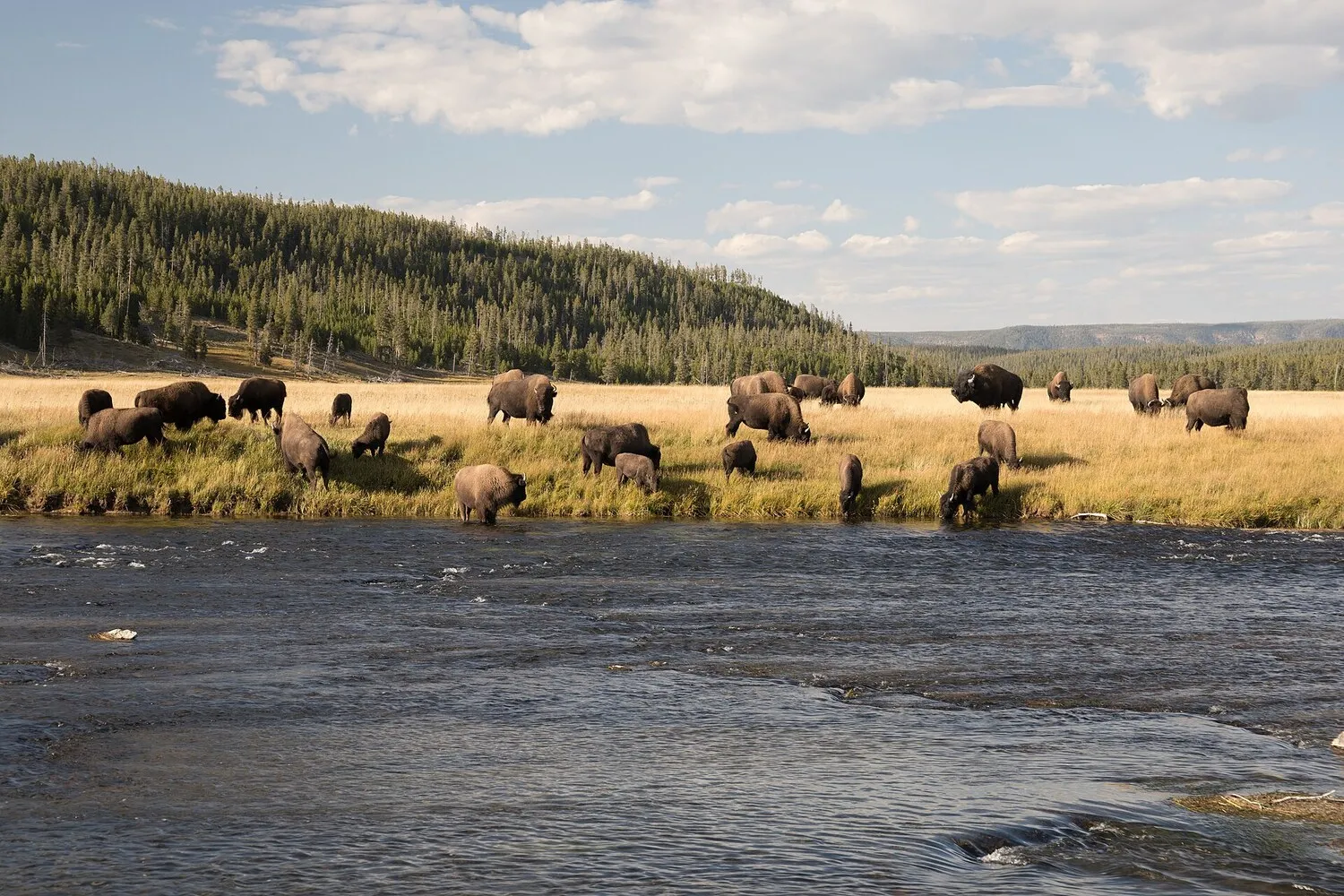
A bison herd on the western range. Saving the American bison from extinction became one of the Boone and Crockett Club’s signal conservation victories. (Wikimedia Commons)
A Lasting Legacy
The Boone and Crockett Club still exists today, more than 130 years after its founding. It continues to advocate for wildlife conservation and for ethical hunting standards. It has published numerous books on hunting and conservation. It has influenced wildlife policy across North America. The club stands as a testament to an important idea: that love of hunting and commitment to conservation are not contradictory, but complementary. You protect what you love. And in the case of the Boone and Crockett Club, hunters loved wild animals and wild places enough to devote their resources and influence to ensuring that future hunters would have the same opportunities they had enjoyed.
For Theodore Roosevelt, the Boone and Crockett Club represented something deeply important: the joining of his personal passion for hunting with a larger purpose. He was not simply killing animals; he was participating in a movement to preserve wild nature itself. This conviction would shape everything he did later in his presidency, when he used the power of the federal government to protect forests, establish national parks, and preserve wild places. He would protect more land than any previous president. He would establish the U.S. Forest Service. He would create the U.S. Bureau of Reclamation. All of these initiatives grew from the intellectual foundation that the Boone and Crockett Club had provided in the 1890s. The club was the school where Theodore Roosevelt learned to think about conservation as a central purpose of government.
Continue Reading
- The Dakota Badlands—Roosevelt's frontier experiences that shaped his conservation ethic
- Governor of New York—Roosevelt's conservation efforts in office
- Conservation During the Presidency—Roosevelt's major conservation achievements
- George Bird Grinnell—The naturalist co-founder of the Boone and Crockett Club
- Rise to Power Overview—Roosevelt's path to the presidency
- Conservation at the TR Center—Roosevelt's conservation legacy
Primary Sources at the TR Center
The Theodore Roosevelt Center's digital library contains materials about Roosevelt's conservation work and the Boone and Crockett Club.
- George Bird Grinnell encyclopedia—The conservationist and Boone and Crockett co-founder
- TR Center Bibliography—Extensive references on conservation and the Boone and Crockett Club
- Forest Conservation subject page—Overview of Roosevelt's forest protection efforts
- Theodore Roosevelt Life Timeline—Key dates in Roosevelt's conservation career
From the Archives
Explore original photographs, documents, and illustrations related to this topic in the Theodore Roosevelt Center Digital Library.
Recommended Reading
- Theodore Roosevelt and the Idea of Race by Thomas G. Dyer (1980). ISBN: 978-0-231-05031-9
- The Rise of Theodore Roosevelt by Edmund Morris (1979). ISBN: 978-0-307-77782-9
- The Big Burn: Teddy Roosevelt and the Fire that Saved America by Timothy Egan (2009). ISBN: 978-0-312-59688-8