
Henry Cabot Lodge: The Loyal Friend
Two Brahmins of Boston: A Friendship Forged in Politics
Both Theodore Roosevelt and Henry Cabot Lodge came from old New England families with deep roots in American history and wealth. Roosevelt's mother brought Southern heritage to New York society; Lodge embodied the best of New England intellectual tradition. Both were educated men — Roosevelt at Harvard, Lodge at Harvard College and the Harvard Law School. Both believed in literature, history, and thoughtful political philosophy. Both were voracious readers and aspiring authors. Both were Republicans who shared a vision of American naval strength, expansionism, and America's destiny as a great power.
They met in Massachusetts politics in the early 1880s when Roosevelt was serving in the New York State Assembly and Lodge was beginning his political career in Massachusetts. The setting was the Republican Convention of 1884. When the party nominated James G. Blaine, many reform-minded Republicans — the so-called “Mugwumps” — bolted to the Democrats; Roosevelt and Lodge, though reformers themselves, made the fateful decision to stay loyal to the party, a shared stand that drew Mugwump scorn and cemented their bond. They immediately recognized kindred spirits — men who thought alike about America's future and who shared intellectual passions for history, literature, and statecraft. There was an immediate bond born not from political calculation but from genuine intellectual connection.
Unlike many political friendships that are built on mere convenience, Roosevelt and Lodge seemed to genuinely like each other from the start. They were nearly contemporaries in age — Lodge was some eight years Roosevelt's senior — yet they approached their intellectual interests with equal passion. Both had read deeply in history and literature. Both could discourse at length on classical authors, discuss the merits of various historical figures, and debate the great questions of statecraft. Lodge's admiration for Roosevelt was particularly striking: he counted Theodore among the most lovable, cleverest, and most daring men he had ever known — high praise from a man not normally given to hyperbole.
They lived in different states — Roosevelt in New York, Lodge in Massachusetts — yet they began a correspondence that would continue for thirty-five years, from 1884 until Roosevelt's death in 1919. They shared jokes in their letters, confided doubts and frustrations, and pushed each other toward bolder action. When Roosevelt was discouraged about his political prospects, Lodge encouraged him. When Lodge saw an opportunity for Roosevelt to advance in his career, he seized it enthusiastically on his behalf. Their letters reveal two men who thought in remarkably similar ways about power, duty, and America's place in the world.
In 1893, Lodge was elected to the U.S. Senate, where he represented Massachusetts until his death in 1924. As a senator, he wielded considerable influence on matters of foreign policy and naval power. But his real influence in American politics came from his friendship with Roosevelt and his ability to mentor the younger man through the various stages of his career. When Roosevelt served as Civil Service Commissioner under Presidents Benjamin Harrison and Grover Cleveland (1889–1895), Lodge was his political ally on Capitol Hill, defending Roosevelt's reform efforts against the machine politicians who dominated the Republican establishment. When Roosevelt became New York Police Commissioner (1895–1897), Lodge supported his aggressive reform agenda. When Roosevelt was Assistant Secretary of the Navy (1897–1898), Lodge was the key senator who backed his naval policies, and the two men collaborated closely on matters of naval expansion and strategic thinking.
Lodge was genuinely proud of Roosevelt's military service during the Spanish-American War. When Roosevelt charged up San Juan Hill as a Rough Rider colonel and returned as a national hero in 1898, Lodge immediately recognized the political opportunity. He was instrumental in elevating Roosevelt's national profile and helping him secure the Republican nomination for Governor of New York. When Roosevelt was elected Governor in 1898, Lodge worked behind the scenes to position him for higher office. And when an assassin's bullet elevated Vice President Roosevelt to the presidency in 1901, Lodge felt vindicated in his long conviction that his friend possessed the qualities necessary for the nation's highest office.

Henry Cabot Lodge as a young member of Congress. The Boston Brahmin and the New York patrician began a friendship that would last thirty-five years. (Wikimedia Commons)

Lodge as U.S. Senator from Massachusetts, the ally who helped steer Roosevelt toward the presidency. (Library of Congress)
The Senator Who Launched a President
Long before Roosevelt moved into the White House, Lodge was pushing him toward higher office. Lodge saw Roosevelt's potential and believed he represented the future of the Republican Party — energetic, reform-minded, and unafraid to challenge established power. After Roosevelt served as Governor of New York, Lodge and others worked to get him nominated for Vice President in 1900. When McKinley's assassination suddenly elevated Roosevelt to the presidency in 1901, Lodge felt vindicated in his faith.
As president, Roosevelt relied on Lodge's judgment on major issues. Their letters show them debating policy, discussing appointments, and strategizing about politics. Lodge had Roosevelt's ear in ways few others did. He wasn't sycophantic; he would disagree with Roosevelt and say so. But they operated from a shared worldview that made their disagreements productive rather than divisive.
The Spanish-American War and Strategic Partnership
The Spanish-American War of 1898 revealed the depth of the Roosevelt-Lodge partnership. As Assistant Secretary of the Navy, Roosevelt pushed aggressively for war with Spain over the issue of American interests in Cuba. Lodge, in the Senate, became Roosevelt's most forceful advocate. When Roosevelt wrote to Lodge about his desire to fight in the war himself, Lodge understood completely. When Roosevelt left the Navy Department to organize the Rough Riders, Lodge supported him. When Roosevelt returned from Cuba as a war hero, Lodge was instrumental in making sure his national prominence was leveraged for further political advancement. The two men were not just political allies; they were partners in a shared vision of America's role in the world.
One of the deepest bonds between Roosevelt and Lodge was their shared intellectual fascination with naval power and international strength. Both men had come of age reading Alfred Thayer Mahan's writings about sea power and national greatness, and both considered Mahan a formative intellectual influence on their thinking. They believed that a strong navy was not merely defensive — it was the instrument through which America could exercise influence in world affairs and fulfill what they saw as America's destiny as a great power in the twentieth century. They supported the Spanish-American War enthusiastically, seeing it as an opportunity for America to shed its provincial isolation. They championed the acquisition of territories like the Philippines and Hawaii as strategic necessities, outposts from which American naval and commercial power could project into the Pacific. They were ardent advocates for the construction of the Panama Canal, understanding that such a canal would allow the American navy to move between the Atlantic and Pacific without having to sail around Cape Horn, fundamentally altering global naval strategy.
Roosevelt and Lodge's shared intellectual worldview — their mutual reverence for Mahan, their reading of history as a tale of great powers competing for dominance, their belief in Anglo-Saxon racial superiority and American cultural superiority — created a philosophical foundation for their political alliance. They were not mere opportunists seeking imperial expansion for profit. They genuinely believed that American power, rightly exercised, would bring civilization, progress, and good governance to less-developed regions of the world. They believed in American power, American intervention, and American leadership on the world stage, and they worked together to translate that vision into policy.
As president, Roosevelt pursued an extraordinarily ambitious foreign policy — negotiating peace between Russia and Japan, building the Panama Canal, expanding American influence in Latin America and the Caribbean, and constructing a great navy. Lodge defended Roosevelt's foreign policy consistently in the Senate. When critics attacked Roosevelt's interventionism or his expansionism as imperial overreach, Lodge could be counted on to mount a forceful, learned defense rooted in his own deep knowledge of history and statecraft. Their alignment on these grand strategic questions meant that Roosevelt could pursue his ambitious foreign policy knowing he had a powerful voice in Congress backing him — a voice that was all the more influential because Lodge was a respected intellectual who could make arguments about American power that went beyond mere party loyalty.
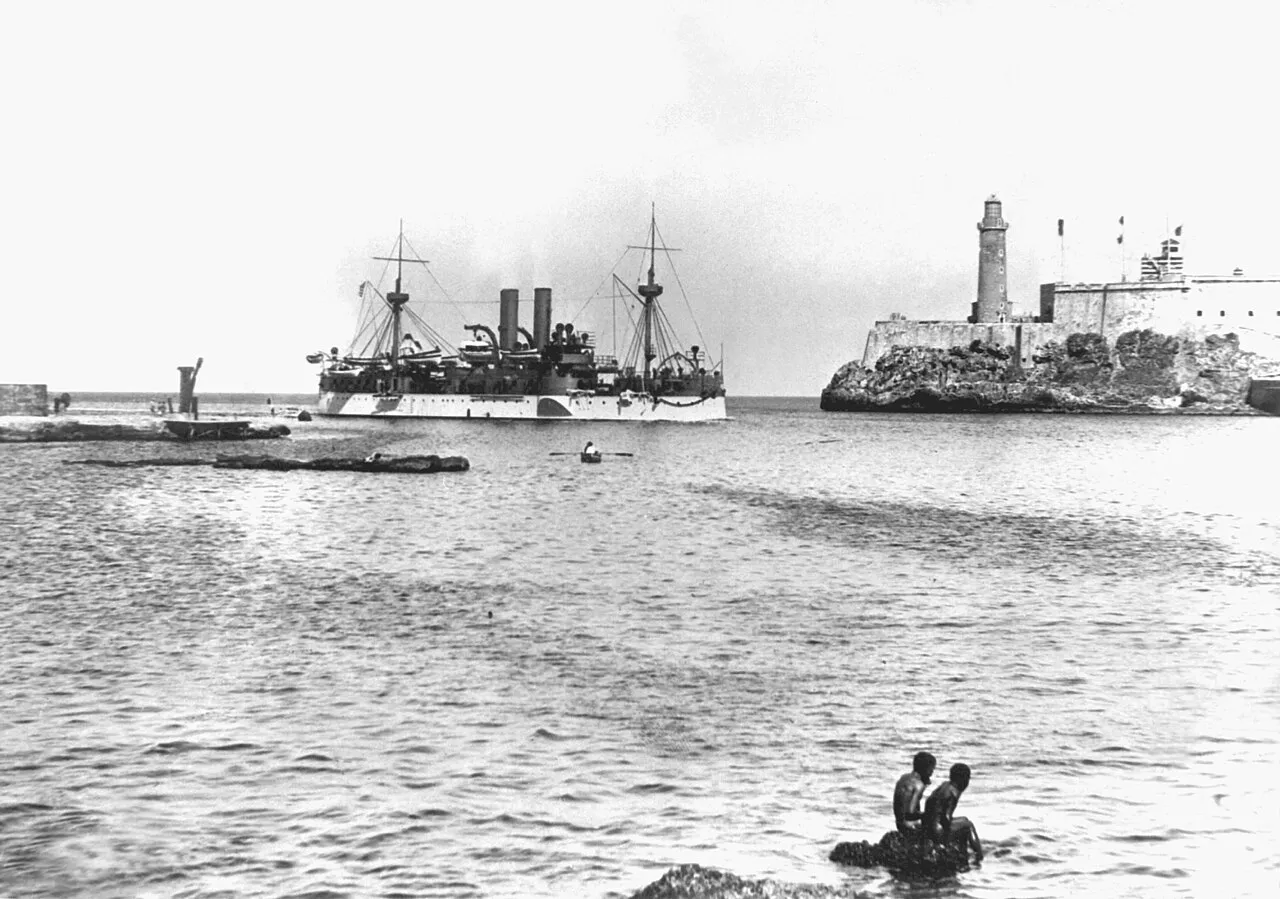
The USS Maine entering Havana harbor, 1898. Lodge and Roosevelt shared a vision of American naval power and expansion. (Wikimedia Commons)

Roosevelt with running mate Hiram Johnson after the 1912 Bull Moose nomination — the insurgency that Lodge, a loyal Republican, could not follow. (Library of Congress)
The Crisis of 1912: When Even Friendship Is Tested
The one real crisis in their decades-long friendship came in 1912 when Roosevelt challenged William Howard Taft for the Republican presidential nomination. Lodge, respecting Taft as a friend and believing that a party split would be catastrophic for Republicans, initially supported Taft. This was profoundly painful for Roosevelt. He felt betrayed by the man who had supported him consistently since the 1880s. In Roosevelt's mind, this was not a mere political disagreement — it was a breach of loyalty by the person he trusted most in the Senate.
Lodge's position was nuanced, though Roosevelt initially had difficulty appreciating the nuance. Lodge feared that Roosevelt's ambitions for a third term, his aggressive progressivism, and his willingness to challenge the Republican establishment would destroy the party. Lodge believed that Taft, though more conservative than Roosevelt, deserved party loyalty. Lodge also believed that some of Roosevelt's ideas about executive power and Progressive reform were too radical for his tastes. Yet Lodge also remained personally attached to Roosevelt; the disagreement was genuine but not meant to be absolute.
The 1912 campaign split the Republican Party three ways — Taft and the Republicans, Roosevelt and the Bull Moose Progressives, and Wilson and the Democrats. Roosevelt lost the nomination and then the general election, but his third-party campaign demonstrated his continued political power. After the tumultuous election, the breach between Roosevelt and Lodge gradually healed. By the time Roosevelt returned from his post-presidency expedition down the River of Doubt in South America in 1914, he and Lodge had reconciled. When America entered World War I in 1917, Lodge and Roosevelt were again aligned, both supporting Wilson's decision to fight, though both believing the war effort wasn't being prosecuted with sufficient vigor and commitment.
The Letters That Revealed the Man
What makes the Roosevelt-Lodge relationship so historically significant is the extraordinary correspondence between them. Roosevelt wrote to Lodge constantly thirty-five years — about politics, yes, but also about hunting, literature, his children, his doubts, his ambitions, his fears, his hopes for America. Lodge wrote back with genuine affection and candid advice, often challenging Roosevelt when he disagreed, always remaining loyal to their friendship even when their political views differed. These thousands of letters give us an intimate picture of Roosevelt that formal biographies cannot provide. We see him as a friend worries about him, celebrates with him, and shares his inner life with.
The correspondence reveals Roosevelt's mind at work — his ranging curiosity, his ability to move from profound intellectual matters to personal gossip in the space of a few sentences, his capacity for both fierce conviction and genuine doubt. He discusses books with Lodge — entire novels read in a night, poems he admires, historical works that shaped his thinking. He confides his anxieties about his political career and his satisfaction with his accomplishments. The letters show a man who trusted Lodge enough to reveal his uncertainties, a luxury few presidents allow themselves.
The letters also show us Lodge as more than just a senator or political operator. He was a man of letters himself — a historian and author of some distinction who had written works on American history and biographies of historical figures. He and Roosevelt could discuss books, poetry, and historical figures with the ease of educated men who shared deep reading and intellectual interests. Lodge would send Roosevelt books he thought he would enjoy, and Roosevelt would read them with the voracious appetite that characterized all his intellectual pursuits. Their friendship was not merely political; it was genuinely personal, rooted in mutual respect for each other's minds and characters.

Lodge in maturity. His decades of candid letters with Roosevelt reveal the private man behind the public senator. (Harvard College Library, Theodore Roosevelt Collection)

Roosevelt (center, holding his hat) with Senator Lodge and others at Nahant, Massachusetts — a friendship that shaped both men’s careers. (Library of Congress)
The Friendship That Mattered
When Roosevelt died on January 6, 1919, Lodge grieved deeply. He had lost not just a political ally but a friend of thirty-five years. In his eulogy and in subsequent writings about Roosevelt, Lodge sought to defend Roosevelt's legacy and ensure that the former president's contributions would not be forgotten or minimized.
History often focuses on Roosevelt's dramatic actions — his charge up San Juan Hill, his trust-busting, his conservation efforts. But in many ways, Henry Cabot Lodge was the perfect friend for such a man: someone who understood him, supported him without enabling him, challenged him when necessary, and remained loyal through decades of American political life. Their friendship demonstrates that even in politics, genuine human connection matters profoundly.
Lodge's Later Career and His Defense of Roosevelt's Legacy
In the years that followed Roosevelt's death, Lodge wrote extensively about Roosevelt, contributing to memorials and biographical works that sought to capture his friend's extraordinary life and legacy. He was particularly active in defending Roosevelt's foreign policy vision and his views on American power against critics who wished to minimize or discredit his legacy.
The great political battle of Lodge's final years came over the League of Nations, which President Woodrow Wilson had championed as the keystone of his peace settlement after World War I. Roosevelt had opposed the League before his death in January 1919, viewing it as an inadequate and dangerous institution that might entangle America in European quarrels without providing real protection for American interests. Lodge inherited this opposition and fought the League with every weapon at his command. As chairman of the Senate Foreign Relations Committee, Lodge controlled the fate of the League in the Senate. He fought ratification with the same vigor and intellectual force that he had once used defending Roosevelt's policies. Lodge's opposition to the League was not merely partisan — he articulated a sophisticated argument that American interests were better served by maintaining freedom of action rather than binding the country to collective security arrangements. In the end, Lodge's position prevailed: the Senate rejected the League, and the United States never joined Wilson's creation.
Lodge died in 1924, having represented Massachusetts in the Senate for 31 years. For most of that time, he had been either the friend and ally of Theodore Roosevelt or the dedicated defender of Roosevelt's legacy. His final years were spent ensuring that his friend's ideas about American power, naval strength, and national interest would not be forgotten or displaced by the Wilsonian vision that had come to dominate the Democratic Party. Lodge's own writings and speeches on foreign policy remained influential into the twentieth century, his name becoming synonymous with the tradition of American nationalism and power politics that stood in opposition to the idealistic internationalism represented by Woodrow Wilson.
Continue Reading
- The Roosevelt Presidency — Policies that Lodge championed in Congress
- Foreign Policy and American Power — The shared vision binding Lodge and Roosevelt
- The Spanish-American War — A defining moment in their partnership
- Panama Canal and American Expansion — Lodge's Senate support for Roosevelt's vision
- The 1912 Split and Temporary Breach — The crisis that tested their friendship
- Roosevelt and World War I — Their later reconciliation during global conflict
Primary Sources at the TR Center
Explore the Theodore Roosevelt Center's Digital Library for correspondence and documents featuring Henry Cabot Lodge's relationship with Theodore Roosevelt.
- Letter to Henry Cabot Lodge — Example of Roosevelt-Lodge correspondence preserved in the digital collection
- Family and Friends Encyclopedia — Essays on Roosevelt's close relationships and political allies
- Politics and Government Section — Articles on Republican Party dynamics and Roosevelt's political networks
- Roosevelt Biography and Papers — Comprehensive biographical context for the Roosevelt-Lodge partnership
- Bibliography and Further Resources — Scholarly works on Progressive Era politics and personal diplomacy
From the Archives
Explore original photographs, documents, and illustrations related to this topic in the Theodore Roosevelt Center Digital Library.
Recommended Reading
- Selections from the Correspondence of Theodore Roosevelt and Henry Cabot Lodge, 1884–1918 (1925).
- Colonel Roosevelt by Edmund Morris (2010). ISBN: 978-0-679-60415-0
- The Bully Pulpit: Theodore Roosevelt, William Howard Taft, and the Golden Age of Journalism by Doris Kearns Goodwin (2013). ISBN: 978-1-4555-0100-7