
TR and World War I: Preparedness and Sacrifice
The Neutrality Question: Roosevelt's Fierce Opposition
In August 1914, the powers of Europe descended into a war of unprecedented scope and brutality. The Great War, as it was called, pitted the Allied powers (Britain, France, Russia) against the Central powers (Germany, Austria-Hungary). President Woodrow Wilson declared American neutrality, calling on Americans to be “neutral in fact as well as in name,” to remain detached from European conflict, to pursue peace through negotiation and diplomatic pressure. Wilson was reelected in 1916 on the slogan “He Kept Us Out of War.”
Theodore Roosevelt found Wilson's stance beneath contempt. To Roosevelt, standing aside while German militarism threatened democratic civilization was not neutrality but cowardice. Roosevelt believed that the United States had a moral and strategic obligation to support Britain and France. He had long viewed German militarism as a threat to civilization itself, a program of imperial conquest that could not be defeated without American power. He called for “preparedness,” for massive American military buildup, for the organization of citizens in civilian training camps, for what he saw as an inevitable American entry into the war on the side of the Allies.
Roosevelt's position put him at odds not merely with President Wilson but with much of American public opinion. Americans in 1914-1916 overwhelmingly favored neutrality. The memory of industrial-scale slaughter on the Western Front terrified ordinary Americans, who had no desire to send their sons to die in European trenches. Roosevelt's calls for preparedness and his scathing criticism of Wilson's neutrality made him a controversial figure, a man seen by many as a dangerous warmonger eager to drag America into an unnecessary conflict for reasons of American vanity and imperial ambition.
But Roosevelt was unmoved by criticism. In his view, America's traditions and values aligned it with Britain and France. American interests lay in a world where democracy and civilization were not overwhelmed by German militarism. The United States should, he believed, prepare for war, build its military capacity, and be ready to enter the conflict on the side of civilization and democracy. The war, when America finally entered it, would be the culmination of decades of Roosevelt's conviction that might and military power were the true currencies of civilization.

As war engulfed Europe in 1914, Roosevelt raged against Wilson's neutrality, denouncing it as moral cowardice and demanding American preparedness. (Library of Congress)
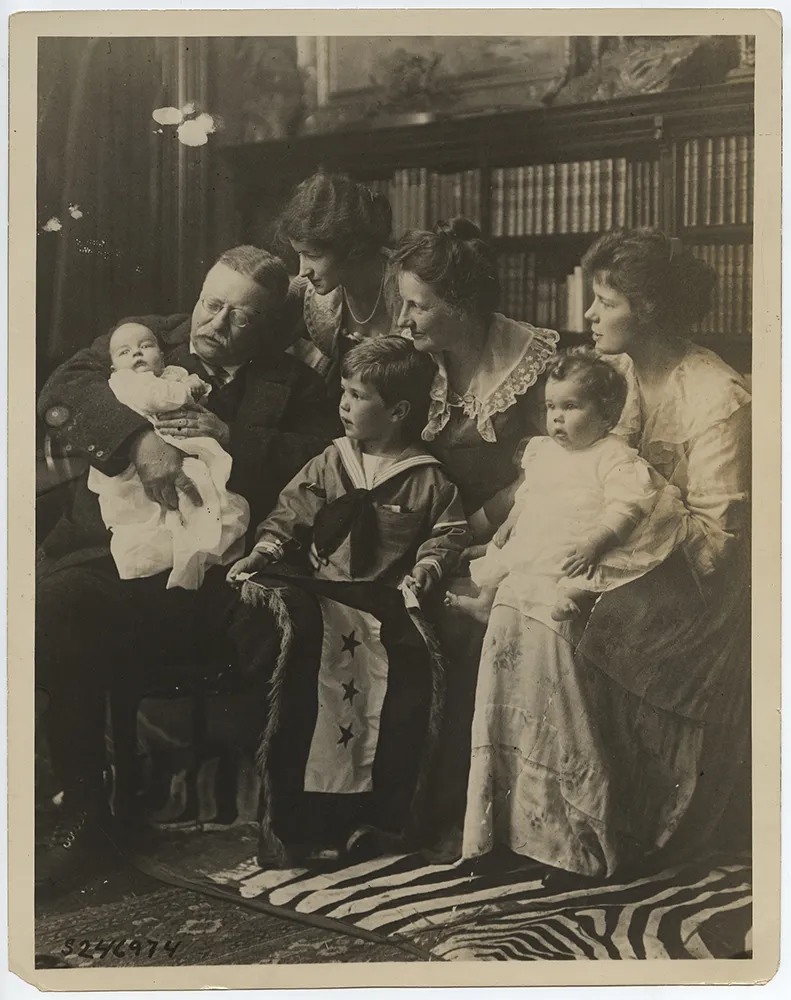
When the United States entered the war in 1917, all four of Roosevelt's sons — Ted, Kermit, Archie, and Quentin — went to fight, with their father's fierce blessing. (Wikimedia Commons)
When America Entered the War: The Sacrifice of Sons
In April 1917, after much international incident and provocation, the United States finally entered World War I on the side of the Allies. American troops began to be mobilized, trained, and dispatched to the European theater. Roosevelt, who had called for American entry, found that the war's demands extended into his own family. All four of his sons—Theodore Jr., Kermit, Archie, and Quentin—served in the military during the war.
Theodore Jr., Roosevelt's eldest son, served as an officer and was wounded and gassed in combat. Kermit served in Mesopotamia and France. Archie was severely wounded and suffered permanent injuries. Quentin, the baby of the family at twenty years old, became a pilot with the U.S. Army Air Service's 95th Aero Squadron. Quentin was eager and brave—perhaps too eager, too willing to take risks. In July 1918, he was shot down over France and killed.
The Shadow Lawn Campaign: TR's Attack on Wilson's Caution
Before America's entry into the war, Roosevelt's most sustained public assault on President Wilson came during the 1916 presidential campaign. Wilson's campaign slogan was “He Kept Us Out of War”—a simple message that resonated with millions of Americans who feared the devastation of European conflict. Roosevelt viewed this as moral abdication. America, in his view, had a duty to stand with the Allies not merely from strategic interest but from the fundamental obligation to defend democracy and civilization itself against German militarism and what he called the “Hun mentality.”
Roosevelt's criticism of Wilson reached its climax at Cooper Union in New York on November 3, 1916, in a speech invoking Shadow Lawn, Wilson's summer home in New Jersey. Conjuring the shadows gathering about the estate, Roosevelt denounced Wilson's policy of strict neutrality as a betrayal of everything America stood for. Wilson, in Roosevelt's view, had adopted a position of moral abdication. A great nation could not simply stand aside while democracy struggled and civilization fought for survival. Roosevelt's “Shadow Lawn” address was among his most caustic and cutting, attacking not merely Wilson's policies but Wilson's intelligence, his courage, and his moral clarity. In Roosevelt's reckoning, the president was simply too proud to fight, too timid to recognize where American honor and American interest lay. Though Wilson won the election, Roosevelt's voice had become the conscience of those millions of Americans who believed their nation should have entered the war years before, that American blood should have been spilled in defense of democracy sooner rather than later.
When America finally entered the war in April 1917, Roosevelt felt vindicated. But vindication came with a terrible price. The war he had advocated for with such fierce moral conviction now demanded payment in the blood of his own sons. Roosevelt had always believed in sacrifice. He had believed that a man of privilege had an obligation to serve the nation, to put his life and the lives of his children on the line for principles larger than himself. But having his sons wounded and his youngest son killed in the war forced a reckoning he had not anticipated. The abstraction of sacrifice became concretely real when it was his children paying the price for his political convictions. “To feel that one has inspired a boy to conduct that has resulted in his death, has a pretty serious side for a father,” Roosevelt said, words that reveal the depth of his anguish.

Roosevelt campaigned savagely against Wilson, ridiculing his caution and his slogan-laden front-porch style as unworthy of a wartime leader. (Library of Congress)

The fury was genuine, and so was the agony: even as he demanded total commitment to the war, Roosevelt dreaded the danger it posed to the sons he had sent into it. (Wikimedia Commons)
The Patriotic Fury and the Personal Agony
Roosevelt's response to his sons' military service and to Quentin's death was characteristic: he channeled his grief into patriotic fervor. He continued to advocate for the war, to criticize those who opposed American military efforts, to insist that American soldiers were fighting for civilization itself. But friends close to Roosevelt understood that beneath the patriotic rhetoric lay a father's agony, a man who had championed war and sacrifice and had paid a terrible price for his convictions.
Quentin's death in July 1918 struck Roosevelt with devastating force. He had known devastating loss before—his first wife, Alice, and his mother had died on the same day in 1884. But those losses had come from illness, beyond anyone's control. Quentin's death was a consequence of a war that Roosevelt had advocated for, a conflict he had called necessary and righteous. The knowledge that his political convictions had indirectly contributed to his son's death was a burden Roosevelt would carry for the brief remainder of his life.
Yet Roosevelt did not repent of his advocacy for American entry into the war or for his calls for military preparedness. He believed that the war had been necessary, that American participation had been morally correct, that the sacrifice of American soldiers—including his own son—had been justified by the cause they fought for. This unwillingness to recant his convictions, even in the face of personal tragedy, revealed something essential about Roosevelt: his conviction that principle must sometimes transcend personal loss.
The Request for a Volunteer Division: Wilson's Refusal
As America entered the war, Roosevelt's combative impulses surged. He was past military age—nearly sixty—but he believed that he still had a role to play in the conflict. He formally requested permission from President Wilson to organize and lead a volunteer division, much as he had organized the Rough Riders during the Spanish-American War. The request was audacious and, from Wilson's perspective, threatening. Roosevelt's charisma and military reputation might have drawn talent and attention away from the regular army. More fundamentally, Wilson had no intention of allowing his predecessor to use the war for personal aggrandizement.
Wilson refused. The refusal stung Roosevelt deeply. He had believed that his military experience and his capacity for leadership entitled him to serve. Wilson's decision to deny him this opportunity meant that Roosevelt would be left at home, advocating for the war while his sons fought and died in Europe. It was a bitter irony—the man who had done so much to push America into the war was denied the opportunity to contribute to it directly. The refusal also marked a deeper rift between Roosevelt and Wilson, the two most powerful personalities in American politics of that era, now locked in mutual contempt.

Roosevelt begged Wilson to let him raise a volunteer division and lead it to France, as he had the Rough Riders. Wilson refused — so his sons went in his place. (Library of Congress)

Ted and Archie were wounded and decorated; Kermit served with the British in Mesopotamia and then the U.S. Army; Quentin trained as a fighter pilot. (Library of Congress)
Four Sons in Service: The Specific Record of Sacrifice
Theodore Roosevelt Jr., the eldest, served as a Lieutenant Colonel in the First Division, commanding men in some of the war's most brutal engagements. At Cantigny, in May 1918, in the first major American offensive action of the war, Ted was gassed in a chemical attack and temporarily blinded, his eyes turning crimson-red from the caustic fumes. Two hundred of his comrades were killed around him in that three-day assault. Yet he refused evacuation, refusing to abandon his command, continuing to lead his battalion through the assault until it was complete. His superiors reported that they had never seen such heroism. He was eventually evacuated, his health permanently damaged by the gas exposure, his lungs scarred, his vision impaired. Seven weeks later, at Soissons, he was wounded again, shot through the leg by machine-gun fire. He survived the war and went on to a distinguished military and political career, but the cost was evident in his weakened constitution for the rest of his life.
Kermit Roosevelt, impatient with the slow pace of American mobilization, took a commission in the British Army in mid-1917 and served first in Mesopotamia, where he earned the British Military Cross. In 1918 he transferred to the American Expeditionary Forces, serving in France as a field artillery officer with the 1st Division. His military service was marked by quiet competence rather than the dramatic heroism that characterized Quentin's brief career. Yet Kermit bore his own psychological burdens from the war, and the experience shadowed his later life with a melancholy that never fully lifted.
Archie Roosevelt served as a captain in the 26th Infantry Regiment of the 1st Division. On March 11, 1918, in the Toul sector of France, he was severely wounded by shrapnel from German artillery. His left arm was badly damaged, his kneecap was shattered, and he suffered multiple other wounds that would cause him lifelong pain and permanent disability. Yet Archie survived and, with remarkable courage and determination, built a productive life around his disabilities. In World War II, despite his injuries, he served again in the Army, refusing to allow his wounds to define the limits of his service.
Quentin's story was the most tragic. At age twenty, he became a pilot in the 95th Aero Squadron, the unit that would become famous for producing many of America's leading fighter aces. He was enthusiastic about flying, brave to the point of recklessness, eager to prove himself in combat. On July 14, 1918—Bastille Day—he was shot down in aerial combat near Chamery, France. Two bullets passed through his brain before his aircraft crashed. He was buried with military honors by German soldiers who recognized a brave pilot when they saw one, cementing his legend as a hero of the air.
TR's Advocacy for the Draft: Conscription as Duty
Throughout the war, Roosevelt was a vocal supporter of conscription. The draft was controversial—many Americans viewed it as un-American, a violation of liberty, a threat to individual freedom. Roosevelt disagreed vehemently. He believed that in a nation founded on popular sovereignty, all citizens had an obligation to contribute to the nation's defense. The draft was not tyranny but democracy. Every able-bodied man had a duty to serve. This was not negotiable. Roosevelt's support for the draft was consistent with his larger philosophy: citizenship entailed obligation. You could not enjoy the benefits of a free society without bearing its burdens.

Roosevelt championed universal military service as a citizen's duty, arguing that a free nation had the right — and the obligation — to conscript its young men. (Library of Congress)

The weight came due on July 14, 1918, when his youngest son Quentin, a 20-year-old fighter pilot, was shot down and killed over France. (Wikimedia Commons)
The Weight of Conviction
Roosevelt's experience during World War I reveals the complexity and the tragedy of his character. He was a man of conviction who believed that moral clarity demanded sacrifice, that nations and individuals had obligations that transcended personal preference or personal safety. He had long preached that a man must be willing to place his life on the line for principles larger than himself. But when his convictions resulted in the deaths of his sons and the permanent wounding of others, he was forced to confront the terrible reality of those beliefs—that sacrifice meant real pain, real death, real loss.
After Quentin's death, Roosevelt admitted that to feel one has inspired a boy to conduct that resulted in his death "has a pretty serious side for a father." The words reveal a man grappling with guilt, with the knowledge that his own fierce advocacy for American military preparedness and entry into the war had inspired his sons to take risks they otherwise might not have taken.
This unwavering commitment to principle, even in the face of personal catastrophe, is what some admirers found most noble about Roosevelt—evidence of a man who would not retreat from his convictions merely because those convictions came with terrible personal cost. It is also what some critics have found most troubling—a quality of obsessive grandiosity that made him willing to sacrifice others, including his own children, for the pursuit of what he understood as justice and righteousness. The knowledge that his own political advocacy had, directly and indirectly, contributed to his sons' suffering and Quentin's death weighed heavily on him in his final years. Yet he never disavowed the cause or questioned whether American entry into the war had been righteous. His principles, in the end, transcended his grief.
The War's Final Year: Consuming the Remaining Energy
In 1918, Roosevelt's remaining years were consumed by the war. The knowledge of Quentin's death in July shattered something in him. The armistice came in November, but by then Roosevelt's health was failing. The River of Doubt expedition had damaged his constitution. That November, Roosevelt was hospitalized for inflammatory rheumatism, coming home to Sagamore Hill only on Christmas Day. When he died on January 6, 1919, less than six months after learning of Quentin's death, many observers believed that grief had accelerated his decline, that the burden of conviction had finally proven too much, even for a man of Roosevelt's iron will.
Continue Reading
- Post-Presidency Overview — Roosevelt's remarkable decade after leaving the White House.
- The Death of Quentin Roosevelt — TR's youngest son and the tragedy of war.
- Theodore Roosevelt Jr. — TR's eldest son and his military service.
- Kermit Roosevelt — TR's adventurous son and his role in the war.
Primary Sources at the TR Center
Explore original documents and resources related to Roosevelt's views on World War I in the Theodore Roosevelt Center Digital Library.
- World War I Encyclopedia Entry — Comprehensive overview of Roosevelt's advocacy for preparedness and American entry into the war.
- Roosevelt's Sons in World War I Encyclopedia Entry — Information about Theodore Jr., Kermit, Archie, and Quentin's military service and sacrifices.
From the Archives
Explore original photographs, documents, and illustrations related to this topic in the Theodore Roosevelt Center Digital Library.
Recommended Reading
- TR's Last War: Theodore Roosevelt, the Great War, and a Journey of Triumph and Tragedy by David Pietrusza (2018)
- The Lion's Pride: Theodore Roosevelt and His Family in Peace and War by Edward J. Renehan Jr. (1998).
- Colonel Roosevelt by Edmund Morris (2010). ISBN: 978-0-679-60415-0