
Theodore Roosevelt Jr.
The Dutiful Son
Young Ted Jr. grew up surrounded by the intensity of his father's political career. As Theodore Roosevelt's presidency unfolded, Ted was a boy—watching, learning, absorbing the lessons his father was trying to teach all his children about duty, courage, and service to the nation. He was not the vivid, dominant personality his father was, but he had something perhaps more valuable: steadiness, honor, and a quiet determination to prove himself worthy of the Roosevelt name.
He attended Harvard, as his father had, and then went into business, first in the carpet trade and later in investment banking. In 1915 he attended the civilian officers' training camp at Plattsburg, preparing himself for the war he sensed was coming. When the United States entered World War I, he was ready and was commissioned as an officer.

Theodore Roosevelt watches his eldest son, Ted, take a jump. Named for his father, Ted Jr. grew up under the weight of an illustrious name. (Library of Congress)

Ted Jr. served with distinction in the First World War, gassed and wounded at Soissons, and helped found the American Legion afterward. (Library of Congress)
The First World War and Its Aftermath
Theodore Roosevelt Jr. served with distinction in the First World War. He was a combat officer in the Western Front trenches—not a distant commander, but a man who led from the front, who shared the dangers his men faced. He was gassed in combat. He was wounded. He earned the respect of his troops and the recognition of his superiors.
After the war, Ted Jr. continued his military career and his government service. He held significant posts: he served as Assistant Secretary of the Navy (the same position his father had held), he was Governor-General of Puerto Rico, and he served as Governor-General of the Philippines. These were not ceremonial appointments but positions of real administrative responsibility, and Ted Jr. handled them with competence and integrity.
The Greatest Generation Goes to War
When World War II began, Theodore Roosevelt Jr. was no longer young. By D-Day, June 6, 1944, he was 56 years old—well past the age when most men are asked to serve in active combat. But he was a soldier, and his country was at war. He returned to service. He was commissioned as a Brigadier General in the United States Army. He was assigned to the 4th Infantry Division.
In the planning for the Normandy invasion, Ted Jr. wanted to be in the first assault wave. He pushed for this assignment. He wanted to be there when the beaches were being taken, when the fighting was fiercest, when his men needed leadership most. His commanding officers tried to convince him otherwise—he was a general, a valuable officer, too important to risk on the beach in the first moments of invasion. But Ted Jr. insisted. He would lead from the front, as he always had.

In his fifties and walking with a cane, Ted Jr. insisted on returning to combat in the Second World War as a brigadier general. (Wikimedia Commons)
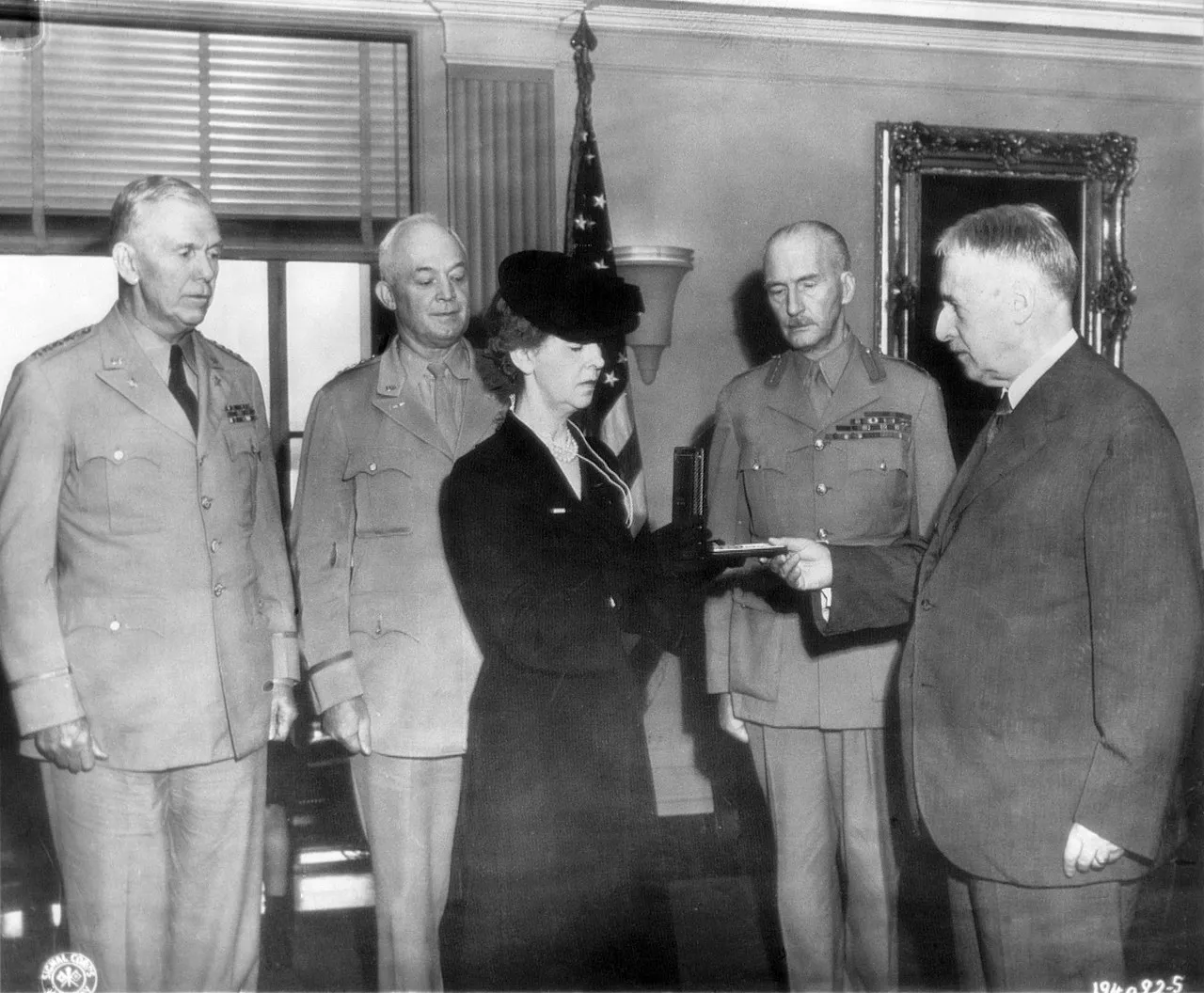
On D-Day he was the only general to land with the first wave at Utah Beach, rallying his men under fire. He received the Medal of Honor for it. (Wikimedia Commons)
Utah Beach and the Medal of Honor
On June 6, 1944, Brigadier General Theodore Roosevelt Jr. landed on Utah Beach at Normandy as part of the first assault wave. He was the oldest man and the only general to land in the first wave of the invasion. He carried a walking cane and a pistol. He was suffering from arthritis, a heart condition, and the physical ailments that come with age. But he was there.
When the landing was made, the troops found themselves on the wrong part of the beach—the terrain was different from what maps showed. Units were scattered. The situation was confused and dangerous. Roosevelt stood in the midst of chaos, used his cane as a pointer, and calmly reorganized the troops. He moved along the beach under fire, encouraging men, organizing units, taking command. He walked where death was falling from above, and he did his duty.
His actions that day earned him the Congressional Medal of Honor—one of the highest military decorations the nation can bestow. He was recognized not just for bravery, but for exemplary leadership under the most extreme conditions. He showed his men that a general would ask them to do nothing he was not willing to do himself. He showed them that age did not diminish courage. He showed them what duty meant.
A Life Cut Short
Theodore Roosevelt Jr. never returned home from World War II. He died of a heart attack on July 12, 1944—just over a month after D-Day. He was 56 years old. His heart, strained by age and the rigors of military life, finally gave out.
He died knowing that he had done his duty. He died as a soldier, in service to his nation. He died in a way that would have made his father proud—without complaint, without asking for special treatment because of his age or his name or his health. He died a hero, and the nation mourned.
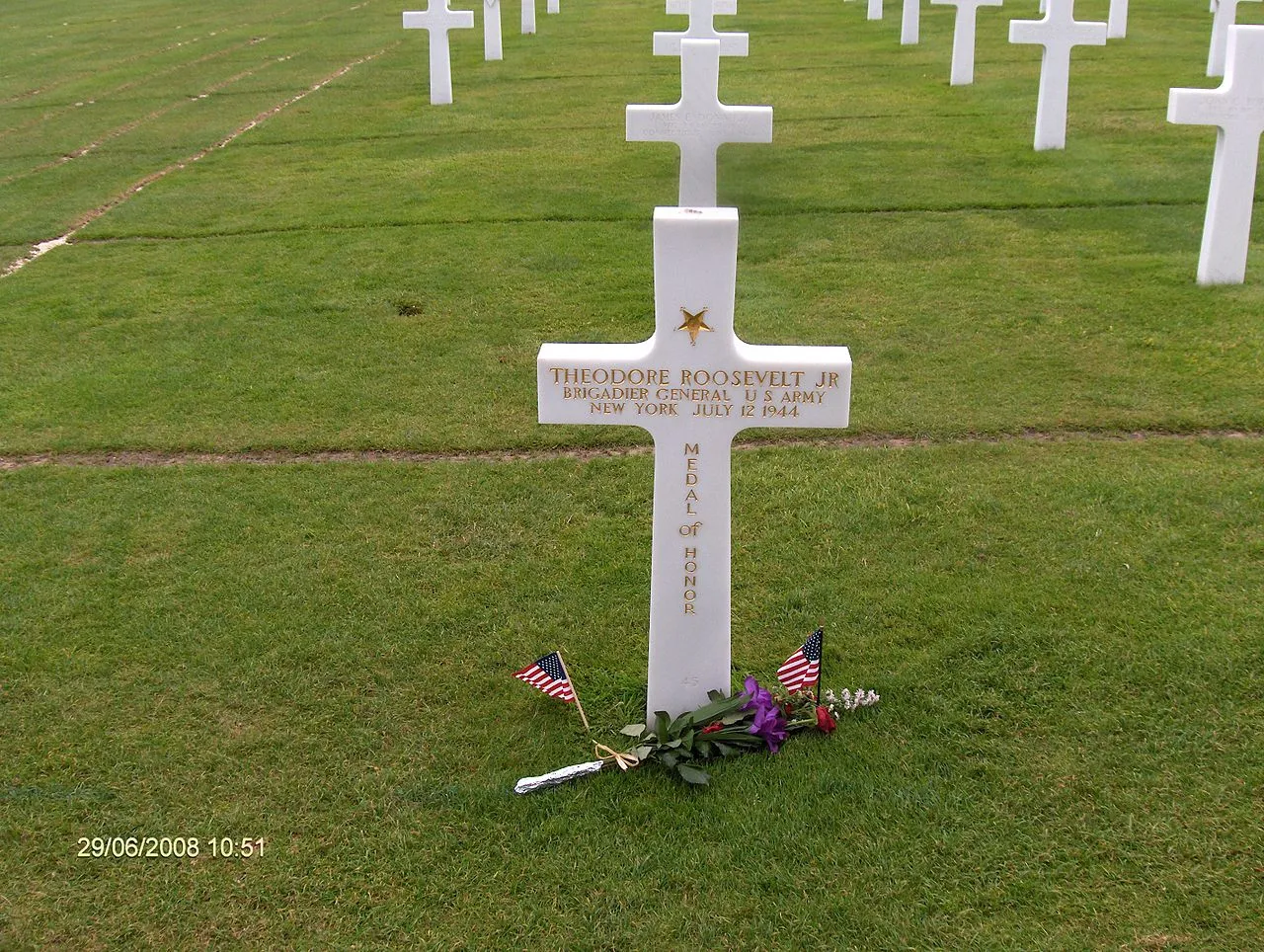
Ted Jr. died of a heart attack in Normandy on July 12, 1944, weeks after D-Day. He rests at the Normandy American Cemetery beside his brother Quentin. (Wikimedia Commons)

Businessman, writer, and public servant — Ted Jr. carried his father's name without his father's hunger for the spotlight. (Library of Congress)
The Quiet Roosevelt
Theodore Roosevelt Jr. was not as flamboyant as his father, not as captivating as his sister Alice, not as wildly adventurous as his brother Kermit. But he was, in his way, just as remarkable. He lived a life of quiet service. He asked little for himself. He gave everything to the nation he served.
His Medal of Honor citation reads like a psalm to duty: a man who, when the moment required, stood and did what had to be done, without regard for personal cost, without regard for age or infirmity, without regard for anything except the obligation to his men and his nation.
A Legacy of Service
Theodore Roosevelt Jr. never had children who became famous. He never wrote bestselling books or gave thundering speeches. He was not a president. He was simply a man who understood that serving something larger than himself was the highest calling. He lived that understanding, and he died in service to it.
His father often spoke of "the strenuous life"—the life lived with vigor and purpose and engagement. Theodore Roosevelt Jr. lived that life in the most literal sense. He strenuously served his nation, his family, and his ideals. And when the moment came that required the ultimate sacrifice, he was ready.
Continue Reading
- Ethel Roosevelt Derby — Ted Jr.'s sister who preserved the family legacy
- The Roosevelt Family Tree — Ted Jr.'s position within the larger Roosevelt family
- The Strenuous Life — The philosophy Ted Jr. embodied through his military service
Primary Sources at the TR Center
Explore original documents and resources related to Theodore Roosevelt Jr. in the Theodore Roosevelt Center Digital Library.
- Theodore Roosevelt Jr. Encyclopedia Entry — Comprehensive biography of his military service and family legacy
- D-Day and World War II Resources — Context for Ted Jr.'s heroic service
From the Archives
Explore original photographs, documents, and illustrations related to this topic in the Theodore Roosevelt Center Digital Library.
Recommended Reading
- Theodore Roosevelt Jr.: The Life of a War Hero by H. Paul Jeffers (2002)
- Colonel Roosevelt by Edmund Morris (2010). ISBN: 978-0-679-60415-0
- Rough Rider: The Life of Theodore Roosevelt by Edward J. Renehan Jr. (1997)
Historical Note: Theodore Roosevelt Jr. was born September 13, 1887, and died July 12, 1944. He served as Assistant Secretary of the Navy (1921–1924), Governor-General of Puerto Rico (1929–1932), and Governor-General of the Philippines (1932–1933). He earned the Medal of Honor for his actions on Utah Beach on June 6, 1944, becoming the oldest man and only general to land in the first assault wave. He was posthumously promoted to Major General. Information comes from military records, H. Paul Jeffers's Theodore Roosevelt Jr.: The Life of a War Hero (2002), and contemporary accounts of the D-Day invasion.