
Ethel Roosevelt Derby: The Devoted Daughter
Growing Up at Sagamore Hill
Ethel was, by all accounts, the most conventionally successful and least troubled of Theodore's children by his second marriage. Unlike her older stepsister Alice, who sometimes felt emotionally distant from her father during childhood, Ethel seemed to understand and embrace the reserve that characterized her mother Edith's parenting style. She knew her mother loved her even if affection wasn't expressed with grand gestures—it was shown through reliable presence and unwavering commitment. This was not coldness, but rather a different kind of devotion: steady, principled, and absolute.
At Sagamore Hill, the Roosevelt family home on Oyster Bay, Long Island, Ethel grew up in a household where duty and action were paramount. She watched her father work himself to exhaustion as Police Commissioner, Governor, and eventually President of the United States. She saw her mother manage a complex household with grace and efficiency, running everything from household accounts to the management of household staff with the same careful attention that Theodore brought to his political offices. She observed her siblings chart their own courses—her older brother Ted pursuing military service, her younger brother Quentin embodying the spirit of youthful enthusiasm that Theodore so admired, her brother Archie showing the quiet determination that would mark all his undertakings. Perhaps more than any of her brothers, Ethel absorbed and embodied the family values of service, responsibility, and quiet excellence. She understood, perhaps intuitively, that not all important work is dramatic, and that the foundation upon which great achievements rest is often the steady, reliable work of people who ask for no recognition.

Ethel Roosevelt, Theodore and Edith's elder daughter — steady, practical, and unflappable amid the whirl of White House life. (Library of Congress)

In 1913 Ethel married surgeon Richard Derby and settled into family life near her parents at Oyster Bay. (Library of Congress)
Marriage and Domestic Life
At a time when some of her contemporaries sought to break free from traditional expectations, Ethel made a conscious choice to embrace them. In 1913, she married Richard Derby, a respected New York surgeon of good family and solid means. The union was a happy one by all accounts—a genuine partnership between two people committed to service and family. While Ethel could have remained in the public eye through her connection to her father's legacy, she chose instead to build a private life centered on her husband and the children they would raise together.
This choice did not mean Ethel retreated from the world. Rather, she expressed her values through different channels: as a devoted wife, an engaged mother, and an active member of her community. She managed her household with the same careful attention to detail that characterized all her undertakings. She raised her children with the principles she had absorbed from her parents: honor, duty, and service to something larger than oneself.
Nursing in France During World War I
When war engulfed Europe in 1914—nearly three years before the United States entered the conflict—Ethel did what many women of her class and generation felt called to do: she contributed her abilities to the war effort. She sailed for France with her husband, Dr. Richard Derby, who served as a surgeon at the American Ambulance Hospital in Neuilly, outside Paris, and there she worked as a nurse, caring for wounded soldiers. It was heartbreaking work. She saw men at their most vulnerable, dealt with wounds and illnesses that tested her physical and emotional endurance, and gained an intimate understanding of what modern industrial warfare meant—the overwhelming scale of casualties, the suffering of young men far from home, the particular kind of anguish that comes from watching people you care for die or suffer permanent injuries.
For Ethel, this was a natural and almost inevitable expression of the values she had been taught since childhood. Her father had always preached the gospel of "the strenuous life"—the idea that privilege carried with it the obligation to contribute to the common good, to put oneself at some risk in service of something larger than personal comfort. Here was her opportunity to do exactly that, in a cause her father believed deeply in and that represented, in his view, the defense of civilization itself. She worked with dedication and compassion, earning the respect of both the soldiers she cared for and her fellow nurses. Unlike her brothers who fought on the front lines, Ethel received no military honors or public recognition for her service, yet in many ways her contribution was just as real and just as costly to her emotionally and physically.

When war came in 1914, Ethel and Richard sailed to France, where she nursed the wounded at the American Ambulance Hospital in Paris. (Wikimedia Commons)

The Roosevelt family, with Ethel among her siblings. She became the quiet anchor who held the family together through its many losses. (Library of Congress)
The Family Anchor
What made Ethel truly remarkable was not any single achievement, but rather the constancy of her presence across the arc of her family's life. When her father died in 1919, Ethel was there. When her troubled uncle Elliott's legacy required family management and support for his daughter Eleanor, Ethel was there. When Sagamore Hill required stewardship and preservation, Ethel took on that responsibility. She was the keeper of traditions, the one who remembered stories, the one who ensured that the Roosevelt name continued to stand for something principled and good.
Unlike some members of her family who sought the spotlight or whose lives were marked by dramatic turns and public controversy, Ethel's life was marked by what we might call the heroism of sustained responsibility. She was the steady presence that allowed others in her family to pursue their more visible accomplishments. She was the one who made sure the family home remained a place of gathering and belonging. She was the one who could be counted on, who would show up, who would help without seeking credit.
Life at Sagamore Hill
Ethel and her family lived near Sagamore Hill for much of her life, and she remained deeply connected to the family home after her father's death. Under her stewardship, Sagamore Hill became a kind of living memorial—not a museum frozen in time, but a home where the Roosevelt legacy could be understood not as history but as values still vital and still relevant. She opened her home to family members and to visitors who came to understand who Theodore Roosevelt had been and what he had stood for.
In the quiet work of maintaining this space and sharing its stories, Ethel achieved something of lasting value. She ensured that future generations could walk the halls where Theodore had written, could see the study where he had worked, could understand through the physical reality of place what kind of man he had been and what his life had meant.
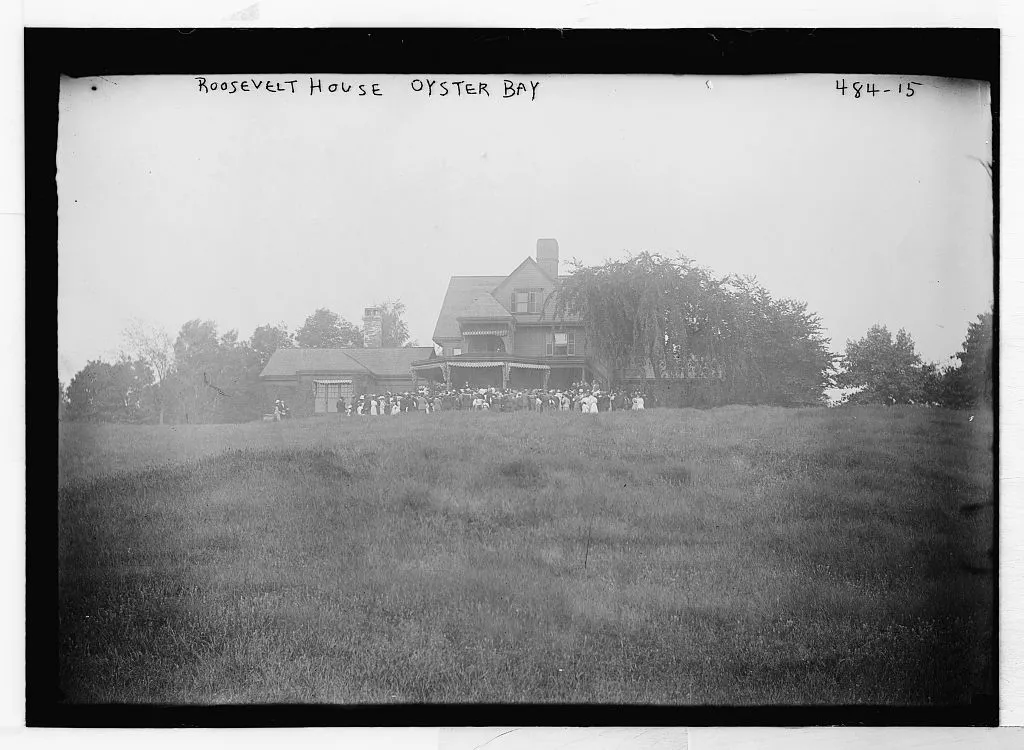
Ethel remained devoted to Sagamore Hill her whole life, helping to preserve her father's home as a place of memory for the nation. (Library of Congress)
A Long and Meaningful Life
Ethel Roosevelt Derby lived to be eighty-six years old, passing away in 1977—nearly six decades after her father's death. She saw her children grow and prosper, her grandchildren born, the world change in ways both dramatic and subtle. She lived through the Great Depression, two world wars, and the beginning of the Cold War. Yet throughout all these changes, she remained connected to the values and principles that had been instilled in her as a young girl at Sagamore Hill.
Ethel's life reminds us that not all heroism is public. Not all meaningful contributions to the world involve grand gestures or dramatic action. Sometimes the most important work is simply being present, being reliable, being committed to values that endure. Ethel Roosevelt Derby was her father's daughter in her dedication to service and duty, and her legacy was written not in laws passed or wars fought, but in the lives she shaped and the family she held together across the challenging years of the twentieth century.
Continue Reading
- Theodore Roosevelt — Ethel's father, whose values of duty and service shaped her entire life
- The Roosevelt Family Tree — Ethel's position within the broader family structure and her siblings
- Theodore Roosevelt National Park — The Badlands landscape connected to Roosevelt family history
Primary Sources at the TR Center
Explore original documents and resources related to Ethel Roosevelt Derby in the Theodore Roosevelt Center Digital Library.
- Ethel Roosevelt Derby Encyclopedia Entry — Comprehensive biography of her life, service, and family stewardship
- Sagamore Hill National Historic Site — The home that Ethel preserved and maintained after her father's death
From the Archives
Explore original photographs, documents, and illustrations related to this topic in the Theodore Roosevelt Center Digital Library.
Recommended Reading
- The Roosevelt Women by Betty Boyd Caroli (1998).