
Quentin Roosevelt: The Youngest and the Lost
The White House Gang Leader
Born in 1897, Quentin Roosevelt grew up during his father's presidency—a unique circumstance that made him one of the most publicly visible children ever to inhabit the White House. But what made him truly distinctive among presidential children was his role as the ringleader of what newspapers delightfully called "the White House Gang"—a group of energetic young people who sometimes pushed the boundaries of acceptable behavior within and around the White House itself.
Quentin was, from earliest childhood, the boy most like his father in temperament. Edmund Morris, in his biography of Roosevelt, noted that signs were already appearing that "Quentin is developing an exceptional charm" and natural gift for leadership. He was clever, quick-witted, and possessed an almost magnetic ability to engage people and make them want to follow his lead. Unlike his older brother Ted Jr., who inherited the Roosevelt love of reading and intellectual seriousness, Quentin was pleasure-seeking, spontaneous, and immediately engaging. He seemed to delight in experience itself—in the simple fact of being young and alive in a house of power.
The White House Gang did not engage in anything criminal or genuinely dangerous. Rather, they were high-spirited young people—children and adolescents who shared a certain class background and a certain freedom from ordinary restraints—who occasionally found ways to amuse themselves that their elders found exasperating. They might sneak through corridors they weren't supposed to use, find ways to startle dignified guests, or engage in pranks that tested the patience of the Secret Service and the staff. When President Roosevelt walked into a room where Quentin was present, he would sometimes brace himself: something amusing and disruptive was likely to follow.
What was remarkable was Theodore Roosevelt's response to his son's mischief. While he could certainly be exasperated by Quentin's antics, the President seemed genuinely delighted by his youngest son's spirit and ingenuity. Here was a boy who embodied the very values Theodore preached—energy, creativity, courage, and a willingness to test boundaries—even if those values were being expressed in ways that made governing the nation slightly more complicated than it needed to be. Theodore could recognize, in his youngest son's pranks and schemes, a reflection of his own temperament and philosophy. The father saw in the son a mirror of his own youthful energy and daring.

Quentin, the baby of the family, led the mischievous 'White House Gang' — the boys whose pranks enlivened his father's presidency. (Library of Congress)

Bright and quick-witted, Quentin grew into a thoughtful young man and enrolled at Harvard before the war changed everything. (Library of Congress)
Coming of Age
As Quentin moved through adolescence and into manhood, he developed into a young man of considerable charm and genuine promise. He was less intellectually serious than some of his siblings—he had not inherited the bookish inclinations of his older brother Ted or the philosophical bent of some of his sisters. Instead, Quentin was more spontaneous, more pleasure-seeking, more immediately engaging. He seemed to delight in experience itself, in the pleasures of friendship and adventure, in the simple fact of being young and alive. He was, in the judgment of those who knew him, everything a young Roosevelt should be: energetic, courageous, and full of enthusiasm.
He fell in love with Flora Payne Whitney, a young woman of prominent family and considerable wealth. Flora came from one of America's greatest fortunes, and she was known for her beauty, intelligence, and accomplishments. Their romance seemed to promise a conventional, happy future—a marriage between two young people of suitable background and position, children, a life of the sort that men of Theodore Roosevelt's class were expected to live. One can imagine Theodore's satisfaction at seeing his spirited youngest son finding love and embarking on the responsibilities of adult life. By all accounts, Flora was devoted to Quentin, and he to her. They planned a future together.
Quentin attended Harvard, as was customary for Roosevelt men, and seemed destined for a future of comfortable, respectable achievement—until he left college after his sophomore year in 1917 to join the air service. He was not seeking to revolutionize anything or to transform the world. He simply wanted to live a full, active, pleasurable life—a goal that seemed entirely within reach. He had the health, the charm, the intelligence, and the resources to accomplish whatever he set his mind to. The world seemed open before him, full of possibility and promise.
The Call to War
When the United States entered World War I in April 1917, Quentin felt, as many young men of his generation did, the powerful pull of duty and responsibility. But unlike his older brothers—Ted Jr. and Archie, who entered the infantry, and Kermit, who took a British commission in Mesopotamia—Quentin chose the newly formed Air Service. Aviation in World War I was a novelty, a technological marvel, and an extraordinarily dangerous occupation. Pilots were few in number, their training was minimal by later standards, and the casualty rate was shockingly high. Many young men who trained as pilots did not survive their first month of combat missions.
But Quentin Roosevelt, the spirited, adventurous youngest son, saw in military aviation exactly the kind of adventure and challenge that called to him. It was the strenuous life his father had preached, but now in modern form—combat in the sky, racing through clouds at speeds that seemed miraculous, facing death with nothing between him and the earth but canvas and wire and his own courage. He underwent pilot training and was soon flying combat missions over France in a Nieuport fighter plane. He was good at what he did—reports from fellow pilots and from the Army suggest that Quentin was a capable pilot and an effective combat flyer. He was officially credited with downing a German aircraft on July 10, 1918, proving himself in the aerial arena in which he had chosen to fight. His squadron mates noted his bravery, his skill, his willingness to take on the most dangerous assignments.
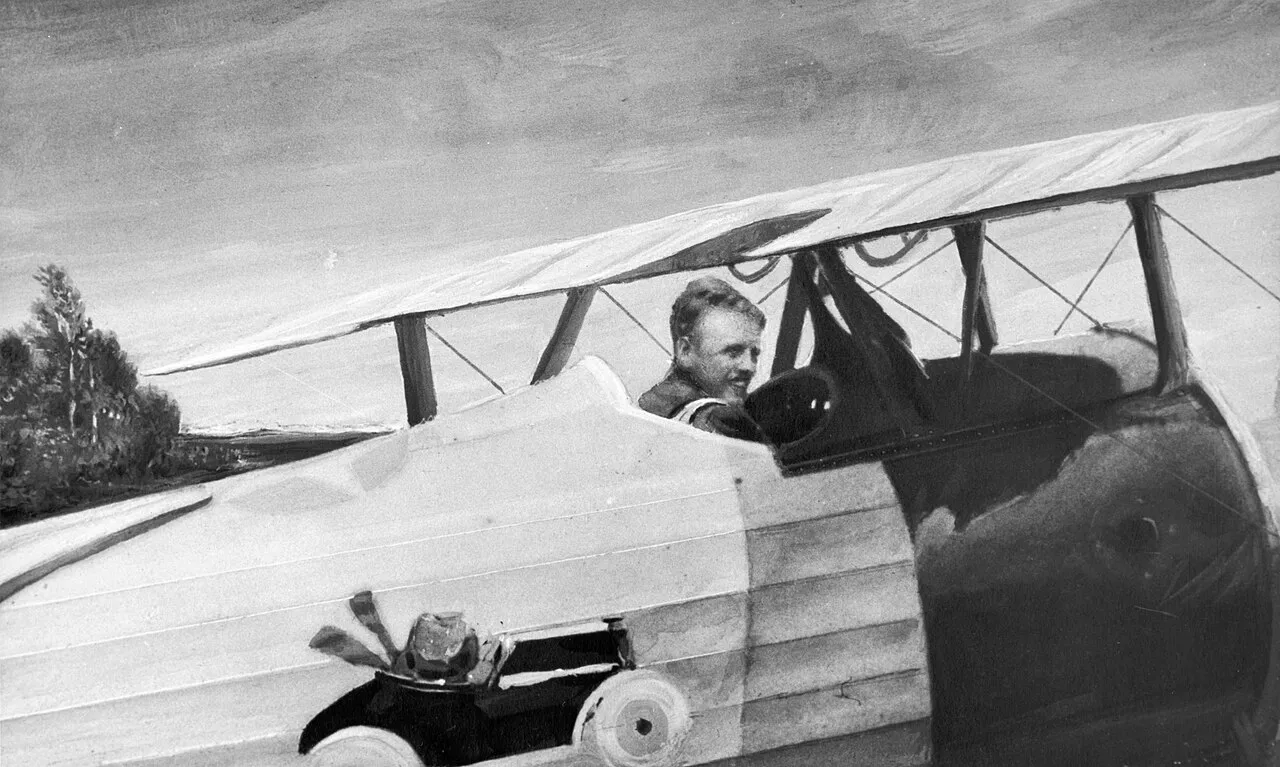
Quentin left Harvard to train as a fighter pilot, joining the American air service in France in 1917. (Wikimedia Commons)
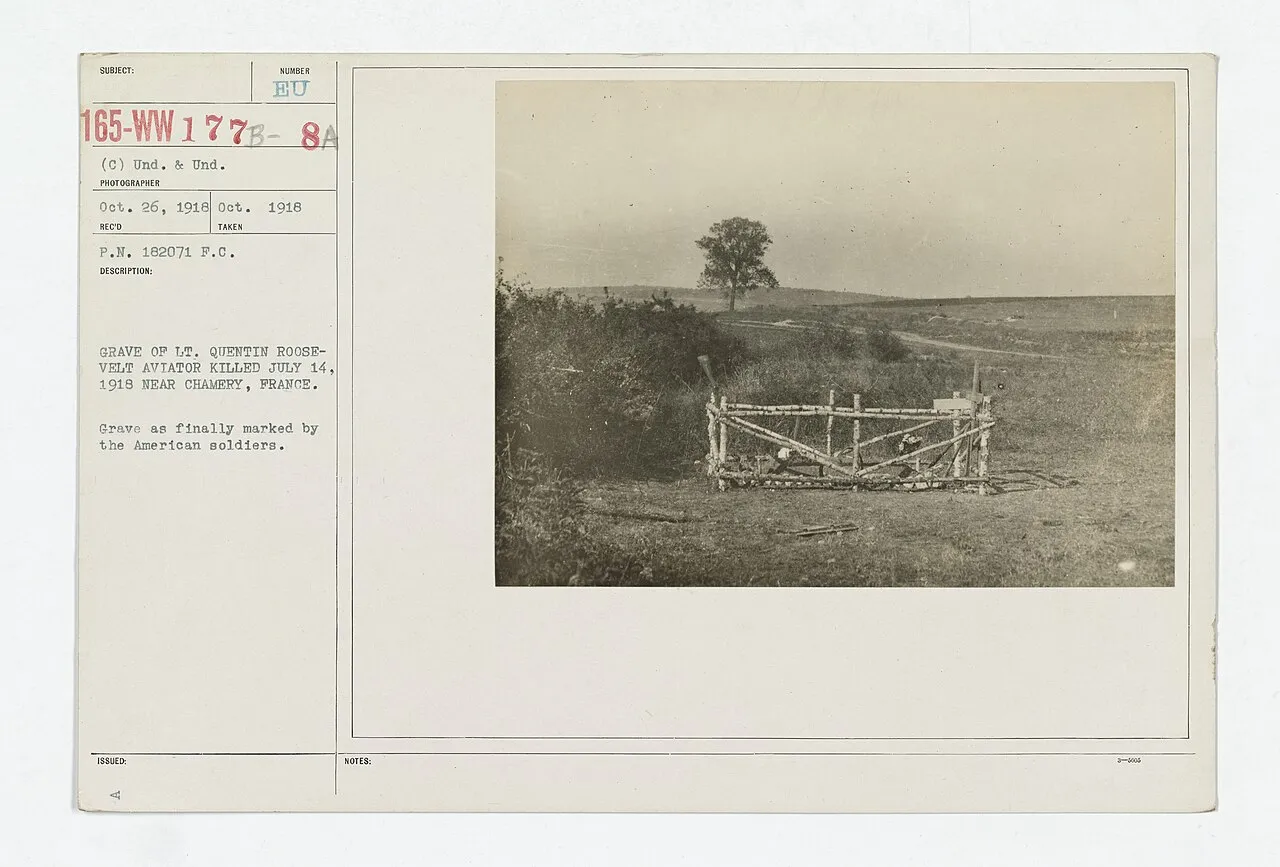
On July 14, 1918, Quentin was shot down and killed in a dogfight over Chamery, France. German soldiers buried him with military honors. (National Archives)
July 14, 1918: Chamery, France
On July 14, 1918—Bastille Day, a day when all of France was celebrating liberty and independence—Quentin Roosevelt was engaged in aerial combat over Chamery, a small French village near the Marne River. He was flying his Nieuport fighter plane when he encountered German aircraft. By his comrades' accounts Quentin was worn down by weeks of combat flying, but—embodying the family's tradition of never shirking duty or adventure—he was flying that morning.
The details of what happened next are not entirely clear—accounts differ, and in the chaos of aerial combat high above the earth, exact details are often impossible to establish. What is known is that Quentin's plane was shot down. An American soldier advancing through the tiny village of Chamery, in the Marne province, came upon a cross-shaped fragment of a Nieuport fighter sticking out of a field just east of the road to Coulonges. Some German soldier had taken a knife and scratched on it the word ROOSEVELT. An autopsy performed by the Germans before Quentin's burial indicated that he had been killed before he crashed—two bullets had passed through his brain. He died in the aircraft as it fell, or possibly had already been dead when it went down.
The Germans, in an act of courtesy and respect toward a fallen enemy, buried Quentin with military honors. According to accounts from American prisoners of war who witnessed the ceremony, approximately one thousand German soldiers attended, standing at attention before the ranks. They honored Quentin not only because he was a gallant aviator who died fighting bravely against odds, but because he was the son of Colonel Roosevelt, whom they esteemed as one of the great Americans. His family, separated from him by an ocean and by the fog of war, had no way of knowing immediately what had happened to him. For days, the uncertainty was almost as terrible as the eventual confirmation of his death. Woodrow Wilson's telegram of July 20, 1918, confirmed it: "Am greatly distressed that your son's death is confirmed. I had hoped for other news."
Quentin Roosevelt was twenty years old. He had lived a full, vivid life—more than many men have experienced. He had known adventure, love, friendship, purpose, and the respect of his peers. He had done what he believed was right and what his father had taught him to do: when his country called, he answered without hesitation. But he would not live to see the war end, would not return home in triumph, would not marry Flora Whitney or raise children or grow old in the ordinary human way. His promise, his charm, his extraordinary gift for engaging and leading people—all of it extinguished in an instant on a summer morning over France.
A Father's Anguish
Theodore Roosevelt's grief at his youngest son's death was profound and, according to those who witnessed it, unconsolable. This was not merely the death of a child—it was the loss of the son he had adored, the one he had hoped would grow to adulthood and carry on the Roosevelt name with honor. More than that, it was the opening of a terrible chasm between his deepest convictions and his most devastating personal loss.
Theodore had preached, throughout his public life and especially during the past few years, the gospel of the strenuous life—the idea that courage, action, and the willingness to meet challenges were the marks of a properly lived life. He had advocated energetically and publicly for American entry into the First World War, believing it a just cause worth the sacrifice. He had raised all his sons to embody these values—to be courageous, to act decisively, to put duty before personal safety. And now his youngest son, his beloved Quentin, had taken that teaching to its ultimate and final conclusion. The boy had answered his father's call to courage, and it had cost him his life.
In his anguish, Theodore wrote to a friend: "To feel that one has inspired a boy to conduct that has resulted in his death" was almost unbearable. It was not that Quentin had done anything wrong—he had done precisely what a courageous young man should do. He had answered his country's call. He had flown the dangerous missions. He had fought with bravery and skill. But that was the point. Theodore's own philosophy of courage and action and devotion to duty had led directly to his son's death. The man who had seemed to embody American vigor and confidence was forced to confront, in the most personal and devastating way possible, the terrible price that those virtues could exact. And yet he could not say his philosophy was wrong, because Quentin had died for something that mattered.

The loss broke something in Theodore Roosevelt. 'The old side of him is gone,' a friend wrote; he died himself just six months later. (Library of Congress)
The Legacy of Loss
Many who knew Theodore Roosevelt believed that the loss of Quentin hastened his own death. Theodore's health had been declining for years—he suffered from recurrent tropical illnesses contracted during the River of Doubt expedition, and he was no longer a young man. But the grief of losing his youngest son seemed to accelerate a decline that was already underway. He died less than six months after Quentin—on January 6, 1919—and those close to him believed that the anguish had broken something in him that could not be repaired. On his deathbed, the man who had seemed invincible, who had commanded armies and nations and expeditions, was broken by the loss of his boy. Flora Whitney, Quentin's fiancée, came to Sagamore Hill to be with the grieving family. According to Ethel, Roosevelt's daughter, Flora was "perfectly wonderful... calm and controlled," but she too was devastated, her future and her happiness extinguished along with her fiancé.
Quentin Roosevelt's short life and tragic death became part of the Roosevelt legend—the young pilot shot down over France, the beloved youngest son whose sacrifice seemed to embody both the best and the worst of his father's teachings about the strenuous life. He was not the only Roosevelt to die in war—his brother Kermit, broken by his wartime experiences and haunted by shadows that no peacetime could dispel, would eventually take his own life during World War II. But Quentin's death seemed to crystallize something about the cost of Theodore Roosevelt's philosophy, the terrible price that the strenuous life could exact on those who followed it most faithfully.
Yet even in death, Quentin Roosevelt was what he had been in life: a man of genuine courage and principle, a young person who answered his country's call without hesitation or complaint, who did what he believed was right regardless of the cost. He died as he had lived—with energy and conviction, with charm and bravery, with a willingness to face danger that his father had taught him to admire. And in his death, he became a symbol, not only of the tragedy of war and the waste of young lives, but of the extraordinary courage of a remarkable young man doing what he believed he was called to do.
Continue Reading
- Theodore Roosevelt — Quentin's father and a defining influence on his life.
- The Death of Quentin Roosevelt — Detailed account of his death in aerial combat.
- Theodore Roosevelt and World War I — His sons' military service and family sacrifice.
- Kermit Roosevelt — Quentin's older brother and fellow World War I veteran.
Primary Sources at the TR Center
Explore original documents and resources related to Quentin Roosevelt in the Theodore Roosevelt Center Digital Library.
- Quentin Roosevelt Encyclopedia Entry — Comprehensive overview of his life, military service, and tragic death.
- Roosevelt's Sons in World War I Encyclopedia Entry — Information on all four Roosevelt sons' military service.
From the Archives
Explore original photographs, documents, and illustrations related to this topic in the Theodore Roosevelt Center Digital Library.
Recommended Reading
- The Golden Lad: The Haunting Story of Quentin and Theodore Roosevelt by Eric Burns (2016).
- Rough Rider: The Life of Theodore Roosevelt by Edward J. Renehan Jr. (1997)
- Colonel Roosevelt by Edmund Morris (2010). ISBN: 978-0-679-60415-0