
The Bull Moose Campaign of 1912: The Third-Party Insurgency
The Growing Rift: From Faith to Betrayal
When Theodore Roosevelt stepped down from the presidency in March 1909, he had confidently endorsed William Howard Taft as his successor, believing Taft would continue and expand the progressive reforms that had characterized the Roosevelt administration. Roosevelt and Taft had been close friends. Roosevelt had selected him as his Secretary of War. He trusted Taft's judgment and his commitment to progressive reform.
But within months of taking office, cracks appeared in the Roosevelt-Taft relationship. Taft's approach to conservation proved more cautious than Roosevelt's. While Roosevelt had aggressively moved public lands into conservation status, Taft was slower to expand the conservation program. The controversies surrounding Taft's Interior Secretary Richard Ballinger—who was accused of opening conservation lands to private exploitation—created a rift between Roosevelt's conservationist allies and the Taft administration.
More broadly, Roosevelt began to see Taft as insufficiently committed to the expansive vision of federal power that Roosevelt believed necessary to regulate the modern industrial economy. Taft was a legalist; he cared about constitutional constraints on executive power. Roosevelt believed that in the twentieth century, a strong president was necessary to protect the public interest against monopolies and privilege. Taft's caution seemed to Roosevelt like timidity, a failure of the willingness to enter the arena.
By 1911, Roosevelt had become thoroughly convinced that Taft had betrayed the progressive cause. Taft had failed to continue Roosevelt's aggressive antitrust litigation. Taft had moved too cautiously on conservation. Most fundamentally, Taft lacked the moral clarity and the willingness to exercise executive power that Roosevelt believed essential to progressive reform. Roosevelt began to speak publicly of the need for a "strong man" as president—a transparent reference to himself.

Roosevelt had hand-picked William Howard Taft as his successor, then grew disillusioned as Taft sided with the party's conservatives. By 1912 the two were open rivals. (Library of Congress)
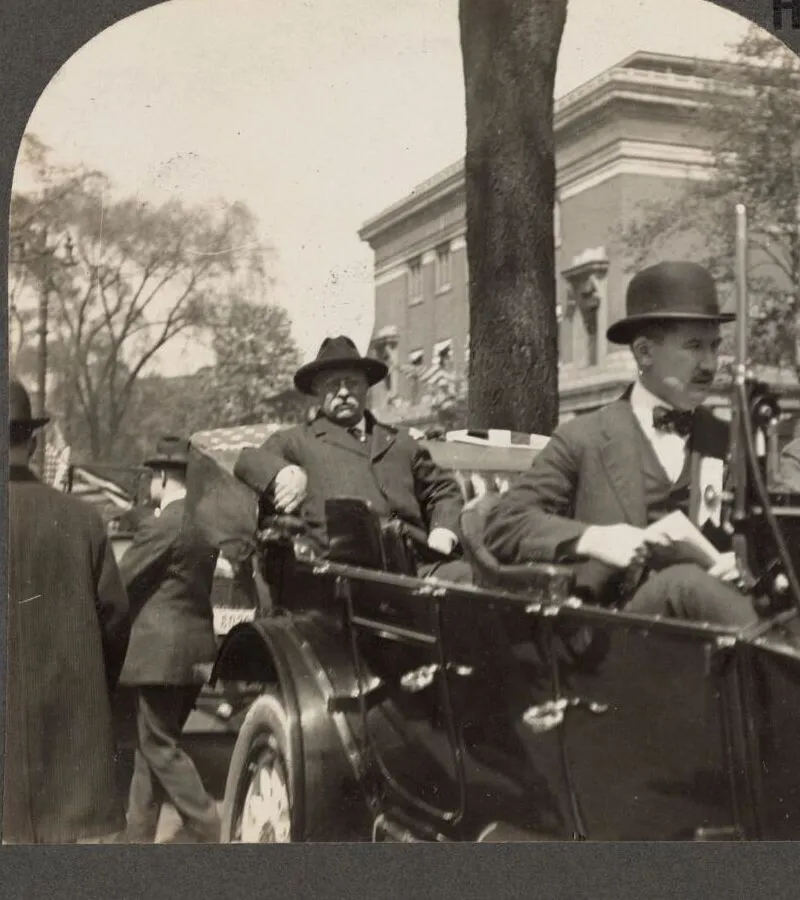
Roosevelt swept the new presidential primaries, but party bosses controlled the Chicago convention and handed the nomination to Taft. Roosevelt's forces walked out. (Library of Congress)
The Primary Campaign and the Contested Convention
Complicating Roosevelt's political position was his own earlier pledge, made in 1904, that he would not seek another term as president. That pledge had been made when Roosevelt was confident Taft would prove a worthy successor. Now, having realized that Taft was unfit to lead the party and the nation, Roosevelt began to hint that circumstances might override that earlier commitment.
By February 1912, Roosevelt had made his decision. He announced his candidacy for the 1912 Republican nomination, declaring that his earlier no-third-term pledge should be understood as applying only to three consecutive terms—he had served only slightly more than two full terms, having assumed the presidency after McKinley's assassination. Roosevelt supporters mobilized rapidly. In the twelve primary elections held that year, Roosevelt won the majority of delegates. He was the clear preference of Republican voters who could participate in primaries.
But the Republican Party machinery was controlled by Taft and the conservative Republican establishment. Many delegates to the national convention were not chosen through primaries but were selected by party leaders in non-primary states. Taft controlled that process. At the Republican National Convention in June 1912 in Chicago, the credentials committee—controlled by Taft supporters—made a series of contested-delegate rulings that favored Taft. Delegates whom Roosevelt's supporters claimed had been improperly chosen were seated; Roosevelt's legitimate delegates were sometimes unseated on technical grounds. Through these procedural manipulations, Taft secured enough delegates to win the nomination.
Roosevelt's supporters were furious. They believed they had been cheated through deliberate procedural manipulation. They believed Roosevelt had earned the nomination through victories in competitive primaries, but that the party machinery had stolen it from him. Roosevelt himself felt the sting of what he perceived as an outright theft. He declared at the convention that he felt "as strong as a bull moose"—a phrase that captured both his continuing physical vigor at age fifty-three and his determination to fight on despite the convention's apparent rejection of him.
The Progressive Party Convention: "We Stand at Armageddon"
In August 1912, Roosevelt's supporters held a Progressive Party convention in Chicago to nominate him for the presidency. The convention was a remarkable gathering—reform-minded Republicans, progressives, social justice advocates, and idealists of various stripes assembled to nominate a candidate they believed embodied their hopes for America's future. Roosevelt’s address to the convention — his “Confession of Faith” — was passionate and declarative. He had already given the movement its battle cry in Chicago on June 17, on the eve of the Republican convention: "We stand at Armageddon, and we battle for the Lord."
The rhetoric was characteristic of Roosevelt—apocalyptic in its framing, moralistic in its language, presenting the political contest as a battle between good and evil, between progress and reaction, between the forces of democracy and the entrenched powers of monopoly and privilege. For Roosevelt's supporters, the phrase captured something essential: this was not merely an ordinary political campaign but a crusade for the soul of the nation, a battle between those who believed in progressive reform and those who clung to the privilege of the status quo.

Roosevelt's followers founded the Progressive Party and nominated him with Hiram Johnson. “We stand at Armageddon,” he thundered, “and we battle for the Lord.” (Library of Congress)

The platform was radical for its day: women's suffrage, an eight-hour workday, social insurance, and direct primaries — reforms that mostly became law over the next thirty years. (Library of Congress)
The Platform: Progressive Reforms Decades Ahead of Their Time
The Progressive Party platform of 1912 embodied the New Nationalism—a comprehensive vision of progressive reform that included women's suffrage, a minimum wage, an eight-hour workday, social insurance (the forerunner of Social Security), workers' compensation, the prohibition of child labor, the direct election of senators, and the initiative, referendum, and recall. These were radical proposals for 1912, far more comprehensive and far-reaching than anything the Democratic or Republican platforms offered.
The platform also championed conservation, the regulation of monopoly, and an expansive vision of federal power to address social and economic injustice. It was, in many respects, the most progressive platform ever offered in an American presidential election up to that point. For young progressives, socialists, and reformers of all varieties, the Progressive Party offered a genuinely progressive alternative to both major parties.
The Three-Way Race: Roosevelt, Taft, and Wilson
The 1912 election became a three-way race without precedent in American history. Woodrow Wilson, the governor of New Jersey, represented the Democratic Party, offering "The New Freedom"—a vision of progressive reform that was more cautious and legalistic than Roosevelt's. William Howard Taft represented the Republican establishment and the defense of his administration's record against Roosevelt's attacks. Theodore Roosevelt represented the Progressive insurgency, offering the most comprehensive progressive vision ever presented in an American presidential campaign.
The campaign became primarily a contest between Roosevelt and Wilson for the progressive vote. Both men claimed to represent progress and reform, but they disagreed fundamentally on the means. Roosevelt believed in a strong federal government actively regulating the economy; Wilson believed in breaking up monopolies and trusting competitive markets. Roosevelt's vision was more expansive; Wilson's was more traditional, rooted in classical liberal economics.
Taft, squeezed between the two progressives, found his traditional Republican business base insufficient. Conservative Republicans felt betrayed by his administration's antitrust activity; progressive Republicans had followed Roosevelt into the Progressive Party. Taft's campaign was damaged, defensive, unable to inspire the enthusiasm necessary to win.
Roosevelt campaigned with characteristic vigor despite being fifty-three years old. He traveled across the country, gave hundreds of speeches, and projected an image of moral clarity and physical vitality that resonated with millions of voters. The assassination attempt on October 14 in Milwaukee—when an assassin's bullet pierced Roosevelt's chest but failed to kill him—actually enhanced his campaign narrative. The image of Roosevelt, bleeding but determined, delivering a ninety-minute speech with a bullet lodged in his chest, symbolized his message: here was a man of extraordinary courage and commitment, a man willing to endure physical pain in service to a cause.
In the November election, the results reflected the three-way division. Woodrow Wilson, winning only 42 percent of the popular vote, nevertheless won a clear electoral college victory because Roosevelt and Taft had split the Republican vote. Roosevelt finished second nationally with 27 percent of the popular vote—the strongest third-party performance in American history. Taft finished third with 23 percent. The Republican Party had fractured, and the consequence was Wilson's election to the presidency.

With the Republican vote split between Roosevelt and Taft, Democrat Woodrow Wilson won easily. Roosevelt still ran second — the best showing ever for a third party. (Library of Congress)

Roosevelt lost, but the Bull Moose crusade pushed progressive ideas into the mainstream and reshaped both parties for a generation. (Theodore Roosevelt Collection, Harvard College Library)
The Meaning of Defeat and the Reshaping of American Politics
Roosevelt's defeat was politically catastrophic. The man who had been president less than four years earlier was now rejected by his own party. His third-party campaign, despite its electoral success compared to other third parties, had failed to win the presidency. The split between Roosevelt and Taft had guaranteed a Democratic victory and returned the White House to the Democratic Party for the first time since 1893.
Yet the 1912 campaign had demonstrated something profound about American politics. More than four million voters cast their ballots for Roosevelt, and the combined Roosevelt and Wilson vote came to nearly seventy percent of the popular total, with another six percent going to Socialist Eugene V. Debs. The American electorate was prepared to embrace progressive reform on a scale that neither major party leadership had anticipated. The contest had been not over whether America should embrace progressivism, but over what form that progressivism should take.
The Legacy of the Bull Moose Campaign
Though Roosevelt lost the 1912 election, the Bull Moose campaign profoundly influenced American politics. Many of the reforms proposed in the Progressive platform were eventually enacted—some under Wilson, some under Franklin Roosevelt, some under later progressive administrations. Women's suffrage, the direct election of senators, workers' compensation, prohibition of child labor—all became law in the years following the 1912 campaign.
The campaign also demonstrated the political viability of comprehensive progressive reform. It showed that millions of Americans were prepared to support a progressive vision that went well beyond traditional Democratic or Republican platforms. The Progressive Party itself would not survive as a major force, but its ideas would profoundly shape American politics for decades to come.
Continue Reading
- The Progressive Party Platform of 1912 — The radical reforms Roosevelt championed as the Bull Moose candidate.
- The New Nationalism — Roosevelt's evolved political philosophy articulated in 1910.
- The Milwaukee Assassination Attempt — The remarkable event that occurred during the 1912 campaign.
- The "Man in the Arena" Speech — Roosevelt's philosophy of courageous action in public life.
- William Howard Taft — Roosevelt's successor and rival in the 1912 election.
- Post-Presidency Timeline — Key events of 1912 and the Bull Moose campaign.
Primary Sources at the TR Center
The Theodore Roosevelt Center's Digital Library contains campaign speeches, photographs, and platform documents from the 1912 Progressive Party campaign.
- Politics and Government — Resources on Roosevelt's Progressive political vision.
- New Nationalism Encyclopedia — Detailed exploration of Roosevelt's political philosophy.
- Life Timeline — Chronology of the 1912 campaign and election.
- Complete Encyclopedia — Comprehensive resources on the Progressive Party and its candidates.
From the Archives
Explore original photographs, documents, and illustrations related to this topic in the Theodore Roosevelt Center Digital Library.
Recommended Reading
- Let the People Rule by Geoffrey Cowan (2016). ISBN: 978-0-393-24984-2
- Four Hats in the Ring by Lewis L. Gould (2008). ISBN: 978-0-7006-1856-9
- Theodore Roosevelt, the Progressive Party, and the Transformation of American Democracy by Sidney M. Milkis (2009). ISBN: 978-0-7006-1667-1
- Colonel Roosevelt by Edmund Morris (2010). ISBN: 978-0-679-60415-0