
"The Man in the Arena": Post-Presidency Context and Global Prominence
From Africa to Europe: The World's Most Celebrated American
When Theodore Roosevelt completed his African safari in early 1910, he did not return immediately to the United States. Instead, he and his son Kermit embarked on a tour of Europe that would confirm what many already suspected: the former president of the United States had become the most famous American alive, a figure of global importance whose influence transcended national borders. Kings and emperors received him. Universities invited him to lecture. The press of Europe followed his every movement with intense interest.
This European tour represented a remarkable triumph for Roosevelt. He had left office in 1909 as a sitting president; he had returned to public prominence in 1910 as a global intellectual figure. The transformation was almost unprecedented in American political history. Usually, former presidents faded from the public consciousness or became elder statesmen issuing occasional pronouncements. Roosevelt had instead become something more: a global political and intellectual force, a man whose thoughts on democracy, civilization, and American power would command attention on the other side of the Atlantic.
The centerpiece of his European tour was a series of academic lectures, most notably his address at the Sorbonne in Paris on April 23, 1910. This speech, titled "Citizenship in a Republic," would become one of the most famous and influential addresses in American political discourse. The Sorbonne, the great university of Paris, provided the perfect setting for Roosevelt to address the nature of democratic citizenship, the requirements of a worthy life, and the dangers of mere criticism unaccompanied by constructive effort.

The Rue de la Paix in Paris, decorated with American flags to welcome Theodore Roosevelt during his celebrated 1910 European tour. (Library of Congress)
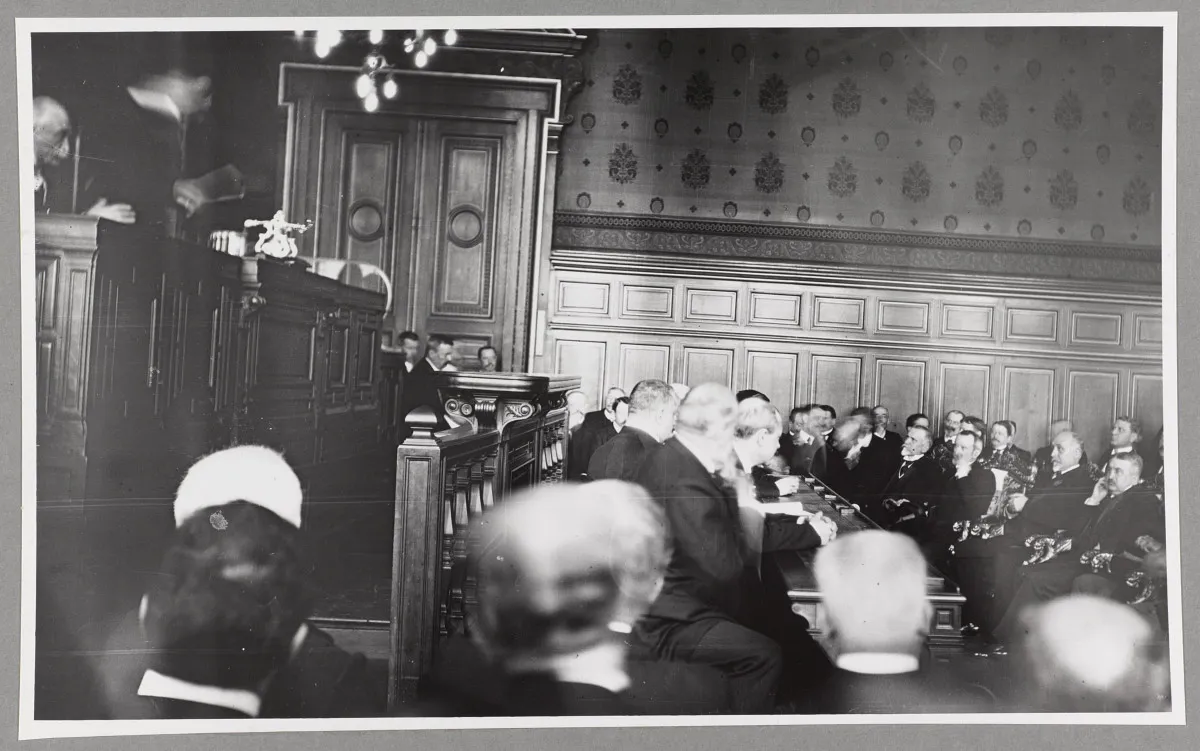
Theodore Roosevelt addresses dignitaries at the Hôtel de Ville in Paris in 1910, the same visit on which he delivered his ‘Citizenship in a Republic’ address at the Sorbonne. (Library of Congress)
The Sorbonne Address: "The Man in the Arena"
Roosevelt's Sorbonne address is remembered principally for one extended passage, the "man in the arena" metaphor. In this passage, Roosevelt contrasted the person who actually enters the arena of public life and accepts the risks of failure and criticism with the person who stands safely on the sidelines, criticizing those who are actually doing the work. The speech captured something essential about Roosevelt's worldview: that action was superior to passivity, that the willingness to risk failure was more admirable than the safety of non-participation.
The full text of the speech is available elsewhere on this site (visit the complete "Man in the Arena" speech page for the text and detailed analysis). Here we focus on the context and significance of the address within Roosevelt's post-presidency trajectory. The speech was not merely a philosophical meditation on the requirements of democratic citizenship; it was a subtle defense of his own presidency and an implicit criticism of those who had attacked his actions without offering better alternatives.
A Former President Becomes an International Statesman
The European tour, and the Sorbonne address in particular, established Roosevelt as more than a former American president. He became an international figure—a man whose thoughts on civilization, on democracy, on the responsibilities of great powers were solicited and valued by European intellectual and political elites. This was a remarkable position for an American. Most American presidents of that era were viewed, in European circles, as representatives of a rising but still somewhat provincial power. Roosevelt, by contrast, was received as an intellectual equal by Europe's great statesmen and intellectuals.
This international prominence would have profound consequences for Roosevelt's political future. When he returned to America in June 1910, he would find himself at a crossroads. Should he remain retired from politics? Should he attempt to influence politics from outside the formal structures of power? Or should he return to active political life? The standing ovation he received in New York suggested that the American public had not forgotten him, that they regarded him as a figure of continuing importance and authority.

A formal portrait of Theodore Roosevelt from around 1910, when the former president was received across Europe as an international statesman. (Library of Congress)

Colonel Roosevelt addresses a large crowd from a bunting-draped platform, a scene repeated across his post-presidential speaking tours. (Library of Congress)
The Political Implications of Global Prominence
Roosevelt's European tour and the international recognition he received had important political implications. President William Howard Taft, who had succeeded Roosevelt in 1909, had proven less dynamic and less aligned with Roosevelt's progressive vision than Roosevelt had hoped. Taft's presidency was marked by a more cautious approach to conservation, to antitrust enforcement, and to executive power generally. Roosevelt's trip abroad, and his emergence as a global figure, kept him in the public consciousness precisely at a moment when his disagreements with Taft were beginning to surface.
When Roosevelt returned to America in June 1910 and delivered speeches outlining his progressive vision—most notably the "New Nationalism" address in Osawatomie, Kansas, in August 1910—he was stepping back into American political life with enhanced credibility. He had spent a year abroad, he had been received as a statesman and philosopher, and now he was returning to offer his vision for America's future. The combination of global prominence and domestic political voice made him a powerful figure.
The Speech's Forgotten Years and Modern Rediscovery
Interestingly, the "man in the arena" passage was not immediately recognized as the enduring classic it would become. The speech received respectful attention in 1910, but it was not immediately hailed as one of the great addresses in American history. For decades, it remained primarily known to scholars and to those interested in Roosevelt's thought. It was quoted occasionally, but it was not the universal reference point it would become in the late twentieth century.
The rediscovery of the passage began in the latter part of the twentieth century. Civil rights activists found in it validation of their willingness to risk themselves for justice. Entrepreneurs and innovators found in it encouragement for their willingness to attempt ambitious projects despite the risk of failure. Scholars of leadership and virtue found in it a philosophical foundation for thinking about the qualities that make people worthy of respect. The passage had been waiting, in some sense, for an era that would fully appreciate its insights about the relationship between risk, failure, and meaningful achievement.
In recent years, the passage has achieved something close to viral status in American culture. It has been quoted in TED talks and corporate training seminars. It has been invoked by everyone from professional athletes to social media activists. Brene Brown, in her work on vulnerability and courage, has made the passage central to her argument that daring greatly—being willing to fail in public pursuit of meaningful goals—is essential to human flourishing. Nelson Mandela handed a copy of the passage to Springbok captain François Pienaar before South Africa’s victorious 1995 Rugby World Cup campaign. It has become a kind of modern scripture, invoked whenever someone wants to explain why attempting something difficult and risky is more valuable than remaining safe on the sidelines.

Theodore Roosevelt at his desk with papers in hand; his Sorbonne speech was largely overlooked for decades before its ‘Man in the Arena’ passage found new life. (Library of Congress)
The Arena and the Man: The Speech's Enduring Relevance
The "man in the arena" passage from the Sorbonne address has become one of the most quoted passages in Roosevelt's speeches. Political leaders, business executives, activists, artists, and athletes of all kinds have invoked it to justify their participation in public life, their willingness to take risks and accept criticism in pursuit of important goals. The speech has transcended its original context and become something approaching a secular scripture for those who believe that participation in public affairs, or in any meaningful endeavor, is a duty and a privilege.
For Roosevelt himself, the speech represented a culmination of his post-presidency thinking. He had spent a year hunting in Africa, testing himself against nature and against danger, reaffirming his belief in the strenuous life. He had spent months in Europe, observing European politics and expressing his views on American civilization and American democracy. The European tour had confirmed his international prominence and his conviction that he had something important to say about democracy and citizenship. Now, returning to America, he was ready to re-enter the political arena, to accept the criticism and the risk that such re-entry would entail, and to offer his vision for America's future. The "man in the arena" passage was his way of explaining why, despite knowing the cost, he would step back into the public sphere.
Continue Reading
- The African Safari (1909–1910) — The hunting expedition that preceded his European tour.
- The New Nationalism — His political philosophy articulated upon returning to America.
- The Bull Moose Campaign of 1912 — His return to electoral politics after the Sorbonne address.
- Roosevelt's Presidency — His earlier activism and vision as sitting president.
- The River of Doubt Expedition — Another expedition reflecting his philosophy of action.
- Post-Presidency Timeline — Key events from 1909 through 1919.
Primary Sources at the TR Center
The Theodore Roosevelt Center's Digital Library contains the complete text of the Sorbonne address and records of Roosevelt's European tour.
- Citizenship in a Republic — Full text and analysis of the "Man in the Arena" speech.
- The New Nationalism — Roosevelt's foundational progressive political philosophy.
- Life Timeline — Chronology of his European tour and return to America in 1910.
- Kermit Roosevelt — Information on his son and companion during African and European travels.
From the Archives
Explore original photographs, documents, and illustrations related to this topic in the Theodore Roosevelt Center Digital Library.
Recommended Reading
- Colonel Roosevelt by Edmund Morris (2010). ISBN: 978-0-679-60415-0
- The Bully Pulpit: Theodore Roosevelt and the Golden Age of Journalism by Doris Kearns Goodwin (2013). ISBN: 978-1-4165-4786-0
- Theodore Roosevelt: A Life by Nathan Miller (1992). ISBN: 978-0-307-42968-1