
The Man in the Arena: Citizenship in a Republic
The Journey to the Sorbonne: A Former President Among Intellectuals
On April 23, 1910, when he rose to speak at the Sorbonne, Theodore Roosevelt was fifty-one years old and at the height of his influence, yet curiously unmoored. He had voluntarily stepped down from the presidency at the end of his second term in 1909, pledging that he would not run again. The African safari had been his escape, a chance to hunt, to study natural history, and to disappear from American politics long enough for President William Howard Taft to chart his own course. But Roosevelt could never stay away from the arena for long. His European tour that spring—which included stops in Egypt, the Sudan, and Italy—was a triumphal procession. Kings and presidents received him. Scientists sought his company. Everywhere he went, crowds assembled to catch a glimpse of the tireless American who had become a living symbol of vigor, reform, and the strenuous life.
The invitation to lecture at the Sorbonne was a signal honor. The University of Paris, founded in the twelfth century, stood at the apex of European intellectual culture. To be invited to address its faculty and students was to be granted a platform of extraordinary prestige. Roosevelt accepted with enthusiasm. He would speak not on hunting or adventure, but on something that had occupied his mind throughout his presidency: the nature of citizenship in a democratic republic. The lecture hall filled to capacity with professors, students, diplomats, and the cream of Parisian intellectual society—a room full of the very people whom Roosevelt felt most compelled to challenge.

The Rue de la Paix in Paris, decorated with American flags to welcome Theodore Roosevelt during his 1910 European tour, which brought him to the Sorbonne. (Library of Congress)
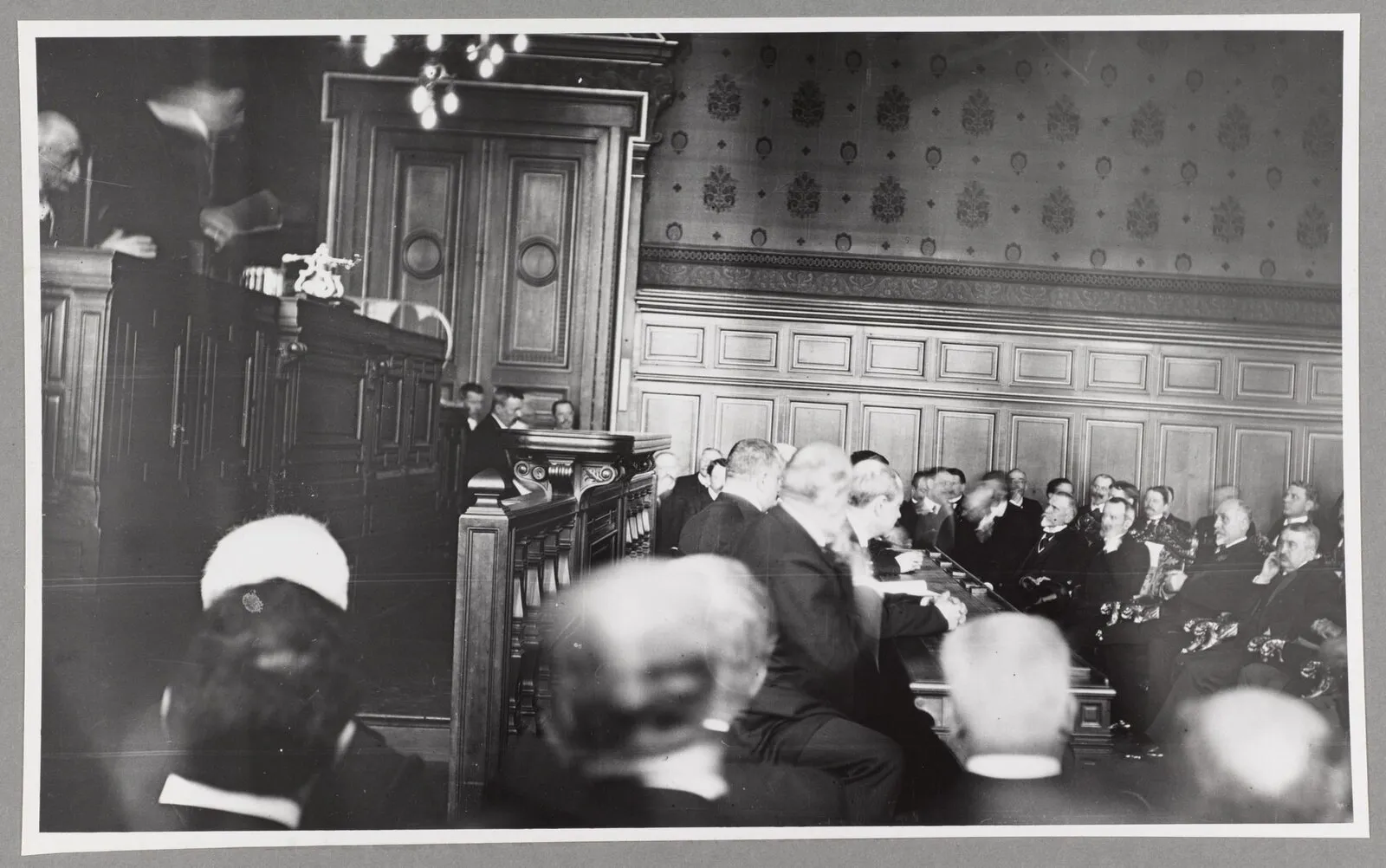
Theodore Roosevelt addresses a distinguished audience in the ornate hall of the Hotel de Ville in Paris during his 1910 visit, days before his Sorbonne address. (Library of Congress)
The Setting and Audience: An Auditorium of Influence
The Sorbonne's amphitheater was a space designed for grandeur. High ceilings, formal rows of seats, the architectural weight of centuries of learning pressing down from the walls—it was an intimidating venue, yet Roosevelt was never intimidated by an audience. He had spent his career speaking to crowds, and he understood that the most important speeches were often those delivered in intimate conversation with power. The audience that evening represented the intellectual and political leadership of France, many of them skeptical of this American who spoke with such apparent moral certainty. Roosevelt's reputation preceded him: he was seen as a reformer, an imperialist, a man unafraid of controversy. The lecture would prove that all these characterizations contained some truth.
The Passage That Would Endure: The Man in the Arena
The text of Roosevelt's lecture, titled "Citizenship in a Republic," ranged across history, politics, and philosophy. But one passage—delivered in the middle of his remarks—would eventually overshadow everything else he said that night. In it, Roosevelt articulated a vision of moral courage and civic engagement that spoke to something deeper than politics. It is the passage that would be quoted by Nelson Mandela in his prison cell, invoked by Brene Brown in her research on vulnerability, and recited by Americans across the political spectrum when they wanted to justify the importance of trying, despite the risk of failure. Here is what he said:
It is not the critic who counts; not the man who points out how the strong man stumbles, or where the doer of deeds could have done them better. The credit belongs to the man who is actually in the arena, whose face is marred by dust and sweat and blood; who strives valiantly; who errs, who comes short again and again, because there is no effort without error and shortcoming; but who does actually strive to do the deeds; who knows great enthusiasms, the great devotions; who spends himself in a worthy cause; who at the best knows in the end the triumph of high achievement, and who at the worst, if he fails, at least fails while daring greatly, so that his place shall never be with those cold and timid souls who neither know victory nor defeat.
— "Citizenship in a Republic," the Sorbonne, Paris, April 23, 1910
These words, delivered with Roosevelt's characteristic force and conviction, struck at something that had shaped his entire political philosophy. He had watched from the gallery as Congress debated. He had read the criticisms of those who picked apart his policies without having the courage to implement policies of their own. He had seen brilliant men paralyzed by fear of failure, cautious men who preferred safety to significance. The Man in the Arena passage was Roosevelt's answer to all of them: significance requires risk. Meaning requires the willingness to fail publicly, messily, and without guarantee of success.
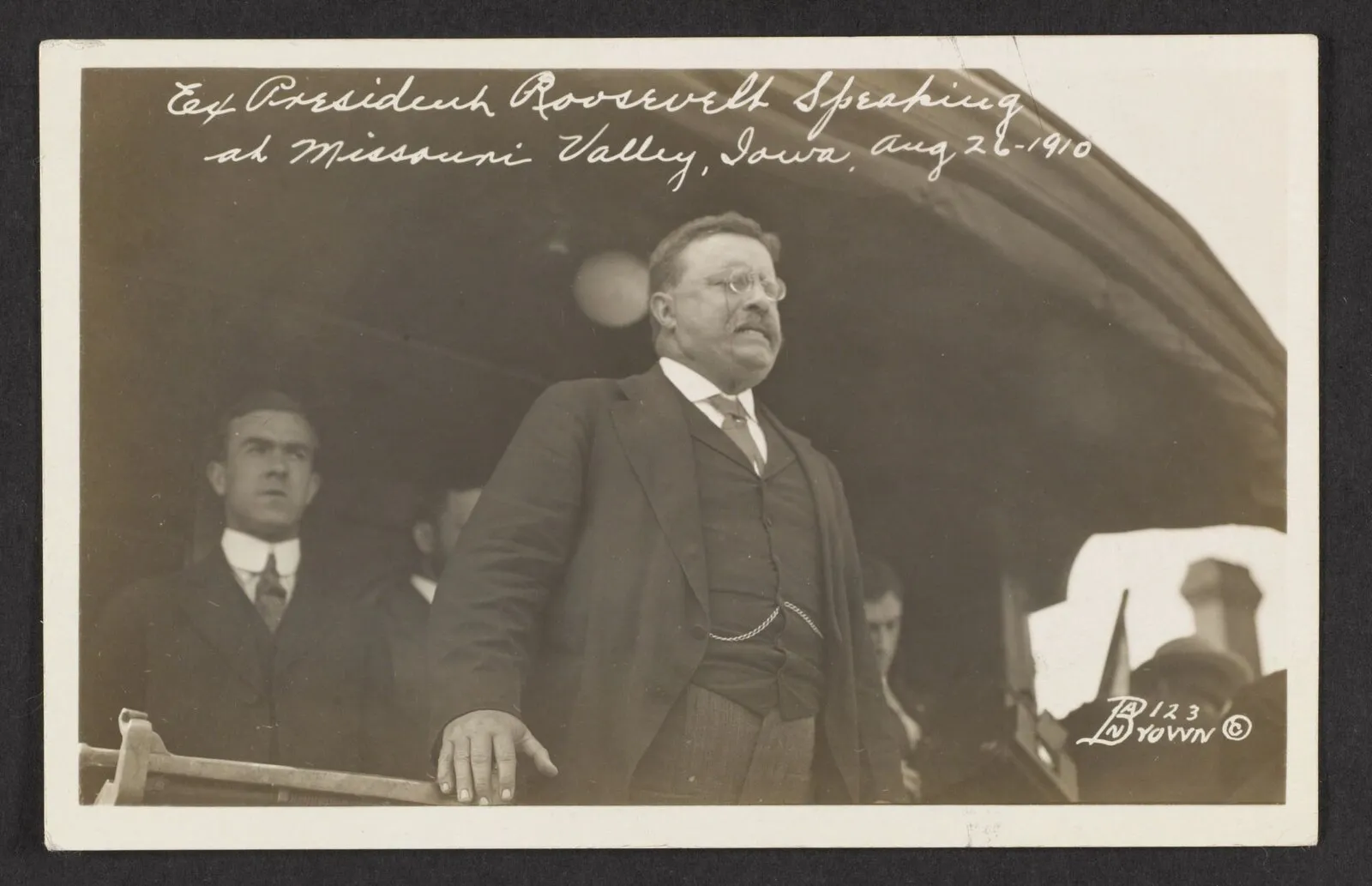
Former President Roosevelt speaks from a platform at Missouri Valley, Iowa, in August 1910 - the same year he delivered the 'Man in the Arena' passage in Paris. (Library of Congress)

An enormous crowd fills a New York City street to welcome Theodore Roosevelt home in June 1910 - the engaged citizenry his Sorbonne speech championed. (Theodore Roosevelt Collection, Harvard College Library)
Beyond the Famous Passage: The Broader Vision of Citizenship
Though the Man in the Arena passage is the part of the Sorbonne lecture that endures, Roosevelt had much more to say that night about the nature of citizenship. He spoke of the obligations of citizens in a free society—the duty to participate, to inform oneself, to vote wisely, and to contribute to the common good. He warned against the dangers of cynicism and detachment, arguing that these were forms of moral cowardice. He celebrated the pioneers, the reformers, the men and women who had built America not through criticism but through action, often in the face of opposition and ridicule.
The lecture was essentially a call to civic courage. Roosevelt believed that democracy could only survive if citizens were willing to engage actively in self-government. Voting alone was not enough. Paying taxes was not enough. Citizens had to be willing to serve, to risk their reputations, to be willing to fail for something they believed in. This was the deeper meaning of the Man in the Arena passage. It was not a celebration of individualism or recklessness. Rather, it was an argument that the health of the republic depended on citizens who were willing to step out of the safety of private life and into the arena of public service, fully aware of the costs.
Why the Passage Endures: From Mandela to Modern Times
The century that has passed since Roosevelt stood in that Paris lecture hall has only amplified the relevance of his words. The passage has been invoked in contexts Roosevelt could never have imagined. Brene Brown, the researcher and author who studies vulnerability and courage, has written extensively about the Man in the Arena passage and what it means to engage in work that requires us to risk failure and criticism. She has noted that the passage resonates with people in any field—business, art, science, athletics—where real achievement requires real risk.
Nelson Mandela quoted the passage while imprisoned on Robben Island, finding in Roosevelt's words a confirmation of his own belief that the pursuit of justice, even when the outcome was uncertain, was more worthy than the safety of withdrawal. Civil rights leaders have found in it validation of their commitment to nonviolent resistance, which required them to risk violence without retaliating. Entrepreneurs have cited it when launching ventures that might fail. Artists have invoked it when putting vulnerable work into the world. Athletes have drawn strength from it before competitions they might lose. The passage has become a secular scripture, a statement of what it means to live courageously in any context.
This universality speaks to the power of Roosevelt's insight. He understood that the fundamental human challenge is not intellectual—most people know what the right thing to do is. The challenge is moral: it is the willingness to do it despite the cost. The Man in the Arena passage is Roosevelt's way of saying that the cost is worth it. That to have tried and failed is immeasurably better than never to have tried at all. That the only real failure is to remain forever in the stands, criticizing those foolish enough to risk themselves in the arena.

A dignified portrait of Theodore Roosevelt from around 1910; his 'Man in the Arena' passage would be quoted for generations, from Nelson Mandela to today. (Library of Congress)

Theodore Roosevelt, in an open carriage, receives flowers from well-wishers on returning to New York in 1910 - a picture of the active citizenship he preached. (Theodore Roosevelt Collection, Harvard College Library)
The Speech and Civic Engagement: Roosevelt's Core Message
The Theodore Roosevelt Presidential Library exists to champion civic engagement. We believe that a healthy democracy requires citizens who are willing to be in the arena—to vote, to advocate, to serve, to take positions on difficult questions, and to accept the consequences of those positions. Roosevelt's Sorbonne lecture, and especially the Man in the Arena passage, articulates this vision with unmatched clarity. Roosevelt believed that the measure of a person's life was not what they avoided or what they were safe from, but what they attempted and what they contributed.
When we invite you to engage with the library, when we encourage you to participate in civic life, when we ask you to consider your obligations as a citizen in a democracy, we are echoing Roosevelt's call from that Paris amphitheater more than a century ago. We are saying that your life matters more fully, more richly, more meaningfully when you are willing to risk yourself for something you believe in. That is the Roosevelt way. That is the challenge of the arena.
Reading the Complete Speech
We encourage you to read Roosevelt's entire lecture. The Man in the Arena passage is powerful precisely because it emerges from a larger argument about citizenship, democracy, and the obligations we bear toward one another. Understanding the context of the passage—Roosevelt's larger vision of what it means to be a good citizen—deepens its resonance.
You can access the complete text of "Citizenship in a Republic" through the Theodore Roosevelt Center at Dickinson State University, which maintains the most comprehensive archive of Roosevelt's speeches, writings, and correspondence. The Center's scholars have also provided extensive commentary on this speech and others, offering insight into Roosevelt's thinking and the historical context in which these words were delivered.
Continue Reading
- All Major Speeches — More on TR
- Quotes on Citizenship — More on TR
Primary Sources at the TR Center
Explore original documents and resources related to this topic in the Theodore Roosevelt Center Digital Library.
- TR Center Digital Library — Primary source collection
From the Archives
Explore original photographs, documents, and illustrations related to this topic in the Theodore Roosevelt Center Digital Library.
Recommended Reading
- Colonel Roosevelt by Edmund Morris (2010). ISBN: 978-0-679-60415-0
- Theodore Roosevelt: A Strenuous Life by Kathleen Dalton (2007). ISBN: 978-0-307-42968-1
- The Man in the Arena by Theodore Roosevelt (2016). ISBN: 978-0-7653-0671-5