
Theodore Roosevelt on Citizenship
The Strenuous Doctrine of Citizenship
From the greatest to the smallest, happiness and usefulness are largely found, and the joy of life is won in its deepest and truest sense, only by those who have not shirked life’s burden.
— “The Key to Success in Life,” 1916 · Theodore Roosevelt Center
Roosevelt rejected the notion that citizenship was comfortable or easy. The joy of life, as he saw it, belonged to those who carried their share of its burdens rather than shirking them.
The welfare of a state depends upon the character of its citizenship.
— Remarks at Minneapolis, Minnesota, April 4, 1903 · Theodore Roosevelt Center
Speaking from a hotel balcony in Minneapolis, Roosevelt reduced his civic creed to a single sentence: the republic rises or falls on the character of its ordinary citizens.
President Theodore Roosevelt speaks with characteristic vigor to a crowd of citizens who traveled to hear him. (Library of Congress)

President Roosevelt addresses an immense crowd from a bunting-draped platform, meeting the public in the arena of civic life. (Library of Congress)
On Civic Duty and the Arena
It is not the critic who counts; not the man who points out how the strong man stumbles, or where the doer of deeds could have done them better. The credit belongs to the man who is actually in the arena, whose face is marred by dust and sweat and blood; who strives valiantly; who errs, who comes short again and again, because there is no effort without error and shortcoming; but who does actually strive to do the deeds; who knows great enthusiasms, the great devotions; who spends himself in a worthy cause; who at the best knows in the end the triumph of high achievement, and who at the worst, if he fails, at least fails while daring greatly, so that his place shall never be with those cold and timid souls who neither know victory nor defeat.
— “Citizenship in a Republic,” speech at the Sorbonne, Paris, April 23, 1910
This passage, from Roosevelt’s 1910 “Citizenship in a Republic” speech at the Sorbonne, stands as perhaps his most powerful statement on the duty of citizenship. The citizen in the arena—the one who votes, who serves, who speaks, who acts—deserves respect. The critic on the sidelines, comfortable and safe but useless, deserves contempt.
We live in a rough world and good work in it can be done only by those who are not afraid to do their part in the dust and smoke of the arena.
— Address at the Exposition Building, Milwaukee, Wisconsin, April 3, 1903 · Theodore Roosevelt Center
Citizenship demands participation. The work of self-government belongs to those willing to step into the dust and smoke, not to those who watch from a safe distance.
On Voting and Democratic Participation
In our government we cannot permanently succeed unless the people really do rule. We have tried the other experiment. The present system means the rule of the powers of political and industrial privilege, and for that we propose to substitute the right of the people to rule themselves and their duty to rule so as to bring nearer the day when every man and every woman within the boundaries of this great land of ours shall have fair play, equal rights, shall receive and shall give justice, social and industrial, justice for every man, for every woman within our borders.
— Speech at St. Louis, Missouri, March 28, 1912
Roosevelt insisted that democratic citizenship required active participation in governance—the people’s right to rule themselves, and their duty to use that power to secure fair play and equal rights.
All young men should take an active part in our political life and should do their full duty as citizens in the exercise of their rights of self-government; they should rank action far above criticism and should understand that he is deserving who actually does things and not he who confines himself to talking about how they ought to be done; they should have a high ideal and strive to realize it; they should show the virtues of uprightness and tolerance and gentleness but they should also show the sterner virtues of courage, resolution and hardihood and the desire to fight unceasingly against the existence of wrong.
— Letter to Floyd Bartholomew, May 18, 1904 · Theodore Roosevelt Center
Writing to a young correspondent, Roosevelt set out what participation demanded: action ranked far above criticism, high ideals joined to the sterner virtues of courage, resolution, and hardihood.

Theodore Roosevelt takes his case directly to the people, speaking from a train rear platform at Durant, Indian Territory. (Theodore Roosevelt Collection, Harvard College Library)

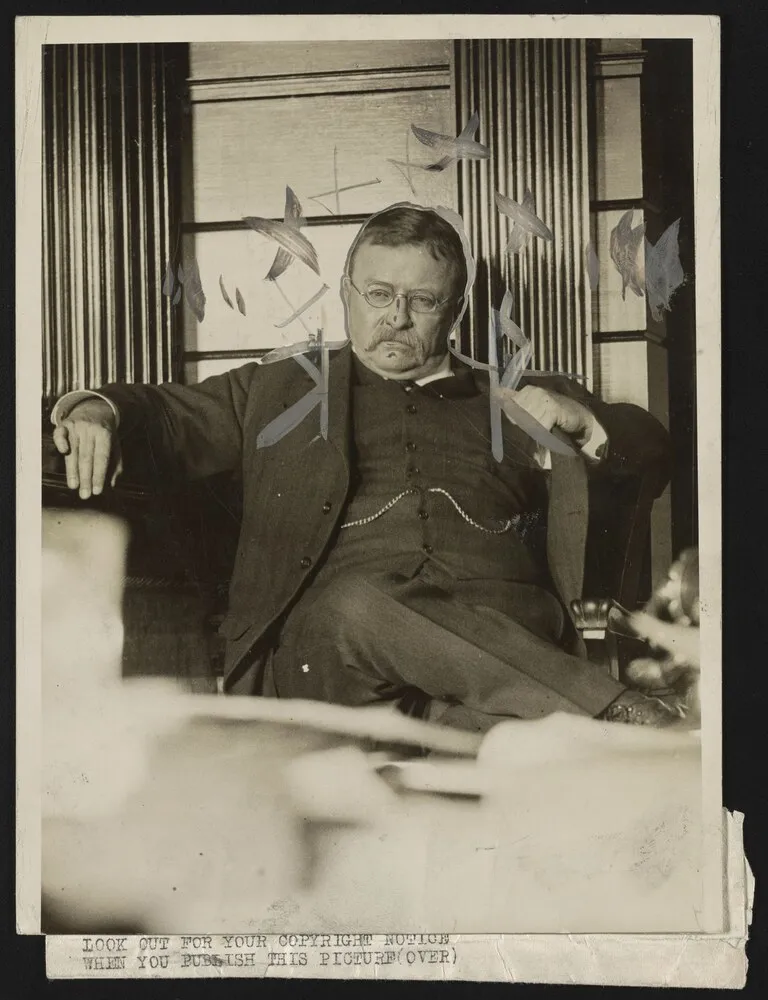
A dignified studio portrait of Theodore Roosevelt, 1902, an image of the character citizenship demands. (Library of Congress)
On the Moral Foundation of Citizenship
It is sometimes very attractive and very pleasant to make any kind of promise without thinking whether or not you can fulfill it; but in the after event it is always unpleasant when the time for fulfilling comes; in the long run the most disagreeable truth is a safer companion than the most pleasant falsehood.
— Address at Columbia Gardens, Butte, Montana, May 27, 1903 · Theodore Roosevelt Center
Citizenship required moral grounding. For Roosevelt, the disagreeable truth always outranked the pleasant falsehood—in public life as in private life.
Honesty is not only the best, it is the only policy that can win anything anywhere that is lasting and beneficial.
— Letter to Mrs. Nicholson, July 18, 1916 · Theodore Roosevelt Center
Roosevelt saw honesty as both moral imperative and practical necessity. A republic cannot function when its citizens are liars.
On Active Citizenship and Justice
Just as in battle it is the man behind the gun who counts most, so in civil life it is the average citizen back of the law who counts most.
— Address at Newcastle, Wyoming, April 25, 1903 · Theodore Roosevelt Center
Citizenship was not hierarchical. The health of the republic depended on the ordinary person—the average citizen standing back of the law—being treated fairly and keeping faith with it in return.
The man who really counts in the world is the doer, not the mere critic—the man who actually does the work, even if roughly and imperfectly, not the man who only talks or writes about how it ought to be done.
— New York, Historic Towns series, 1891
This became Roosevelt’s constant refrain, two decades before the Sorbonne speech made it famous: doing is what matters. The citizen who votes for reform, who serves in local government, who takes a stand on principle—that citizen deserves honor. The person who merely complains deserves nothing.
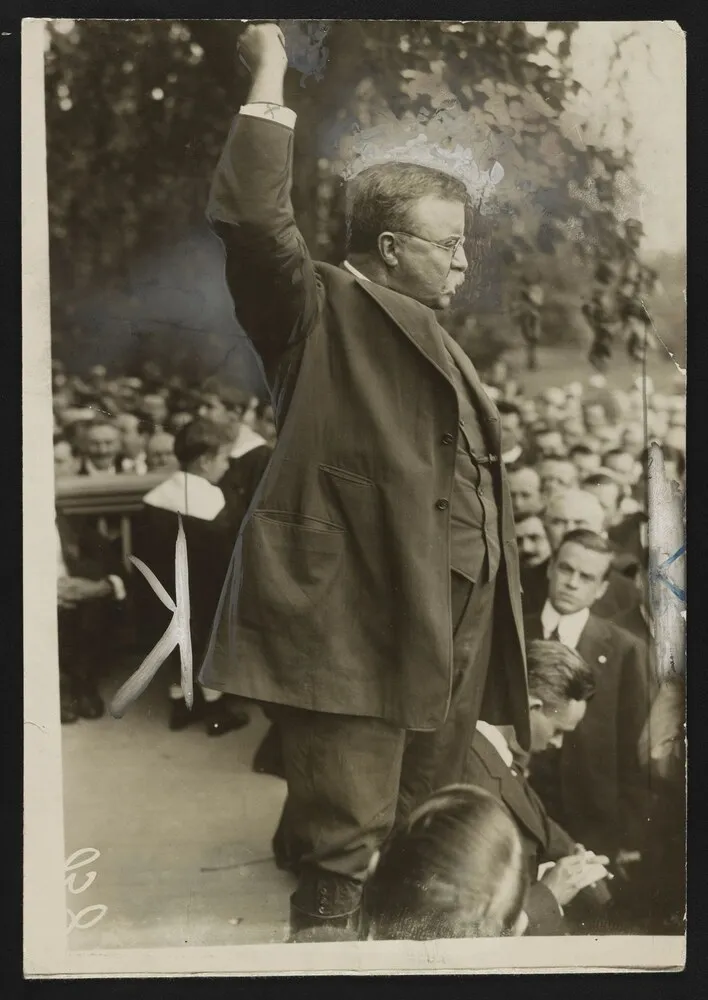
Theodore Roosevelt gestures emphatically while testifying at the Barnes-Roosevelt libel trial, standing up for principle in a court of law. (Library of Congress)

Theodore Roosevelt at his desk with papers in hand, attending to the daily obligations of public office. (Library of Congress)
On Rights and Obligations
In a democracy it is essential that each man should think of his rights but it is even more essential that he thinks of his duties.
— Speech at Boston, Massachusetts, May 2, 1918 · Theodore Roosevelt Center
Roosevelt understood that citizenship was reciprocal. Citizens had rights, but also obligations. A strong nation required both protections for ordinary people and a willingness by those people to contribute. This balance—between individual rights and community responsibilities—ran through all of his politics.
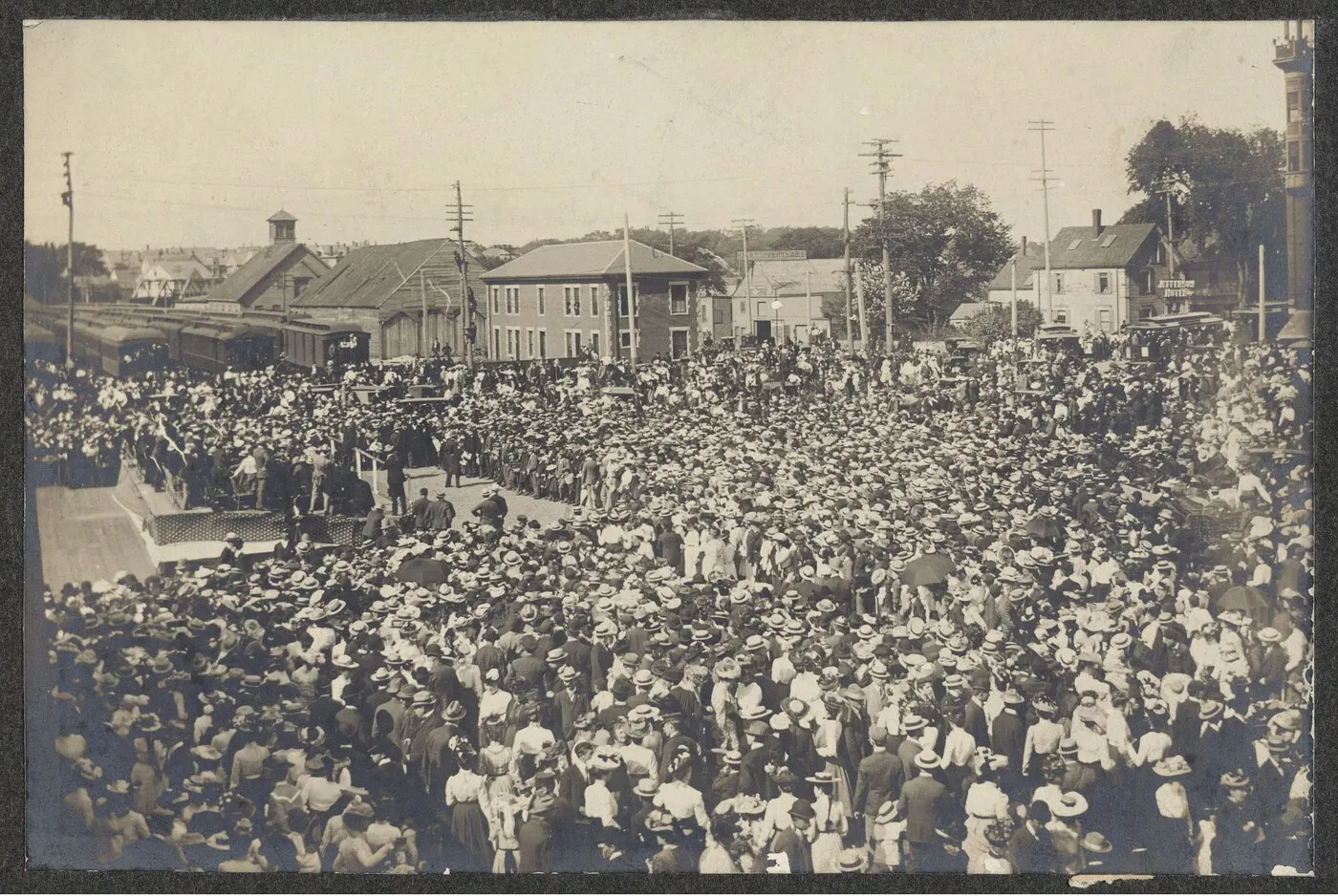
A vast crowd of ordinary citizens fills Railroad Square in Portland, Maine, to hear President Roosevelt speak, 1902. (Theodore Roosevelt Collection, Harvard College Library)

Theodore Roosevelt stands bareheaded with his hat over his heart during a ceremony at Denver, an image of principle and reverence. (Library of Congress)
On Resisting Corruption and Standing for Principle
…and there will be some fool who will say: “Well, yes, may be he is a little crooked; but he is ‘dreadful smart.'” That kind of praise speaks ill for the man praised and ill for the man who praises him. We cannot afford, as citizens of this republic, to tolerate the successful scoundrel any more than the unsuccessful scoundrel. Other nations with other forms of government may be able to get along after a fashion without the average citizen being straight and decent. We cannot.
— Address at Boise, Idaho, May 28, 1903 · Theodore Roosevelt Center
Roosevelt demanded civic courage from citizens. A republic that tolerates the successful scoundrel because he is clever, he warned, corrupts itself—wrongdoing survives on the willingness of ordinary citizens to excuse it.
On Service Beyond Oneself
…patriotism means service to the nation; and only those who render such service are fit to enjoy the privilege of citizenship.
— Speech at Lincoln, Nebraska, June 14, 1917 · Theodore Roosevelt Center
Roosevelt saw citizenship as a form of service. You were a citizen not merely to enjoy rights, but to contribute to something larger than yourself. This philosophy informed his major initiatives: conservation was service to future generations, trust-busting was service to ordinary workers, preparedness was service to the nation itself.

Colonel Theodore Roosevelt in his Rough Rider uniform, a full-length portrait embodying service to the nation beyond oneself. (Library of Congress)
On the Educated Citizen’s Special Obligations
Each one of us then who has an education, school or college, has obtained something from the community at large for which he or she has not paid, and no self-respecting man or woman is content to rest permanently under such an obligation. Where the state has bestowed education the man who accepts it must be content to accept it merely as a charity unless he returns it to the state in full, in the shape of good citizenship.
— Address at the University of California, Berkeley, May 14, 1903 · Theodore Roosevelt Center
Roosevelt believed that education was not a personal possession to be used for individual advantage. Whoever received schooling had been given something by the community that could be repaid only one way: in the shape of good citizenship.
Learn More: Read Roosevelt's full 1910 "Citizenship in a Republic" speech at the Theodore Roosevelt Center. It remains one of the most powerful statements on American citizenship ever delivered.
Continue Reading
- Leadership — More on TR
- Conservation — More on TR
From the Archives
Explore original photographs, documents, and illustrations related to this topic in the Theodore Roosevelt Center Digital Library.
Recommended Reading
- American Ideals, and Other Essays by Theodore Roosevelt (1897)
- The Wisdom of Theodore Roosevelt by Donald J. Davidson (2010)
- Theodore Roosevelt: A Strenuous Life by Kathleen Dalton (2007). ISBN: 978-0-307-42968-1