
Theodore Roosevelt on Leadership
On Decisiveness and Action
it seems to me that it is of enormously greater consequence to get men who have shown the power of command, the power of handling themselves and others in actual work, than it is to have good scholars. I know that, if I were to raise a brigade I should care very little indeed for the capacity of men as shown by any scholastic examination, while their proved ability in the field, or any place where they have commanded men, would weigh with me far more than anything else.
— Letter to Elihu Root, November 15, 1901 · Theodore Roosevelt Center
Roosevelt understood that effective leaders pick proven doers. When choosing men, he valued demonstrated ability in command over paper credentials—and once he had chosen talented people, from his cabinet members to his field officers, he trusted them to execute.
Do what you can, with what you’ve got, where you are.
— Quoted by Roosevelt in An Autobiography, 1913, where he credits it to Squire Bill Widener
Roosevelt did use this famous maxim—but not as his own. In his Autobiography he calls it “a bit of homely philosophy, quoted by Squire Bill Widener, of Widener’s Valley, Virginia, which sums up one’s duty in life.” It captures his approach all the same: leaders work with available resources and circumstances, not ideal conditions.
Unless the man is master of his soul all other kinds of mastery amount to little.
— “Discipline,” January 1917 · Theodore Roosevelt Center
Roosevelt insisted that leaders must first master themselves—their impulses, their fears, their ambitions—before they could lead others. Self-discipline preceded executive authority.

Roosevelt at his desk reviewing papers, the decision-maker at work. (Library of Congress)
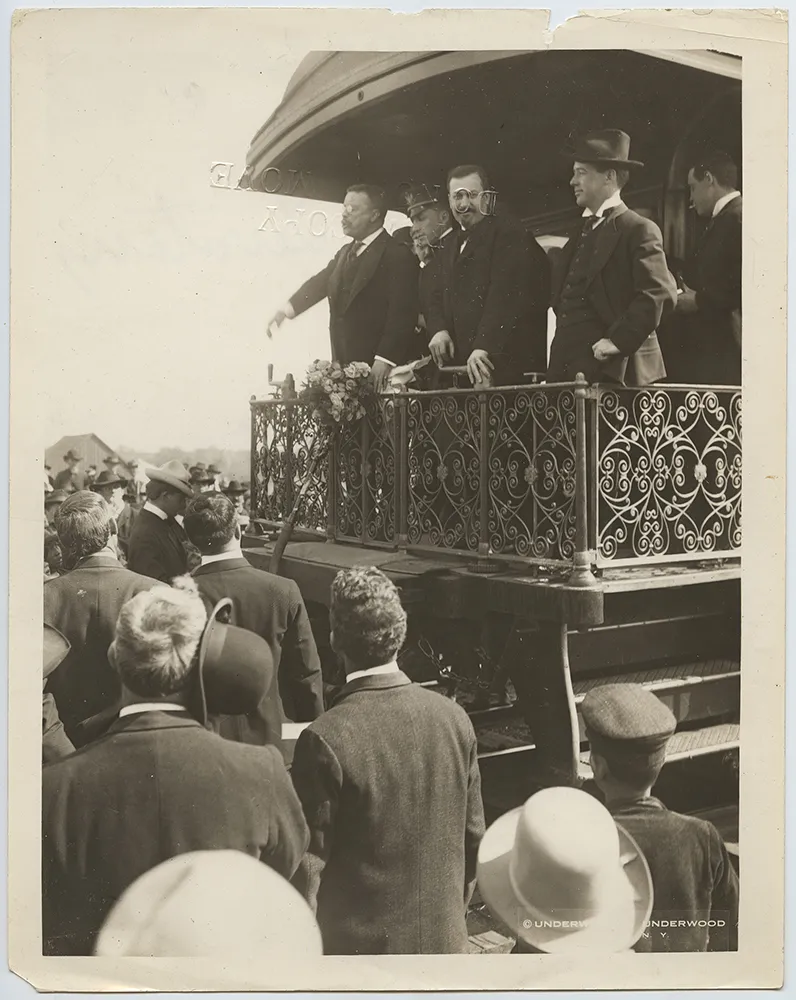
Roosevelt carries his message to the people from the platform of a railroad observation car. (Wikimedia Commons)
On Responsibility and Action
It is not the critic who counts; not the man who points out how the strong man stumbles, or where the doer of deeds could have done them better. The credit belongs to the man who is actually in the arena, whose face is marred by dust and sweat and blood; who strives valiantly; who errs, who comes short again and again, because there is no effort without error and shortcoming; but who does actually strive to do the deeds; who knows great enthusiasms, the great devotions; who spends himself in a worthy cause; who at the best knows in the end the triumph of high achievement, and who at the worst, if he fails, at least fails while daring greatly, so that his place shall never be with those cold and timid souls who neither know victory nor defeat.
— “Citizenship in a Republic,” speech at the Sorbonne, Paris, April 23, 1910
This passage, from a 1910 speech at the Sorbonne, encapsulates Roosevelt’s entire philosophy of leadership. The person in the arena—struggling, risking, sometimes falling—deserves respect more than the critic on the sidelines. Leaders must be willing to fail publicly for meaningful causes.
the people who wish to work for decent politics must work practically, and yet must not swerve from their devotion to a high ideal. They must actually do things, and not merely confine themselves to criticising (sic) those that do them.
— “True Americanism,” 1894 · Theodore Roosevelt Center
Roosevelt had no patience for passive complaint. Leaders observe problems and fix them. They do not merely point out what is broken; they work to repair it.
On Continuous Improvement
Be practical as well as generous in your ideals. Keep your eyes on the stars but remember to keep your feet on the ground.
— Address at Groton School, May 24, 1904 · Theodore Roosevelt Center
A practical visionary, Roosevelt encouraged leaders to hold high ideals while maintaining pragmatic grip on reality. Leaders must inspire and direct; they must also see clearly what is actually possible.
It is hard to fail, but it is worse never to have tried to succeed. In this life we get nothing save by effort.
— “The Strenuous Life,” 1899
He repeated this theme throughout his career: the attempt matters more than the outcome. A failed effort made in good faith was worth infinitely more than cautious, comfortable inaction.

A lifelong reader, Roosevelt studies papers at his desk. (Library of Congress)

Roosevelt makes his case with characteristic conviction from the speaker’s platform. (Library of Congress)
On Leading with Conviction
A man’s usefulness depends upon his living up to his ideals in so far as he can. Now, I have consistently preached what our opponents are pleased to call “jingo doctrines” for a good many years. One of the commonest taunts directed at men like myself is that we are armchair and parlor jingoes who wish to see others do what we only advocate doing. I care very little for such a taunt, except as it affects my usefulness, but I cannot afford to disregard the fact that my power for good, whatever it may be, would be gone if I didn’t try to live up to the doctrines I have tried to preach. Moreover, it seems to me that it would be a good deal more important from the standpoint of the nation as a whole that men like myself should go to war than that we should stay comfortably in offices at home and let others carry on the war that we have urged.
— Letter to William Sturgis Bigelow, March 29, 1898
Roosevelt’s conviction was absolute—and he paid for it in person. He wrote these words while preparing to leave his post as Assistant Secretary of the Navy to volunteer for combat in Cuba, refusing to ask other men to fight a war he had urged from behind a desk.
A man is worthless unless he has in him a lofty devotion to an ideal, and he is worthless also unless he strives to realize this ideal by practical methods.
— The Outlook, July 28, 1900
No tricks. No artifice. Genuine leadership, for Roosevelt, required genuine devotion to an ideal—joined to the practical, unglamorous work of realizing it.
On Institutional Leadership
A nation’s greatness lies in its possibility of achievement in the present, and nothing helps it more than the consciousness of achievement in the past.
— American Ideals, 1897
A leader must think beyond immediate pressures and current conditions. Roosevelt drew on the nation’s past achievements as the foundation for present action, and his programs for conservation and naval power were framed as obligations reaching decades into the future—even when the current moment demanded he handle immediate crises.

A dignified presidential portrait of Theodore Roosevelt. (Library of Congress)

Roosevelt addresses an audience from the platform, the executive answerable to the public he serves. (Library of Congress)
On Executive Power and Its Limits
My view was that every executive officer, and above all every executive officer in high position, was a steward of the people bound actively and affirmatively to do all he could for the people, and not to content himself with the negative merit of keeping his talents undamaged in a napkin.
— An Autobiography, 1913
Roosevelt was a vigorous executive—one who believed in the power of the presidency to act decisively for the people. But he was equally clear that this stewardship was bounded: executive power, as he put it in the same chapter, was limited only by specific restrictions and prohibitions appearing in the Constitution or imposed by Congress under its constitutional powers.
I did not usurp power, but I did greatly broaden the use of executive power. In other words, I acted for the public welfare, I acted for the common well-being of all our people, whenever and in whatever manner was necessary, unless prevented by direct constitutional or legislative prohibition.
— An Autobiography, 1913
Roosevelt expanded the presidency more than any of his predecessors, but always, he argued, in service of clear national purposes and grounded in the Constitution itself. He did not act in secret or in defiance of law; he acted openly, boldly, and accepted the judgment of the people and Congress on whether his actions were justified.
On the Courage to Make Difficult Choices
“On the one hand I wish by my action to avoid stirring up any bitterness; on the other hand, I must not act in a cowardly manner and make the apostles of lawlessness and of brutal disregard of the rights of the black man feel encouraged in their indignity. As always in life, I have to face conditions, not as I would like to have them, but as they actually are, and every course I take is beset with difficulties.”
— Letter to John Byrne, September 14, 1904 · Theodore Roosevelt Center
Leadership meant accepting the weight of decisions with no comfortable option. Roosevelt wrote these words about the Indianola affair, in which he refused to accept the forced resignation of Minnie Cox, Mississippi’s first Black postmistress, after a white mob drove her from town—an unpopular stand he took because his conscience demanded it.
I enjoy being President, and I like to do the work and have my hand on the lever. But it is very worrying and puzzling, and I have to make up my mind to accept every kind of attack and misrepresentation.
— Letter to Kermit Roosevelt, October 2, 1903 · Theodore Roosevelt Center
Roosevelt accepted criticism as part of the job. The leader who avoided all attack was a leader who avoided all risk, and therefore avoided all meaningful action.
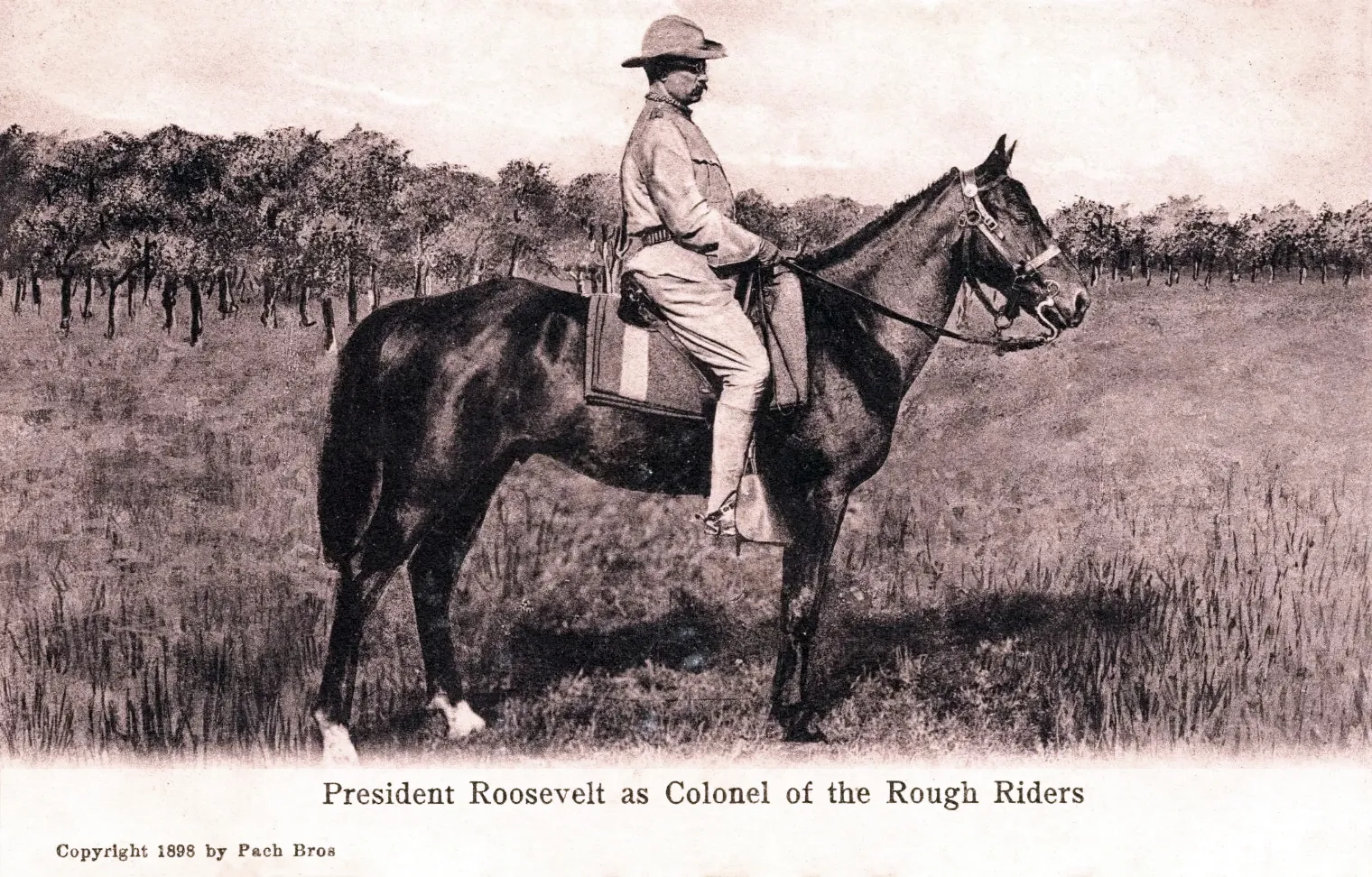
Colonel Roosevelt of the Rough Riders, 1898, whose wartime command demanded hard choices under fire. (Pach Brothers / Library of Congress)

Roosevelt in a formal portrait; he held that character is the bedrock of leadership. (Library of Congress)
On Character as the Foundation of Leadership
Alike for the nation and the individual, the one indispensable requisite is character–character that does and dares as well as endures, character that is active in the performance of virtue no less than firm in the refusal to do aught that is vicious or degraded.
— “Character and Success,” The Outlook, March 31, 1900
This conviction shaped how Roosevelt selected and worked with his cabinet. He did not always choose the most intellectually gifted; he chose people of demonstrated character and integrity. John Hay, Elihu Root, James Garfield—these men were brilliant, yes, but it was their character that Roosevelt valued most. He could trust them.
Roosevelt believed that leadership and citizenship were deeply connected. A nation that valued character in its leaders would produce leaders of character. A nation that tolerated corruption and dishonesty in its leaders would find itself led by corrupt and dishonest people. The responsibility, therefore, rested not merely on the leaders but on the citizens who chose them.
On the Duty of Leaders to the Weak
justice and generosity in a nation, as in an individual, count most when shown not by the weak but by the strong.
— Inaugural Address, March 4, 1905 · Theodore Roosevelt Center
This principle guided Roosevelt’s domestic policies. His conservation efforts protected public lands for ordinary Americans. His trust-busting was framed as protecting the worker and the small business from predatory monopolies. His support for labor legislation was grounded in the belief that those with economic power had duties toward those without it.
Learn More: Visit the Theodore Roosevelt Center for digitized speeches and letters where you can read Roosevelt's own words on leadership in full context.
Continue Reading
- Citizenship — More on TR
- Conservation — More on TR
Primary Sources at the TR Center
Explore original documents and resources related to this topic in the Theodore Roosevelt Center Digital Library.
- TR Center Digital Library — Primary source collection
From the Archives
Explore original photographs, documents, and illustrations related to this topic in the Theodore Roosevelt Center Digital Library.
Recommended Reading
- Theodore Roosevelt on Leadership by James M. Strock (2001). ISBN: 9780307560575
- The Bully Pulpit by Doris Kearns Goodwin (2013). ISBN: 978-1-4165-4786-0
- The Wisdom of Theodore Roosevelt by Donald J. Davidson (2010)