
Trust-Busting: Roosevelt's War on Monopoly
The Northern Securities Case and Presidential Power
On February 19, 1902, Attorney General Philander C. Knox announced that the government would sue the Northern Securities Company; the bill in equity was filed in federal court in St. Paul on March 10. The case seemed routine enough in form: the government alleged that Northern Securities violated the Sherman Antitrust Act of 1890 by combining three major railroads—the Northern Pacific, the Great Northern, and the Chicago, Burlington and Quincy—into a holding company that eliminated competition between them. But the case was anything but routine. Northern Securities represented the largest industrial combination yet attempted in America, and it had been orchestrated by J.P. Morgan, the nation's most powerful banker, and James J. Hill, one of its greatest railroad magnates.
Roosevelt's decision to prosecute Northern Securities announced that his presidency would challenge the assumption that mega-corporations lay beyond government authority. Previous presidents had worried about offending the business establishment; McKinley had been reluctant to push antitrust action hard. Roosevelt had no such hesitation. He believed that if the federal government was truly sovereign, it must possess the authority to break apart combinations that threatened the competitive market. To hesitate would be to acknowledge that corporations had become more powerful than the state—an intolerable proposition for any president who took the Constitution seriously.
The lawsuit shocked the business community. J.P. Morgan, accustomed to arranging deals in private conversation with presidents and cabinet members, went to the White House and, by Roosevelt's own account, told him: "If we have done anything wrong, send your man to my man and they can fix it up." "That can't be done," Roosevelt replied, and Attorney General Knox drove the point home: "We don't want to fix it up, we want to stop it." The government had filed suit to enforce the law, not to negotiate. If Morgan believed the law was wrong, he could argue that position in court.

“No Lack of Big Game” — Roosevelt is cast as a hunter stalking the trusts, drawn as octopi labeled Standard Oil, Beef, and Hard Coal. (Library of Congress)

“The Beef Trust — Don't shoot, I'll come down”: a cornered trust surrenders to Roosevelt, an image of the president's new leverage over big business. (Library of Congress)
The Victory and Its Significance
In March 1904, the Supreme Court ruled 5-4 that Northern Securities violated the Sherman Act. Roosevelt had won. The company was ordered to dissolve. More than two years of litigation had concluded with a decisive government victory. The significance was not merely legal but political and psychological: it demonstrated that the federal government possessed the will and the authority to challenge even the most powerful industrial combinations.
The narrow margin—a single Justice's vote—revealed that the Court itself was divided on how much antitrust authority Congress had delegated to the president. But what mattered was the result: Roosevelt had broken the largest industrial combination in the nation. The message reverberated through boardrooms and financial centers: the age of untouched corporate power had ended.
Roosevelt filed more than 40 antitrust suits during his presidency. These included actions against Standard Oil, the tobacco trust, meatpacking combinations, and numerous railroad trusts. The sheer quantity announced that Northern Securities was no aberration but the beginning of a sustained campaign. Yet Roosevelt's approach was more sophisticated than simple trust-busting. He distinguished between “good” trusts and “bad” trusts. A trust that achieved efficiency through consolidation while still treating workers fairly and charging reasonable prices might be tolerated. A trust that destroyed competition, exploited consumers, or brutalized workers deserved destruction.
The Standard Oil Prosecution
The prosecution of Standard Oil illustrated how Roosevelt's antitrust campaign worked in practice. Standard Oil, created by John D. Rockefeller, had achieved near-monopoly control of American petroleum refining through systematic purchase of competitors, exclusionary pricing practices, and intimidation of rivals. At its peak, Standard Oil controlled roughly 90 percent of American petroleum refining capacity, though its share had begun to decline by the early 1900s. To consumers, this meant prices determined by a single firm; to small refiners, it meant either sale to Standard at unfavorable terms or bankruptcy.
Roosevelt authorized his attorney general to file suit against Standard Oil in 1906. The case would continue for years, finally resulting in a 1911 Supreme Court decision (under Roosevelt's successor William Howard Taft) ordering the company's dissolution. Standard Oil was broken into dozens of separate companies, each of which continued to prosper but could no longer operate as a single unified monopoly. This dissolution would prove the most significant antitrust victory of Roosevelt's presidency.

“The Infant Hercules and the Standard Oil Serpents” — Roosevelt as the infant Hercules strangles serpents bearing the heads of John D. Rockefeller and Senator Nelson Aldrich. (Puck, 1906; Library of Congress)

A cartoon crowds the sky with trusts — Sugar, Oil, Coal, Steel, Beef and more — the many-fronted world Roosevelt's antitrust campaign confronted. (Library of Congress)
The Scale of Roosevelt's Antitrust Campaign
The most dramatic statistic of Roosevelt's antitrust campaign was the sheer number of indictments filed under the Sherman Act. The McKinley administration had filed three antitrust suits in four and a half years. By 1909, at the end of Roosevelt's presidency, his administration had brought more than 40 antitrust suits, with mixed but often dramatic results. The increase in activity was staggering: Roosevelt brought more antitrust actions in seven and a half years than all of his predecessors combined had brought in the eleven years since the Sherman Act became law.
This volume of litigation created bureaucratic capacity within the Department of Justice. Roosevelt also built investigative capacity: in 1903 he created the Bureau of Corporations, headed by James R. Garfield, whose investigations of the beef, oil, and tobacco industries laid the groundwork for later prosecutions. The litigation machinery, once established, generated its own momentum. Each victory created legal precedent; each case victory strengthened the Sherman Act's enforceability.
The railroad trust cases proved particularly significant. American railroads had consolidated dramatically in the 1890s through financial engineering—large investment banking houses like Morgan's would arrange mergers and combinations that eliminated competition. Roosevelt's government filed suits against the Union Pacific combination, the Northern Pacific-Great Northern merger, and numerous other railroad consolidations. The railroads were not merely private businesses but operated as common carriers serving the public interest; unregulated monopoly in rail transportation threatened the broader economy's efficiency.
Good Trusts and Bad Trusts: The Nuance
Roosevelt's distinction between "good" and "bad" trusts was more than rhetoric—it reflected genuine conviction about how antitrust law should function. A large firm that achieved size through genuine business efficiency, that did not artificially restrict competition, and that treated workers and customers fairly might serve the public interest. But a firm that used predatory practices to destroy competitors, that leveraged monopoly power to exploit consumers, or that paid substandard wages and maintained dangerous working conditions deserved federal prosecution and dissolution.
This distinction infuriated purist trust-busters who wanted all large firms broken into smaller competitors. Roosevelt's approach was more pragmatic: size alone was not evil; abuse of market power was evil. The solution was not to prevent growth but to prevent the use of growth to strangle competition and exploit the powerless.
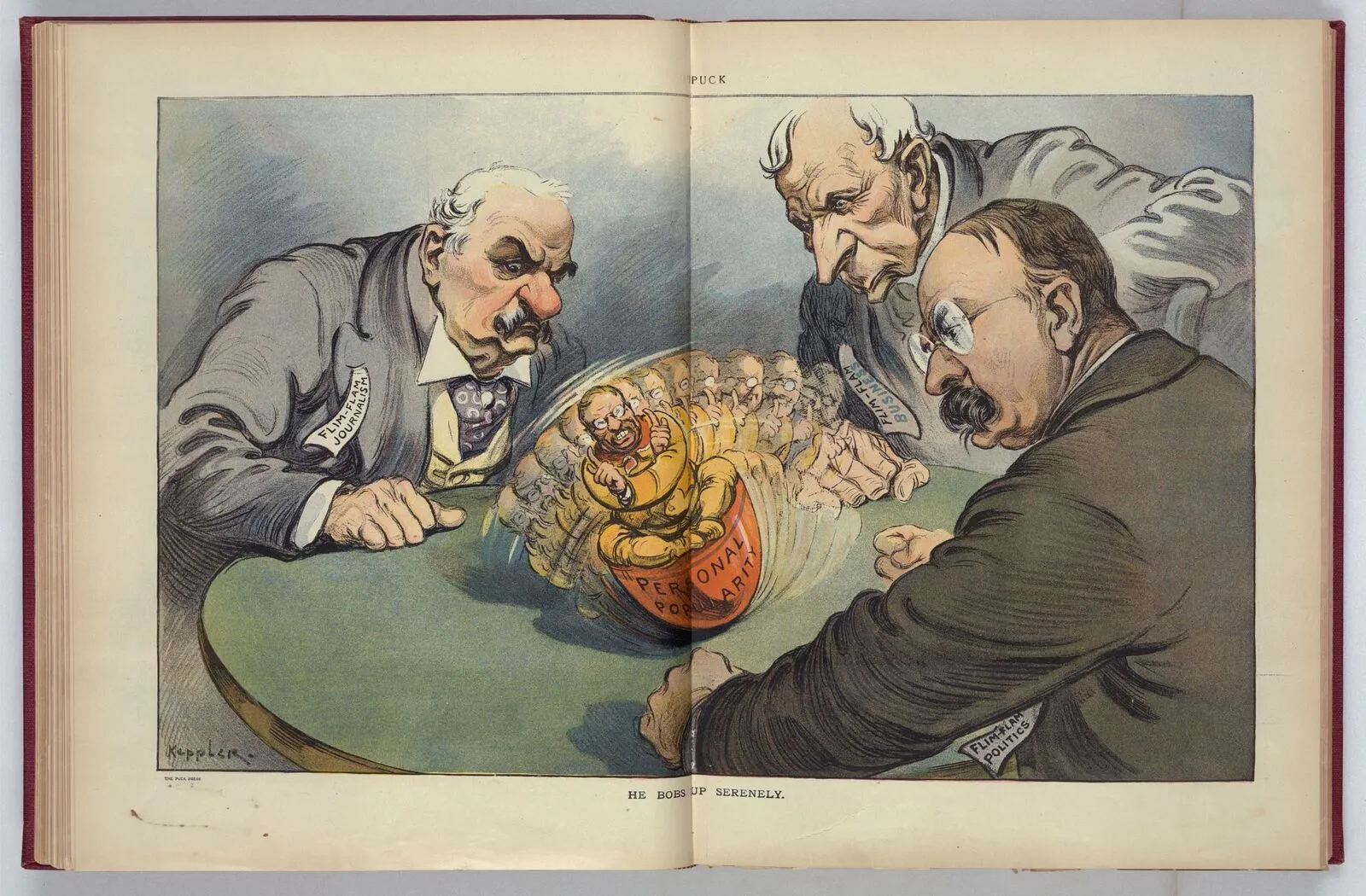
“He Bobs Up Serenely” — a cartoon on the resilience of Standard Oil, the archetype of the “bad trust” Roosevelt set out to discipline. (Puck; Library of Congress)

“A Little Practical Railroading” — the fight over the Hepburn Act, which gave federal regulators real power to set railroad rates. (Library of Congress)
Legislative Coordination and the Hepburn Act
Roosevelt understood that antitrust litigation alone was insufficient. He also pushed Congress for legislation that would strengthen federal authority over combinations. The Hepburn Act of 1906 expanded the Interstate Commerce Commission's authority beyond railroads to include express companies, sleeping car companies, and pipeline operators. More importantly, it gave the ICC direct authority to set railroad rates, rather than requiring the government to litigate rate disputes through the courts. This shift represented a transfer of power from judicial review to executive-administrative determination.
Roosevelt saw the ICC as a model for economic regulation. Rather than rely on courts to punish monopolies after they had already harmed the public, government agencies could regulate economic behavior in advance, setting rates and conditions of service that the law required companies to meet. This represented the emergence of modern administrative agencies as tools of economic regulation.
The Limits and Legacies of Trust-Busting
Not all of Roosevelt's antitrust actions succeeded. Some cases were lost in court; others were settled on terms less favorable than Roosevelt preferred. Some historians have argued that Roosevelt's antitrust campaign was partly theatrical—that he prosecuted firms that made political enemies while leaving others untouched. There is truth in this criticism; politics and principle mixed in Roosevelt's selections of which combinations to challenge.
But the fundamental achievement remained: Roosevelt had established that the federal government possessed authority to challenge monopolies and had created a culture of enforcement around antitrust law. The Sherman Act, which had been effectively dormant in the 1890s, became a real constraint on corporate behavior. Future presidents and attorneys general would build on Roosevelt's precedent, using antitrust law to challenge Microsoft, Bell Telephone, and numerous other dominant firms across twentieth-century American history.
Roosevelt's approach also shaped how Americans understood monopoly. Before Roosevelt, monopolies were seen as natural and inevitable—the result of competition's logic. Roosevelt convinced the public that monopolies were bad for consumers, bad for workers, and bad for democracy. This conviction entered American political consciousness and has endured for more than a century. The “trust-buster” label that attached to him—one he himself never embraced—became a rallying cry of progressive reform and influenced how Americans debated economic policy throughout the twentieth century.
Continue Reading
- The Square Deal — Roosevelt's governing philosophy of fairness for capital, labor, and consumers
- Railroad Regulation — The Hepburn Act and federal authority over private enterprise
- Executive Power — The stewardship theory and Roosevelt's expansion of presidential authority
- The Bully Pulpit — How Roosevelt used the press to shape public opinion on corporate reform
- The Election of 1904 — Roosevelt's mandate for his reform agenda
Primary Sources at the TR Center
Explore primary documents on Roosevelt's antitrust campaign in the Theodore Roosevelt Center Digital Library.
- Trust-Busting Cartoon “Next!” — Political cartoonists celebrated Roosevelt's antitrust campaign
- Edward H. Harriman Encyclopedia Entry — One of the railroad magnates challenged by Roosevelt's trust-busting
- Politics and Government Encyclopedia — Essays on Roosevelt's regulatory philosophy and methods
From the Archives
Explore original photographs, documents, and illustrations related to this topic in the Theodore Roosevelt Center Digital Library.
Recommended Reading
- Theodore Rex by Edmund Morris (2001)
- Antitrust: The Case for Repeal by Dominick T. Armentano (1986). ISBN: 978-0943360317
- Theodore Roosevelt: A Life by Nathan Miller (2011). ISBN: 978-0061340382