
William Howard Taft: Friend, Protégé, Rival
How It All Began
William Howard Taft first caught Roosevelt's attention as a judge and administrator with a reputation for competence and legal knowledge. Roosevelt appointed him Secretary of War in 1904, a post from which Taft oversaw American military interests in the Philippines and other territories. The two men were not temperamentally similar — Taft was more cautious, more legalistic, more interested in constitutional process than in executive vigor. But Roosevelt respected Taft's abilities and genuinely liked him. They worked well together, and when Roosevelt decided he would not seek another term in 1908, he was confident that Taft was the right man to continue his policies.
Roosevelt ensured Taft's nomination and election. In 1908, Taft easily won the presidency with Roosevelt's enthusiastic backing. As Taft boarded the train to Washington, he carried Roosevelt's hopes and expectations. The problem was that Taft was not Roosevelt, and the presidency he inherited was not the same job Roosevelt had shaped through the force of his personality.
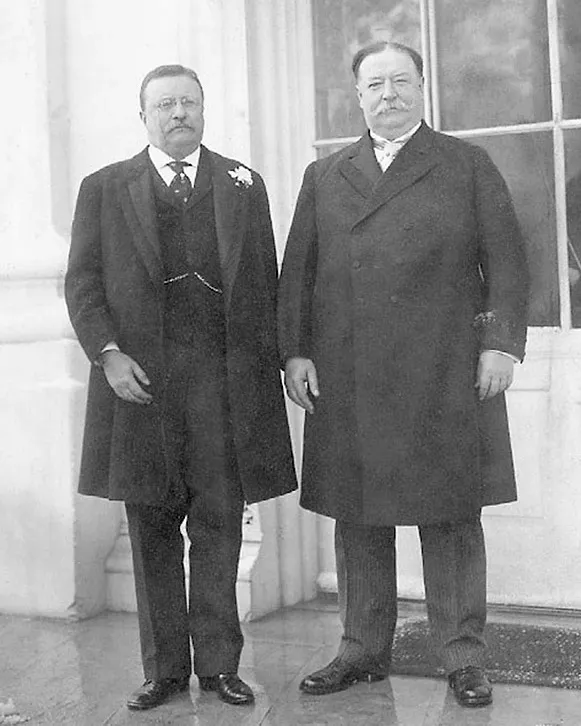
Theodore Roosevelt and his chosen successor, William Howard Taft, at the White House on inauguration day, March 1909. (Library of Congress)

William Howard Taft in 1908, the year Roosevelt helped make him president. (Library of Congress)
The Temperamental Divide
Roosevelt was a man of action, impulse, and decisiveness. He believed that a strong president should push the boundaries of constitutional authority in service of progressive reform. He was comfortable with executive power and unafraid of confrontation. Taft, by contrast, was more conservative constitutionally. He believed in the separation of powers, in proceeding carefully through legal channels, in consulting Congress rather than circumventing it. What Roosevelt saw as necessary vigor, Taft saw as dangerous executive overreach.
These weren't just personality differences; they reflected fundamentally different philosophies of the presidency. The problem was that Taft had been elected, in large measure, because the public believed he would be like Roosevelt. When he proved to be substantially different, both his supporters and Roosevelt himself felt betrayed.
The Ballinger Controversy and the Conservation Rift
The first serious rupture came over conservation policy and public lands management. Taft's Secretary of the Interior, Richard Ballinger, made decisions about public lands that Gifford Pinchot — still chief of the Forest Service and a trusted Roosevelt ally — believed violated conservation principles. When Pinchot publicly criticized Ballinger, Taft fired him. From Taft's perspective, Pinchot had been insubordinate. From Roosevelt's perspective, Taft had abandoned conservation and sided with special interests.
The firing of Pinchot was, to Roosevelt, unforgivable. It suggested that Taft was reversing the conservation agenda that Roosevelt had made one of his presidency's defining achievements. Roosevelt, now living in Africa after leaving office, learned of Pinchot's dismissal and felt personally betrayed. Letters between them grew cooler. What had seemed like a smooth transition was beginning to look like a repudiation.

Richard A. Ballinger, Taft's Secretary of the Interior, whose conservation clash with Gifford Pinchot deepened the Roosevelt-Taft rift. (Wikimedia Commons)

Theodore Roosevelt around 1910, back from Africa and increasingly at odds with the man he had put in the White House. (Wikimedia Commons)
Growing Apart: The Split Widens
Other issues compounded the rift. Taft was less aggressive in trust-busting than some progressives expected, though he actually brought more antitrust suits than Roosevelt had. Taft moved more cautiously on labor issues. Most importantly, Taft seemed to align more closely with the conservative wing of the Republican Party — the very forces Roosevelt had battled throughout his presidency. Old Guard Republicans who had chafed under Roosevelt's reformism found Taft more accommodating.
By 1910, Roosevelt was growing convinced that Taft was failing as president. By 1911, he was considering challenging him for the nomination. By early 1912, he had made his decision: he would enter the race against the man he had personally chosen and groomed for the presidency.
1912: The Most Dramatic Political Breakup
The 1912 election was, in many ways, the political equivalent of a divorce. Roosevelt ran on the Progressive "Bull Moose" ticket, splitting the Republican Party and guaranteeing victory for Democrat Woodrow Wilson. Taft, meanwhile, felt wounded and angry. He had tried to govern according to his best judgment, and Roosevelt was punishing him for not being Roosevelt. The campaign was bitter, with personal attacks on both sides. Roosevelt felt betrayed by Taft's failures. Taft felt betrayed by Roosevelt's betrayal of his own chosen successor.
The election results were devastating for both men and for the Republican Party. Wilson won with a plurality of the vote. Roosevelt came in second, splitting the Republican vote. Taft came in third. It was a humiliating outcome for a sitting president. The political realignment of 1912 had consequences that would reshape American politics for decades. None of it would have happened if Roosevelt and Taft had remained allies.

The 1912 race: Roosevelt's Bull Moose insurgency split the Republican vote with Taft and handed the White House to Woodrow Wilson. (Library of Congress)

Taft found his true calling as Chief Justice of the United States, appointed in 1921 — two years after Roosevelt's death. (Library of Congress)
The Later Reconciliation
Perhaps the most poignant aspect of the Roosevelt-Taft story is that they eventually reconciled. Not immediately — the wounds were too fresh, the betrayals too recent. But over time, particularly during World War I when both men were alarmed by Wilson's policies, they began to heal the breach. By the time Roosevelt died in 1919, they had restored enough friendship that Taft could speak of Roosevelt with genuine affection and respect.
This reconciliation is important historically because it suggests that both men came to understand their conflict with more nuance. Roosevelt came to see that Taft had genuine reasons for governing differently, that their constitutional philosophies were legitimately different, that Taft wasn't simply failing or betraying him. Taft came to see that Roosevelt had genuine concerns about his presidency and that the split, while painful, had some justification.
What the Split Reveals
The Roosevelt-Taft rupture reveals several important truths about American politics and human relationships. First, it shows how difficult it is to succeed a strong leader. The very qualities that made Roosevelt successful as president — his vigor, his willingness to stretch executive authority, his combativeness — became impossible expectations for his successor to meet. Taft was a capable president in his own right, but he couldn't be Roosevelt, and the public and Roosevelt himself seemed unable to accept that.
Second, it shows how friendship, even deep friendship based on respect and affection, can fracture when political expectations clash. Roosevelt and Taft genuinely liked each other, but that wasn't enough to overcome fundamental differences about the presidency, about power, about what reform required.
Third, it demonstrates that in American politics, loyalty to individuals sometimes matters as much as loyalty to principles. For Roosevelt, the question wasn't primarily whether Taft was advancing progressive reform — the question was whether Taft was being loyal to Roosevelt's legacy. That confusion between personal loyalty and political principle drove much of the conflict.
Continue Reading
- The Presidency — Roosevelt's approach to executive power and progressive reform
- Conservation Legacy — Roosevelt's environmental achievements and the Pinchot-Ballinger controversy
- The 1912 Election and the Bull Moose Split — The dramatic political rupture that reshaped American politics
Primary Sources at the TR Center
Explore original documents and resources related to William Howard Taft and his relationship with Theodore Roosevelt in the Theodore Roosevelt Center Digital Library.
- William Howard Taft Encyclopedia Entry — Comprehensive biography of Taft's life, presidency, and complex relationship with Roosevelt
- The Progressive Party and 1912 Election — Context on the Bull Moose movement and the political realignment that followed
From the Archives
Explore original photographs, documents, and illustrations related to this topic in the Theodore Roosevelt Center Digital Library.
Recommended Reading
- The Presidency of William Howard Taft by Paolo E. Coletta (1973)
- Four Hats in the Ring: The 1912 Election and the Birth of Modern American Politics by Lewis L. Gould (2008)
- Colonel Roosevelt by Edmund Morris (2010). ISBN: 978-0-679-60415-0