
Gifford Pinchot: The Chief Forester and Architect of Conservation
A Yale-Trained Visionary from a Gilded Age Dynasty
When Theodore Roosevelt became president in 1901, one name would shape his conservation legacy more than any other: Gifford Pinchot. Born in Connecticut in 1865 to a wealthy New York merchant family, Pinchot had every advantage—but he chose to use it for the forests. While his peers pursued Wall Street fortunes, young Pinchot went to Yale, then traveled to Europe to study forestry—a subject no American university yet taught—at the French national forestry school in Nancy, with study tours in the forests of Switzerland and Germany. (In 1900 his family's money would endow the Yale Forest School, the first of its kind in the country.) He returned to America with a radical vision: forests could be managed for both protection and profit. You didn't have to choose between saving the woods and harvesting them wisely.
Before TR came to power, Pinchot had already earned his stripes. President McKinley's administration had appointed him as head of the Division of Forestry (what would soon become the U.S. Forest Service). But when Roosevelt took the reins, everything accelerated. The two men shared a philosophy that shaped American land management for generations: the idea that nature's resources should be used wisely—not squandered, not locked away untouched, but managed scientifically for the greatest good of the greatest number over the longest time.

Gifford Pinchot (right), the nation's first Chief Forester, with President Roosevelt. A Yale-trained forester from a wealthy family, he became the architect of Roosevelt's conservation program. (Library of Congress)
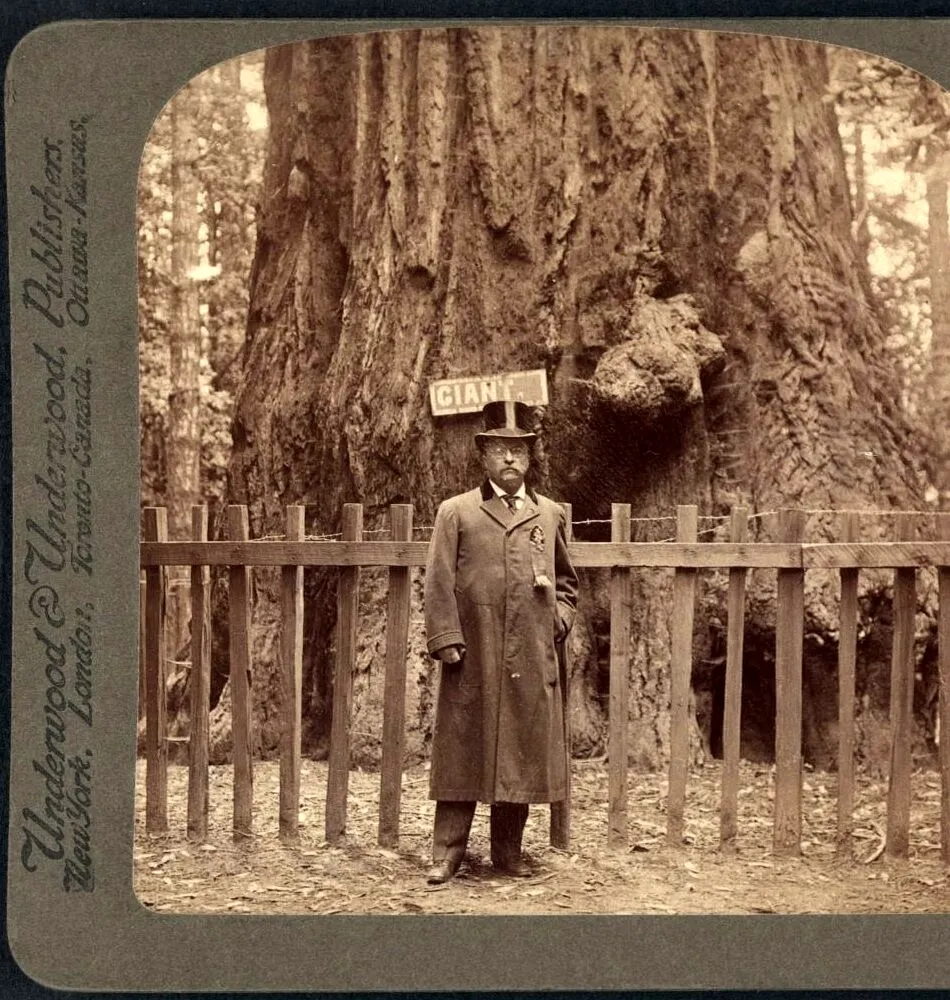
Roosevelt before a giant sequoia, “the Forest King.” Pinchot's creed — conservation as the “wise use” of resources — set him against John Muir's call to preserve such places untouched. (Library of Congress)
"Conservation Means Wise Use": Pinchot's Philosophy vs. Muir's Preservation
To understand Gifford Pinchot, you have to understand the great debate that defined early American conservation. On one side stood Pinchot and his "conservation" doctrine—the idea that you could have forest management and timber harvest working together, that cutting trees responsibly wouldn't destroy the forest. On the other side stood John Muir and other preservationists who believed wild nature had value beyond dollars, that some places should be left untouched for their own sake and for future generations to wonder at.
These weren't enemies—there was real respect between Pinchot and Muir. But they disagreed fundamentally. Pinchot believed that trained foresters, armed with science, could manage forests to produce timber, wildlife habitat, clean water, and scenic beauty all at once. For Pinchot, the right way to save a forest was to put it to wise, continuing use. Muir felt differently. He wanted some wild places preserved intact, kept separate from the machinery of commerce. Roosevelt, ever the pragmatist, tried to honor both visions—protecting untouched valleys and sequoias while also embracing Pinchot's science-based forest management across millions of acres.
"The fundamental idea in forestry is that of perpetuation by wise use," Pinchot wrote in his Primer of Forestry (1899), capturing the essence of his life's work. It was an idea that shaped a nation's relationship with its wildlands.
Building the Forest Service: From Interior to Agriculture in 1905
On February 1, 1905, Roosevelt accomplished something that had seemed impossible: he transferred control of the nation's forest reserves from the Department of the Interior to the Department of Agriculture, placing them under Pinchot's authority. It might sound like bureaucratic shuffling, but it was revolutionary. The Interior Department had treated forests as real estate to be disposed of. Agriculture, under Pinchot, treated them as living systems to be managed.
This Transfer Act of 1905 created what we now know as the U.S. Forest Service. Suddenly, 63 million acres of forest fell under unified management. Pinchot immediately set about professionalizing the force. He hired trained foresters rather than political appointees. He insisted on examinations for forest rangers. He created schools of forestry. Where once timber merchants and local politicians had run the forests, now scientists were in charge. The results were measurable: illegal logging dropped, fires were fought more effectively, and the forests were managed as long-term resources instead of quick cash.
As Chief Forester, Pinchot embodied the Progressive Era belief that expertise and science could solve public problems. He wasn't content just managing forests—he wanted to transform how Americans thought about natural resources. He gave speeches, wrote articles, and worked tirelessly to convince the public that conservation wasn't about locking nature away. It was about stewardship, about using resources intelligently so they would last.

The 1908 Conference of Governors on the Conservation of Natural Resources, which Pinchot organized — the high-water mark of the movement he built with Roosevelt. (Harvard College Library, Theodore Roosevelt Collection)

“The Fight for the Water-Hole,” a cartoon on the era's battles over natural resources; in 1907 Roosevelt and Pinchot rushed to set aside 16 million acres of forest before Congress could stop them. (Puck; Library of Congress)
The Midnight Forests: Pinchot and Roosevelt's Last Stand
By 1906 and 1907, Pinchot and Roosevelt had made enemies. Lumber companies resented restrictions. Western politicians wanted their public lands. Congress began to push back against the sweeping proclamations that had created vast forest reserves. In March 1907, Congress threatened to revoke Roosevelt's power to create new forests in six western states. The deadline was weeks away.
What happened next became legend in conservation circles. Pinchot recalled that Roosevelt had ordered the Forest Service to work "night and day" drafting proclamations of the restricted lands. Working frantically, Pinchot's team identified 16 million additional acres across Oregon, Washington, Idaho, Montana, Colorado, and Wyoming—and Roosevelt proclaimed them all as national forests before Congress's deadline took effect. When his opponents realized what had happened, one observer noted, they "turned handsprings in their wrath." Roosevelt had outmaneuvered them. The forests were protected.
The Fall from Grace: The Ballinger-Pinchot Controversy and Its Aftermath
When Roosevelt left office in 1909, Pinchot must have felt secure. His friend had championed conservation, protected the forests, and built an agency that would outlast them both. But within months, everything cracked apart. Roosevelt's successor, William Howard Taft, appointed Richard Ballinger as Secretary of the Interior. Ballinger believed in development over conservation. He began reversing Pinchot's decisions, opening public lands to mining and logging that Pinchot had considered off-limits.
Pinchot fought back. He spoke publicly about Ballinger's decisions. He wrote letters to newspapers. He didn't go quietly. Taft, eager to establish independence from Roosevelt's shadow, fired Pinchot in January 1910. The dismissal shocked progressives across America. Here was the man who had worked beside Roosevelt to save the forests, cast out by a president who seemed to be dismantling the conservation legacy.
The Ballinger-Pinchot controversy—one of the greatest public feuds of the Progressive Era—would drive a wedge between Roosevelt and Taft. It would help push Roosevelt toward running for president again in 1912 on the Progressive Party ticket. And it would cement Pinchot as a hero to conservationists everywhere. He continued his fight for forests for the rest of his life, eventually serving as Governor of Pennsylvania and champion of state forestry.
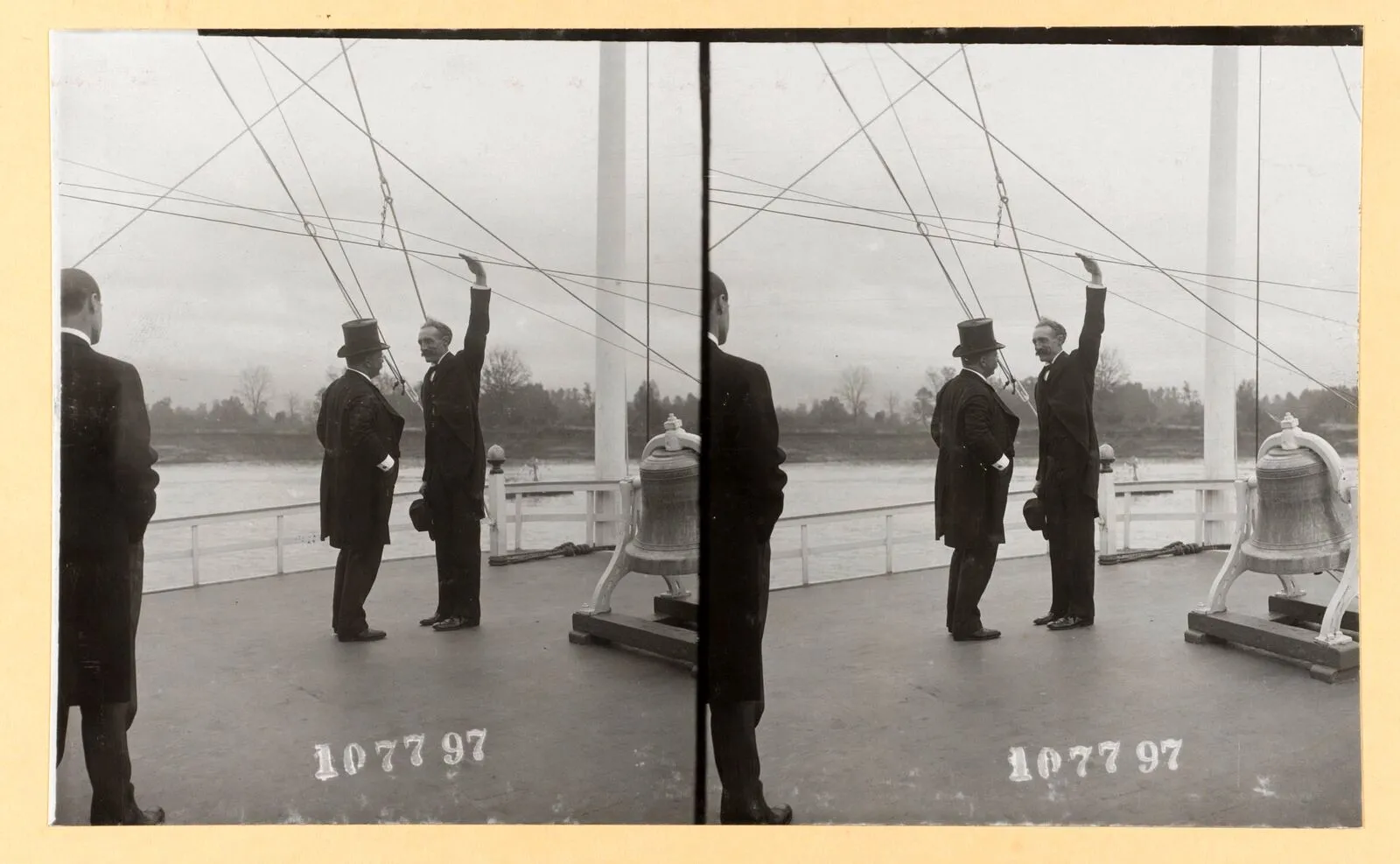
Roosevelt and Pinchot aboard the Mississippi steamer on the 1907 inland-waterways trip. After Roosevelt left office, Pinchot's clash with Interior Secretary Ballinger under President Taft ended in his firing. (Library of Congress)
A Legacy Written in Trees and Science
When Gifford Pinchot died in 1946, he left behind millions of acres protected by his philosophy of wise use. The Forest Service he built continues today. The idea that we can use natural resources while preserving them—that took Pinchot's entire life and has become the backbone of American resource management. He proved that a wealthy man could devote his life to something larger than wealth. He showed that science and democracy could work together to protect public lands. And he demonstrated that a visionary with the ear of a powerful president could shape a nation's relationship with its forests for generations to come.
In his autobiography, Roosevelt wrote that "Gifford Pinchot is the man to whom the nation owes most for what has been accomplished as regards the preservation of the natural resources of our country." History has proven the president right. In Gifford Pinchot, conservation found its first great professional, its first scientific mind, and its first tireless advocate for the idea that America's natural wealth didn't belong to any one generation—it belonged to all of us.
Continue Reading
- National Forests: From 47 Million to 194 Million Acres — The transformation of America's forests under Pinchot's management.
- John Muir and the Wilderness Campaign — The preservationist vision that complemented Pinchot's conservation approach.
- The Midnight Forests of 1907 — Roosevelt and Pinchot's last-minute protection of 16 million acres.
- The 1908 Governors Conference — Coordinating conservation across the nation.
- Gifford Pinchot Biography — The forester's full life and legacy.
- Trust Busting and the Square Deal — Roosevelt's broader Progressive Era agenda.
Primary Sources at the TR Center
Explore the TR Center’s Digital Library for documents and resources on Pinchot, the Forest Service, and Roosevelt’s conservation philosophy.
- Forest Conservation Subject Page — Comprehensive resources on Roosevelt’s protection of America’s forests.
- Roosevelt’s Conservation Record — A comprehensive overview of his environmental accomplishments.
- Conservation Encyclopedia — In-depth articles on Roosevelt’s conservation initiatives.
- National Park Service Collections — Resources on the public lands system Roosevelt helped establish.
From the Archives
Explore original photographs, documents, and correspondence related to Gifford Pinchot and the Forest Service in the Theodore Roosevelt Center Digital Library.
Recommended Reading
- Gifford Pinchot: Private and Public Forester by M. Nelson McGeary (1960)
- The Fight for Conservation by Gifford Pinchot (1910). ISBN: 978-1584654995
- Teddy Roosevelt: The Wilderness Warrior by Douglas Brinkley (2009). ISBN: 978-0060565312