
National Parks Established Under Theodore Roosevelt

The Grand Canyon of the Yellowstone. Roosevelt believed places like this belonged to all Americans — and used the presidency to keep them that way. (Brocken Inaglory / Wikimedia Commons)

Yosemite Valley. During his presidency Roosevelt helped establish five national parks and laid the groundwork for many more. (David Iliff / Wikimedia Commons)
The Vision of National Parks: Preservation vs. Multiple Use
Roosevelt distinguished between national forests—places where timber harvesting and multiple-use management were permitted—and national parks, where preservation took priority. National parks were special places set aside primarily to protect scenic beauty and preserve natural wonders. Unlike forests managed for sustained yield, parks were meant to remain largely unchanged for future generations. Roosevelt believed that America's most distinctive natural features deserved absolute protection from commercial exploitation.
Creating a national park required Congressional action. Unlike monuments, which Roosevelt could proclaim unilaterally under the Antiquities Act, parks needed legislation. This meant that establishing parks required building Congressional consensus, persuading skeptics, and overcoming timber and mining interests. Roosevelt championed park legislation even when it proved politically difficult. Each park represented a careful balance between Roosevelt's conservation vision and the political realities of Congress.
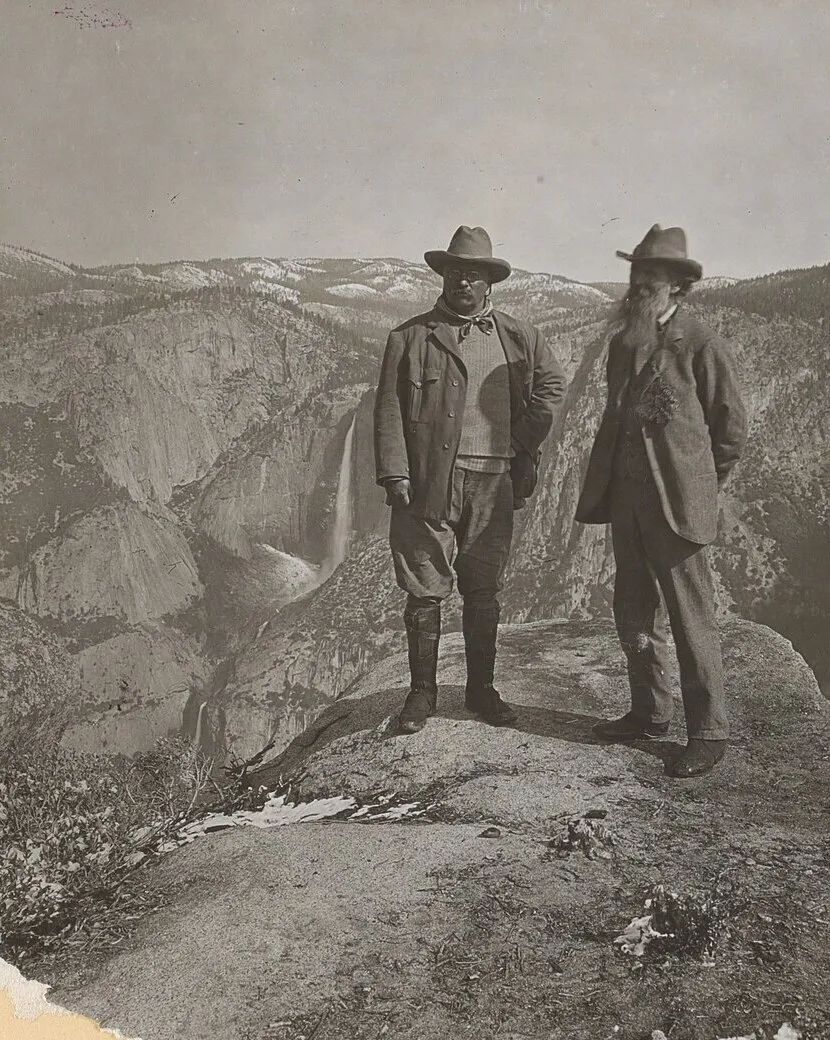
Roosevelt and naturalist John Muir at Glacier Point, 1903. Their Yosemite camping trip crystallized Roosevelt's conviction that some lands should be preserved, not merely used. (Library of Congress)

Crater Lake, Oregon, became a national park in 1902 — the first Roosevelt signed into being, protecting the deepest lake in the United States. (Pavel Špindler / Wikimedia Commons)
Crater Lake National Park, Oregon — 1902
Crater Lake, the nation's deepest lake, sits in the caldera of Mount Mazama, a volcano that collapsed roughly 7,700 years ago. The lake's extraordinary blue color—caused by pure water and extreme depth—made it one of America's most photographed natural features. At 1,943 feet deep, Crater Lake fascinated geologists. Its pristine water, surrounded by ancient forest, embodied scenic beauty and geological significance.
Crater Lake National Park, established in May 1902, protected some 286 square miles of volcanic landscape. The park's creation required Congressional action, but Roosevelt championed the legislation. Crater Lake demonstrated that even in his early presidency, before the Antiquities Act gave him unilateral power to protect monuments, Roosevelt prioritized bringing spectacular natural features under federal protection. The park remains popular with visitors who descend its narrow trail to take in the astonishingly clear water, fed entirely by rain and snow, and experience the volcanic geology of Mount Mazama.
Wind Cave National Park, South Dakota — 1903
Wind Cave, near Hot Springs in the Black Hills, encompasses a vast underground labyrinth of passages, chambers, and distinctive "boxwork" formations. The cave, known to the region's Lakota people for centuries, attracted growing tourism in the late 19th century. Cave owners worried about protection and preservation. In January 1903, Congress established Wind Cave National Park, the first national park created primarily to protect a cave system.
Wind Cave's designation marked Roosevelt's commitment to protecting geological and scientific wonders beyond the typical geysers and canyons that shaped earlier national park thinking. The park protected not scenic vistas but underground geological formations—chambers and passages formed by water dissolving limestone over millions of years. The cave remains a treasure of geological study and public education about subterranean landscapes.

Wind Cave, South Dakota, protected in 1903, safeguards one of the world's finest displays of delicate “boxwork” calcite — and the prairie and bison above it. (National Park Service)

Sullys Hill, North Dakota, set aside in 1904, became a refuge for bison when the species was near extinction. Today it is the White Horse Hill National Game Preserve. (U.S. Fish & Wildlife Service)
Sullys Hill, North Dakota — 1904 (a Park, Later a Game Preserve)
Sullys Hill, near Fort Totten in northeastern North Dakota, encompassed prairie grassland, wetlands, and forests surrounding what became Fort Totten Lake. The landscape provided critical habitat for elk, deer, and waterfowl. Roosevelt set aside Sullys Hill Park in 1904—it is the fifth of his five parks—and the area was reclassified as a national game preserve in the 1910s (today the White Horse Hill National Game Preserve). The designation reflected Roosevelt's interest in wildlife conservation alongside scenery protection.
Sullys Hill was later reclassified and renamed, but it represented Roosevelt's consistent belief that national parks and preserves should protect not just scenic features but living ecosystems and the animals that inhabited them. Wildlife conservation was integral to his preservation philosophy.
Mesa Verde National Park, Colorado — 1906
Mesa Verde, in southwestern Colorado, encompasses roughly 80 square miles of canyons and plateaus containing hundreds of Ancestral Puebloan cliff dwellings and pueblo ruins. The park's most famous structures—Cliff Palace with over 150 rooms, Balcony House, and Spruce Tree House—represent sophisticated pre-Columbian architecture and engineering. Mesa Verde's creation in 1906 protected not only scenic landscapes but irreplaceable archaeological treasures.
Mesa Verde exemplified Roosevelt's conviction that national parks should protect cultural heritage alongside natural wonders. The park combined archaeological significance with natural beauty. Establishing Mesa Verde as a national park required Congressional action, which Roosevelt enthusiastically supported. The park has become one of America's most visited and most important archaeological sites, attracting scholars and tourists from around the world.

Mesa Verde, Colorado, protected in 1906, was the first national park created to preserve the works of human beings — the cliff dwellings of the Ancestral Puebloans. (Tobi 87 / Wikimedia Commons)

Platt, Oklahoma, established in 1906 around its cool mineral springs, was among the smallest national parks; today it anchors the Chickasaw National Recreation Area. (Jonathan Schilling / Wikimedia Commons)
Platt National Park, Oklahoma — 1906
Platt National Park (originally the Sulphur Springs Reservation, created in 1902), renamed in June 1906, protected roughly 1,400 acres of springs, forests, and grassland near Sulphur, Oklahoma. The park's natural springs attracted visitors seeking health benefits from the mineral-rich waters—a common belief in the Progressive Era. The park combined scenic beauty with what were then believed to be therapeutic natural mineral springs.
Platt remained relatively small and modest compared to Yellowstone or Yosemite. But it demonstrated Roosevelt's inclusive approach to national parks—he did not limit parks to grand canyons and dramatic geysers. Natural springs, forests, and smaller scenic areas merited protection as national parks if they possessed distinctive natural features worthy of preservation.
Park Visitation and Roosevelt's Personal Experience
Roosevelt understood that national parks could inspire conservation sentiment only if Americans actually visited them. He championed the construction of roads and accommodations to facilitate access. During his presidency, park visitation grew steadily. Roosevelt himself traveled to several of the parks he championed, experiencing firsthand the geological wonders and natural beauty they protected. His 1903 camping trip to Yosemite and Glacier Point with John Muir became the most famous presidential park visit, but he also visited other sites and championed their accessibility.
Roosevelt believed that experiencing the nation's natural wonders would transform Americans into conservation advocates. A visitor to Crater Lake or Mesa Verde would understand viscerally why these places deserved protection. The national parks were, in Roosevelt's vision, classrooms in which Americans could learn to appreciate natural beauty and scientific importance. Accessibility was essential to this educational mission.

Roosevelt lays the cornerstone of the Yellowstone gateway arch that now bears his name, 1903. He knew these places firsthand — camping, riding, and speaking for them. (National Park Service)

Grand Prismatic Spring, Yellowstone. Roosevelt saw the national parks as monuments to the American land itself — a natural heritage he believed every generation had a duty to pass on intact. (Jim Peaco / National Park Service)
Parks as Monuments to American Nature
Roosevelt's five national parks—modest in number compared to his 18 national monuments and 150 national forests—nonetheless represented an important conservation category. National parks were preserved primarily for scenic beauty, scientific study, and public enjoyment. Unlike national forests, they were not meant for timber harvesting or mining. Unlike some national monuments, they were not primarily archaeological sites. They were landscapes preserved as monuments to American nature in its most distinctive forms.
The five parks Roosevelt preserved—from Crater Lake's deep blue waters to Mesa Verde's cliff dwellings to Wind Cave's underground chambers—demonstrated diversity in what Americans thought worth preserving. The parks reflected both scenic grandeur and scientific importance. They showed Roosevelt's broad conception of what national parks should encompass. Some parks emphasized geological wonders, others archaeological treasures, still others biological or ecological significance.
Roosevelt believed strongly that all Americans should have access to these parks. He opposed excessive development that would degrade the landscapes. He championed roads and accommodations to allow public enjoyment. But he insisted that the parks' primary purpose was preservation—protecting these distinctive places from exploitation, vandalism, and commercial degradation. The parks were held in trust for the nation and for future generations. Unlike national forests, which were expected to yield timber and other resources, parks were meant to preserve nature largely untrammeled.
A Living Legacy
The five national parks Roosevelt established remain among America's most visited and cherished protected places. Millions of visitors pass through Crater Lake, Mesa Verde, and Wind Cave annually. The parks generate substantial economic benefits for surrounding regions through tourism. But more fundamentally, they preserve landscapes and ecosystems that would otherwise have been destroyed or severely degraded by development.
Roosevelt's park policy established the principle that some American landscapes merit absolute protection from commercial exploitation. His conviction that scenic beauty and natural wonders belonged to all Americans, not just those wealthy enough to own private lands, shaped the entire national park system. The five parks he helped establish during his presidency stand as testament to his belief that the nation's natural patrimony should be preserved for "the people."
"In the Grand Canyon, Arizona has a natural wonder which is in kind absolutely unparalleled throughout the rest of the world." — Theodore Roosevelt
Continue Reading
- National Monuments — Roosevelt's proclamations under the Antiquities Act
- National Forests — Multiple-use conservation strategy
- John Muir and Roosevelt — Conservation philosophy and friendship
- Gifford Pinchot — Key conservationist in Roosevelt's administration
Primary Sources at the TR Center
Explore original documents and resources related to this topic in the Theodore Roosevelt Center Digital Library.
- National Parks under Roosevelt — Documents and records of park establishment
- Conservation History — Roosevelt's park and preservation initiatives
From the Archives
Explore original park designation documents and photographs from Roosevelt's national parks in the Theodore Roosevelt Center Digital Library.
Recommended Reading
- Teddy Roosevelt: The Wilderness Warrior by Douglas Brinkley (2009). ISBN: 978-0060565312
- How the Canyon Became Grand: A Short History by Stephen J. Pyne (1998)
- John Muir: A Life by Gretel Ehrlich (2000). ISBN: 978-0865474948