
John Muir: The Wilderness Prophet
From Wisconsin to the Sierra: A Thousand-Mile Walk
John Muir was born in Scotland and immigrated to Wisconsin as a boy. He grew up in the harsh frontier environment of 1850s Wisconsin, where his father's stern discipline and demanding work contrasted sharply with Muir's love of the natural world. As a young man, he studied botany and geology at the University of Wisconsin, and he walked, explored, and documented the plant life of the region. But Wisconsin was not his true home — his heart was drawn westward, to the great wild places he read about.
In 1867, at age 29, Muir set out on what he called his "Thousand-Mile Walk to the Gulf" — a solitary journey from Indianapolis south to the Gulf of Mexico, through Tennessee and Florida, observing and sketching plants and geological formations. This journey, which he later documented in his journal, was a spiritual awakening. It was during this time that he began to conceive of nature not as resources to be extracted but as sacred spaces worthy of contemplation and protection. When he eventually reached California and first saw the Sierra Nevada in 1868, something shifted in him. He had found home. He took a job as a shepherd in Yosemite Valley and spent his days exploring the granite peaks, the giant sequoias, the waterfalls, and the ecological wonders that would consume the rest of his life.

John Muir around 1863. (Wikimedia Commons)
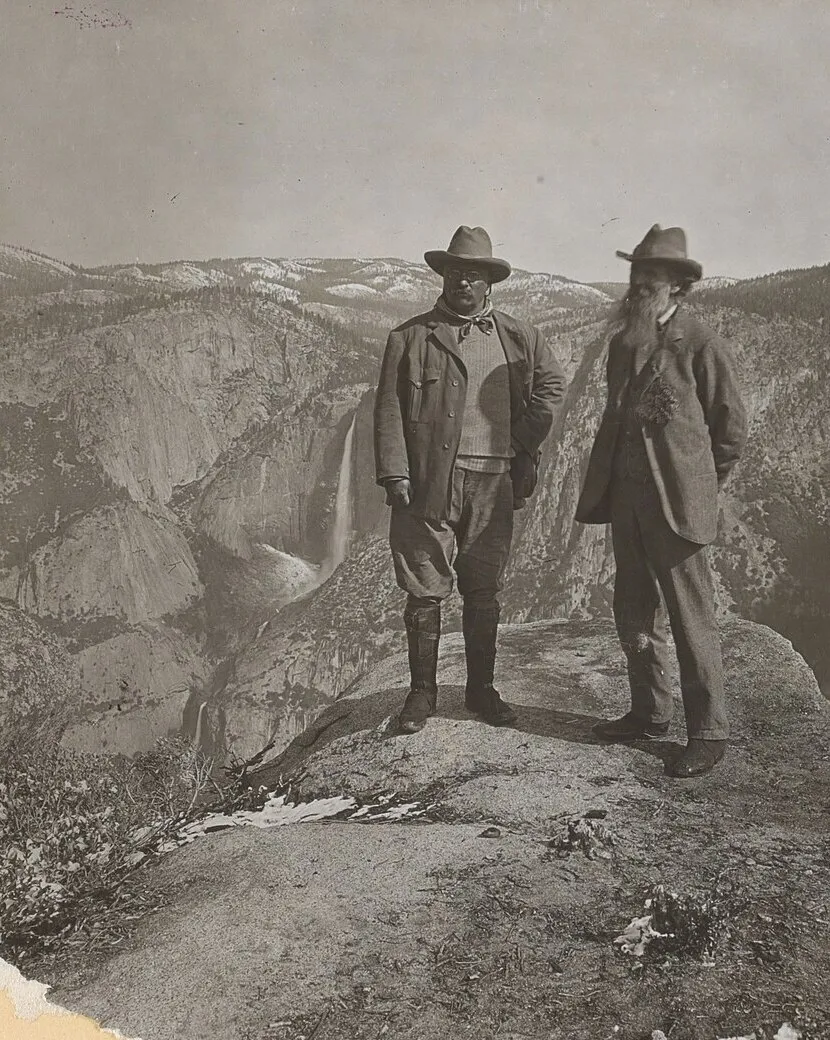
President Roosevelt and John Muir at Glacier Point during their three-day Yosemite camping trip, May 1903. (Library of Congress)
The Historic 1903 Camping Trip: Three Days That Changed a Presidency
In May 1903, President Theodore Roosevelt came to California on a speaking tour. Muir, now in his sixties and an elder statesman of the conservation movement, arranged for Roosevelt to visit Yosemite Valley. What followed was extraordinary: a three-day camping trip into the high country with Roosevelt, Muir, and a small party including a guide. They camped in the wilderness of Yosemite's backcountry, sleeping under giant sequoias and the stars, riding through landscapes of granite cliffs and mountain meadows, entirely removed from civilization and its demands.
Over those three days and nights, Muir and Roosevelt talked constantly — about nature, about philosophy, about the spiritual value of wild places, about the possibility of preserving wilderness for future generations. Muir was a passionate, poetic advocate for preservation. He showed Roosevelt not just beautiful scenery but a vision of what wild nature meant, what it offered to the human spirit, and what would be lost if America continued to treat every forest and valley as mere resources for extraction. Roosevelt, energetic and intellectually hungry, listened intently. He asked questions. He understood that he was in the presence of a genuine visionary.
Roosevelt later wrote that those days with Muir were among the most significant of his presidency. Here was a man he respected profoundly, a man whose entire life had been devoted to understanding and protecting wild nature, telling him that certain places were too sacred, too valuable, too important to the human spirit to be dammed or logged or exploited. The message took root. Within months of returning to Washington, Roosevelt accelerated his program of creating national parks and monuments. By the time he left office in 1909, he had protected approximately 230 million acres of public land — forests, canyons, mountains, and deserts that remained wild because of his decisions. Muir's influence over Roosevelt during those spring days in 1903 was profound and irreversible.
Two Different Visions of Protection
If Pinchot and Roosevelt represented "wise use" conservation — managing resources for sustainable human benefit — then Muir represented preservation in its purest form. He wanted certain landscapes locked away from human industry entirely. He believed that a forest's highest purpose might simply be standing there, offering visitors a chance to contemplate beauty and feel connected to something larger than themselves. This wasn't impractical mysticism in Muir's view; it was deeply practical. Humans needed wild places to nourish their spirits and remember their place in nature.
Despite their differences, Roosevelt and Muir shared genuine affection. Roosevelt came to support the creation of the National Parks system, which protected areas specifically for preservation rather than use — this was closer to Muir's vision than Pinchot's. But Roosevelt also supported Pinchot's National Forests, where timber could be harvested sustainably. Roosevelt believed in both approaches.

John Muir around 1875, as he was becoming the nation's most eloquent voice for wilderness. (Wikimedia Commons)

The Hetch Hetchy Valley before the dam — the Yosemite twin whose flooding Muir fought to prevent. (Wikimedia Commons)
The Breaking Point: Hetch Hetchy
Then came Hetch Hetchy, and the friendship was tested. In the 1900s, the city of San Francisco needed water. The Hetch Hetchy Valley, a wild canyon in Yosemite similar in some ways to the more famous Yosemite Valley, seemed like the perfect place for a dam. Muir opposed it vehemently. He saw this as a betrayal of everything preservation meant — to dam a wild valley for human consumption seemed to him a desecration. Pinchot and other conservationists supported the dam as a legitimate use of public resources. The battle became national news.
Roosevelt left office in 1909 before the final decision on Hetch Hetchy. Under President Woodrow Wilson, the Raker Act of December 1913 authorized the dam to be built. Muir was devastated. He spent his final years fighting the decision, but it was too late. He died in 1914, a year after the decision; the O'Shaughnessy Dam was completed in 1923 and the valley flooded in the years that followed. For Muir, it felt like a defeat for the entire preservation movement. Yet his opposition to the dam became iconic — a clarion call for protecting wild places that still resonates today.
The Sierra Club and a Movement
In 1892, before his trip with Roosevelt, Muir had founded the Sierra Club — an organization dedicated to exploring, enjoying, and protecting the Sierra Nevada and other wild lands. It remains one of America's most influential environmental organizations. Through the Sierra Club, Muir built a movement of people who shared his vision that wild nature was worth preserving for its own sake. The club didn't just advocate for protection; it took people into the mountains, showed them the beauty, and convinced them to fight for conservation.

John Muir around 1913, near the end of his life and of the losing fight over Hetch Hetchy. (Wikimedia Commons)

O'Shaughnessy Dam and the Hetch Hetchy Reservoir today, filling the valley Muir called a mountain temple. (Wikimedia Commons)
The Hetch Hetchy Dam: The Divide That Could Not Be Bridged
If the 1903 camping trip represented the high point of the Muir-Roosevelt partnership, the conflict over Hetch Hetchy Dam represented its fundamental limits. In the early 1900s, the city of San Francisco needed water. The Hetch Hetchy Valley, a spectacular canyon within Yosemite National Park, seemed the perfect location for a dam. The valley, like Yosemite Valley, was lined with dramatic granite cliffs and waterfalls. It was, in its way, as beautiful as the more famous Yosemite Valley.
Muir opposed the dam with fierce intensity. He saw it as a betrayal of everything preservation meant — a violation of the sacred principle that certain wild places must be left untouched by human industry, no matter what human benefit might result. Gifford Pinchot, Roosevelt's Chief Forester, supported the dam as a legitimate use of public resources. Providing water to a major American city was, in Pinchot's view, a perfect example of "wise use" conservation — using natural resources to serve human needs while maintaining ecological health. Pinchot and Muir, two of the greatest environmental figures of the era, found themselves on opposite sides of a question that neither could compromise on.
Roosevelt left office in 1909 before the final decision on Hetch Hetchy. Under President Woodrow Wilson, the Raker Act of December 1913 authorized the dam to be built. Muir was devastated. He spent his final years fighting the decision through lawsuits and public advocacy, but it was too late. Muir died in 1914, a year after the decision; the completed dam later flooded the valley, destroying forever the wilderness that Muir had fought to protect. For Muir, it felt like a defeat not just of his efforts but of the entire preservation movement.
A Writer's Enduring Legacy
Muir was a writer first and an activist second. His books — especially The Mountains of California, My First Summer in the Sierra, and Our National Parks — are still read today because they capture the spiritual experience of wild nature in language that profoundly moves people. He had the rare gift of making readers want to visit places they had never seen, making them understand viscerally why those places mattered, making them feel that the survival of wilderness was a moral imperative. In an age of increasing industrialization and urbanization, Muir insisted that humans needed wild places — not as commodities or even as resources, but as spiritual necessities essential to the health of the human soul.
His influence on Roosevelt proved lasting. Even after leaving office, Roosevelt came to emphasize preservation of wild spaces almost as much as wise use of resources. The two men represented fundamentally different philosophies about nature and human relationship to it, but both changed how America related to its natural heritage. Roosevelt's legacy of protected lands and Muir's legacy of environmental writing continue to inspire new generations to fight for wilderness preservation.
Continue Reading
- Gifford Pinchot: The Forester Who Shaped a Nation — Muir's philosophical rival in conservation
- Roosevelt's Conservation Legacy — How both preservation and wise-use conservation advanced
- National Parks During the Roosevelt Presidency — Muir's vision realized through federal protection
- National Monuments and Preservation — Roosevelt's use of executive authority for conservation
- Conservation Overview — The broader context of Roosevelt's environmental achievements
- Roosevelt's Post-Presidency Years — His continued environmental advocacy after leaving office
Primary Sources at the TR Center
Explore the Theodore Roosevelt Center's Digital Library for correspondence, essays, and documents about conservation, wilderness preservation, and environmental philosophy.
- Conservation Encyclopedia Section — Comprehensive essays on Roosevelt's environmental legacy and conservation philosophy
- John Burroughs and Conservation — Another influential naturalist in Roosevelt's circle
- George Bird Grinnell and Ornithology — Conservation advocacy alongside Roosevelt
- Roosevelt Biography and Life Timeline — Chronological context for Roosevelt's conservation achievements
- Bibliography on Conservation and Environmental History — Scholarly resources on preservation movements
From the Archives
Explore original photographs, documents, and illustrations related to this topic in the Theodore Roosevelt Center Digital Library.
Recommended Reading
- John Muir: The Eight Wilderness Discovery Books by John Muir (1992)
- Son of the Wilderness: The Life of John Muir by Linnie Marsh Wolfe (1945)
- Colonel Roosevelt by Edmund Morris (2010). ISBN: 978-0-679-60415-0