
The Assassination Attempt: Milwaukee, October 14, 1912
John Schrank: The Assassin's Delusions
John Schrank was a thirty-six-year-old German immigrant who had worked as a saloonkeeper in New York. But by October 1912, he was no longer a functioning member of society. He suffered from what physicians of the era termed "dementia praecox, paranoid type"—a diagnosis that modern medicine would recognize as schizophrenia with paranoid features. His mind had fractured, and in the shattered landscape of his delusions, a vivid vision had taken shape: the ghost of President William McKinley—assassinated eleven years earlier—had appeared to him in a dream. McKinley commanded him, Schrank believed, to avenge the president's death by killing Theodore Roosevelt.
Schrank had convinced himself that Roosevelt had been responsible, however indirectly, for McKinley's death. The logic of his paranoid thinking was inaccessible to rational scrutiny. What mattered was the compulsion he felt to obey the spectral command. Over the preceding weeks, Schrank had become consumed by this mission. He traveled from New York to the Midwest, following Roosevelt's campaign schedule with methodical determination. His clothes became shabby and sleep-stained. His appearance deteriorated. But his purpose became increasingly clear: he would find Theodore Roosevelt and kill him.
In his pockets, Schrank carried notes justifying his action. One referenced the two-term tradition, suggesting that Roosevelt's violation of that tradition justified assassination. Another invoked religious language, declaring in broken phrases his willingness to die for his country and his conviction that God had called him to be an instrument. The vocabulary was McKinley's, or Schrank's distorted memory of it. The belief was absolute and unshakable.

John Schrank, a delusional New York saloonkeeper, stalked Roosevelt for weeks, later claiming McKinley's ghost had ordered him to stop TR from seeking a third term. (Library of Congress)

As Roosevelt rose in his open car outside a Milwaukee hotel on October 14, 1912, Schrank fired a revolver into his chest at close range. (Wikimedia Commons)
The Shot That Didn't Stop a Bull Moose
On October 14, 1912, Theodore Roosevelt arrived at the Gilpatrick Hotel in Milwaukee, Wisconsin, on the final leg of his Bull Moose campaign. He was fifty-three years old, vigorous despite his age, campaigning with characteristic energy and determination. That evening, he had already delivered one speech to local Progressive supporters. A second address was scheduled at the Auditorium—a major speech before a large crowd of ten thousand people. Roosevelt, his usual self-confident, energetic manner intact, folded his carefully prepared 50-page typed speech manuscript and placed it in his inner right jacket pocket, directly over his heart. His steel-reinforced eyeglass case went into the same pocket, layered beneath the manuscript. The manuscript contained his most important arguments of the campaign—positions on trust-busting, labor policy, and the philosophy of the Progressive Party that he believed would persuade the American people. He descended from his suite and prepared to depart for the Auditorium.
As Roosevelt stepped into his open automobile on the street outside the hotel, a roofless seven-seat vehicle with his escorts flanking him, he stood to wave his hat at the crowd that had gathered. Elbert Martin, his secretary, was beside him. At that moment, John Schrank stepped forward from the throng. Without hesitation or apparent emotion, Schrank raised a revolver and fired a single shot at point-blank range, no more than seven feet from Roosevelt's body. The shot rang out in the Milwaukee night.
The bullet struck Roosevelt in the right breast, aimed directly at his heart. But fortune intervened in ways that would have seemed impossible had they not been proven true. The bullet's trajectory passed through Roosevelt's heavy overcoat, through his suit jacket, and then directly into the 50-page speech manuscript that was folded in his jacket pocket. The dense paper of fifty pages slowed the bullet's force dramatically. More importantly, the three-layered steel-reinforced eyeglass case that lay beneath the manuscript—its hard metal casing designed to protect his spectacles—absorbed a substantial portion of the remaining bullet's force. The projectile was significantly slowed by these unexpected barriers. The slug then tore through his vest, the webs of his suspender belt, his shirt, and his undershirt, before finally entering his chest cavity and lodging against his fourth right rib, four inches from his sternum. Had the bullet struck even a fraction of an inch differently, had it not been slowed by the manuscript and eyeglass case, it would have pierced his heart or punctured his lungs, and Roosevelt would have bled to death internally within minutes.
Roosevelt gasped and dropped into his seat without making a sound. Martin, his secretary, reacted with the reflexes of a powerful athlete. Flying through the air like a tackle, he slammed into Schrank and took him around the neck in a half nelson. Other security men piled on as they crashed to the ground. Fred Leuttisch and Alfred Girard subdued the assassin within seconds. Schrank, a weedy little man, put up no resistance. Leuttisch disarmed him and kept him from being murdered on the spot by the enraged crowd.
Delivering the Speech: "It Takes More Than That to Kill a Bull Moose"
Roosevelt was shaken but composed as he was helped from the automobile. When Dr. Terrell, his physician, discovered the bullet hole in his overcoat, Roosevelt remained calm. "He pinked me, Harry," he said to Henry Cochems, using the understated language of a man who had hunted big game across Africa and the American West. Terrell insisted he be taken immediately to Emergency Hospital. Roosevelt refused with absolute finality. "You get me to that speech," he said with a "savage rasp" to his voice. No amount of pleading from Terrell, from his aides, or from his young cousin Philip Roosevelt, serving as a campaign aide, would dissuade him. He would deliver his campaign message to the people of Milwaukee.
The automobile proceeded at parade speed through Milwaukee's streets to the Auditorium. Inside, in a holding room behind the stage, Dr. Terrell at last examined the wound. It was a ragged, dime-sized hole, bleeding slowly, about an inch below and to the right of Roosevelt's right nipple. The entire right side of his body had turned black with bruising—a massive internal injury. The bullet itself was nowhere to be found; it lay embedded against his fourth rib, a permanent resident of his chest cavity. Terrell's face showed his alarm at the severity of the wound.
Roosevelt barely acknowledged Terrell's concern. "It's all right, Doctor. I don't get any pain from this breathing," he said, inhaling deeply to demonstrate. He plastered a clean handkerchief to his chest to stanch the bleeding, pulled his shirt down, straightened his vest, and prepared to walk onstage. He was bleeding internally and externally, carrying a bullet in his heart's vicinity, but he would deliver his speech.
Henry Cochems preceded Roosevelt to announce to the crowd of ten thousand—with thousands more milling outside in the Milwaukee streets—that an assassination attempt had just been made. The announcement created shock and confusion. Voices cried "Fake! Fake!" in disbelief that anything could stop Roosevelt. Others shouted "Are you hurt?"
Roosevelt stepped to the podium and gestured for silence. His opening words, preserved in the speech transcript, became legend: "Friends, I shall ask you to be as quiet as possible. I don't know whether you fully understand that I have just been shot; but it takes more than that to kill a Bull Moose." The crowd erupted in a roar of emotion—fear, admiration, amazement. He then unbuttoned his vest and exposed his bloodstained shirt. The spreading bloodstain, larger than a man's hand, drew screams of horror from the audience. Women in the crowd shrieked. Voices called out pleading with him to sit down, to seek medical attention, to stop. But Roosevelt obliged the requests to see the wound, turning so the crowd could witness the evidence of the bullet's passage.
"I'm going to ask you to be very quiet. I'll do the best I can," he said, still breathing heavily from pain, his voice hoarse with effort.
Roosevelt reached into his jacket pocket for his speech manuscript. As he withdrew it, he noticed for the first time that it had been shot through—a double starburst of bullet perforations ran through the 50-page typescript, holes punched clean through the paper. The sight of those holes shocked him more than the blood on his hands. "You see, I was going to make quite a long speech," he said with attempted levity, a smile crossing his pale face. The folded fifty-page manuscript and the steel spectacle case in his breast pocket had slowed the bullet. He held up the damaged manuscript for the crowd to see, and a wave of wonder passed through the auditorium at how the dense paper and the eyeglass case beneath it had saved his life.
For the next eighty to ninety minutes, Roosevelt delivered a rambling, passionate address. His voice alternated between forceful and weak. A knifelike pain in his ribs forced him to breathe in short gasps. Two or three times, he appeared to totter, steadying himself against the podium. His cousin Philip approached the podium at one point, begging him to stop, but Roosevelt fixed him with a steely gray stare that sent his son retreating, helpless. Roosevelt half-read, half-improvised his speech on trust-busting and labor policies, threw down page after page as was his habit (spectators snatched them up as souvenirs), and even improvised an appeal to Senator La Follette's supporters to join the Progressive cause.
About forty-five minutes into the speech, Roosevelt asked how long he had been speaking. Upon being told approximately that amount, he announced, "I'll speak for a quarter of an hour more." In fact, he continued for well over half an hour more, his face growing increasingly pale, his voice losing strength though never losing force or moral clarity. Aides stationed themselves below the podium ready to catch him if he fell forward, while others waited onstage behind him, prepared for collapse. Finally, with no more manuscript pages in his hands, Roosevelt concluded his remarks to tumultuous applause. Only then did he turn to Dr. Terrell and say: "Now I am ready to go with you and do what you want." He had delivered his campaign message. The bullet had not stopped him.

The bullet lodged in his chest, but Roosevelt insisted on speaking. “It takes more than that to kill a Bull Moose,” he told the stunned crowd — and talked for ninety minutes. (Wikimedia Commons)

The bullet had cracked a rib and lodged near his lung. Judging it safer to leave it in place, doctors never removed it — and Roosevelt carried it the rest of his life. (Library of Congress)
Medical Crisis and a Bullet That Remained Forever
By 10 p.m., Roosevelt arrived at Milwaukee's Emergency Hospital. Before undressing for examination, he dictated a telegram to his wife Edith, assuring her that he was in "excellent shape" and that the wound was "trivial." He also took the time to instruct aides to contact Seth Bullock of Deadwood, South Dakota, with a message that he had been shot with "a thirty-eight on a forty-four frame"—technical details that mattered to a man who had spent his life hunting and studying firearms.
At Chicago's Mercy Hospital, where he was transferred by special train, a team of thoracic specialists including Dr. John B. Murphy, the nation's leading chest surgeon, carefully examined the wound and took X-rays. The bullet lay embedded against Roosevelt's fourth right rib, precisely four inches from his sternum. Had it penetrated even a fraction of an inch differently, it would have struck the pleura—the membrane surrounding the lungs—and Roosevelt would have bled to death internally within minutes. A consulting surgeon later noted with astonishment that "there was no other place on his body so thoroughly armored as the spot where the bullet struck."
The physicians debated whether to attempt surgery to remove the bullet. Their decision was unanimous and cautious: attempting to probe for and extract the bullet, which was deeply embedded and surrounded by tissue, carried greater risk than leaving it in place. The consulting doctors issued a statement that his pulse was 86, his temperature 99.2, his respiration 18. They praised his "magnificent physical condition due to his regular physical exercise and his habitual abstinence from tobacco and liquor." The bullet would remain with Roosevelt, a permanent lodger in his chest cavity, for the rest of his life.
Roosevelt insisted on demonstrating his recovery. A week after being admitted, he insisted on leaving the hospital and returning to Sagamore Hill, where he marked his fifty-fourth birthday on October 27, 1912. Still wounded, still in pain, still carrying the bullet, he announced that he would deliver another major address at Madison Square Garden on October 30. When he appeared on the platform before sixteen thousand supporters, the crowd erupted. Dowagers climbed onto their chairs and screamed. The ovation lasted more than forty minutes. Observers noticed that Roosevelt raised only his left arm to gesture—his right remained stiff and painful from the wound. But his voice filled the vast hall, and his arguments were as forceful as ever.
This second speech proved remarkably different in tone from his earlier campaign rhetoric. The rancor that had characterized his attacks on Taft and Wilson seemed to have drained away. Instead, he spoke in philosophical terms about human rights and applied Christian principles to modern social issues. A reporter noted that Roosevelt appeared "tired, then impatient" during the standing ovation but emerged with no diminution of his capacity for sustained public address.
A Bullet That Remained Forever
Roosevelt returned to campaigning within days of his recovery, continuing his vigorous schedule as if nothing had happened—though he carried the bullet with him always. To some observers, this was evidence of his extraordinary constitution and his unshakeable determination. To others, it was evidence of a recklessness, an unwillingness to acknowledge pain or danger, a quality of obsessiveness that drove him forward even when prudence would have counseled extended rest and recovery.
The assassination attempt did not dampen Roosevelt's campaign efforts or his moral clarity. If anything, it reinforced his conviction that his campaign was important enough to justify personal risk. A man willing to deliver a campaign speech with a bullet in his chest was, in Roosevelt's own view, demonstrating the seriousness with which he regarded the issues of the campaign. His willingness to endure pain and danger was a kind of testimony to the importance of what he was fighting for—and to the depth of his commitment to the Progressive cause.

The bullet had passed through his folded 50-page speech and a steel eyeglasses case in his breast pocket — which together slowed it just enough to save his life. (Wikimedia Commons)
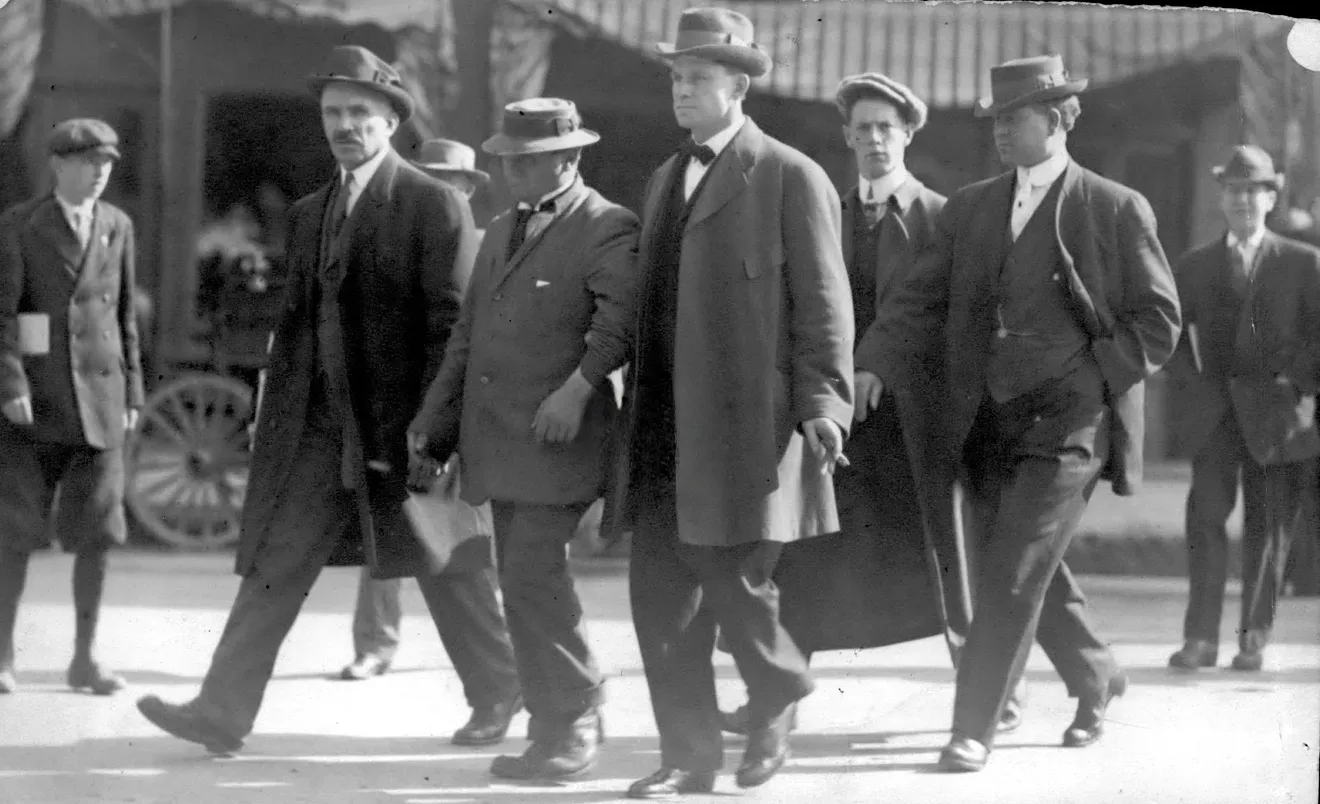
Judged legally insane, Schrank was committed to a state mental hospital, where he remained until his death in 1943. (Wikimedia Commons)
The Fate of John Schrank
John Schrank, the would-be assassin, was arrested immediately and taken into custody. If not for Roosevelt's explicit intervention, the mob surrounding him might well have lynched Schrank on the spot. But Roosevelt, immediately after being shot, ordered his attackers: "Don't hurt him. Bring him here. I want to see him." As Martin restrained Schrank with a half nelson, Roosevelt leaned from the automobile and took the delirious man's head in both hands, turning it upward to examine him. "What did you do it for?" he asked, sounding more puzzled than angry. What he saw was "the dull-eyed, unmistakable expressionlessness of insanity."
Roosevelt's compassion extended beyond that moment. Even after Schrank had shot him, even after the man had attempted to end his life, Roosevelt never spoke harshly of his would-be assassin. He understood, from the beginning, that Schrank was mentally ill rather than evil. Under interrogation at the police station, Schrank proved calm despite his bruises. He readily produced written accounts of his visions of President McKinley commanding him to act. His notebooks were filled with a bizarre mixture of paranoid reasoning and invocations of religious authority. Schrank never stood trial: a court-appointed commission of physicians found him insane, and he was committed to Wisconsin state mental hospitals — first at Oshkosh, then at Waupun — where he remained until his death in 1943.
Echoes and Significance
The assassination attempt and Roosevelt's response entered American political folklore. The image of Roosevelt, bleeding but determined, delivering his speech became iconic—evidence of his physical courage, his determination, his unwillingness to be stopped or defeated. For supporters, it was proof that Roosevelt was indeed the Bull Moose—nothing could stop him, nothing could defeat him, nothing could silence him.
For his opponents, the incident revealed something different: a kind of recklessness, an unwillingness to acknowledge limitations, a grandiosity that bordered on the pathological. A reasonable man, having been shot, would have sought immediate medical attention. That Roosevelt insisted on delivering his speech suggested a man for whom political messaging was more important than personal safety, a man whose obsessive commitment to public action overrode basic prudence.
The assassination attempt had a paradoxical effect on the final weeks of the 1912 campaign. Rather than focusing on substantive policy differences, the campaign became, to some degree, a meditation on Roosevelt's character, his courage, his determination. This probably helped Roosevelt's campaign in the short term—it reinforced his image as a man of extraordinary determination and moral clarity. All the hatred that various political factions had directed at Roosevelt was momentarily subsumed in a surge of protective admiration.
But the shooting did not alter the fundamental mathematics of the three-way race. Wilson continued to gain strength. Taft, though diminished, remained a candidate. Roosevelt, despite his heroic response to being shot, continued to split the Republican vote—and that split remained fatal to any possibility of a Roosevelt victory. On November 5, 1912, Woodrow Wilson was elected president. Theodore Roosevelt finished second nationally, but was unable to reclaim the office he had once held. The bullet that had failed to kill him politically did not change that outcome.
Continue Reading
- The Bull Moose Campaign of 1912 — The third-party insurgency that made Roosevelt a target for assassination.
- The New Nationalism — The Progressive political philosophy Roosevelt was promoting when attacked.
- The Progressive Party Platform — The radical reforms Roosevelt advocated during his 1912 campaign.
- The "Man in the Arena" Speech — His earlier articulation of the dangers of criticism without action.
- Post-Presidency Timeline — Key events of 1912 including the assassination attempt.
- Spanish-American War — Roosevelt's earlier experience in combat and courage under fire.
Primary Sources at the TR Center
The TR Center's Digital Library contains campaign materials and historical documentation from the remarkable 1912 election.
- John Schrank Encyclopedia Entry — Detailed information on the would-be assassin and the assassination attempt.
- Robert La Follette — Progressive ally Roosevelt referenced in his Milwaukee speech.
- Politics and Government — Resources on Roosevelt's 1912 campaign and political philosophy.
- Life Timeline — Chronological entry for October 14, 1912.
From the Archives
Explore original photographs, documents, and illustrations related to this topic in the Theodore Roosevelt Center Digital Library.
Recommended Reading
- The Attempted Murder of Teddy Roosevelt by Burt Solomon (2019). ISBN: 978-0-7653-9267-1
- Theodore Roosevelt and the Assassin by Gerard Helferich (2013). ISBN: 978-1-4930-0076-0
- Colonel Roosevelt by Edmund Morris (2010). ISBN: 978-0-679-60415-0