
The Bull Moose Platform: Progressive Party of 1912
A Platform Decades Ahead of Its Time
The Progressive Party platform of 1912, adopted at the party's national convention in August, represented the most comprehensive progressive vision ever offered in an American presidential election. The platform embodied Theodore Roosevelt's "New Nationalism"—his conviction that federal government had an affirmative obligation to regulate the economy, protect workers, prevent exploitation, and ensure genuine opportunity for all citizens. Many of the proposals in the platform would not become law until decades later, under Franklin D. Roosevelt or Lyndon B. Johnson. Yet in 1912, the Progressive Party was calling for these reforms when most American politicians viewed them as dangerously radical.
The platform revealed a political party that had transcended conventional Republican and Democratic categories. It embraced both business regulation and labor protection, both conservation and development, both federal power and genuine democracy. The platform articulated a vision in which government was not the enemy of democracy but the instrument through which democratic majorities could shape economic life in accordance with the general welfare.

Labor and Social Protections: Radical for 1912
The platform called for an eight-hour workday—a radical proposal in 1912, when ten-hour and twelve-hour workdays were common. It called for a minimum wage, establishing that workers had a right to compensation sufficient for basic subsistence. It called for workers' compensation laws, ensuring that workers injured on the job would receive compensation rather than being left destitute. It called for the prohibition of child labor, an idea that many business interests opposed as an inappropriate intrusion into family economic decisions.
The platform also called for social insurance—what would become known as Social Security. The platform envisioned a system in which workers and employers would contribute to a fund that would provide protection against unemployment, sickness, old age, and death. This was essentially a forerunner of the Social Security Act, which would not be passed until 1935, more than two decades after the Progressive campaign.
These labor and social protection provisions represented a fundamental reorientation of the relationship between government and the economy. Rather than viewing government as a neutral arbiter that should remain detached from economic life, the platform embraced government as an active agent ensuring that workers had dignity, protection, and a voice in the economic system.
Women's Suffrage: Early Endorsement
The Progressive Party platform called for women's suffrage—the right of women to vote. In 1912, women could not vote in most states. The major parties were divided and cautious on the question. The Progressive Party, however, embraced women's suffrage as a matter of democratic principle. The 19th Amendment, granting women the right to vote, would not be ratified until 1920, eight years after the Progressive campaign. But the Progressive Party had made women's suffrage a plank in its platform when many American politicians and voters still opposed it.


Conservation and Environmental Protection
The platform championed conservation—the protection of the nation's natural resources from exploitation by private interests. Roosevelt had made conservation a centerpiece of his presidency. Now the Progressive Party was calling for expanded protection of forests, waterways, mineral resources, and wildlife. The platform advocated for the federal government to prevent monopolistic exploitation of natural resources, to preserve wilderness areas, and to ensure that natural resources were used for the benefit of all citizens rather than the profit of a few industrialists.
Economic Reform and Anti-Monopoly Provisions
The platform called for a graduated income tax, enabling the federal government to tax wealthy individuals at higher rates than poor citizens. The 16th Amendment, ratified in 1913, would authorize the federal income tax. The platform also called for an inheritance tax, preventing the emergence of hereditary wealth and hereditary class. These provisions reflected Roosevelt's conviction that economic inequality, if unchecked, would undermine democratic government.
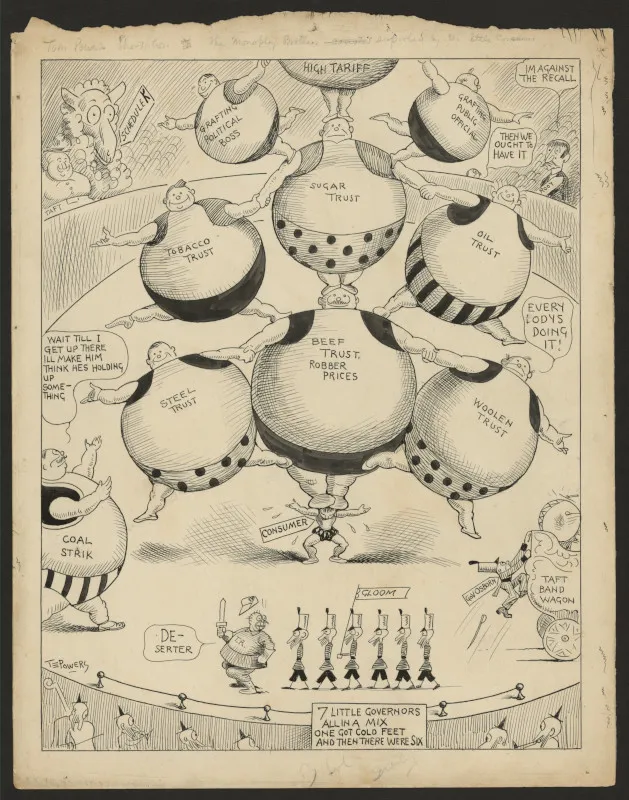
The platform advocated aggressive antitrust enforcement, the prohibition of monopolistic practices, and federal regulation of interstate commerce. It called for the direct election of senators (the 17th Amendment would be ratified in 1913), arguing that senators should be elected directly by the people rather than chosen by state legislatures. This was a genuine democratic reform, ensuring that the upper house of Congress would be responsive to popular will.

The Initiative, Referendum, and Recall: Direct Democracy
The platform called for the initiative, referendum, and recall—mechanisms for direct popular participation in government. The initiative would allow citizens to propose laws directly. The referendum would allow citizens to vote on laws passed by the legislature. The recall would allow citizens to remove elected officials who had lost their confidence. These provisions reflected the Progressive belief that democracy required genuine popular participation, not merely periodic elections.
The most radical plank of all — and the one that most scandalized contemporaries — was the recall of judicial decisions, which would have allowed voters to overturn certain state court rulings that struck down social legislation. It was this proposal, more than any other, that drove conservative allies such as Elihu Root and Henry Cabot Lodge away from Roosevelt in 1912. The platform also promised protection against "the hazards of sickness" — an early call for what would much later become national health insurance.
These provisions were controversial and remain so. Critics argued that direct democracy mechanisms could lead to mob rule, that the people could not be trusted to make wise decisions on complex policy questions. Defenders argued that representative government without mechanisms for popular participation could become unresponsive to genuine popular will, that political elites could use their control of the legislative process to ignore the wishes of ordinary citizens.
A Vision of Progressive Governance
Taken together, the Progressive platform of 1912 articulated a comprehensive vision of progressive governance. It called for a strong federal government that would regulate the economy, protect workers, conserve natural resources, and ensure genuine opportunity for all citizens. It called for genuine democracy through mechanisms of direct popular participation. It called for the regulation of corporate power and the prevention of monopoly. It called for labor protections, social insurance, women's suffrage, and environmental conservation.
Many of these proposals were enacted into law in the decades following the 1912 campaign. Some were enacted under Wilson (the women’s suffrage amendment passed Congress in June 1919 and was ratified in 1920, after TR’s death). More were enacted under Franklin D. Roosevelt and the New Deal, which essentially enacted the economic and social protections that the Progressive Party had called for in 1912. Still others—the inheritance tax, graduated income tax, conservation measures—were partially enacted but remained subjects of political controversy.

Legacy: A Blueprint for the Future
The platform’s egalitarian promise had a conspicuous limit: at the Progressive convention itself, Roosevelt and the party leadership accepted the exclusion of Black delegates from the Southern states, courting white Southern support through a “lily-white” strategy that Roosevelt defended in an open letter to the editor Julian Harris. The party that endorsed women’s suffrage and workers’ rights declined to challenge the color line in the South — a contradiction contemporaries noted and historians still weigh.
The Progressive platform of 1912 is significant not merely because it called for reforms that later became law, but because it articulated a comprehensive vision of what progressive governance could accomplish. It showed that it was possible to imagine a government that was simultaneously pro-business (in the sense of believing in economic development) and pro-labor (in the sense of believing workers deserved protection and dignity). It showed that government could be active and powerful without being tyrannical. It articulated a vision in which democracy and economic regulation were compatible, mutually reinforcing values.
Though the Progressive Party itself did not survive as a major political force—Roosevelt's 1912 campaign split the Republican vote and ensured a Democratic victory—the Progressive platform endured as a source of inspiration for subsequent reformers. Many of the ideas that the Progressive Party championed in 1912 became conventional wisdom by the 1930s and 1940s. The platform revealed that a third party could articulate a genuinely progressive vision that transcended the conventional categories offered by the major parties.
Continue Reading
- The Bull Moose Campaign of 1912 — The campaign on which Roosevelt ran this progressive platform.
- The New Nationalism — Roosevelt's foundational speech outlining progressive philosophy.
- The Milwaukee Assassination Attempt — The dramatic event that occurred during the 1912 campaign.
- Roosevelt's Presidency — His earlier progressive accomplishments as president.
- Trust-Busting and Reform — Roosevelt's approach to corporate regulation during his presidency.
- Conservation During Presidency — Environmental protection as a progressive priority.
Primary Sources at the TR Center
The Theodore Roosevelt Center's Digital Library contains the full Progressive Party platform and related campaign materials from 1912.
- New Nationalism — Encyclopedia entry on the philosophy underlying the platform.
- Politics and Government — Resources on Roosevelt's political philosophy and reform agenda.
- Frances Kellor — Progressive ally and influencer of labor platform provisions.
- Life Timeline — Chronology of the 1912 campaign and Progressive Party activities.
From the Archives
Explore original photographs, documents, and illustrations related to this topic in the Theodore Roosevelt Center Digital Library.
Recommended Reading
- Theodore Roosevelt, the Progressive Party, and the Transformation of American Democracy by Sidney M. Milkis (2009). ISBN: 978-0-7006-1667-1
- Let the People Rule by Geoffrey Cowan (2016). ISBN: 978-0-393-24984-2
- Four Hats in the Ring by Lewis L. Gould (2008). ISBN: 978-0-7006-1856-9