
Theodore Roosevelt and the Spanish-American War: America's Rise to Power
The Crisis in Cuba: Spanish Colonialism and American Interests
Cuba had been a Spanish colony for four centuries. By the 1890s, Cuban insurgents were fighting desperately for independence from Spanish rule. The Spanish government, unable to suppress the insurgency decisively, pursued increasingly brutal policies against Cuban civilians, driving them into reconcentration camps where disease and starvation killed Cubans on a scale estimated in the low hundreds of thousands. The warfare was savage and destructive. Hundreds of thousands of Cubans were killed or displaced from their homes and farms. American newspapers covered the conflict extensively, often in language that was inflammatory and one-sided—some accounts were exaggerated, some accurate, but all fueled American outrage at Spanish conduct. American readers saw vivid images and accounts of Spanish brutality in their daily papers. American public opinion shifted markedly toward supporting Cuban independence. And American business interests, which had significant investments in Cuban sugar plantations, mining operations, and other enterprises, were threatened by the continuing warfare and instability.
President William McKinley, a cautious man who preferred diplomacy and feared the consequences of war, initially sought to resolve the Cuban question through patient negotiation with Spain. He sent diplomatic envoys to Madrid. He urged the Spanish government to grant Cuba autonomy or independence. Spain, proud and unwilling to admit defeat to American pressure, resisted American diplomatic overtures. The situation deteriorated rather than improved. Spanish forces in Cuba appeared unable to defeat the insurgency, yet Spanish pride prevented acceptance of any solution that appeared to be American dictation.

The Maine and American Outrage
On February 15, 1898, the American battleship USS Maine exploded catastrophically in Havana harbor. The explosion was sudden and violent, tearing the warship apart in a shower of fire and twisted metal. Two hundred sixty-six American sailors died in the blast—young men far from home, killed in a single instant of destruction. The cause of the explosion was never definitively established. The U.S. Court of Inquiry concluded that an external mine had detonated the Maine's forward magazine, but it could not determine who had planted the mine or whether the explosion was intentional or accidental. It was possible that the Maine's own munitions had detonated due to fire or accident. Spanish officials vigorously denied responsibility. But American public opinion was inflamed beyond reason. Newspapers across the country proclaimed Spanish guilt without evidence. "Remember the Maine!" became a rallying cry that swept across America. The explosion, whether caused by Spain or not, became the immediate psychological trigger that pushed American public opinion toward military action.
Theodore Roosevelt, advocating forcefully for war, made his views crystal clear. In speeches and interviews, he argued that Spanish rule in Cuba was intolerable and that American military action was morally necessary and strategically unavoidable. He used his position as Assistant Secretary of the Navy to prepare the Navy for combat, issuing orders that positioned naval squadrons for rapid deployment, ensuring ammunition and coal supplies, and preparing battle plans. He lobbied his superiors and friendly members of Congress for war authorization, believing that American power should be used to end Spanish colonialism. When war authorization came before Congress in April 1898, Roosevelt was one of the most visible and vocal supporters of military action.
The Path to War: Congressional Action and McKinley's Decision
In April 1898, President McKinley asked Congress for the authority to use military force to resolve the Cuban situation. Congress passed a joint resolution on April 19, 1898, authorizing McKinley to use military force. The resolution included a provision—the Teller Amendment—stating that the United States did not seek to annex Cuba but supported Cuban independence. On April 20, McKinley signed the resolution. Spain responded by severing diplomatic relations and, on April 23, declared war on the United States. Congress formally declared war on April 25, retroactively dating the declaration to April 21.
The war was officially begun. American military forces—regular Army, National Guard units, and volunteer regiments like the Rough Riders—began mobilizing and deploying to Cuba and other potential theaters of combat. The American Navy, including the ships whose construction Roosevelt had advocated for when he was Assistant Secretary, prepared for combat against Spanish forces.


The War in the Caribbean: Cuba and Puerto Rico
American ground forces, commanded by General William Shafter, began landing in Cuba in June 1898. The Rough Riders, the volunteer cavalry regiment under Roosevelt's leadership, were part of the invasion force. Roosevelt had resigned from his position as Assistant Secretary of the Navy to lead them, believing that if war was to be fought, he should fight. The campaign was brief but intense and brutal. American forces defeated Spanish armies that were weakened by tropical disease and supply shortages. American forces laid siege to Santiago de Cuba, the major Spanish stronghold in Cuba, trapping Spanish forces in the city. The Battle of San Juan Hill on July 1, 1898, was the most famous engagement of the war and the one that made Roosevelt a national hero, but it was only one battle in a campaign that involved thousands of soldiers, multiple engagements, tropical disease, and logistical struggles.
Spanish forces in Cuba, under siege and cut off from reinforcement by American naval superiority, surrendered in July 1898. American forces also invaded Puerto Rico in the same month and quickly overcame Spanish resistance. In both cases, American military superiority—particularly American naval superiority, which had been created through naval expansion authorized by Congress largely due to Roosevelt's advocacy as Assistant Secretary—made the outcome inevitable. Spain, maintaining a weak and aging navy and unable to reinforce its Caribbean forces, could not sustain meaningful resistance to American military power.
"Above all, let us shrink from no strife, moral or physical, within or without the nation, provided we are certain that the strife is justified, for it is only through strife, through hard and dangerous endeavor, that we shall ultimately win the goal of true national greatness."
— "The Strenuous Life," Hamilton Club, Chicago, April 1899, reflecting on the nation's new responsibilities after the war
The War in the Pacific: The Philippines and Guam
While American forces were defeating Spain in the Caribbean, American naval forces in the Pacific were achieving an even more significant victory. Commodore George Dewey, commanding the Asiatic Squadron, had received orders from Roosevelt (issued when Secretary Long was away from his office) to prepare for offensive operations in the Philippines. When war came, Dewey moved on the Spanish fleet in Manila Bay. On May 1, 1898, the American fleet defeated the Spanish fleet in a one-sided naval engagement that lasted only hours. Spanish losses were catastrophic. American losses were minimal.
Dewey's victory at Manila Bay made the Philippines an American objective. American forces landed in the Philippines and occupied Manila. Guam, another Spanish possession in the Pacific, was also occupied by American forces. The American Navy, now superior to the Spanish fleet, dominated both the Caribbean and the Pacific. American control of the seas meant that Spain could not reinforce or resupply its forces, and American military victory was inevitable.


The Treaty of Paris and American Imperialism
Spain, recognizing that it could not defeat American military power, sought to end the war on the best terms possible. Peace negotiations began in October 1898 and resulted in the Treaty of Paris, signed on December 10, 1898. Under the treaty, Spain relinquished sovereignty over Cuba (which, under the Teller Amendment, was to become independent rather than an American possession), ceded Puerto Rico to the United States, ceded Guam to the United States, and ceded the Philippines to the United States for a payment of $20 million.
The acquisition of the Philippines was controversial. The Philippines were thousands of miles from American territory, with a population of millions of people who had no desire to be American possessions. American anti-imperialist opponents—including Mark Twain, Andrew Carnegie, William Jennings Bryan, and others—argued that acquiring the Philippines violated American principles and would entangle America in imperial rivalries in Asia. But President McKinley and the Republican Congress were committed to American expansion. The treaty was ratified by the Senate, and the Philippines became an American possession.
The Long War: Insurgency in the Philippines
What few Americans understood at the time was that the Spanish-American War was not really over. The war with Spain was short—under four months of combat, resulting in American victory. But American occupation of the Philippines triggered a long insurgency. Filipino nationalists, who had been fighting for independence from Spain, now fought for independence from the United States. The Philippine-American War lasted from 1899 to 1902 (officially; some fighting continued longer), involved tens of thousands of American soldiers, and resulted in tens of thousands of Filipino deaths. It was a brutal conflict, quite different from the brief, victorious Spanish-American War.
Theodore Roosevelt, as President beginning in 1901, oversaw American policy in the Philippines. He supported the suppression of the Filipino insurgency and the maintenance of American control of the islands. He promoted American settlement and development of the Philippines. He believed that American rule was beneficial to the Philippine people, even if imposed by force. This paternalistic view of American imperial responsibility was common among American imperialists of the era, but it has been criticized by historians who see it as a rationalization for imperial conquest.
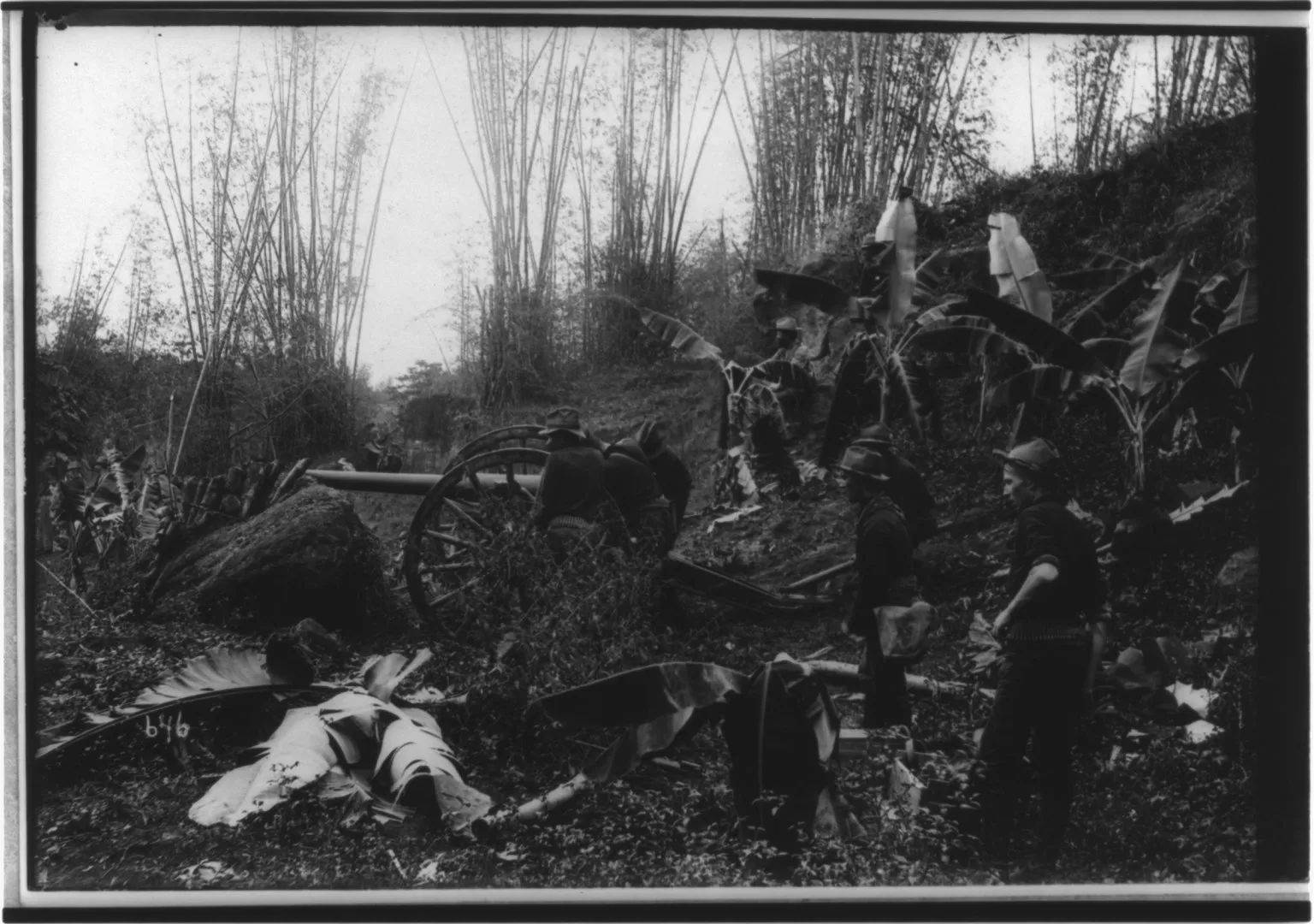
Victory over Spain gave the United States the Philippines — and a brutal three-year war against Filipinos seeking independence, in which thousands of Americans and far more Filipinos died. (Library of Congress)
The Transformation of America
The Spanish-American War transformed America from a continental power to a global power with imperial possessions on multiple continents. American military victory proved the strength of the American Navy. American acquisition of Caribbean and Pacific territories gave America global strategic interests. American political leaders, including Theodore Roosevelt, were now thinking about American interests on a global scale. The war accelerated the development of American naval power, the construction of naval bases and coaling stations, and the strategic planning that would characterize American foreign policy for decades to come.
For Theodore Roosevelt personally, the Spanish-American War provided the opportunity to demonstrate personal courage, to participate in military combat, and to emerge as a national hero. The war was the platform that launched him toward the presidency. Without the Spanish-American War and Roosevelt's prominent role in it, Roosevelt's political trajectory would have been quite different. The war also influenced his subsequent thinking about American power and American responsibility. Roosevelt believed that America had a duty to exercise power responsibly on a global stage. That conviction would shape his presidency and his approach to American foreign policy.
Continue Reading
- The Rough Riders Regiment — The volunteer cavalry unit Roosevelt led
- The Battle of San Juan Hill — The famous cavalry charge that made Roosevelt a hero
- Assistant Secretary of the Navy — Roosevelt's role in planning the war
- Governor of New York — His rapid political ascent after the war
Primary Sources at the TR Center
Explore original documents and resources related to this topic in the Theodore Roosevelt Center Digital Library.
- The Rough Riders Book — Roosevelt's firsthand account of the war and the regiment
- Spanish-American War Timeline — Key dates and events from the conflict
- The Crowded Hour — Documentary resource on San Juan Hill
- Politics and Government Encyclopedia — Roosevelt's governmental roles and policies
From the Archives
Explore original photographs, documents, and illustrations related to this topic in the Theodore Roosevelt Center Digital Library.
Recommended Reading
- The Rise of Theodore Roosevelt by Edmund Morris (1979). ISBN: 978-0-307-77782-9
- The Crowded Hour: Theodore Roosevelt, the Rough Riders, and Lessons of Leadership by Clay Risen (2019). ISBN: 978-0-385-54582-3
- The Spanish-American War: 1898 by Joseph E. Gould (1981)