
Roosevelt's Foreign Policy: America Takes Its Place Among Nations

President Theodore Roosevelt at his White House desk. He directed an assertive foreign policy that lifted the United States into the front rank of world powers. (Library of Congress)
From Isolation to Engagement
When Theodore Roosevelt became president in 1901, American foreign policy was still fundamentally shaped by George Washington's Farewell Address. We minded our own business. We avoided "entangling alliances." We didn't meddle in European affairs, and we expected Europe to stay out of the Western Hemisphere. It was a comfortable policy for a young nation still building its strength. But by Roosevelt's time, America had grown into a continental giant with an industrial economy, a blue-water navy, and interests that spanned the Pacific. The old policy of isolation no longer fit an America that was ready to claim its place as a world power.
Roosevelt transformed American foreign policy by embracing what he called "active participation in world affairs." This wasn't imperialism in the crude sense of conquest. Rather, it was a belief that America, as a great power, had both the right and the responsibility to shape world events according to American interests and American values. "Speak softly and carry a big stick," as Roosevelt liked to say. Listen carefully to what others are saying. Be measured and thoughtful. But make absolutely sure your nation has the military power to enforce its will if negotiation fails. Roosevelt believed that American power could be a force for good in the world—preventing chaos, promoting stability, and advancing democratic principles—if deployed wisely and backed by genuine military capability.
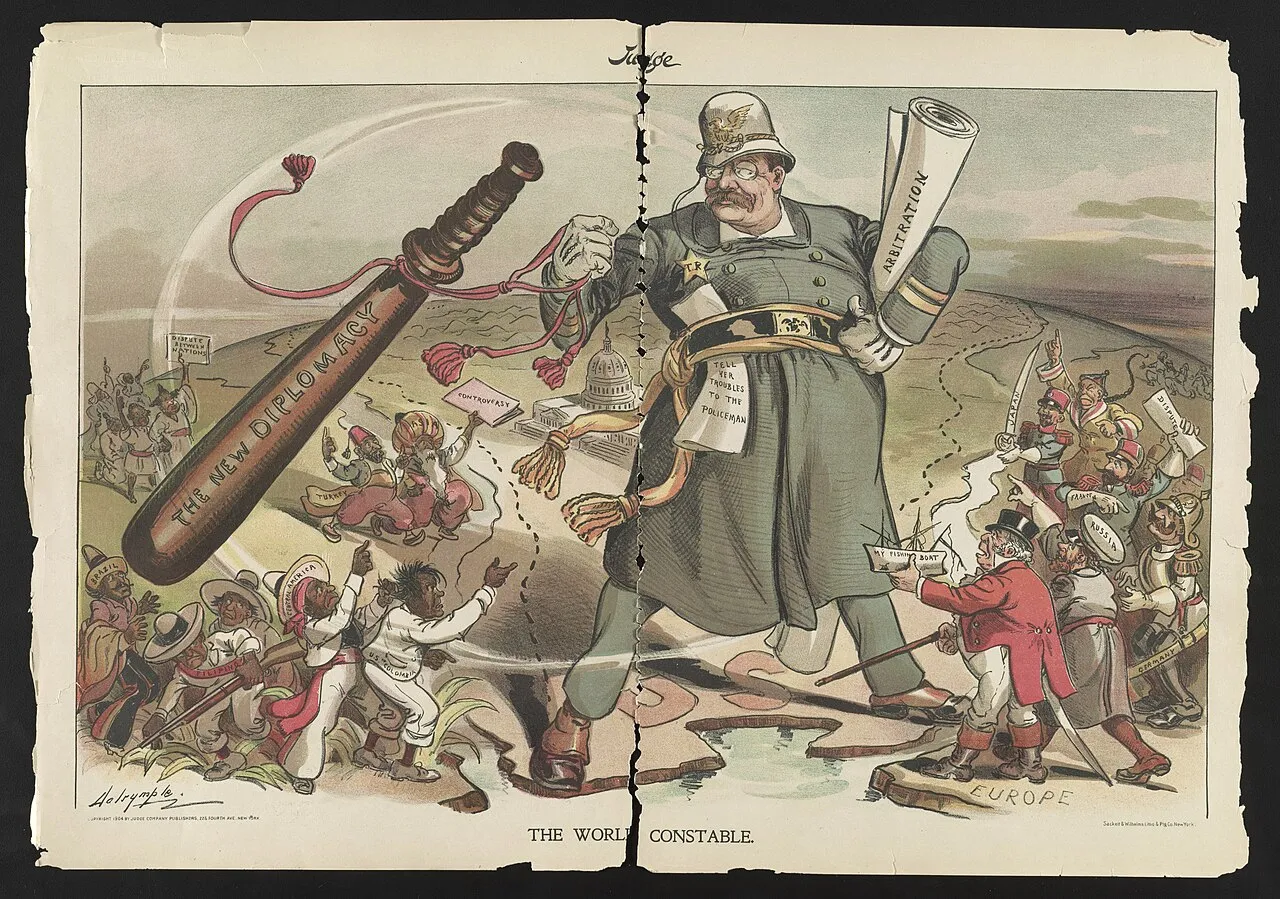
'The World's Constable,' a 1905 cartoon by Louis Dalrymple, casts Roosevelt as a global policeman wielding his 'big stick' among the great powers. (Library of Congress)

A cartoon on the 1906 Algeciras Conference, where Roosevelt helped mediate the Franco-German crisis over Morocco and steady the European balance of power. (Library of Congress)
Realpolitik and the Balance of Power
Roosevelt's foreign policy combined idealism with realpolitik—the hard-headed assertion of national interest. He believed America should promote democracy, the rule of law, and fair dealing. But he equally believed that national survival and prosperity must guide policy decisions. When national interest and idealistic principles conflicted, national interest won. This pragmatism distinguished Roosevelt from later American idealists who would attempt to reshape the world according to abstract principles.
Roosevelt also understood that international stability required a balance of power among great nations. He didn't want Germany to dominate Europe, nor did he want Russia to control all of Asia. He supported England's naval supremacy as preferable to German dominance. He worked to balance Japanese expansion with British and American power. This sophisticated understanding of international relations reflected Roosevelt's voracious reading in history and political theory. He believed presidents had to be students of history and strategy, not merely politicians or lawyers.
The Building Blocks of American Power
Roosevelt understood that foreign policy rests on military strength. He inherited a small navy and made it his mission to build a formidable force that could project American power across two oceans. He pushed Congress for funding to construct new battleships. He reorganized naval strategy and tactics. He promoted able officers and modernized naval technology. By the end of his presidency, the American Navy ranked among the two or three largest in the world, and American naval power was a fact that other nations could not ignore.
Roosevelt also recognized that geographic advantage mattered. Control of the Panama Canal would allow American warships to move quickly between the Atlantic and Pacific without sailing around South America. Control of strategic bases in the Caribbean and the Pacific would extend American reach. The Philippines, seized from Spain during the Spanish-American War, gave America a foothold in Asia. Roosevelt used these geographic advantages to build a system of American power projection that was unprecedented in American history.
But military might alone was not enough. Roosevelt believed in using diplomacy, arbitration, and negotiation to settle international disputes. This wasn't weakness—it was strength used wisely. When Japan and Russia went to war in 1904, Roosevelt offered to mediate. When other nations wanted to intervene in Latin America to collect debts, Roosevelt asserted American authority to prevent such intervention. The "big stick" wasn't always swung. Often, the mere existence of the stick was enough to shape negotiations.

Roosevelt aboard a U.S. warship during a naval review. His expansion of the Navy made sea power central to America's emergence as a world force. (Harvard College Library)

'The Big Stick in the Caribbean Sea,' a 1904 cartoon by William Allen Rogers, illustrates the Roosevelt Corollary and U.S. dominance of the hemisphere. (Wikimedia Commons)
The Roosevelt Corollary: A New Hemisphere Doctrine
In December 1904, Roosevelt announced his interpretation of the Monroe Doctrine. The original Monroe Doctrine, proclaimed nearly a century earlier, warned European powers to stay out of the Western Hemisphere. Roosevelt expanded this concept dramatically. Not only would the United States prevent European powers from intervening in the Americas, but America itself would intervene whenever necessary to maintain order and prevent other powers from stepping in. The United States, in effect, claimed the right to be the hemisphere's policeman. "Chronic wrongdoing" by Latin American nations—political instability, failure to pay debts, internal chaos—gave the United States the right to intervene to restore order and protect its interests.
This Roosevelt Corollary was controversial then and remains controversial now. It became the justification for American interventions throughout Latin America during the 20th century. Marines landed in Nicaragua, Haiti, and the Dominican Republic. American power was asserted over much smaller neighbors, ostensibly to restore order but often to protect American business interests. To Roosevelt, this was necessary to maintain American security and prevent European interference. To Latin Americans, it looked like imperialism dressed up in the language of hemispheric protection. The Corollary arguably did more damage to American relations with Latin America than any other Roosevelt policy. It bred resentment, created memory of American interference that persisted for decades, and contributed to Latin American anti-American sentiment throughout the twentieth century.
"It is not the critic who counts... The credit belongs to the man actually in the arena, whose face is marred by dust and sweat and blood." — Theodore Roosevelt
The Panama Canal: Executive Audacity in Foreign Policy
Roosevelt's boldest foreign policy move was acquiring the Panama Canal Zone and beginning canal construction. An American-controlled canal connecting the Atlantic and Pacific oceans had long been a strategic dream. The route across the Isthmus of Panama offered advantages over rival routes through Nicaragua. But Panama was a province of Colombia, and Colombian leaders were reluctant to grant American control without substantial compensation. When negotiations stalled, Roosevelt took what he later described as audacious action. He supported Panamanian independence. When Panama declared independence in 1903, American naval forces ensured that Colombian troops could not suppress the movement. Within days, the new Panamanian government signed a treaty granting America control of the canal zone.
The canal's strategic importance was immense. American naval power could now operate freely between oceans. Trade could move more efficiently between coasts. American commerce would benefit from the shorter shipping routes. The construction itself was an engineering marvel that commanded world attention and demonstrated American technological prowess. For better or worse, the Panama Canal became the defining symbol of American power projection in the early 20th century.

President Roosevelt at the controls of a steam shovel at the Culebra Cut in 1906, dramatizing his hands-on drive to build the Panama Canal. (Library of Congress)

'We are fighters for peace': Roosevelt (center) with the Russian and Japanese envoys whose 1905 Treaty of Portsmouth won him the Nobel Peace Prize. (Library of Congress)
Mediation and the Nobel Peace Prize
Yet Roosevelt's foreign policy was not all about military assertion. In 1904, Japan and Russia went to war. By 1905, both nations were exhausted. Roosevelt offered to mediate. He invited diplomats from both nations to Portsmouth, New Hampshire, where they negotiated the Treaty of Portsmouth in August-September 1905. While neither side got everything it wanted, the treaty ended the war and restored peace to northeast Asia.
For this achievement, Roosevelt became the first American citizen to win the Nobel Peace Prize. It was a remarkable honor that reflected global recognition of America's emergence as a major diplomatic player. The same man who wielded the big stick could also serve as peacemaker when circumstances demanded. This duality—strength combined with diplomatic skill—was central to Roosevelt's vision of American foreign policy.
The Great White Fleet Circles the Globe
In 1907, Roosevelt dispatched sixteen battleships painted white on an unprecedented voyage around the world. Departing from Hampton Roads, Virginia, in December 1907, the Great White Fleet would sail some 43,000 miles over 14 months, visiting six continents and 20 ports. The voyage was partly a show of American naval power—a demonstration to Japan and other nations that America could project force globally. It was partly a training exercise for the Navy. And it was partly a peacetime mission of goodwill that showed American ships and sailors to the world.
The Great White Fleet returned in February 1909, just weeks before Roosevelt left office. The voyage had accomplished everything Roosevelt intended. The world had witnessed American naval power. Japan had received a clear signal of American strength in the Pacific. And the American Navy had gained experience in long-distance operations that would serve it well in future decades.

Ships of the Great White Fleet fire salutes at a naval review. Roosevelt sent the battleship fleet around the globe in 1907-1909 to display American power. (Library of Congress)
The Legacy of Roosevelt's Foreign Policy
Roosevelt's approach to foreign policy established patterns that would shape American statecraft for a century. The belief that America, as a great power, has the right and responsibility to intervene in world affairs became mainstream American thinking. The assertion of executive power in foreign policy—the president's ability to act boldly without waiting for Congressional authorization—became normalized. The use of military power as an instrument of diplomatic pressure became standard practice.
Critics have argued that Roosevelt's foreign policy set the stage for American interventionism and imperialism. Defenders have argued that his strength and diplomatic skill prevented worse outcomes and promoted American interests effectively. What's beyond dispute: Roosevelt transformed America from a peripheral actor on the world stage into a central player in international affairs. For good or ill, that transformation defined American foreign relations for the entire 20th century and beyond.
Continue Reading
- The Roosevelt Corollary to the Monroe Doctrine — American intervention and hemispheric dominance
- The Panama Canal — Roosevelt's boldest foreign policy achievement
- The Nobel Peace Prize — Mediating the Russo-Japanese War
- The Great White Fleet — Global naval demonstration of American power
Primary Sources at the TR Center
Explore original documents and resources related to this topic in the Theodore Roosevelt Center Digital Library.
- Roosevelt's Foreign Policy and Diplomacy — Speeches and writings on American power and international relations
From the Archives
Explore original photographs, documents, and illustrations related to this topic in the Theodore Roosevelt Center Digital Library.
Recommended Reading
- The Big Stick: The Limits of Soft Power and the Necessity of Military Force by Eliot A. Cohen (2016)
- Theodore Roosevelt: A Life by Nathan Miller (2011). ISBN: 978-0061340382
- The Colossus: The Rise and Fall of the American Empire by Niall Ferguson (2004). ISBN: 978-0465023219