
The Great White Fleet: A Voyage Around the World Announces American Power
An Audacious Idea Takes Shape
In late 1907, Theodore Roosevelt made a decision that would demonstrate American naval power to the world in a way no previous action had done. He would send the United States Navy's newest battleships—sixteen of them, painted brilliant white—on a circumnavigation of the globe. The Great White Fleet, as it would become known, would be the greatest naval undertaking since the Spanish-American War. It would take fourteen months, cover some 43,000 miles, visit six continents and twenty ports, and introduce the world to American naval power in unmistakable terms.
The Great White Fleet was characteristically Rooseveltian: bold, dramatic, and designed to make a point. The point was simple: America was now a world power with global reach and formidable military capability. Other nations—particularly Japan, with whom Roosevelt had complex relations—needed to understand that American naval power was not limited to Atlantic waters or hemispheric concerns. The American Navy could project force anywhere on the globe.
Roosevelt was not content to simply announce American power. He wanted to demonstrate it. Seeing is believing, Roosevelt believed. When the people of Japan, Brazil, Egypt, and Australia saw American battleships in their harbors, commanded by capable American officers and crewed by thousands of American sailors, they would understand the reality of American strength in ways that diplomatic notes and newspaper articles could never convey.

President Roosevelt with Rear Admiral Robley “Fighting Bob” Evans, who commanded the fleet on the first leg of its voyage. (Harvard College Library, Theodore Roosevelt Collection)

Roosevelt reviews the fleet — the sixteen battleships he pushed a reluctant Congress to fund and send around the world. (Harvard College Library, Theodore Roosevelt Collection)
Congress Reluctantly Funds Roosevelt's Vision
Congress, however, was skeptical. The voyage would be expensive—millions of dollars for fuel, supplies, and personnel. Some members of Congress questioned whether the expenditure was justified. Couldn't American naval power be demonstrated in a less expensive way? Congress was reluctant to appropriate funds for what some viewed as a grandiose and wasteful gesture.
Roosevelt responded with characteristic boldness. He told Congress that he had sufficient funds to send the fleet halfway around the world. Congress could fund the return trip if it wanted the fleet to come home, or it could refuse funding and leave the American Navy stranded on the other side of the world. Of course, Congress had no choice but to fund the return voyage. Roosevelt had called Congress's bluff. The Great White Fleet would sail.
This episode exemplified Roosevelt's understanding of presidential power and his willingness to maneuver Congress into supporting his objectives. Technically, Congress controlled appropriations. Practically, Roosevelt had forced Congress's hand by creating a situation in which the most politically costly option for Congress was to refuse to fund the return voyage. By threatening to leave an expensive fleet stranded on the other side of the world, Roosevelt compelled Congressional support for his ambitious vision.
The Voyage Begins
On December 16, 1907, the Great White Fleet departed from Hampton Roads, Virginia, under the command of Rear Admiral Robley "Fighting Bob" Evans. Sixteen battleships painted white, with thousands of sailors aboard, set sail for a voyage that would take them around the world. The fleet's route would take it through the Caribbean to Brazil, around Cape Horn to South America's Pacific coast, across the Pacific to visit Hawaii, the Philippines, Japan, and other Asian ports, then through the Suez Canal, with stops in Egypt and the Mediterranean, before returning to the Atlantic.
Command changed hands mid-voyage: Rear Admiral Robley Evans, his health failing, was relieved at San Francisco, and Rear Admiral Charles Sperry led the fleet across the Pacific and home. The route was deliberately designed to demonstrate American presence in strategically important regions. The Philippines stop was particularly important—America's newest Pacific possession needed to see American naval power in force. The stop in Japan was even more significant. American-Japanese relations were complicated and somewhat tense. Roosevelt wanted the Japanese government and people to understand American naval capability in Asian waters. A visit from the Great White Fleet would accomplish this objective in unmistakable terms.
So far from being in any way a provocation to war, an adequate and highly trained navy is the best guaranty against war, the cheapest and most effective peace insurance.
— Theodore Roosevelt, First Annual Message to Congress, December 3, 1901

The Great White Fleet is sent off from Hampton Roads, Virginia, in December 1907 at the start of its round-the-world cruise. (Harvard College Library, Theodore Roosevelt Collection)
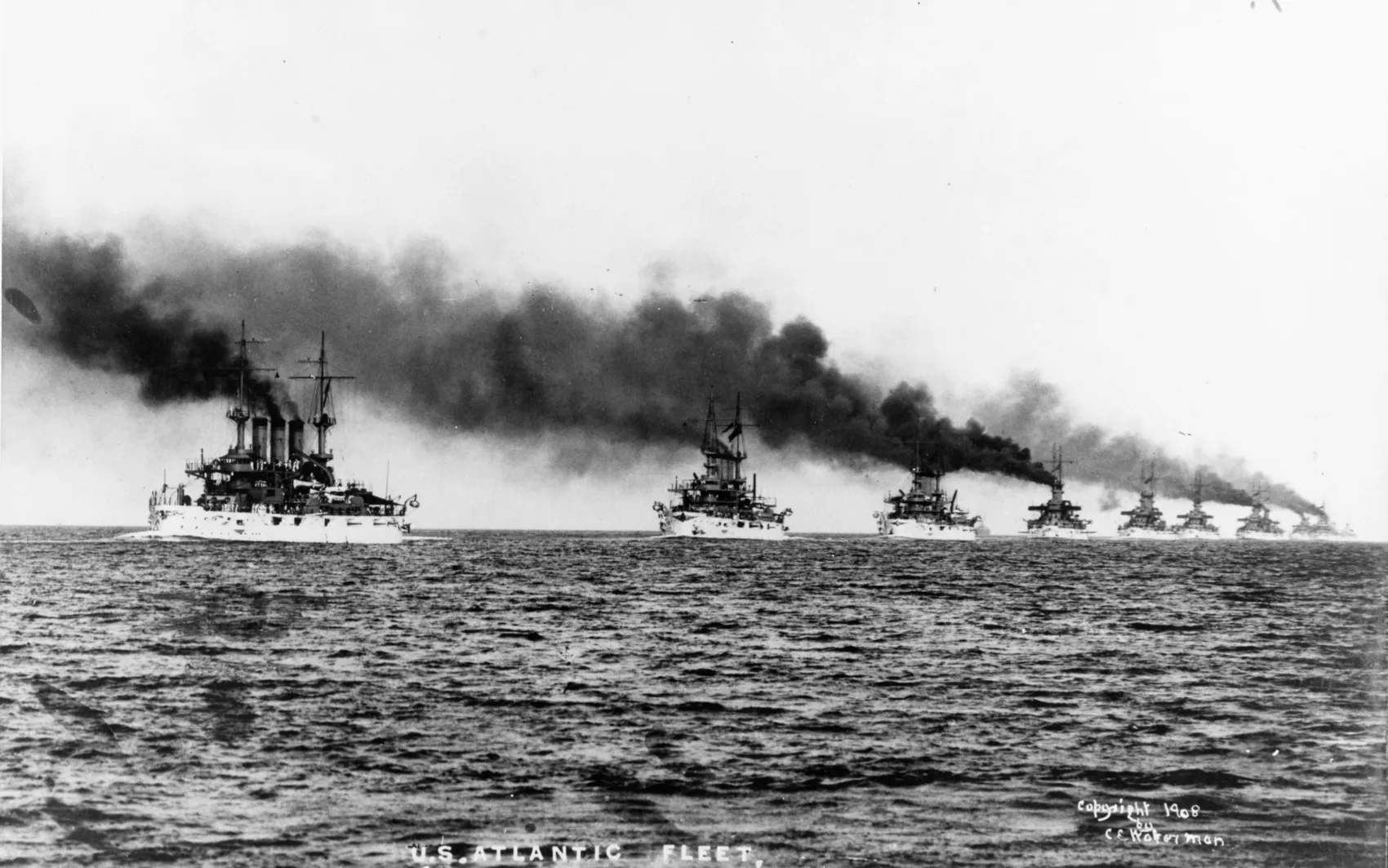
The United States Atlantic Fleet steams in column — sixteen white battleships that carried American power 43,000 miles around the globe. (Public domain)
A Fleet in Motion
As the Great White Fleet sailed around the world, it attracted enormous attention. Newspapers followed its progress with fascination. Mayors in ports of call organized official receptions. Scientists marveled at the naval technology on display. Citizens in distant lands got a concrete sense of American power that abstract discussions of American strength could never convey.
The voyage was not without challenges. There were mechanical breakdowns. There were supply difficulties in distant ports. There were occasional tensions with local governments that had to be managed diplomatically. But overall, the fleet proceeded on schedule and successfully accomplished all of its objectives. The sailors gained experience in long-distance ocean operations. Naval officers perfected tactics and strategy. The American public took pride in witnessing their Navy's global reach.
The stop in Japan was particularly significant. Roosevelt had worried about potential tensions, but the Japanese government and people received the Great White Fleet with warmth and hospitality. The fleet's arrival in Japan was celebrated with elaborate ceremonies and official receptions. Japanese citizens came out to see the American battleships. Japanese officers toured the American ships and were impressed by their quality and crew preparation. The visit demonstrated to Japan that America and Japan could cooperate despite their rivalry, and it made clear to both nations that they were rough equals in naval power in Asian waters.
Returns in Triumph
The Great White Fleet returned to Hampton Roads on February 22, 1909—just two weeks before Roosevelt left office. Roosevelt was present to greet the returning ships, and the homecoming was celebrated with ceremonies and public celebration. The fleet had accomplished what Roosevelt intended. It had demonstrated American naval power to the world. It had shown that American ships could operate far from home for extended periods. It had publicized American strength and American commitment to global affairs.
The voyage had served multiple purposes simultaneously. It was partly strategic theater—an announcement of American power designed to influence how other nations understood and responded to American interests. It was partly a training exercise—the Navy had gained invaluable experience in operating a fleet at great distances from home ports. It was partly diplomatic—the stops in foreign ports had created opportunities for American sailors and officers to meet foreign citizens and demonstrate American values and character. And it was partly a demonstration of American technological capability and industrial prowess.

The Great White Fleet returns home, entering Chesapeake Bay in February 1909 after fourteen months and 43,000 miles at sea. (Harvard College Library, Theodore Roosevelt Collection)

Sailors and a ship's band assemble on deck beneath the flags — the ceremony and spectacle that made the fleet a floating symbol of American power. (Library of Congress)
The Meaning of a Floating Symbol
The Great White Fleet demonstrated Roosevelt's understanding of how power works in international relations. Military strength matters, but how nations understand and perceive that strength also matters. By sending the fleet around the world, Roosevelt was not merely announcing American power—he was demonstrating it in vivid, concrete, unmistakable terms. Other nations could see American ships, observe American sailors, and understand the scale of American naval capability in direct sensory ways that diplomatic papers could never achieve.
The fleet also represented American industrial capacity. The ships had been built in American shipyards using American technology and American materials. The ships were powered by American engines and equipped with American weapons. The fleet represented not merely military might but also the industrial and technological prowess that American power ultimately rested upon. A nation that could build and operate a fleet like this was not merely powerful in military terms but also advanced in technology and industrial organization.
Legacy and Lessons
The Great White Fleet became one of Roosevelt's most enduring achievements, remembered and celebrated long after other aspects of his presidency faded from public consciousness. The voyage symbolized American emergence as a global power. It demonstrated that America was not content to remain in its hemispheric sphere but intended to operate globally. It established a precedent for American naval presence and projection in distant waters.
The Great White Fleet also illustrated Roosevelt's willingness to use creative means to achieve his political objectives. When Congress was reluctant to appropriate funds, he maneuvered them into supporting his vision. When other means of demonstrating American power might have been more subtle or less expensive, he chose the most dramatic and visible demonstration possible. This willingness to push boundaries and force outcomes would become controversial in later assessments of Roosevelt's legacy, but it was effective in achieving his immediate objectives.
The voyage occurred near the end of Roosevelt's presidency, giving way to his successor William Howard Taft. But the image of the Great White Fleet remained powerful in American memory—sixteen battleships painted white, sailing around the world, announcing to every nation that America was now a true world power with the will and capability to project force globally. That image, more than many speeches or policy announcements, defined how Americans understood their nation's place in the world at the beginning of the 20th century.
Continue Reading
- Roosevelt's Foreign Policy — America's role as a world power
- The Nobel Peace Prize — Diplomacy balanced with military strength
- The Panama Canal — Strategic control of global shipping routes
Primary Sources at the TR Center
Explore original documents and resources related to this topic in the Theodore Roosevelt Center Digital Library.
- Roosevelt's Naval Policy and the Great White Fleet — Speeches and writings on American naval power
From the Archives
Explore original photographs, documents, and illustrations related to this topic in the Theodore Roosevelt Center Digital Library.
Recommended Reading
- Theodore Roosevelt and the Great White Fleet: American Sea Power Comes of Age by Kenneth Wimmel (1998)
- The Big Stick: The Limits of Soft Power and the Necessity of Military Force by Eliot A. Cohen (2016)
- Theodore Roosevelt: A Life by Nathan Miller (2011). ISBN: 978-0061340382