
The Nobel Peace Prize: When the Warrior Became a Peacemaker
War in the Far East
In February 1904, Russia and Japan went to war over competing interests in Manchuria and Korea. The Russo-Japanese War surprised many Western observers. Japan, a relatively young industrial power, was challenging Russia, one of Europe's great empires. The initial Japanese naval victories shocked the world. But as months passed, both nations discovered that modern industrialized warfare was tremendously costly in lives and resources. By 1905, both Russia and Japan were exhausted. The war's drain on their treasuries was unsustainable. Their populations were growing war-weary. Both nations desperately needed a way to end the conflict without accepting complete humiliation.
Yet neither Japan nor Russia wanted to be the first to propose negotiations. In Japanese eyes, proposing peace might be seen as weakness. In Russian eyes, negotiating a peace that didn't recover all lost territory would be a political disaster. Both nations needed a neutral intermediary—a respected figure from a great power who could propose negotiations without either side losing face.
Theodore Roosevelt saw opportunity. He recognized that Japan and Russia, locked in a grinding war that neither could win decisively, needed help finding a path to negotiations. He also recognized that American interests were served by preventing Russian dominance in Asia or, conversely, by preventing Japanese dominance. A balance of power in East Asia benefited American interests. More broadly, Roosevelt believed that the United States, as an emerging great power, should be willing to mediate international disputes and assert its influence toward reasonable outcomes. It was diplomacy in service of strategy.

In “Good Offices,” Roosevelt steps between the Russian and Japanese empires — the warring powers whose brutal conflict in the Far East he set out to end. (Library of Congress)
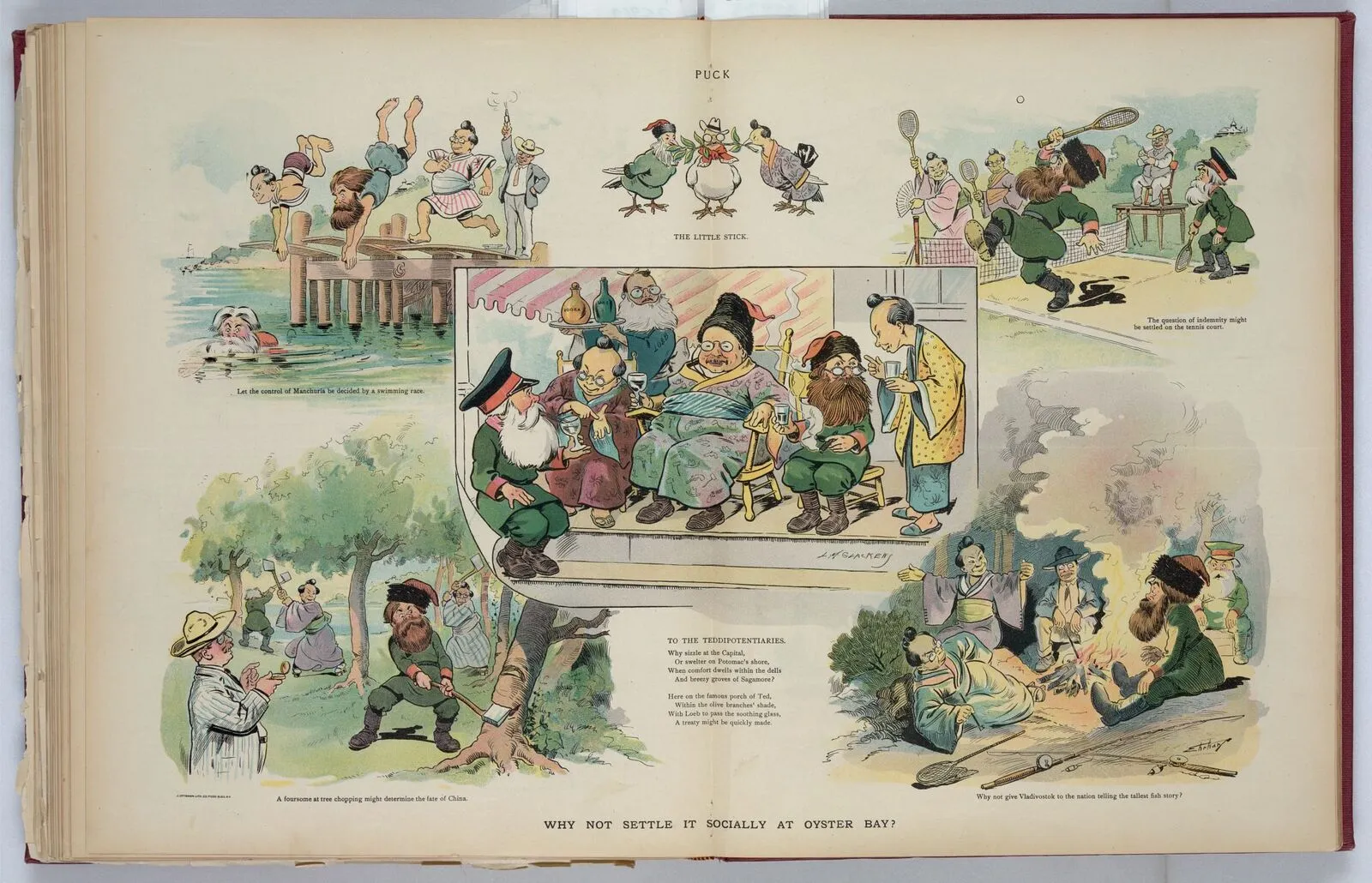
“Why Not Settle It Socially at Oyster Bay?” — a cartoon on Roosevelt's personal, behind-the-scenes diplomacy from his Long Island home. (Puck; Library of Congress)
Private Diplomacy and Public Initiative
Roosevelt began quietly communicating with both Russia and Japan, suggesting that negotiations might be possible. Neither side jumped at the suggestion, but neither rejected it. As 1905 progressed, Roosevelt's pressure for negotiations increased. His ambassador to Russia, George von Lengerke Meyer, and his ambassador to Japan, Lloyd Griscom, worked to convince both governments that their best interests lay in accepting American mediation.
In summer 1905, both Russia and Japan agreed. They would send diplomatic representatives to Portsmouth, New Hampshire, to negotiate under American auspices. Roosevelt chose Portsmouth deliberately—a New England town far from the centers of political power, where serious negotiations could proceed without the interference and pressures that would accompany talks in a major capital.
The conference opened in August 1905. Russian diplomats led by Sergei Witte faced Japanese representatives headed by diplomat Jutaro Komura. Roosevelt did not attend the negotiations himself—he understood that his presence might overshadow the diplomats and interfere with their work. Instead, he remained in close communication, offering suggestions, mediating disagreements, and applying gentle pressure when negotiators seemed stuck.
The Difficult Art of Splitting the Difference
The negotiations were complex. Japan wanted Russia to recognize Japanese control over Korea and acknowledge Japanese interests in Manchuria. Japan also wanted Russia to cede the southern portion of Sakhalin Island and to pay war reparations. Russia was willing to acknowledge Japan's position in Korea and Manchuria, but it was reluctant to cede territory and absolutely opposed to paying war indemnities to a nation it considered inferior.
The negotiations stalled repeatedly. There were moments when both delegations packed their bags and prepared to leave. Roosevelt intervened in these moments, often with remarkable diplomatic finesse. He suggested compromises that allowed both sides to claim partial victory. For example, he proposed that Russia cede the southern part of Sakhalin to Japan but not pay direct war indemnities. Japan would gain territory but Russia would avoid the humiliation of paying tribute to a perceived inferior. The no-indemnity compromise came at a cost in Japan, where public fury at the terms erupted in the Hibiya riots in Tokyo when the treaty was announced.
The negotiations stretched across August and into early September. For weeks, the two delegations argued over details. Roosevelt's patience and persistence were rewarded. On September 5, 1905, the Treaty of Portsmouth was signed. Japan gained recognition of its interests in Korea and southern Manchuria, plus the southern half of Sakhalin Island. Russia preserved its pride by avoiding direct war reparations, though it did effectively lose territory and prestige. Neither side got everything it wanted, but both sides got enough to justify accepting the agreement to their respective populations.
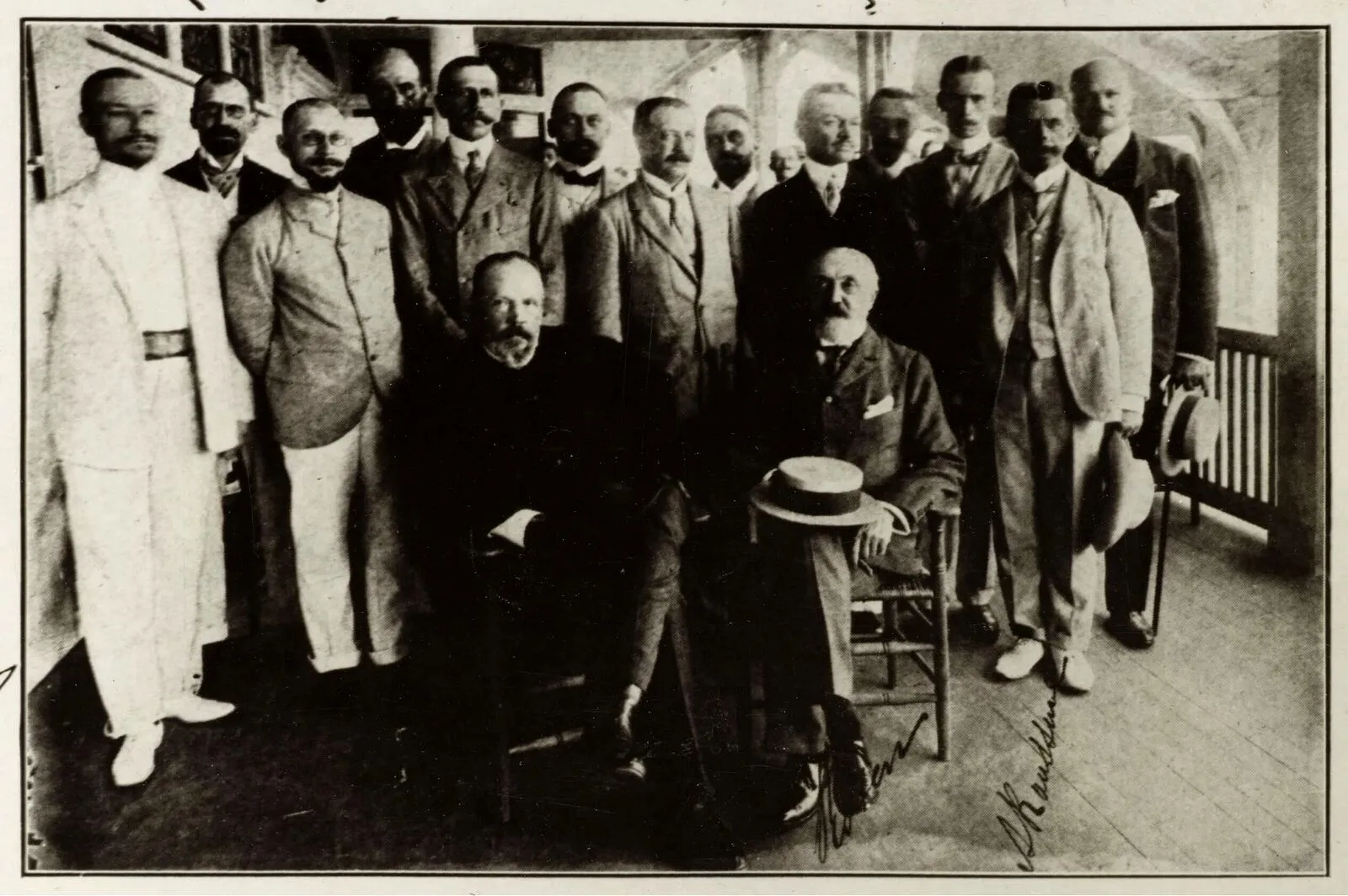
The Russian delegation to the Portsmouth Peace Conference, 1905, where Roosevelt's mediation brokered terms between the exhausted combatants. (Harvard College Library, Theodore Roosevelt Collection)

Roosevelt's Nobel Peace Prize diploma, awarded in 1906 for mediating the Treaty of Portsmouth — the first Nobel Peace Prize given to an American. (Harvard College Library, Theodore Roosevelt Collection)
A Prize for Peace
Roosevelt's achievement was recognized globally. Major newspapers praised his diplomacy. European leaders acknowledged that the United States had successfully intervened in an important international dispute to achieve a reasonable outcome. And in December 1906, the Norwegian Nobel Committee awarded the Nobel Peace Prize to Theodore Roosevelt for his mediation of the Russo-Japanese War.
Roosevelt was the first American citizen to receive any Nobel Prize. It was a remarkable honor that reflected global recognition of American emergence as a great power capable of influencing international affairs. The prize demonstrated that America was not merely a nation of industrial power and military might, but also a nation that could contribute to international peace and stability. Roosevelt had shown that the same nation that wielded a big stick could also serve as peacemaker.
Interestingly, Roosevelt did not keep the prize money. The Nobel Peace Prize award included $36,734.79—a substantial sum in 1906. Roosevelt placed the entire amount in trust for a congressionally chartered foundation intended to promote industrial peace. When Congress never put the plan into effect, he had the funds returned during World War I and distributed them to war relief charities. He felt it inappropriate to accept money for work he viewed as his duty as president and as a responsible citizen of the world.
The Significance of American Mediation
Roosevelt's successful mediation of the Russo-Japanese War had several important consequences. First, it demonstrated that the United States could play a crucial role in international diplomacy. No longer was American foreign policy limited to hemispheric concerns and overseas commerce. America could now insert itself into great-power disputes and shape outcomes. This precedent would influence American foreign policy throughout the 20th century.
Second, the mediation showed that negotiated settlements could be more satisfactory than military victory. Both Russia and Japan gained something through negotiations and compromise that they could not have gained through continued warfare. Japan might have crushed Russia militarily if the war had continued, but at what cost? Russia might have stabilized its position if the war had continued longer, but would it have reversed Japanese gains? Roosevelt's message was that skilled diplomacy could achieve better results than military exhaustion.
Third, the successful negotiation enhanced American prestige globally. Nations now understood that when the United States offered to mediate, it could deliver results. America was not merely a military power but a responsible great power capable of exercising influence wisely. This enhanced prestige gave American diplomacy credibility that it would draw upon throughout the 20th century.

The Japanese delegation at the Portsmouth Peace Conference, 1905; the settlement marked America's arrival as a broker among the great powers. (Harvard College Library, Theodore Roosevelt Collection)

“The Christmas Surprise” — a cartoon that gently questioned whether the prize, and the peace itself, would last. (Library of Congress)
The Limits of Mediation
Yet Roosevelt also learned the limits of American mediation. The Russo-Japanese War had exhausted both sides, creating a mutual incentive to negotiate. But in future conflicts, nations might not be so willing to accept American mediation, or they might refuse to negotiate until one side achieved clear victory. The conditions that made Roosevelt's mediation possible in 1905—mutual exhaustion, recognition that continued warfare was unsustainable, respect for Roosevelt's power and judgment—would not always be present.
Moreover, Roosevelt's mediation ultimately served American strategic interests. He facilitated peace partly because he genuinely opposed war, but also because he believed American interests were best served by a balance of power in East Asia. The treaty he helped negotiate left Japan the leading power in East Asia while keeping Russia in the game—preserving the regional balance that Roosevelt believed served American strategic interests. Future historians would debate whether Roosevelt's mediation was a genuine commitment to peace or a strategic maneuver dressed in the language of pacifism.
Legacy
Yet whatever the mixture of motives, Roosevelt's mediation did achieve something concrete and valuable: an end to a costly war and a framework for future relations between the combatants. That this achievement was recognized with the world's highest peace prize suggests its significance. Roosevelt had shown that American power could be used not only for military assertion but also for diplomatic problem-solving and peacemaking. That duality—strength combined with wisdom—remained Roosevelt's ideal for American foreign policy and American power.
Continue Reading
- Roosevelt's Foreign Policy — Balancing strength and diplomacy on the world stage
- The Great White Fleet — Demonstrating American naval power after the Nobel Prize
- TR and Japan — American-Japanese relations during the peace negotiations
Primary Sources at the TR Center
Explore original documents and resources related to this topic in the Theodore Roosevelt Center Digital Library.
- Roosevelt's Nobel Peace Prize — The ceremony and Roosevelt's writings on international mediation
- Russo-Japanese War Mediation — Diplomatic correspondence and treaty documents
From the Archives
Explore original photographs, documents, and illustrations related to this topic in the Theodore Roosevelt Center Digital Library.
Recommended Reading
- The Big Stick: The Limits of Soft Power and the Necessity of Military Force by Eliot A. Cohen (2016)
- Theodore Roosevelt: A Life by Nathan Miller (2011). ISBN: 978-0061340382
- Armaments and the Coming of War: Europe 1904–1914 by David Stevenson (1996)