
The Autobiography of Theodore Roosevelt (1913)
The Project and Its Purpose
Roosevelt wrote his autobiography after leaving the presidency in 1909. He had already spent some fifteen months—from March 1909 to June 1910—hunting in Africa with his son Kermit and speaking across Europe. By the time he sat down to write this account of his life, he was in his early fifties—old enough to look back with perspective, but still vigorous enough to have much life ahead of him (though he did not yet know this).
The autobiography was not written as a legal record or historical document. Roosevelt intended it as a personal statement—an account of how he had lived and why he had made the choices he made. It was published serially in a magazine first, then collected into book form. The serialization gave Roosevelt the opportunity to respond to readers' reactions and to refine his narrative as he went.

The title page of Theodore Roosevelt: An Autobiography, published in 1913 after he left the presidency. (Internet Archive)

Theodore Roosevelt in a 1913 studio portrait, the year his Autobiography recounted a life of public achievement. (Pach Brothers, Library of Congress)
What He Included: The Narrative of Achievement
The autobiography covers his childhood, his education at Harvard, his early work as a state legislator, his experiences in the Badlands, his service as Police Commissioner of New York, his role as Assistant Secretary of the Navy, his service as governor, his presidency, and his post-presidential adventures. It is in these sections that Roosevelt's voice is most vivid and his narrative most engaging.
He writes about overcoming asthma through willpower and exercise. He describes the intellectual formation he received from his tutors and at Harvard. He recounts his political battles in the New York State Assembly with evident pride in the reforms he championed. He narrates his years in Dakota with romantic enthusiasm, describing the frontier as a formative experience that made him a man.
His account of the Spanish-American War and the Rough Riders is characteristically full of vigor. He does not hide his pride in his military service or in his volunteer regiment. He writes about his presidency with evident satisfaction in what he believed he had accomplished: conservation, trust-busting, Panama Canal construction, mediation of the Russo-Japanese War.
Throughout, Roosevelt emphasizes his beliefs: the importance of action over talk, of duty over comfort, of vigor over ease. He presents himself as a man who lived according to his principles and who was not afraid to take risks or bear consequences.
What He Notably Omitted: Alice Lee
But there is a striking absence in this autobiography. Alice Hathaway Lee, Roosevelt's first wife, is never mentioned at all. Their courtship, their marriage, and her death—one of the most devastating events of his life—are passed over in complete silence. The famous words "the light has gone out of my life" come not from the autobiography but from the private diary entry he made the day she died, February 14, 1884. In his published life story, he simply erased the subject.
Why did Roosevelt choose to omit Alice from his life story? Several explanations have been offered. First, by 1913, Roosevelt had been married to Edith Carow for more than 25 years. Edith had been his partner through his presidency and his post-presidential adventures. Dwelling extensively on his first wife might have seemed disloyal to Edith, even though Edith herself had not discouraged him from this account.
Second, the death of Alice and the depression that followed had sent Roosevelt to the Dakota Badlands to try to recover. He had refashioned himself through action and will. To dwell extensively on his grief would have seemed, to Roosevelt, a kind of weakness—the antithesis of the strenuous life he preached.
Third, his daughter Alice (from his first marriage) was by 1913 a famous, independent woman in her own right—the Princess Alice of American popular imagination. Perhaps Roosevelt felt that dwelling on her mother's death and his early grief would shift attention from his public achievements to his personal sorrow.
Whatever the reason, the omission is notable. It reveals that even Roosevelt, so forthright in other respects, had emotional territories he was not willing to fully explore, even in a work designed to be a personal statement.
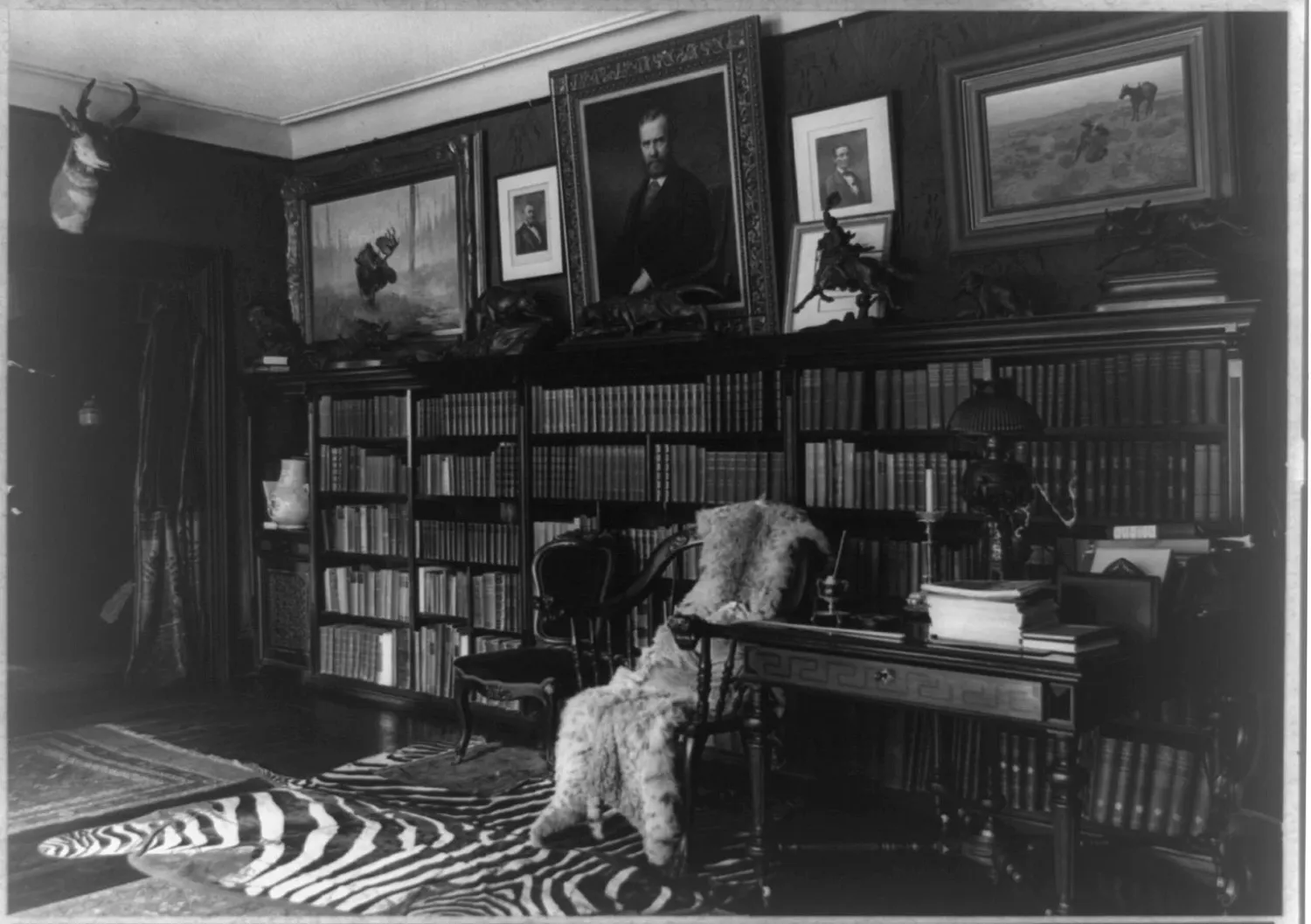
The library at Sagamore Hill, the room where Roosevelt weighed what to remember and what to leave out. (Library of Congress)

Roosevelt at work at his desk at Sagamore Hill, papers spread before him. (Library of Congress)
The Narrative Voice
What is remarkable about the autobiography is Roosevelt's narrative voice. He does not present himself as humble or reflective in the way some autobiographers do. He is unapologetic about his achievements. He is direct about his beliefs. He is sometimes self-deprecating, but always in a way that subtly reasserts his larger point. Unlike the critical reassessments of his legacy today, Roosevelt was relentlessly positive in his self-presentation.
For example, he writes about his intellectual development, acknowledging that he was not the cleverest person, but emphasizing that he worked harder than most and was willing to engage with difficult ideas. The effect is not to diminish himself, but to argue that intelligence alone is not enough—character and effort matter more.
He writes about his political battles with obvious satisfaction in the opponents he defeated and the reforms he championed. He does not pretend to neutrality or detachment. He is openly partisan, openly proud of his accomplishments, openly convinced of the rightness of his causes.
The Autobiography as Political Document
The autobiography was published in the fall of 1913—a year after Roosevelt's third-party campaign of 1912 on the Progressive "Bull Moose" ticket had ended in defeat. Written in its aftermath, the book was partly a document of vindication, making his case to the American people and to history.
It was an argument for himself as a political figure: here is who I have been, here is what I have accomplished, here is what I believe. In this sense, the autobiography was a brief for the defense—an attempt to secure his place in American history and to vindicate his political legacy.

Roosevelt in 1913, when his Autobiography doubled as a testament for his Progressive politics. (Library of Congress)

Theodore Roosevelt in 1913, reflecting on his life near the close of his public career. (Library of Congress)
The Autobiography as Personal Reflection
Yet it is also genuinely personal. Roosevelt writes about his love of nature, his reverence for books, his belief in hard work, his conviction that life should be lived fully and strenuously. These passages reveal the man behind the political figure—a man who loved reading, who found joy in physical exertion, who believed deeply in moral principles even when they were unpopular.
The autobiography shows Roosevelt trying to make sense of his own life—to understand what his experiences had meant, what had shaped him, what lessons he had learned. It is not always successful in this regard. Sometimes his self-justification overshadows genuine reflection. But in its best moments, the autobiography is a portrait of a man trying to understand himself.
Legacy and Limitations
The autobiography remains widely read and widely cited. It is the primary source for understanding how Roosevelt himself thought about his life and achievements. But it is important to remember what it is: a selective account written by the subject himself, designed partly for personal reflection and partly for political vindication.
It is not the complete truth about Roosevelt. The omission of Alice Lee and the emotional impact of her death, the minimizing of his first marriage, the glossing over of setbacks and moments of doubt—these absences tell us as much as what is explicitly stated.
Modern readers of the autobiography should approach it as a fascinating document of self-presentation, a window into how Roosevelt wanted to be remembered, and a sometimes incomplete account of a life that was far more complicated and emotionally textured than even its author was willing to fully explore.
Continue Reading
- Roosevelt's Complete Bibliography — Some 35 published books, with context and significance
- Roosevelt's Six Children — The family members Roosevelt wrote about (and notably omitted)
- The Roosevelt Family — The family dynasty and relationships that shaped his life
Primary Sources at the TR Center
Explore original documents and resources related to Roosevelt's autobiography and writings in the Theodore Roosevelt Center Digital Library.
- Roosevelt's Libraries — Information about his personal libraries and reading collections
- Roosevelt's Reading and Writing — Scholarly analysis of his intellectual life and prolific authorship
From the Archives
Explore original photographs, documents, and illustrations related to this topic in the Theodore Roosevelt Center Digital Library.
Recommended Reading
- Theodore Roosevelt: A Literary Life by Thomas Bailey and Katherine Joslin (2018)
- An Autobiography by Theodore Roosevelt (1913)