
The Teddy Bear: A Moment of Mercy That Became an Icon
November 1902: Mississippi Bear Hunting Trip
In November 1902, President Theodore Roosevelt traveled to Mississippi for a hunting trip. He had been invited by friends to hunt black bear in the state's dense forests. Roosevelt was an accomplished hunter and the trip was organized as an opportunity for the president to enjoy his favorite outdoor activity. His guides and hosts, eager to provide their distinguished guest with a successful hunt, tracked down a black bear and prepared a shocking surprise.
The guides found a black bear in the forest and, rather than allowing Roosevelt to hunt it fairly, they captured and tied the bear to a tree. The animal was defenseless, unable to escape or flee. The guides then led Roosevelt to the tree, presumably expecting him to simply shoot the captive bear. They were offering an easy kill, assured success for the presidential hunter.
Roosevelt refused. He would not shoot a captive, defenseless animal. It violated everything he believed about hunting ethics and the concept of "fair chase." To shoot a tied-up bear would not be hunting; it would be mere killing. It was not sport. It was not honorable. Despite the preparations his hosts had made and their clear expectation that he would accept the easy opportunity, Roosevelt firmly declined. The story has a grimmer coda that contemporary accounts recorded: the bear had been run down by dogs and injured in the chase, and because it could not recover or be released, Roosevelt directed that it be put down with a knife as an act of mercy. He refused the dishonorable kill; he did not pretend the animal could be saved.

Theodore Roosevelt in his fringed buckskin hunting outfit, about 1885. His fame as a big-game hunter set the stage for the 1902 Mississippi bear hunt. (Harvard College Library)

Clifford Berryman's cartoon 'Drawing the Line in Mississippi,' published in the Washington Post in November 1902, immortalized Roosevelt's refusal to shoot a captured bear. (Library of Congress)
The Cartoon That Captured a Moment
Political cartoonist Clifford Berryman, working for the Washington Post, illustrated the incident in a cartoon published just days after it occurred. Berryman's drawing, titled "Drawing the Line in Mississippi," showed Roosevelt with his rifle, facing a small, sad-looking bear. Roosevelt was depicted refusing to shoot while hunters looked on. The cartoon was sympathetic to Roosevelt, portraying him as a man of principle and honor, unwilling to kill an animal that could not defend itself.
Berryman's cartoon was widely reprinted in newspapers across America. The image became iconic—it represented Roosevelt the hunter, but also Roosevelt the man of conscience. Here was the rough, vigorous western hunter refusing to take an easy kill because of principle. The public response was overwhelmingly positive. Roosevelt was praised for his refusal. The incident seemed to demonstrate something important about his character: he had standards. He was willing to walk away from a guaranteed success because the method violated his ethics.
The Toymaker's Inspiration: Morris Michtom
Within weeks of the Mississippi incident, Morris Michtom, a toy maker and candy maker from Brooklyn, New York, created a small stuffed bear toy. Michtom's wife Rose suggested the idea of making a toy bear inspired by the Roosevelt incident. Morris liked the idea and created a prototype—a small, jointed bear cub made of plush material. The toy was intended to be a novelty item, but Michtom had a better idea.
According to Michtom family tradition, Michtom wrote to President Roosevelt asking permission to call the toy "Teddy's Bear" and to use Roosevelt's name in marketing it, and Roosevelt—who actually disliked being called "Teddy" (he preferred Theodore or TR)—found the request amusing and granted permission. No such letter has ever been found, so the exchange remains a charming family story rather than a documented fact. In any case, Roosevelt did not involve himself further in the toy's development or marketing. Michtom then placed the bear in his candy shop window in Brooklyn, with a label identifying it as "Teddy's Bear." The toy began to sell.
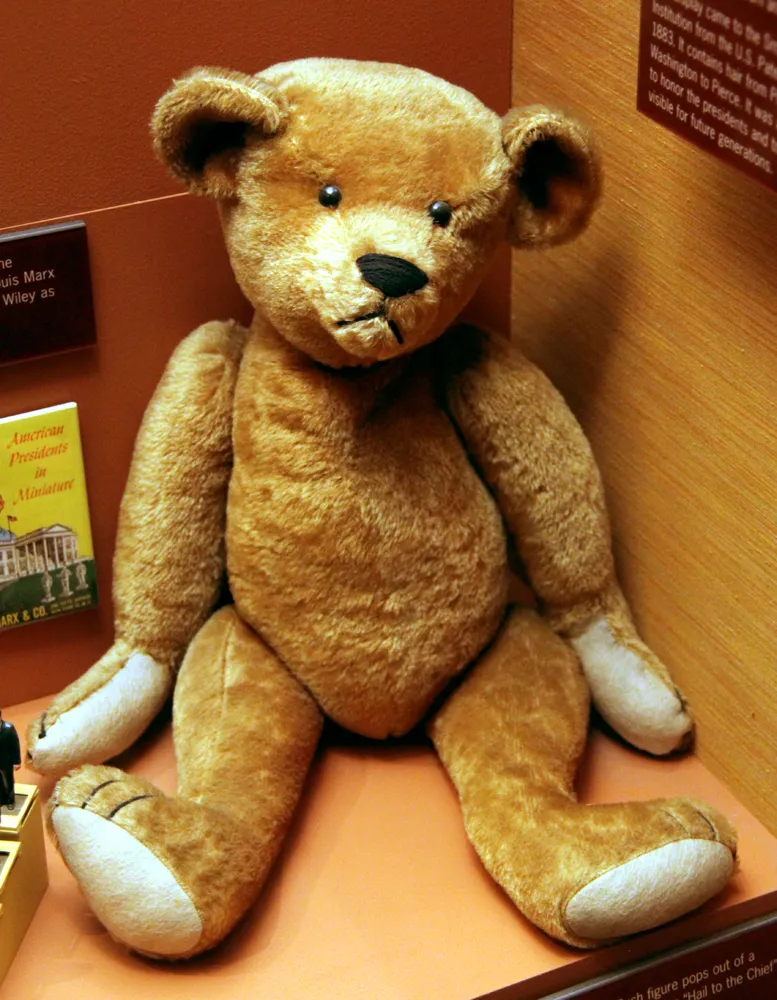
An early American teddy bear from about 1903, the years when Brooklyn shopkeeper Morris Michtom began selling the toys he called 'Teddy's bears.' (Smithsonian)

A Steiff teddy bear made in the German firm's classic 1903 design. Steiff's bears, sold in America the same year as Michtom's, helped turn the toy into a worldwide craze. (Wikimedia Commons)
From Novelty to Icon: The Teddy Bear's Rise
The teddy bear began as a local novelty but quickly became a national sensation. Other toy manufacturers noticed the success and began producing their own versions. The bear became associated with Roosevelt himself—when he traveled, people gave him teddy bears as gifts. Children collected them. By the early twentieth century, the teddy bear had become one of the most popular toys in America. Manufacturers produced millions of bears. They were exported internationally. The teddy bear became a staple of childhood across the developed world.
What makes this remarkable is that the teddy bear's origin—a moment when a hunter refused to kill a defenseless animal—captured something important about Roosevelt. Yes, he was a vigorous, tough, aggressive man who hunted and fought and competed fiercely. But he had principles. He had codes of honor. He would not do something dishonorable, even for an easy success. The teddy bear, intended as a novelty, became a symbol of that quality.
Roosevelt's Reaction to the Teddy Bear
Roosevelt's personal reaction to his name being attached to the bear is not extensively documented. He apparently was amused or at least tolerant of the connection. He gave bears as gifts to friends and family. Yet there is evidence that he didn't particularly enjoy the nickname "Teddy." His family called him Theodore ("Teedie" had been his boyhood nickname). Close friends called him TR. But the public and the press, especially as the teddy bear became popular, increasingly called him "Teddy." He could not stop the tide of popular usage.
In a sense, the teddy bear was a fitting legacy for Roosevelt, despite his ambivalence about the nickname. It represented a moment when he chose conscience over convenience, ethics over easy success. The toy itself—cuddly, harmless, beloved by children—was the opposite of the fierce hunter who spawned it. Yet that contrast was precisely what made the story compelling.

President Theodore Roosevelt in 1904. Roosevelt was privately bemused that a children's toy had been named for him. (Wikimedia Commons)
The Teddy Bear Today: An Enduring Legacy
More than 120 years after Morris Michtom created the first teddy bear, the toy remains one of the most beloved and best-selling toys in the world. Billions of teddy bears have been produced. They are stuffed animals, mascots, symbols of comfort and childhood. Most people today have no idea that the teddy bear originated from a specific incident involving a specific president. Yet the toy endures, carrying with it the memory of a moment in November 1902 when a famous hunter refused to shoot a defenseless bear.
The teddy bear demonstrates the unpredictable ways that history shapes culture. Roosevelt had no intention of sparking a global toy phenomenon. He simply refused to do something he considered dishonorable. A cartoonist noticed and captured the moment. A toymaker was inspired. And suddenly Roosevelt's name was attached to an item that would outlive him by over a century and be known to billions of people.
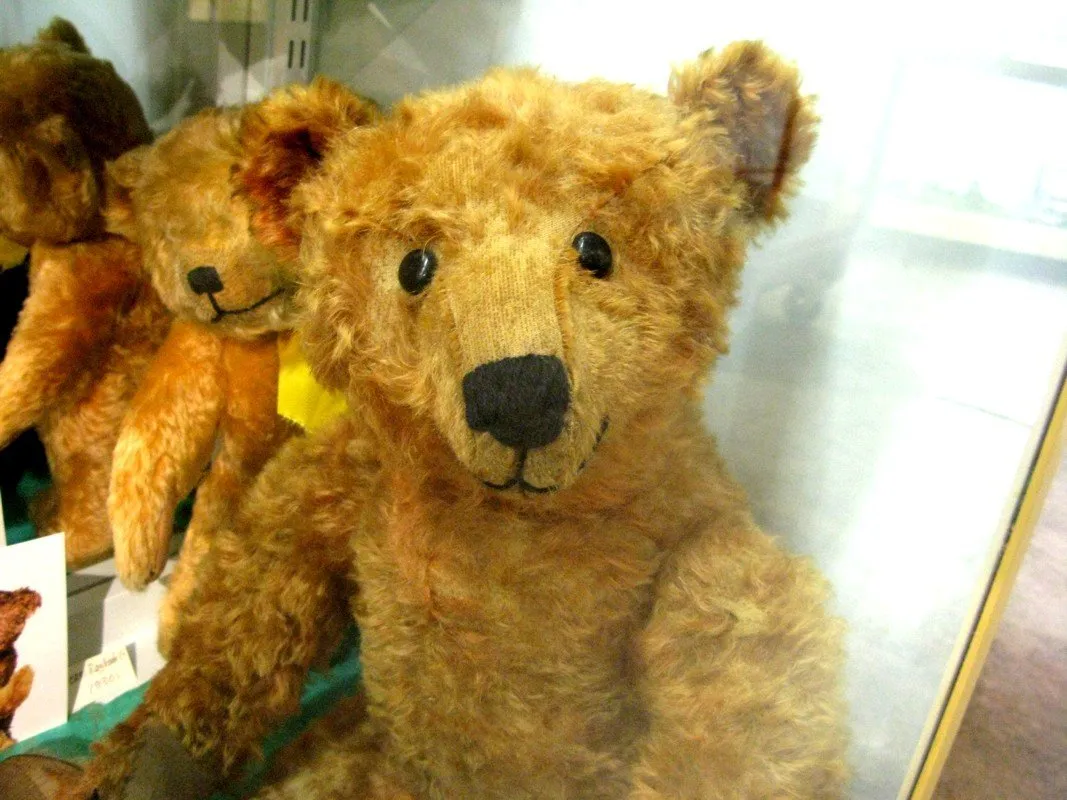
Antique Steiff teddy bears preserved in a museum collection. More than a century later, the teddy bear remains one of the world's most beloved toys. (Wikimedia Commons)
What the Bear Reveals About Roosevelt
The Mississippi bear incident and its consequence—the teddy bear—reveal something essential about Theodore Roosevelt. He was a complex man. He was aggressive and competitive, yet he had principles. He was a great hunter and warrior, yet he could refuse an easy victory because it violated his ethical code. He was not a sentimentalist—he would never have saved the bear's life out of modern animal rights conviction. But he was a man of honor who understood that some things were more important than winning.
For a man who worked so hard to cultivate an image of toughness and vigor, it is fitting that his most enduring legacy is a cuddly stuffed animal. The contradiction is resolved when we understand that true strength includes the ability to say no, to refuse temptation, to choose the hard right over the easy wrong. That is what the teddy bear represents—not Roosevelt the hunter, but Roosevelt the man.
Continue Reading
Primary Sources
From the Archives
Explore original documents, photographs, and cartoons related to the teddy bear story in the Theodore Roosevelt Center Digital Library.
Recommended Reading
- Theodore Roosevelt: A Strenuous Life by Kathleen Dalton (2007). ISBN: 978-0-307-42968-1
- Theodore Rex by Edmund Morris (2001). ISBN: 978-0-307-77781-2