
Memorial Day with Theodore Roosevelt
In Theodore Roosevelt's day, May 30 was often called Decoration Day, a day to honor the Civil War dead. He spent it on a troop train with the Rough Riders, at Grant's Tomb, at Arlington, at Gettysburg and in the saddle on the way to Cheyenne. In 1918, with all four of his sons in the war, he gave his last Memorial Day speech. Quentin was killed in France less than two months later.
Key Facts
| The name | Called both "Decoration Day" and "Memorial Day" in his lifetime; observed May 30 |
|---|---|
| Arlington | As President, he gave the Memorial Day address there once, in 1902 |
| As President | Arlington (1902), Laramie and Cheyenne (1903), Gettysburg (1904), Brooklyn (1905), Portsmouth, Va. (1906), Indianapolis (1907) |
| Gettysburg | Twice: in 1904 as President and in 1912 as a candidate |
| Quentin Roosevelt | Killed in aerial combat in France, July 14, 1918; since 1955, buried at the Normandy American Cemetery |
From Sagamore Hill to a Troop Train
In T.R.'s lifetime, May 30 was widely called Decoration Day, when towns decorated the graves of the Civil War dead. In 1895, while he was a New York City Police Commissioner, he wrote to his sister Anna that he had spent the day in the country with his family at Sagamore Hill.
Three years later he spent it on a train. "It was on Sunday, May 29th, that we marched out of our hot, windy, dusty camp to take the cars for Tampa," he wrote in The Rough Riders. "The journey by rail from San Antonio to Tampa took just four days." On Decoration Day 1898 the regiment was rolling east across Texas toward New Orleans. A wire report from New Orleans the next day said, "Roosevelt's rough riders have been passing through New Orleans all day."
About a month later, on July 1, 1898, he led the charge up Kettle Hill on the San Juan Heights in Cuba. In 2001 he was awarded the Medal of Honor posthumously. President Clinton presented it in the Roosevelt Room of the White House, and his great-grandson Tweed Roosevelt accepted it.

Colonel Roosevelt and his Rough Riders at the top of the hill they captured, Battle of San Juan, 1898. William Dinwiddie, photographer. (Library of Congress)
Parades and Grant's Tomb
As Governor of New York, T.R. made Memorial Day a full day's work. In 1899 he reviewed the Brooklyn parade from a stand near the Soldiers' and Sailors' Memorial Arch, then spoke at Grant's Tomb. The New-York Tribune reported that he "had attended the military parade in Brooklyn in the morning, and had made a speech at Grant's tomb in the afternoon." That night he presided at the Grand Army of the Republic meeting in the Metropolitan Opera House.
In 1900 he reviewed the Manhattan parade at Madison Square with Mayor Van Wyck, escorted by the "Old Guard" under Major Briggs.
He came back to Grant's Tomb in 1911, as a former President, to give a Memorial Day address, standing beside Gen. Daniel E. Sickles. The same day he spoke in Newark, N.J., at the unveiling of Gutzon Borglum's seated statue of Abraham Lincoln.
Arlington, 1902
As President, T.R. gave the Memorial Day address at Arlington National Cemetery once, in 1902, his first Memorial Day in office. He spoke to the Grand Army of the Republic, the Union veterans, and called the day the one on which "we call to mind the deaths of those who died that the nation might live."
He thanked the old soldiers for what they had left behind: "You left us a reunited country. You left us the right of brotherhood with the men in gray, who with such courage, and such devotion for what they deemed the right, fought against you."
Much of the speech was about the Philippine-American War, which was still being fought. That spring a Senate committee had been hearing testimony that American soldiers had tortured Filipinos, including with the "water cure." T.R. defended the Army. He acknowledged that some soldiers had committed "acts of cruelty," and he pledged an effort "to find out every instance of barbarity on the part of our troops, to punish those guilty of it." He also insisted that these cruelties "have been wholly exceptional, and have been shamelessly exaggerated."
Then he turned to lynching at home, which he called "cruelty infinitely worse than any that has ever been committed by our troops in the Philippines." Southern editors and speakers attacked that passage. In a letter a few days later, he wrote that what he had said about lynching "applies to Kansas & Colorado as much as to Texas & Tennessee."
In the Saddle on Decoration Day
On May 30, 1903, during his western tour, T.R. spoke in the morning from the steps of the state university building in Laramie, with special words for the Grand Army veterans. Then he got on a horse and rode more than 60 miles to Cheyenne, by way of Van Tassel's ranch, where his party stopped for lunch.
In Cheyenne, he wrote afterward, he made "a three-quarters of an hour speech under the auspices of the veterans, as it was Decoration Day." "I would preach to my countrymen not the life of ease; not the effortless life of comfort, of avoidance of risk, and avoidance of trouble," he told the crowd. "I would ask them not to strive to find out the things that are easiest to do, but the things that are best worth doing."
Gettysburg, Twice
In 1904, T.R. gave the Memorial Day address on the battlefield at Gettysburg, where Pennsylvania Governor Pennypacker also spoke. He spoke about the man who had stood there before him: "as long as the English tongue is understood, so long shall Abraham Lincoln's Gettysburg speech thrill the hearts of mankind."
He returned in 1912, in the middle of his fight with President William Howard Taft for the Republican nomination. He spoke in the National Cemetery, at the invitation of the Brotherhood of Locomotive Engineers. Taft spoke at Arlington the same day.
A Different Town Every Year
As President, T.R. kept moving. In 1905 he was in Brooklyn for the unveiling of the equestrian statue of Gen. Henry W. Slocum. In 1906 he spoke at the Navy Yard in Portsmouth, Va.: "it is the man behind the ballot who counts most in civil life, just as it is the man behind the gun who counts most in military life."
In 1907 he went to Indianapolis to unveil a monument to Gen. Henry W. Lawton, who had been killed in the Philippines in 1899. "There is no other class of our citizens to whom we owe so much as to the veterans of the great war," he said there.
On his last Memorial Day as President, in 1908, he made no speeches. He drove to Arlington and laid wreaths at the tomb of the Civil War unknown dead, at Gen. Philip Sheridan's monument and at the Spanish-American War monument. A letter he wrote to his son Archie that day is headed "White House."

President Roosevelt with his sons Archie (right) and Quentin (left), about 1904. (Library of Congress)
Memorial Days in Wartime
In 1916, T.R. spoke in Kansas City before Union and Confederate veterans and called for universal training based on universal service. He wrote to his sister Corinne from Kansas City that day that he had been careful to say "we" when describing the government's shortcomings. During the parade, someone threw an open pocketknife at his car. It struck the back of the automobile, and he was not hurt.
In 1917, weeks after the United States entered the war, he addressed his Long Island neighbors at the Mineola Fair Grounds, before a crowd wire reports put at about 20,000, and urged them to buy Liberty Bonds.
His last Memorial Day speech was in Detroit in 1918, on behalf of the Navy. All four of his sons were in the service. According to the Associated Press, he told the crowd that America wanted a knockout, not a win on points.
The Son Who Didn't Come Home
Less than two months after that Detroit speech, on July 14, 1918, Lt. Quentin Roosevelt of the 95th Aero Squadron was killed in aerial combat near Chamery, France. German forces buried him where he fell.
On July 17, T.R. was told that Quentin was missing and presumed dead. His statement went out on the Associated Press wire that day: "Quentin's mother and I are very glad that he got to the front and had the chance to render some service to his country and to show the stuff there was in him before his fate befell him." The next day he spoke to the Republican state convention at Saratoga Springs. That night a cable briefly raised the family's hope that Quentin had landed alive.
In 1955, Quentin was reburied beside his brother Ted at the Normandy American Cemetery in Colleville-sur-Mer, France.
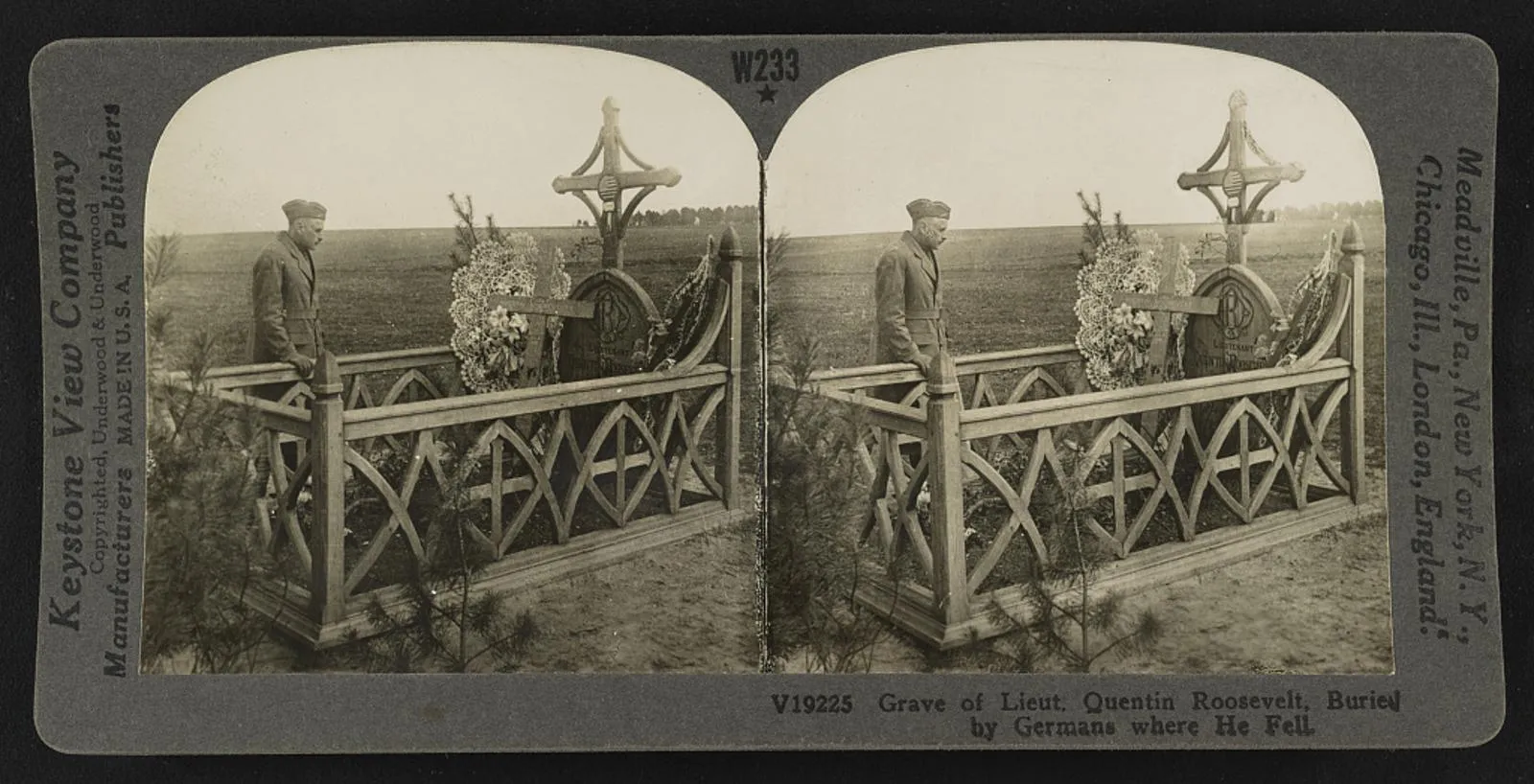
"Grave of Lieut. Quentin Roosevelt, buried by Germans where he fell." Keystone View Company stereograph. (Library of Congress)
Did He Really…?
Speak at Arlington every Memorial Day as President? No. He gave the Arlington address once, in 1902. The other years took him to Wyoming, Gettysburg, Brooklyn, Portsmouth and Indianapolis, and in 1908 he laid wreaths at Arlington but gave no speech.
Ranch in Wyoming? No. A printed text of his 1903 Laramie remarks has him saying he "was engaged for 20 years in the cow-business in this State," but his cattle ranches were in the Dakota Badlands, not Wyoming.
Charge up San Juan Hill? The Rough Riders charged up Kettle Hill, on the San Juan Heights. T.R. wrote that it was "the hill on our right, which we afterward grew to call Kettle Hill."
Is Quentin buried at Arlington, or in Germany? Neither. German soldiers first buried him where his plane fell, near Chamery, France, and since 1955 at the Normandy American Cemetery in France.
Was Armistice Day T.R.'s holiday? No. The first Armistice Day came after his death in January 1919. Nov. 11, 1918, the day the fighting ended, was the day he entered Roosevelt Hospital in New York. Read that story at Veterans Day with Theodore Roosevelt.
Explore More
Timeline of T.R.’s Memorial Days
Where he spent May 30, from a Rough Rider troop train to Detroit in 1918.
Theodore Roosevelt and Veterans Day
Nov. 11, 1918, his four soldier sons and his last weeks.
Primary Sources
- Presidential Addresses and State Papers (Memorial Day addresses, 1902–1905)
- The Rough Riders (1899)
- Chronicling America (Library of Congress)
From the Archives
Speeches, letters and photographs about Memorial Day from the Theodore Roosevelt Center’s digital library.
Recommended Reading
- The Rough Riders, Theodore Roosevelt (1899)