
Theodore Roosevelt and Veterans Day
Veterans Day began as Armistice Day, marking Nov. 11, 1918, the day the fighting stopped. Theodore Roosevelt lived to see it, but he spent that day being taken from Sagamore Hill to a New York hospital. He died before the first Armistice Day was ever observed. He was a veteran himself, a Rough Rider, and the father of four sons who served overseas.
Key Facts
| The holiday | Began as Armistice Day. First observed in 1919, after T.R.'s death. Renamed Veterans Day in 1954. |
|---|---|
| Nov. 11, 1918 | T.R. was taken from Sagamore Hill to Roosevelt Hospital in New York. He stayed until Christmas Day. |
| His own service | Lieutenant colonel, then colonel, of the 1st U.S. Volunteer Cavalry, the Rough Riders, in 1898 |
| His sons | All four were overseas in 1918. Quentin, a pilot, was killed in aerial combat on July 14, 1918. |
| Medal of Honor | Awarded to T.R. posthumously on Jan. 16, 2001 |
The Day the Guns Fell Silent
Monday, Nov. 11, 1918, was the day the Armistice ended the fighting. It should have been a day of celebration at Sagamore Hill. Instead, T.R. had been in bed for more than a week, with what newspapers called sciatica. An early biography calls it inflammatory rheumatism.
That day he was taken from Sagamore Hill to Roosevelt Hospital in New York, to be near his physician. The New-York Tribune reported the next morning: "Colonel Roosevelt was brought to Roosevelt Hospital yesterday from Sagamore Hill suffering from an attack of sciatica. It was the second time since a week ago Saturday that he has been out of the house. The first time was when he went to vote."
He stayed in the hospital until Christmas Day, went home to Sagamore Hill, and died there on Jan. 6, 1919. He never saw an anniversary of the Armistice.
Colonel of the Rough Riders
Long before he was a father of soldiers, T.R. was a soldier himself. In 1898 he served as lieutenant colonel, then colonel, of the 1st U.S. Volunteer Cavalry, better known as the Rough Riders.
"It was on Sunday, May 29th, that we marched out of our hot, windy, dusty camp to take the cars for Tampa," he wrote in The Rough Riders. The next day, Decoration Day, found him on a troop train rolling east across Texas. By May 31 the regiment was passing through New Orleans.
On July 1, 1898, he led the charge up Kettle Hill on the San Juan Heights. In his book he called it "the hill on our right, which we afterward grew to call Kettle Hill."

Colonel Roosevelt and his Rough Riders at the top of the hill they captured, Battle of San Juan, 1898. William Dinwiddie, photographer. (Library of Congress)
Standing With the Old Soldiers
For most of T.R.'s life, the veterans honored on Memorial Day were the men of the Civil War, and he made time for them. As Governor of New York in 1899, he spoke at Grant's Tomb on Memorial Day and that evening presided over the Grand Army of the Republic meeting at the Metropolitan Opera House.
As President in 1903, he rode on horseback from Laramie to Cheyenne, Wyoming, in a single day, then spoke there that evening. It was Decoration Day, and he was introduced by a senator who had fought in the Civil War. In Indianapolis in 1907, he told his audience that the country owed no other group of citizens as much as it owed the veterans of the Civil War.
On Memorial Day 1916 in Kansas City, a leader of the United Confederate Veterans rode in his parade, and he aimed his main speech at the Civil War veterans seated in a section of the hall reserved for them.

President Roosevelt with his sons Archie (right) and Quentin (left), about 1904. (Library of Congress)
Four Sons Overseas
By 1918, all four of T.R.'s sons were overseas in the war: Ted, Kermit, Archie and Quentin. Their father spent the war years on the speaking trail.
On Memorial Day 1918 he was in Detroit, speaking on behalf of the Navy, while Quentin was in France.
Quentin
Quentin, the youngest, was a lieutenant in the 95th Aero Squadron. On July 14, 1918, he was killed in aerial combat near Chamery, in the Aisne region of France. German forces buried him where he fell.
His father learned of it on July 17 and issued a statement: "Quentin's mother and I are very glad that he got to the front and had the chance to render some service to his country and to show the stuff there was in him before his fate befell him."
The next day T.R. kept a speaking date in Saratoga, New York. His sister Corinne later recalled that he refused to cancel, telling her it was more than ever his duty to be there. In 1955 Quentin was reburied beside his brother Ted at the Normandy American Cemetery in Colleville-sur-Mer, France.
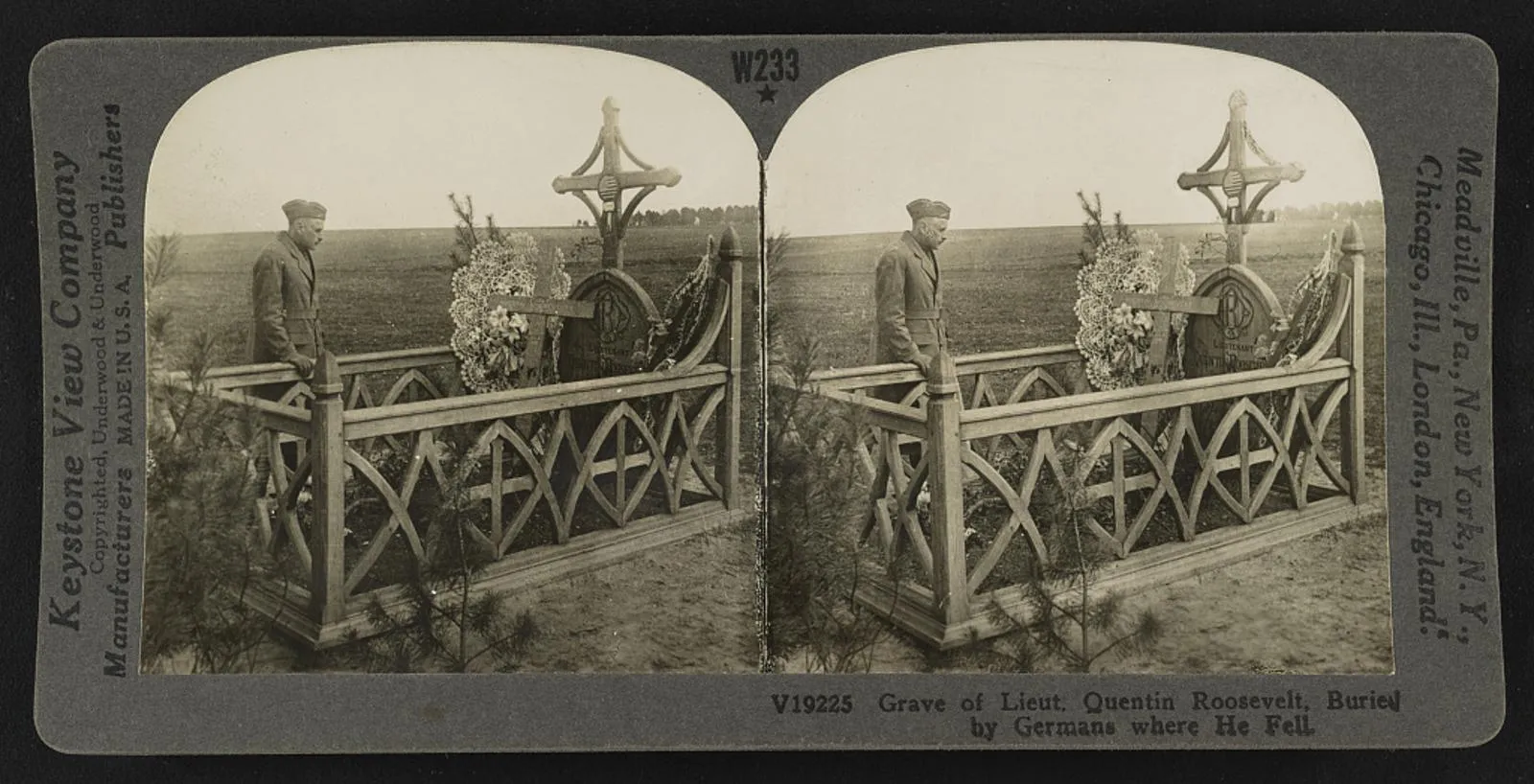
"Grave of Lieut. Quentin Roosevelt, buried by Germans where he fell." Keystone View Company stereograph. (Library of Congress)

"Col. Theodore Roosevelt of the Rough Riders - after his return from Cuba." Strohmeyer & Wyman stereograph, 1898. (Library of Congress)
A Medal of Honor, More Than a Century Later
On Jan. 16, 2001, President Bill Clinton awarded T.R. the Medal of Honor posthumously, in the Roosevelt Room of the White House. His great-grandson Tweed Roosevelt accepted it on his behalf.
Other Nov. 11s
Nov. 11 was an ordinary date for most of T.R.'s life. On Nov. 11, 1884, a week after the election, he wrote Henry Cabot Lodge that he would "in all probability be unable to get back from the west until Xmas." In 1902, as President, he spoke at the dedication of the New York Chamber of Commerce building and again at its banquet that evening. Three days later he was on a bear hunt in Mississippi.
On Sunday, Nov. 11, 1906, he wrote to his son Archie from aboard the U.S.S. Louisiana, steaming south to Panama.
Did He Really…?
Did T.R. celebrate Armistice Day? No. The first Armistice Day observance came in 1919, months after his death. The name Veterans Day came in 1954.
Did he go to the hospital the day after the Armistice? No. Dated newspapers and the 1920 biography Theodore Roosevelt and His Time all put it on Nov. 11, 1918.
Did he charge up San Juan Hill? His charge was up Kettle Hill, on the San Juan Heights. Even the 2001 White House remarks said "San Juan Hill."
Is Quentin buried at Arlington, or in Germany? Neither. He was buried where he fell, near Chamery, France, and since 1955 has rested at the Normandy American Cemetery.
Did T.R. die of a broken heart over Quentin? That is a way of describing his grief, not a medical cause of death.
Explore More
Timeline: The Roosevelts in Uniform
From the Rough Riders to Quentin's last flight and the first Armistice Day.
Memorial Day with Theodore Roosevelt
Where T.R. spent Decoration Day, from a troop train to Gettysburg.
Primary Sources
- The Rough Riders (1899)
- Presidential Addresses and State Papers
- Letters to His Children (1919)
- Chronicling America (Library of Congress)
From the Archives
Letters, photographs and papers about Armistice Day and the Roosevelts at war from the Theodore Roosevelt Center’s digital library.
Recommended Reading
- The Rough Riders (1899)
- My Brother Theodore Roosevelt, Corinne Roosevelt Robinson (1921)