
Medora de Morès: The Marquise Who Gave the Town Its Name
The New York heiress behind the name of Medora paid for the town's Catholic church, offered to pay its schoolteacher and hunted bears in the Big Horn country.
An Heiress from New York
Medora von Hoffman was the daughter of Louis von Hoffman, a wealthy New York banker. The State Historical Society of North Dakota gives her birth year as 1856 and describes her as a gifted artist, a fine rider and an excellent shot.
In the winter of 1881–82 her family was living at Cannes, on the French Riviera, next door to the villa of the Vallombrosa family. Their son was a young French nobleman and former army officer, Antoine de Vallombrosa, the Marquis de Morès. Medora and the Marquis married at Cannes in February 1882 and moved to the United States. Their first child, a daughter named Athenais, was born in 1883; the State Historical Society says she was born in New York.
That same year the Marquis went west to the Little Missouri River with big plans and his father-in-law's fortune behind him. He started a new town across the river from the old settlement of Little Missouri and named it for his wife. The town of Medora still carries her name.

The Marquise de Morès in a portrait miniature in watercolor on ivory, which the New-York Historical Society attributes to Fernand Paillet and dates to 1889. (Fernand Paillet, New-York Historical Society, via Wikimedia Commons)

Medora in the winter of 1883–84, as Hermann Hagedorn dated the photograph. He identifies the buildings as the office and company store of the Marquis de Morès. (Hermann Hagedorn, Roosevelt in the Bad Lands, 1921)
Summers at the Chateau
The Marquise first came through Medora in April 1884, The Bad Lands Cow Boy reported, riding in the Marquis's private railroad car, the Montana. The family's frame house on the bluff above town was large and well furnished for a young frontier town, and the State Historical Society says nurses, maids and other servants came west to run the household. Today it is known as the Chateau de Morès.
For three seasons the family lived in Medora from spring into late fall and spent the winters in New York or abroad. Hunting, music and art filled their days; the State Historical Society says the Marquise painted watercolors of the Badlands. Guests came to the house from New York and the East, and Theodore Roosevelt, a neighboring rancher, was among the visitors.
T.R. and the Marquis were outwardly friendly but sometimes clashed. The Marquise lent T.R. at least one book. In a June 1886 letter to his sister Anna, written at Elkhorn Ranch two weeks into the roundup, he mentioned the novel he had packed. As Hermann Hagedorn printed the letter: "I took along Tolstoy's 'La Guerre et La Paix' which Madame de Mores had lent me; but I have had little chance to read it as yet."
A Church for Medora
The Marquise left her own mark on the town. In September 1884 the corner-stone was laid for a small Catholic church she was paying for. One side of the stone read "Athenais" and the other "Medora, Marquise de Mores, Sept. 15, 1884." Father Martin of Mandan blessed the finished church on November 2, 1884. That December, six Catholics of Medora and Little Missouri signed a public letter in The Bad Lands Cow Boy thanking her for "building and donating the church to us." The little brick church still stands in Medora.
A son, Louis, was born in 1885; the State Historical Society says he was born in New York. Back in Medora by early June 1885, the Marquise, The Bad Lands Cow Boy reported, turned on the steam that started the machinery at her husband's new slaughterhouse. By September she had offered to pay a teacher's salary so the town could open a school, and that October the paper urged the school board to act before the offer was withdrawn.
"Loaded for Bar"
Medora was a serious hunter, and she did not wait for the Marquis. When business kept him home from a July 1885 hunt, she went without him, setting out for the Big Horn country of northern Wyoming with Vic and Frank Smith and a small party. The Bad Lands Cow Boy said she was "loaded for bar," and reported that Vic Smith, writing from Billings, called her "an excellent shot and fearless as a cowboy." By Smith's account she killed four bears on the trip.
In 1886 the paper reported more hunting trips down the Little Missouri, one of them with the Marquis that October. In November it claimed she had now taken every kind of large game in the Northwest, from grizzly bear and elk to antelope and wild cats.
The Marquis's Medora packing plant closed in November 1886, and he gave up his larger meat business the next year. The family left Medora late in 1886 and never again made it their seasonal home, though the Marquis came back on short trips. Hermann Hagedorn wrote that the couple later sailed for India to hunt tigers. A third child, Paul, was born in 1890; the State Historical Society says he was born in France.
Widow, Visitor and Keeper of the Chateau
In June 1896 the Marquis was killed in the Sahara, near the border of Tunisia and Tripoli, by the Tuareg escort he had just taken on. According to Hagedorn, Medora accused the French government of complicity in his death, protested when a French inquiry was dropped, traveled to Tunis herself and offered rewards for the capture of the killers.
She raised her children in France. In September 1903 she came back to Medora with Athenais and Louis. The Dickinson Press reported that she raised the American and French flags over her house and she invited all residents of Billings County to a ball in the Medora hall, held that October. The State Historical Society of North Dakota says she stayed about six weeks and never returned, and that she turned her French home into a hospital for wounded soldiers during World War I.
Medora de Morès died in France in 1921. According to the State Historical Society, she had asked her children never to sell the Medora house. In 1936 her son Louis deeded the chateau and the site of the packing plant to the State of North Dakota, to be preserved as a park and museum. Today it is the Chateau de Mores State Historic Site.
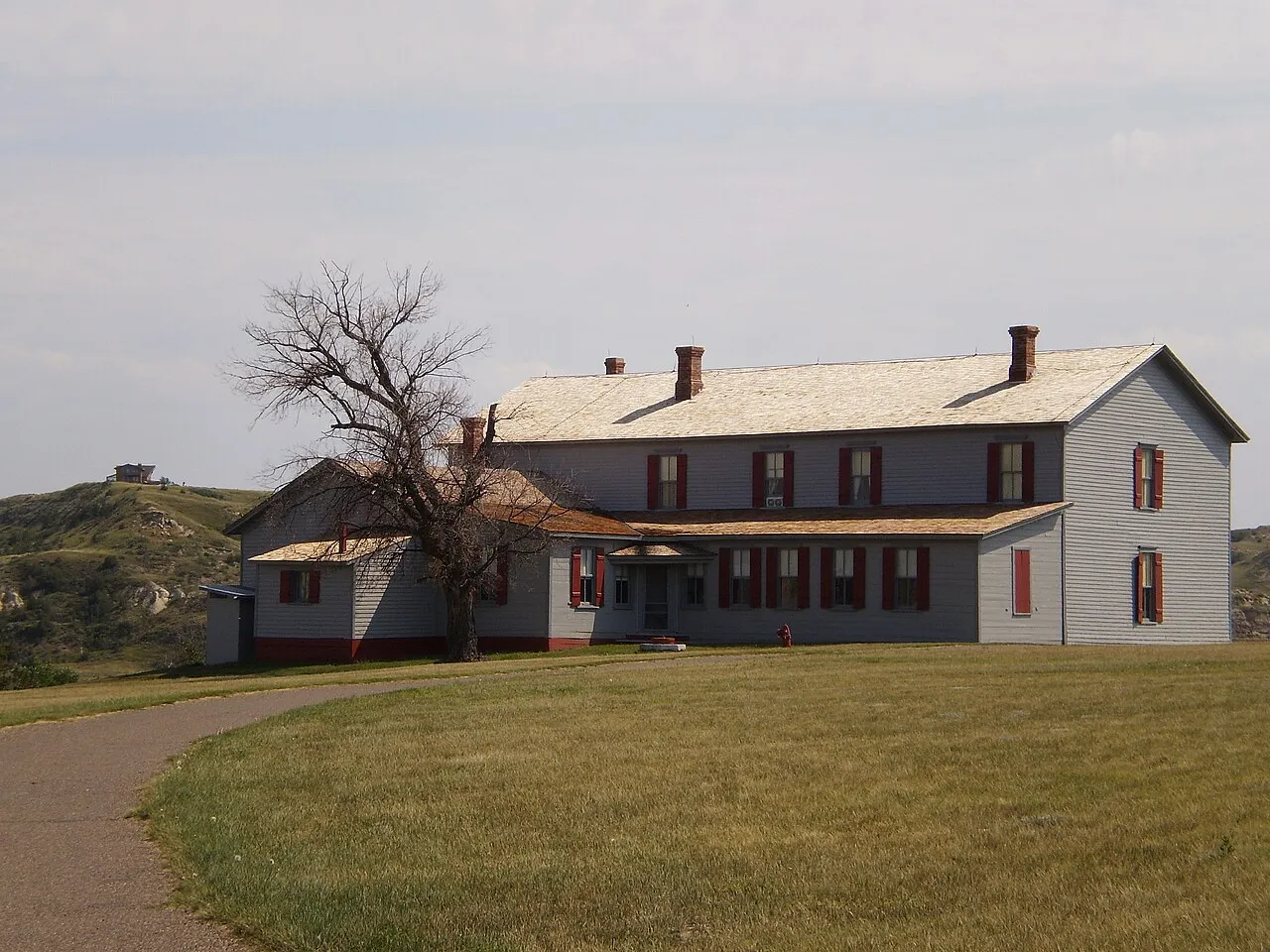
The Chateau de Mores on the bluff above Medora, in a modern photograph. The Marquise's son Louis gave the house to the State of North Dakota in 1936. (Podruznik, Wikimedia Commons)
Why She Matters
The Marquis usually takes center stage in Medora's story. Medora de Morès was more than the name on the town. She paid for its Catholic church, offered to pay its schoolteacher, hunted the Badlands and brought down bears in the Big Horn country. Because her family kept the house after she left, and her son Louis gave it to the state in 1936, visitors can still walk through a home T.R. knew as a guest.
In The Bad Lands Cow Boy
The Bad Lands Cow Boy followed the Marquise's comings and goings, her church, her school offer and her hunting trips from 1884 to 1886. Each item links to the page where it was printed.
Continue Reading
- The Marquis de Morès — The ambitious French nobleman who founded Medora and named it for his wife.
- Medora — The boom town on the Little Missouri, from its founding in 1883 to the end of the open range.
- The Bad Lands Cow Boy — Medora's weekly newspaper, which recorded the Marquise's church, school offer and hunts.
- Frontier Life — What daily life looked like for ranchers and townspeople in the Badlands of the 1880s.
Primary Sources
Read the first-hand accounts behind this page:
- Roosevelt in the Bad Lands by Hermann Hagedorn (1921), built on interviews with Roosevelt’s Medora neighbors
- Every item The Bad Lands Cow Boy printed about Medora de Morès, in the Cow Boy archive
From the Archives
Letters, photographs and documents connected to Medora de Morès in the Theodore Roosevelt Center Digital Library.
Recommended Reading
- Roosevelt in the Bad Lands by Hermann Hagedorn (Houghton Mifflin, 1921)
- The Marquis de Morès: Emperor of the Bad Lands by Donald Dresden (University of Oklahoma Press, 1970)