
The Marquis de Morès: The Romantic Rival
French Aristocrat, American Heiress, Dakota Ambitions
Antoine-Amédée-Marie-Vincent Amat de Vallombrosa, the Marquis de Morès, was born into genuine French aristocracy with old family wealth and connections stretching back centuries. Of the old French nobility, he believed deeply in aristocratic privilege and the natural superiority of his class. Yet he was no idle aristocrat content with inherited leisure. He was an entrepreneur, restless and ambitious, always seeking new ventures that would expand his fortune and prove his exceptional abilities.
His life changed dramatically when he met Medora von Hoffman, daughter of a wealthy New York banker. She was traveling in France with her family, and when de Morès encountered her at the Chateau de la Bocca in Cannes, where her parents were staying, he fell in love and pursued her with the same intensity he brought to all his ambitions. They were married on February 15, 1882, with the Bishop of Fréjus officiating at the ceremony. The marriage united two fortunes: his French title and old-world prestige with her family's considerable American wealth. It was a match that would finance his grandest schemes.
In 1882, shortly after their marriage, de Morès and Medora came to America, landing in New York in August. That autumn, while he familiarized himself with American banking and commerce at Medora's father's bank, he made a careful study of the cattle industry. He became convinced it had tremendous profit potential. More importantly, his cousin, Count Fitz-James, had hunted in Dakota Territory and returned with stories of the region's vast ranching opportunities and dramatic landscape. These accounts fired the Marquis's imagination and led to a fateful decision.
In 1883, at age 24, de Morès came to Dakota Territory with an extraordinarily ambitious plan: he would establish a town in the remote Dakota Badlands, build a major meat-packing facility to compete with established centers in Chicago and Kansas City, and create a new commercial empire in the northern Great Plains. The town he founded was named Medora after his wife, and he invested his wife's considerable fortune into the venture — building substantial buildings, establishing the meat-packing plant, investing in ranching operations, and creating the infrastructure of a town.

Antoine de Vallombrosa, the Marquis de Morès — a French aristocrat who arrived in Dakota Territory in 1883 with vast ambition and his wife Medora’s family fortune. (Bibliothèque nationale de France)
Building an Empire with Unlimited Capital
De Morès's vision was breathtaking in its scope and ambition. Most ranchers simply raised cattle and shipped them east by rail. But de Morès recognized a flaw in that system: the weight of the animals made transportation expensive, and middlemen in Kansas City and Chicago took the profits. His radical idea was to build a slaughterhouse right at Medora, dress the beef locally, ship only the meat east by refrigerated rail car, and keep those middleman profits for himself.
To execute this vision, he built one of the most modern meat-packing facilities in the entire country. The abattoir was completed in the fall of 1883, and slaughtering began the first week of October of that year. Contemporary accounts suggest the plant cost the Marquis over $250,000 — an enormous sum in an era when a skilled worker earned perhaps a dollar a day. The facility was designed and equipped “on the latest and most scientific principles,” and was said to be “the most complete for its size in the country.” The plant was capable of slaughtering 150 beeves per day, which meant, if operating at full capacity, the Marquis could ship 20,000 head of cattle annually.
But building the slaughterhouse was only part of the venture. De Morès established the Northern Pacific Refrigerator Car Company to manage the dressed beef, and he secured a thirty-year contract with the Northern Pacific Railroad itself. He built cold storage and icing stations at Helena, Billings, Miles City, Medora, Bismarck, Fargo, Brainerd, Duluth, Minneapolis, and St. Paul — an integrated supply chain that stretched from the Badlands to the great eastern markets. He assembled approximately 15,000 acres of land around the slaughterhouse to control grazing areas and guarantee cattle supplies.
De Morès didn't merely build a business enterprise; he attempted something far more ambitious — he tried to create a quasi-feudal society in the American West. He saw himself as a natural aristocrat with duties and prerogatives derived from his birth, education, and wealth. He imagined himself as a medieval lord establishing his domain in Dakota. His wife, Medora, was an accomplished horsewoman and skilled hunter who hunted beside him, an “eagle feather in her hat,” could sometimes outshoot her husband. The couple entertained royalty at their elaborate Chateau de Morès. For a time, with seemingly unlimited capital and his commanding personality, it seemed that his vision might actually succeed. Medora grew from an empty plain in April 1883 to a town of 251 permanent residents by the end of 1884, with three hotels, a dozen stores, a church, and other businesses. Roosevelt and other ranchers had to reckon with this powerful, wealthy, ambitious French aristocrat as a major force in the Badlands.

De Morès's beef-packing plant at Medora, center of his scheme to slaughter cattle on the range and ship dressed beef east by refrigerated rail. (Harvard College Library, Theodore Roosevelt Collection)
The Badlands Rivalry
Roosevelt and de Morès were not natural allies. Roosevelt was a self-made man trying to build a ranch through hard work and practical ranching. De Morès was a European aristocrat attempting to transplant feudal social structures to the Dakota frontier. Roosevelt believed in competing fairly and honestly; de Morès was comfortable with business tactics that prioritized ruthless efficiency over scruples. Both men were strong personalities accustomed to dominance, and both were operating in the same region.
De Morès had resources that dwarfed Roosevelt's. His wife's family fortune allowed him to absorb losses that would have bankrupted ordinary ranchers. He could pay wages that undercut competitors, undercut market prices to push rivals out of business, and weather economic storms that would destroy other enterprises. To Roosevelt, this seemed fundamentally unfair — using inherited wealth rather than effort and ability to achieve dominance. Roosevelt understood that the self-made man would eventually lose to unlimited capital unless the man with capital made mistakes.
Beyond economic competition lay deeper philosophical differences. A New York Herald correspondent captured the essential conflict: the Marquis was of the old French nobility and believed in the divine right of kings, while Roosevelt, though born to the American upper class, believed in democratic ideals and competition on merit. De Morès expected obedience and deference by virtue of his title and wealth. Roosevelt expected to compete as an equal on the basis of effort and achievement. These were fundamental, irreconcilable differences in worldview.

Theodore Roosevelt in his Badlands buckskin. The rancher and the marquis became wary neighbors and rivals along the Little Missouri. (Harvard College Library, Theodore Roosevelt Collection)
A Fatal Shooting and the Murder Trial
The incident that crystallized local antagonism toward the Marquis occurred in June 1883, only a few months after his arrival. The trouble began when de Morès began fencing his extensive property holdings. Several local hunters protested, particularly a man named Frank O'Donnell, who had long used a trail that now crossed the Marquis's fence. After a drinking session in Little Missouri, O'Donnell, in the presence of others, made threats against de Morès's life. The Marquis, taking these threats seriously, obtained a warrant for O'Donnell's arrest.
On June 26, 1883, O'Donnell, along with two other hunters named Riley Luffsey and Frank Wannegan, approached the depot where de Morès was waiting, armed and alert. The Marquis, accompanied by employees including Frank Miller and Dick Moore, confronted the hunters. When they refused to surrender to the warrant and moved to draw weapons, gunfire erupted. Riley Luffsey, an innocent bystander who simply happened to be with O'Donnell, was killed.
The shooting created an uproar. Local opinion was sharply divided. O'Donnell and Wannegan faced arrest themselves, but the Marquis and his associates were also arrested on murder charges. In a formal examination before Justice Bateman, the Marquis and his companions were acquitted. But the grand jury of Morton County brought a new indictment. De Morès, convinced he could not receive a fair trial locally — claiming bias from the “Irish element in Mandan” sympathetic to the Irish-born Luffsey — petitioned for a change of venue to Bismarck.
The trial was held in September 1885, more than two years after the shooting. The jury returned a verdict of “not guilty.” Contemporary observers suggested that money may have influenced the jurors, and even after acquittal, many locals remained indignant about the outcome. Yet the incident had a curious denouement: after the trials, the Marquis and O'Donnell reportedly came to be on friendly terms. The psychological damage to de Morès's reputation in the Badlands, however, was permanent. Even those who credited him with friendliness and generosity to employees couldn't ignore the taint of the shooting.

Medora in 1883 — the town de Morès founded and named for his wife, and the setting for the killing that led to his murder trial. (Harvard College Library, Theodore Roosevelt Collection)
The Near-Duel and Personal Animosity
Apart from the Luffsey incident, Roosevelt's relations with de Morès became increasingly hostile. According to Roosevelt's biographer Hermann Hagedorn, the two men had frequent disagreements, particularly over range rights and cattle deals. Disputes also arose over water rights and grazing land. There were even stories that at one point the men came dangerously close to settling their differences by a duel, though contemporary accounts are contradictory about whether such a challenge was ever formally issued.
The deeper truth is more subtle. Perhaps it was simply a natural incompatibility between two strong characters in a small community—two very large personalities in a very small town. The Marquis and the young Dakota rancher represented different worlds colliding on the frontier. Roosevelt believed a man should earn his position through effort and ability; de Morès believed his birth and wealth entitled him to dominance. The two worldviews were incompatible, and both men were too proud and too powerful to defer to the other.

The marquis was a noted duelist. His feud with Roosevelt grew so bitter that de Morès nearly challenged him — until Roosevelt’s steady reply defused the threat. (Bibliothèque nationale de France)
The Failure of De Morès's Vision
In the end, neither man's vision for the Badlands fully prevailed, but de Morès's grand project collapsed more spectacularly. Medora failed to become the great city he envisioned. The meat-packing business proved less profitable than expected. De Morès's investments suffered losses. By the late 1880s, he was retreating from Dakota. Eventually, he left the Badlands entirely and returned to France.
De Morès's failure wasn't simply due to competition with Roosevelt. Rather, the economics of frontier cattle ranching didn't support his vision. The Badlands were too isolated; transportation costs were too high; the profit margins he needed to justify his investments never materialized. His grand vision, however carefully planned and ambitiously funded, couldn't overcome the fundamental realities of location and economics.

The château de Morès above Medora, the grand home of a man whose reach exceeded the frontier’s grasp. (Harvard College Library, Theodore Roosevelt Collection)
The Failure of De Morès's Vision
By 1886, de Morès's Badlands enterprise had begun to unravel. The meat-packing business, despite its technological sophistication, proved far less profitable than he had anticipated. The fundamental problem was economics. The Northern Great Plains were too isolated; transportation costs were too high; the profit margins needed to justify his massive capital investment never materialized. Ranchers could afford to lose money shipping live cattle east because their overhead was low. But a huge meat-packing facility required constant, high-volume operation to justify its expenses. The Badlands simply couldn't provide that volume year-round.
By 1887, de Morès was retreating from Dakota, abandoning his vision of a northwestern empire. He returned to France a financial failure by his own ambitious standards. The slaughterhouse closed. Medora, which had briefly flourished as a town with the promise of greatness, stagnated and eventually dwindled into a minor settlement. The grand project that was to revolutionize the cattle industry and make him a fortune had collapsed, a cautionary tale about the limits of capital and vision when they ignore local geography and market realities.
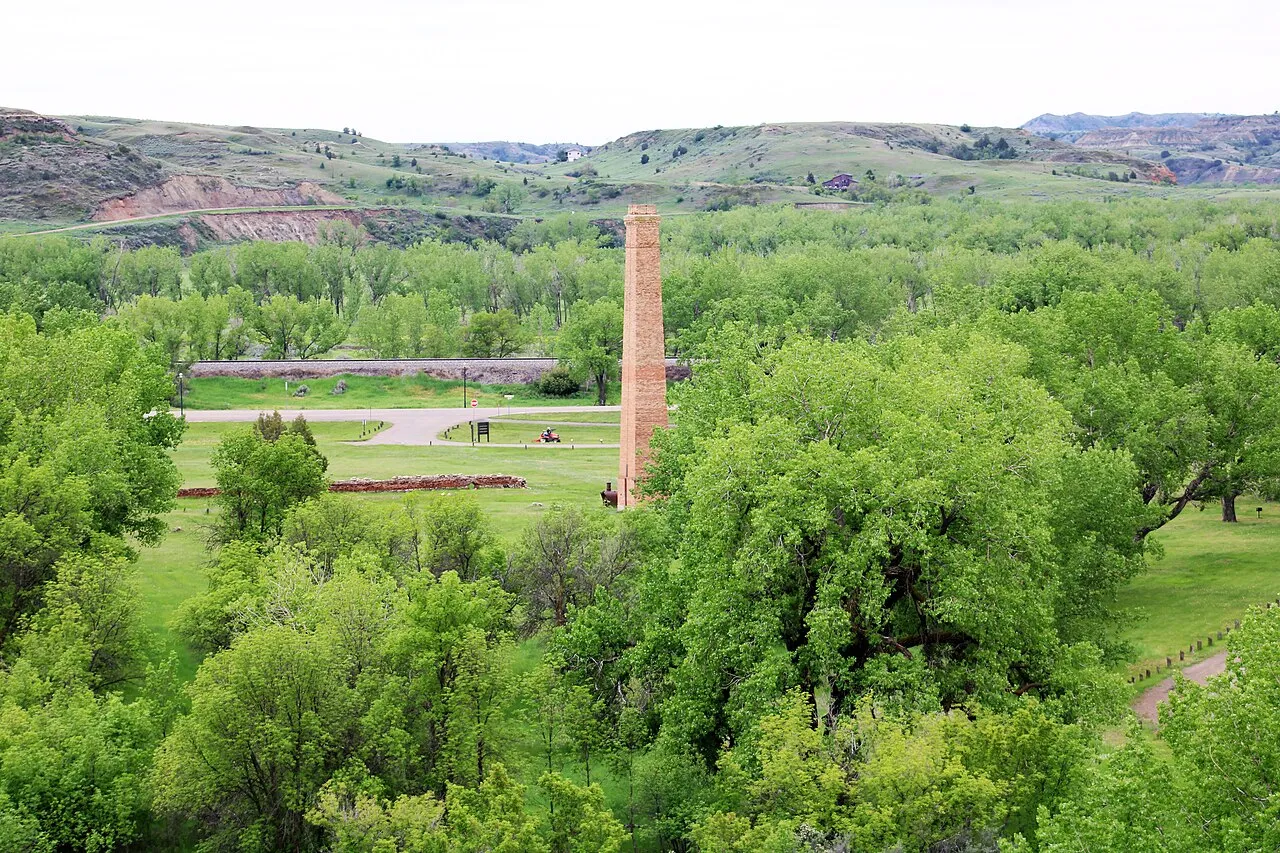
All that remains of the packing plant is its brick chimney, still standing at Medora — a monument to de Morès’s failed empire. (Wikimedia Commons)
The Troubled Path: Politics, Scandal, and Death in Africa
Back in France, the Marquis de Morès proved unable to learn from his Dakota failure. Rather than moderating his ambitions, he threw himself into French politics with the same reckless intensity he had brought to the meat-packing business. He became involved with right-wing political movements and nationalist groups. Historians note his involvement with anti-Semitic politics and various schemes to rebuild his fortune or his prestige. He was implicated in financial scandals and political intrigue. His aristocratic name and family connections gave him influence in certain circles, but his judgment remained questionable and his business ventures continued to fail.
Restless and seeking new adventure, de Morès became increasingly drawn to colonial ventures in North Africa. He envisioned himself as a great explorer and nation-builder, repeating the pattern that had failed in Dakota: grand ambitions, unlimited confidence, aggressive tactics, and insufficient attention to practical realities. He set out from Tunisia into the Sahara in 1896, ostensibly on a colonial and commercial mission.
In June 1896, while traveling through the Sahara Desert, de Morès was killed by local Tuareg tribesmen. The romantic adventurer who had failed to build an empire in the Dakota Badlands met an equally dramatic end in the North African desert — violent, unexpected, and far from home. He was only 37 years old. His wife, learning of his death, took steps to bring his killers to justice, and after a long legal process, convictions were secured in 1902.

After leaving Dakota, de Morès plunged into French politics and financial schemes before being killed in the Sahara in 1896. (Bibliothèque nationale de France)
The Measure of a Life
De Morès's life was filled with grand gestures and ambitious plans. Some had succeeded temporarily; most failed in the end. He seemed constitutionally unable to learn from failure or to moderate his approach in light of experience. He had money, education, sophistication, considerable charm, and genuine courage — observers noted he was willing to take personal risks and the shooting incident had shown him to be fearless. But he lacked the practical wisdom and judgment that allow ambitious people to succeed in the long term.
In a fundamental way, his story is a counterpoint to Roosevelt's. Both men were energetic, ambitious, and in the Badlands simultaneously. Both had money and education and powerful personalities. Both were willing to take risks and face danger. But Roosevelt had something de Morès fundamentally lacked: the ability to adapt to circumstances, to learn from practical experience without pride or bitterness, to accept failure and redirect his energies, and to moderate grand ambitions with practical wisdom and humility. Roosevelt succeeded because he could change. De Morès failed because he couldn't.

The marquis’s statue still stands in Medora — the town he built endures, even as his grander ambitions did not. (Wikimedia Commons)
The Rivalry That Shaped Roosevelt
Roosevelt rarely spoke of de Morès with warmth, but the rivalry was significant in Roosevelt's own development. It forced him to articulate what he believed about fair competition, about the proper use of capital and resources, about what kind of society America should be. De Morès represented an older model — the aristocrat who expected to dominate by virtue of birth and wealth. Roosevelt represented a newer model — the self-made man who competed on the basis of effort and merit.
The conflict between Roosevelt and de Morès, while personal and intense, was also emblematic of larger tensions in the American West. Old-world aristocratic values were colliding with American democratic ideals. European capital was flowing into frontier enterprises but not always transforming the frontier in the ways investors expected. Men of different visions and values were competing for land, resources, and influence. In that larger conflict, de Morès lost and Roosevelt ultimately prevailed — not through defeating de Morès directly, but through embodying values and approaches that proved more durable.
Continue Reading
- Maltese Cross Ranch — Roosevelt's own Dakota ranching venture and investment in the frontier
- Theodore Roosevelt National Park — The Badlands landscape that was the setting for this rivalry
- The Strenuous Life — Roosevelt's philosophy tested against de Morès's different approach to frontier ambition
Primary Sources at the TR Center
Explore original documents and resources related to the Marquis de Morès in the Theodore Roosevelt Center Digital Library.
- Dakota and Ranching Encyclopedia — Full context on the frontier cattle industry and territorial rivalries
- Roosevelt in the Badlands Timeline — Key dates and events from Roosevelt's Dakota years
From the Archives
Explore original photographs, documents, and illustrations related to this topic in the Theodore Roosevelt Center Digital Library.
Recommended Reading
- The Virginian: A Horseman of the Plains by Owen Wister (1902)
- Colonel Roosevelt by Edmund Morris (2010). ISBN: 978-0-679-60415-0
- Theodore Roosevelt in the Badlands of Dakota by Clay S. Jenkinson (2006). ISBN: 0-9786267-0-2