
The Brownsville Affair: An Injustice That Took 66 Years to Correct
August 13, 1906: A Shooting in Texas and a Fateful Accusation
On the night of August 13–14, 1906, shots rang out in Brownsville, Texas, a town adjacent to Fort Brown, where the 25th Infantry Regiment—an all-Black unit of the United States Army—was stationed. A bartender was killed. A police officer was wounded. The immediate question was urgent: who had done the shooting? By morning, the town had reached a conclusion, though not through evidence or investigation. White townspeople had simply assumed that the Black soldiers were responsible. What followed was one of the most unjust episodes of the Roosevelt presidency: a mass punishment administered without individual hearings, without individual evidence, without the basic procedures of military justice that the Constitution and military law required.

An 1877 survey map of the Fort Brown military post at Brownsville, Texas. In 1906 the post was garrisoned by soldiers of the all-Black 25th Infantry Regiment. (Library of Congress)
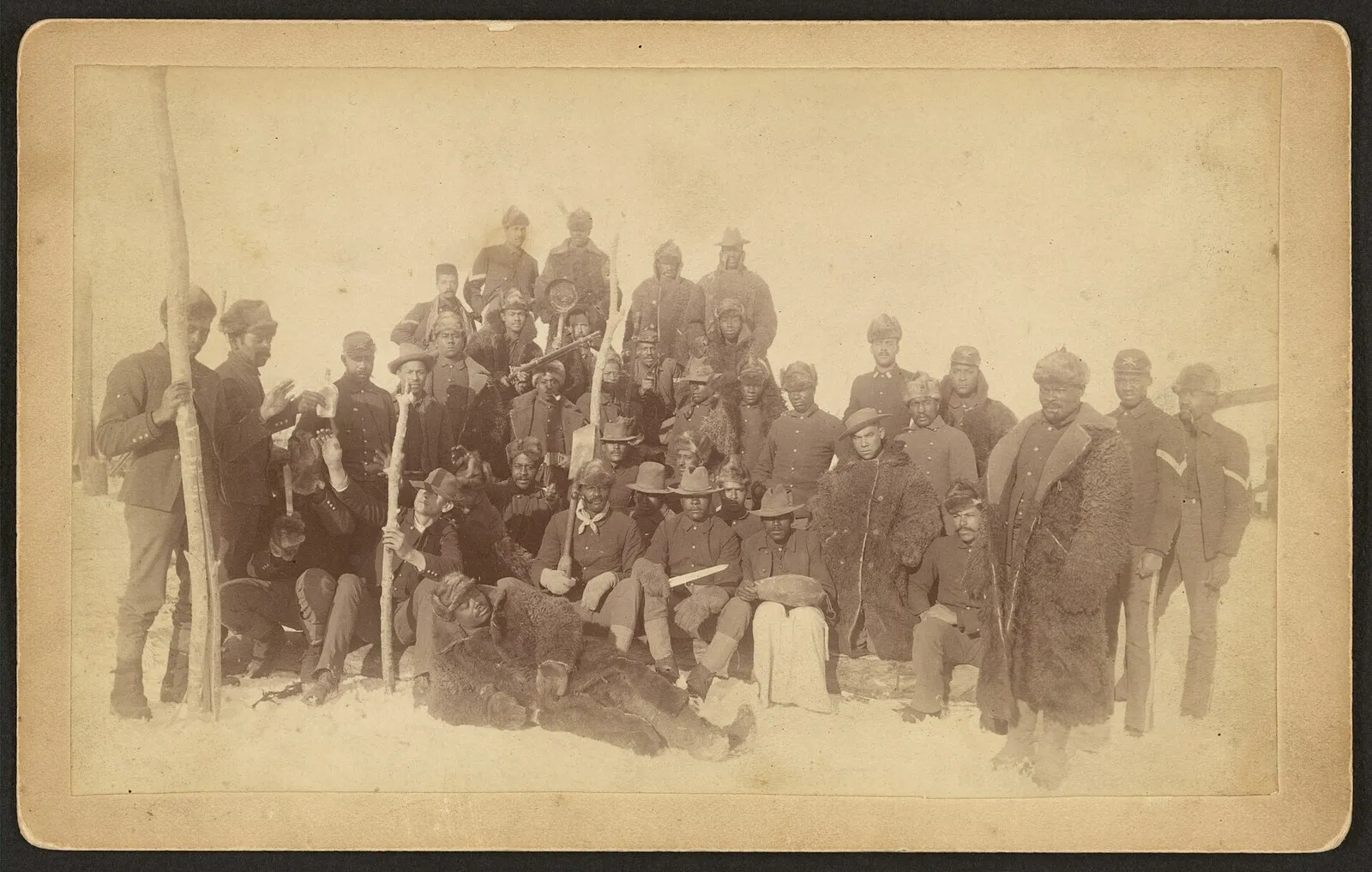
Soldiers of the 25th Infantry Regiment, one of the Army's four Black regular regiments, at Fort Keogh, Montana, in 1890. Men of this regiment were later accused after the Brownsville affray. (Library of Congress)
The Biased Investigation and the Assumption of Guilt
Roosevelt appointed Special Inspector General Ernest A. Garlington to investigate the shooting. Garlington's investigation proceeded from a troubling assumption: that the soldiers must collectively be guilty, that they must be covering for one another, and that their refusal to identify any perpetrator constituted evidence of regimental conspiracy. No individual shooter was ever identified. No individual soldier was ever convicted or even tried in court-martial. The soldiers, facing what amounted to implicit coercion, maintained their innocence and refused to inform on comrades. Their loyalty to one another—a virtue in normal circumstances—was interpreted by the investigator as consciousness of guilt.
Roosevelt, convinced by Garlington's conclusions, accepted the logic of collective punishment. The soldiers had failed to identify a perpetrator, therefore the regiment as a whole was guilty of mutiny and murder. The conclusion seems extraordinary in its injustice, yet Roosevelt arrived at it with apparent certainty. On November 5, 1906, the President had Special Orders No. 266 issued, discharging 167 soldiers from the 25th Infantry Regiment without court-martial, without individual hearings, without individualized determination of guilt, and without opportunity for defense. The soldiers were discharged “without honor”—an administrative category distinct from a dishonorable discharge, which could be imposed only by the court-martial that never took place.
The Consequences of Discharge Without Honor
A discharge without honor was not merely a separation from service. It was a devastating stigma that followed a man for the rest of his life. The discharged soldiers were barred from re-enlistment in the Army or Navy. They were forbidden from federal employment. They were denied military pensions—pensions they had earned through years of service. They were marked in the public record as criminals. Their discharge papers would be examined by employers, and potential employers would see a discharge “without honor” and know that the Army had expelled them for serious crimes. In an era when a man's reputation determined his ability to work and support his family, the consequences were devastating.
Among those discharged were several decorated veterans, including recipients of the Medal of Honor—men whose valor on the battlefield had been officially recognized by the nation. They lost everything. Decades of service, official recognition of bravery, the promise of a pension upon which to retire—all of it vanished because they had been ordered discharged without honor, branded as criminals in connection with a crime that no one had ever proven they committed.

Black soldiers of the U.S. Army in the field around the turn of the twentieth century. In 1906, 167 men of the 25th Infantry at Brownsville were discharged without honor and without trial. (Theodore Roosevelt Presidential Library)

President Theodore Roosevelt in 1904. In 1906 he ordered 167 Black soldiers of the 25th Infantry discharged without honor and publicly defended the decision. (Library of Congress)
Roosevelt's Extraordinary Justification
Roosevelt's public justification for the discharges was severe in its language and expansive in its assertion of presidential authority. "The punishment meet for mutineers and murderers such as those guilty of the Brownsville assault is death," the President stated, "and a punishment only less severe ought to be meted out to those who have aided and abetted mutiny and murder and treason by refusing to help in their detection." This language was extraordinary. Roosevelt was equating refusal to inform on comrades with murder and treason. He was asserting that the soldiers' silence, their loyalty to one another, constituted a crime worthy of severe punishment.
The logic was troubling. In civilian life, the Fifth Amendment protects the right against self-incrimination. Family members are not required to testify against one another. A witness may have reasons for silence other than guilt. Yet Roosevelt's language suggested that he viewed the soldiers' refusal to inform as itself a crime—not a failure of duty, but actual treason. This interpretation of presidential authority was expansive and, from the perspective of military law and constitutional principle, deeply problematic. Yet Roosevelt, convinced of the righteousness of his position, was willing to exercise his authority to its fullest extent.
The Political Timing and the Election
There was one additional troubling aspect to the timing of Roosevelt's action. The order was issued on November 5, 1906—the day before the midterm elections—but its announcement was withheld until the polls had closed, and the discharges were carried out by mid-November. The timing suggested calculation: wait until the election was over, when the immediate political consequences would be muted by the passage of time before the next election. This was not accidental. Roosevelt understood the political dimension of his action. He understood that discharging Black soldiers en masse would provoke controversy. But he also apparently believed that the immediate political fallout could be managed if he timed the action strategically.

Theodore Roosevelt addresses a crowd. The order discharging the Brownsville soldiers was made public only after the November 1906 elections, a timing his critics questioned. (Library of Congress)

Senator Joseph B. Foraker of Ohio, who challenged the discharges on the Senate floor and championed the soldiers' cause against President Roosevelt. (Theodore Roosevelt Presidential Library)
The Controversy and Senator Foraker's Challenge
Despite the strategic timing, the Brownsville Affair generated sustained political controversy. Senator Joseph B. Foraker of Ohio, a Republican and a political rival of Roosevelt's, seized on the issue. Foraker was not primarily motivated by racial justice—he was a politician seeking to embarrass the President. Yet his political attack created space for serious questioning of Roosevelt's actions. Foraker launched a Senate Military Affairs Committee investigation that subjected Roosevelt's order to intensive scrutiny. The investigation examined the evidence, such as it was, that had led to the discharge order. The investigation questioned the logic of collective punishment without individual guilt. The investigation revealed the inadequacy of the investigation that had preceded Roosevelt's decision.
The Foraker-Roosevelt feud became personal and bitter. Roosevelt felt attacked and questioned. Foraker felt that the President had committed an injustice and was trying to cover it up. The clash between them damaged Roosevelt's standing among some Republican constituencies, particularly among African American Republicans who had supported the party since Reconstruction. The Brownsville Affair became a symbol of the Republican Party's abandonment of Black interests—not the only symbol, but one of the most concrete and dramatic.
The Long Wait for Justice: 1906 to 1972
The discharged soldiers fought for vindication for decades. They wrote letters, sought political support, pursued legal remedies. They died waiting for justice. In 1972, more than 65 years after Roosevelt's discharge order, the Army finally reversed itself under President Richard Nixon. The discharges were changed to honorable. The stigma was officially removed. The soldiers were vindicated. Only one of the discharged men, Dorsie Willis, was still alive to see it; in 1973 he received a $25,000 payment from the government. Yet vindication in 1972 meant almost nothing to men who had spent their lives bearing the shame of the discharge, who had died without seeing their names cleared, who had never received the pensions they had earned.

Soldiers of the 25th Infantry Bicycle Corps in Yellowstone National Park, 1896. Not until 1972 did the Army overturn the Brownsville discharges and clear the regiment. (U.S. Geological Survey)

A soldier of Company A, 25th Infantry Regiment, photographed in the 1880s. The Brownsville case became a lasting lesson on due process and the limits of executive power. (Library of Congress)
Constitutional and Military Lessons
The Brownsville Affair illustrated something crucial about executive power in a constitutional system. Roosevelt possessed the formal authority to discharge military personnel. Yet his exercise of that authority in this case violated fundamental principles of justice and fairness. He punished presumed guilt without evidence. He administered collective punishment without individual determination of guilt. He denied the soldiers basic procedural rights that even the most rigorous military justice system requires. His actions were not technically illegal—the President, as commander in chief, has broad authority over military personnel. Yet they violated the spirit of constitutional governance, which requires that power be exercised fairly and with regard for individual rights.
The episode revealed both the vast power of the presidency and the limits that should constrain that power. Roosevelt could discharge soldiers. But the Constitution, rightly understood, suggested that he should not discharge them without individual hearings and individual evidence of individual guilt. His willingness to ignore those limits, his conviction that he was right about the soldiers' guilt despite the absence of evidence, his determination to punish perceived disloyalty—all of these represented a concerning assertion of unchecked executive power.
Roosevelt's Legacy on Brownsville
By the end of his life, Roosevelt had not recanted or apologized for the Brownsville discharges. He maintained that he had acted correctly, that the soldiers had been guilty of conspiracy and cover-up, that his punishment had been appropriate. This unwillingness to acknowledge the injustice he had perpetrated stands in sharp contrast to his capacity, in other contexts, to admit error and change course. On the Brownsville Affair, he remained convinced of his righteousness despite evidence and argument to the contrary. This conviction—this certainty that he was right about the guilt of men he had never spoken to, based on an investigation that had produced no individual evidence of guilt—represents a troubling dimension of Roosevelt's character and his understanding of power.
Learn more about the Brownsville Affair and its place in Roosevelt's presidency and legacy
Continue Reading
- Race and Roosevelt's Presidency — The broader context of racial injustice during his administration
- Executive Power and Constitutional Limits — Unchecked presidential authority in the Brownsville case
- The Booker T. Washington Dinner — Another moment revealing racial tensions
- Race and Roosevelt's Complex Legacy — Confronting the difficult dimensions of his presidency
Primary Sources at the TR Center
Explore original documents and resources related to this topic in the Theodore Roosevelt Center Digital Library.
- The Brownsville Incident — Documents and scholarly analysis of the discharge order
- Race and Roosevelt — Essays addressing racial dimensions of his presidency
From the Archives
Explore original photographs, documents, and illustrations related to this topic in the Theodore Roosevelt Center Digital Library.
Recommended Reading
- Theodore Roosevelt: A Life, Nathan Miller, 2011, ISBN 978-0062078543
- The Brownsville Raid: The Untold Story of How America's Black Soldiers Were Dishonored, John D. Weaver, 1970, ISBN 978-0393087802
- The Brownsville Affair: National Crisis and Black Reaction, Ann J. Lane, 1971