
Roosevelt and Race During the Presidency: A Complicated Legacy
Roosevelt and Race: An Overview
Theodore Roosevelt was an exceptional leader in many ways. He was intelligent, energetic, imaginative in his approach to policy, and genuinely committed to reform. He was also a man who lived in the early twentieth century and whose thinking about race was shaped by the ideas prevalent in his era. His record on race requires neither celebration nor condemnation; it requires the evidence — the gestures he made, the harms he ordered, and the limits of what he attempted. He believed in a racial hierarchy, yet he also believed in individual merit. He took actions that seemed daringly progressive by the standards of his time, yet also ordered actions — above all the Brownsville discharges — that the Army itself later reversed as unjust. He was a man of contradictions—and those contradictions played out in the lives of Black Americans who lived under his presidency.

President Theodore Roosevelt in a 1904 studio portrait. His record on race combined bold gestures with actions that caused lasting harm, reflecting the assumptions of his era. (Pach Brothers, Library of Congress)

Roosevelt working at his desk. Like many public figures of his generation, his views on race were shaped by the era's now-discredited theories of social hierarchy and racial evolution. (Library of Congress)
Social Darwinism and the Assumptions of the Age
Roosevelt's thinking about race was influenced by ideas that were intellectually dominant in his era: ideas about natural selection, racial evolution, and social hierarchy. The pseudoscience of "Social Darwinism"—the notion that human societies reflected natural hierarchies of fitness and capacity—permeated educated discourse. Roosevelt was influenced by these ideas. He spoke about races as though they possessed inherent characteristics. He believed that some peoples were more "developed" than others. Yet even within the framework of these flawed assumptions, Roosevelt maintained a conviction that individual capacity and individual achievement mattered. A person of any race who demonstrated ability, who showed courage and competence, deserved recognition. This belief in individual merit was not sufficient to overcome his era's racial assumptions. But it did create the space for actions that, within the context of the time, seemed bold.
The Booker T. Washington Dinner: Bold Gesture, Limited Impact
In October 1901, President Roosevelt invited Booker T. Washington, the most prominent African American in the nation and founder of the Tuskegee Institute, to dine at the White House. Washington had come to discuss federal appointments for the South. The invitation itself was spontaneous—Washington was in Washington to discuss appointments, and Roosevelt asked him to stay to dine. News of the dinner reached the press through the routine listing of White House guests, and the story exploded overnight. For the first time in American history, a Black American had been invited to dine as a guest of the President in the nation's house. The message seemed clear: a Black leader of prominence deserved the respect due to any important American.
The backlash was immediate and severe. Southern newspapers erupted. White politicians, particularly from the South, denounced the dinner as an insult to white civilization. Senator Benjamin Tillman of South Carolina, a powerful political figure and a violent white supremacist, made threats of violence. The controversy revealed the depth of racial hatred in America—a hatred that the dinner had provoked despite, or perhaps because of, Roosevelt's intention to challenge racial convention.
Yet the impact of the dinner's boldness was limited by Roosevelt's response to the backlash. He never invited another Black American to dine at the White House. Instead, he shifted to private consultations with Black leaders—meetings that were not announced to the press and therefore did not provoke sectional outrage. Roosevelt understood that his legislative agenda depended on support from Southern Democrats. He could not indefinitely defy Southern racial expectations without risking that support. So he adjusted his strategy. The dinner had been a gesture, powerful for its time, but ultimately constrained by Roosevelt's need to maintain his political coalition.
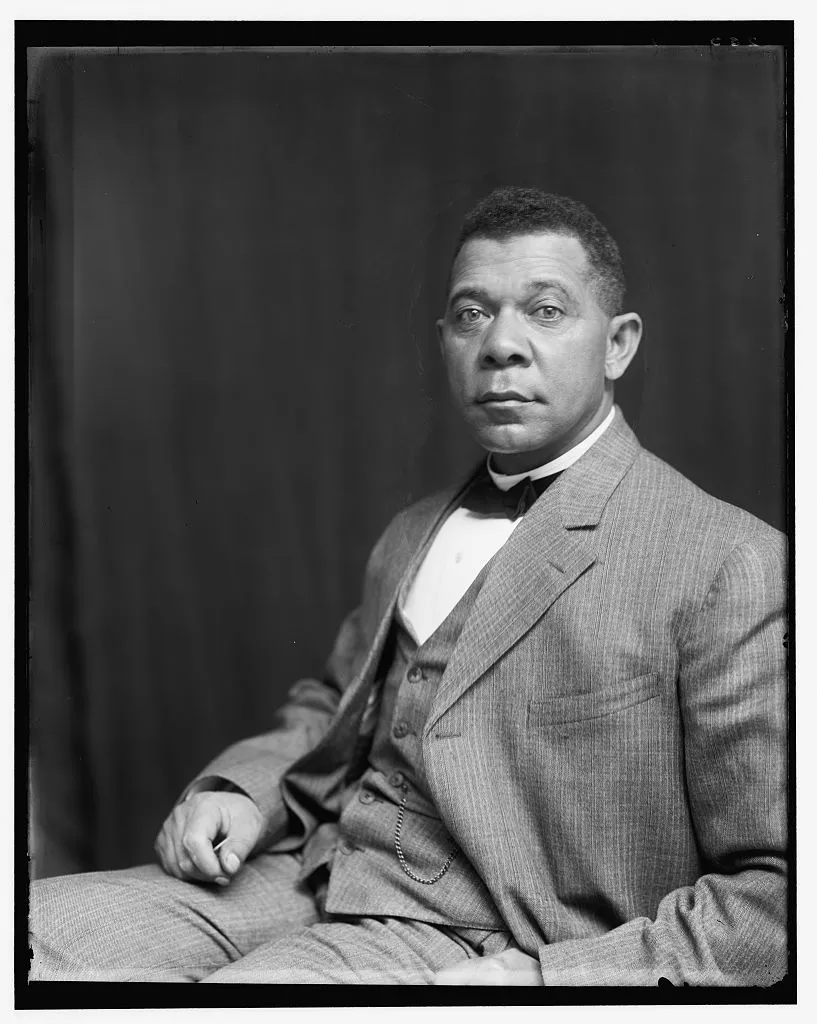
Booker T. Washington, founder of Tuskegee Institute and the era's most prominent Black leader. Roosevelt's 1901 invitation for him to dine at the White House drew fierce Southern condemnation. (Frances Benjamin Johnston, Library of Congress)
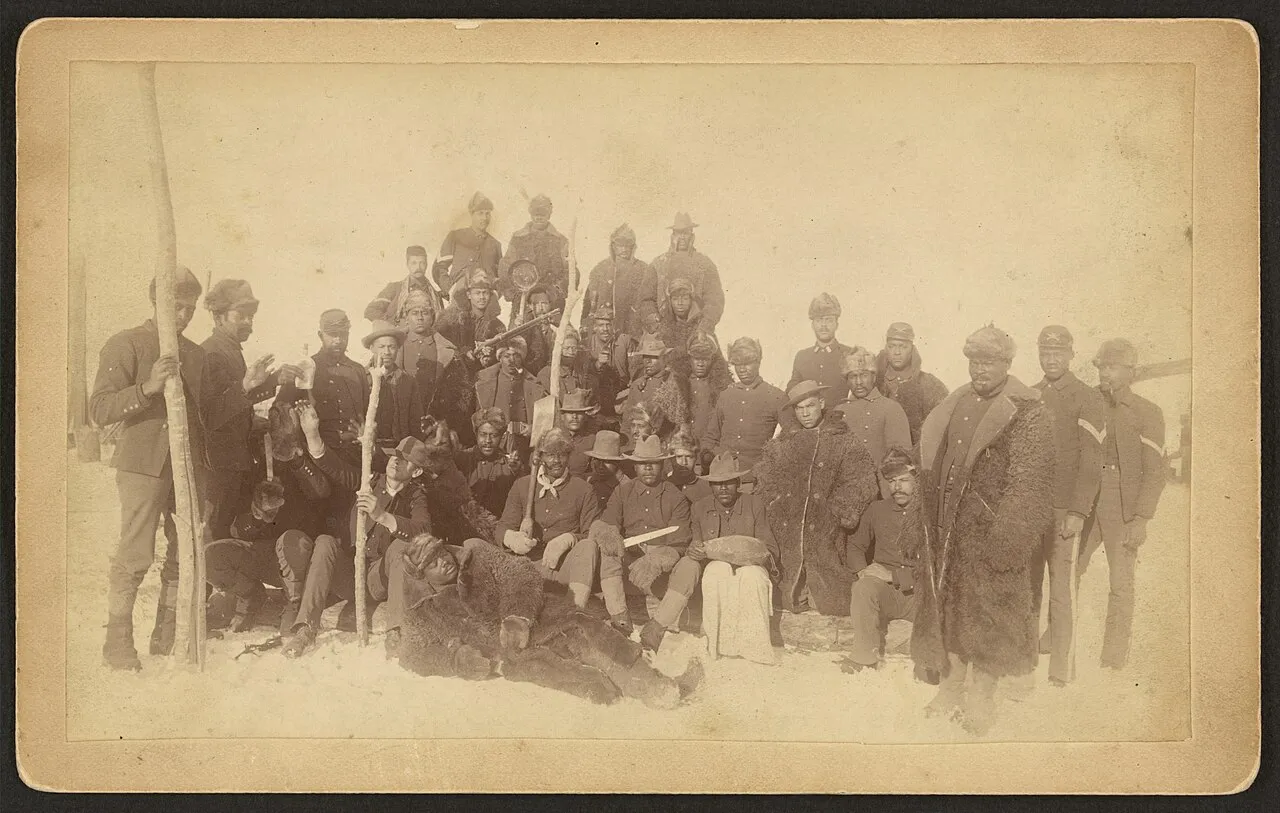
Soldiers of the U.S. Army's 25th Infantry Regiment, photographed in Montana in 1890. After a 1906 shooting in Brownsville, Texas, Roosevelt discharged 167 Black soldiers of the regiment without trial. (Library of Congress)
The Brownsville Affair: Discharge Without Trial
If the Washington dinner represented Roosevelt at his most progressive on matters of race, the Brownsville Affair was the episode the Army itself would later reverse as unjust. On August 13, 1906, a shooting erupted in Brownsville, Texas, near Fort Brown, where the all-Black 25th Infantry Regiment was stationed. A bartender was killed. A police officer was wounded. The immediate question was: who had done the shooting? Segregation laws made it difficult for Black soldiers to move through town without drawing attention. Yet the shooting had occurred at night under circumstances that made individual identification extraordinarily difficult.
Roosevelt appointed an investigator who, working from the assumption that the soldiers must be covering for one another, concluded that the regiment as a whole was responsible. No individual perpetrator was ever identified. No individual soldier was ever convicted in court-martial. The soldiers maintained their innocence. Yet Roosevelt, convinced of military conspiracy and mutiny, had Special Orders No. 266 issued on November 5, 1906, discharging all 167 Black soldiers of three companies from the Army. The discharges were made “without honor”—an administrative category no court-martial ever reviewed, and a stigma that barred them from federal employment, denied them pensions, and marked them as criminals for the rest of their lives.
Among those discharged were several decorated veterans, including recipients of the Medal of Honor—men whose valor had been recognized by the nation. They lost everything because they refused to inform on comrades, or because they were presumed to belong to a regiment Roosevelt had decided was guilty of mutiny. Roosevelt's justification was extraordinary in its severity: "The punishment meet for mutineers and murderers such as those guilty of the Brownsville assault is death; and a punishment only less severe ought to be meted out to those who have aided and abetted mutiny and murder and treason by refusing to help in their detection." This language—equating refusal to inform on comrades with murder and treason—revealed an expansive view of executive power and a willingness to punish presumed guilt without evidence or due process.
The Controversy and Its Consequences
The Brownsville Affair generated sustained political controversy. Senator Joseph B. Foraker of Ohio, a Republican and a critic of Roosevelt's methods, championed the soldiers' cause. He launched a Senate investigation that subjected Roosevelt's order to intensive scrutiny. The confrontation between Roosevelt and Foraker became personal and bitter. The affair revealed the fragility of Roosevelt's support among Black Republicans and foreshadowed a broader political realignment. Black voters, who had been overwhelmingly Republican since Reconstruction, began to feel that the party of Lincoln no longer represented their interests. The damage to Republican standing among African Americans would take decades to fully manifest, but the Brownsville Affair was a pivotal moment in that estrangement.

Senator Joseph B. Foraker of Ohio, photographed in 1902. He led a Senate investigation challenging the Brownsville discharges and defending the soldiers' right to due process. (Harris & Ewing, Library of Congress)

A soldier of the 25th Infantry Regiment. The Brownsville dismissals stood for decades; in 1972 the Army reversed the discharges and cleared the men's records. (O. S. Goff, Library of Congress)
Belated Justice and Enduring Questions
The vindication of the Brownsville soldiers came very late. Not until 1972, under President Richard Nixon, did the Army finally clear the discharged soldiers and change their discharge characterizations from dishonorable to honorable. But that belated justice could not undo the decades of stigma, the lost pensions, the ruined careers, the lives marked by injustice. The soldiers were vindicated only after most were dead.
Roosevelt's Complex Legacy on Race
Roosevelt was a man of his time—shaped by his era's racial assumptions, limited by its political constraints, yet also capable of gestures that challenged racial convention. The Booker T. Washington dinner demonstrated his willingness to treat Black leaders with respect. His continued consultation with Black Republican leaders showed that he valued their counsel. Yet the Brownsville Affair demonstrated his willingness to perpetrate extraordinary injustice when he believed his authority was being challenged. His failure to advocate forcefully for civil rights, his silence as Southern states systematically disenfranchised Black voters, his alignment with the progressive movement even as that movement adopted a "lily-white" strategy in the South—all of these represent failures of moral imagination and political courage. Yet the record also includes his stubborn defense of Black officeholders—he stood by William Crum's appointment as Charleston customs collector against furious Southern opposition, and closed the Indianola, Mississippi, post office rather than accept the forced ouster of its Black postmistress, Minnie Cox—and his 1906 annual message condemning lynching.
Understanding Roosevelt requires holding all of this in mind simultaneously: the bold gesture and the grave injustice, the progressive achievement and the conservative failure. He was a consequential president who shaped the nation's future. That future included both advancements and setbacks for Black Americans. His legacy on race is not one of simple celebration or simple condemnation. It is one of genuine complexity—the legacy of a brilliant, flawed man whose presidency advanced some interests while harming others.
Learn more about Theodore Roosevelt and race relations during his presidency
Continue Reading
- The Booker T. Washington Dinner — Breaking racial barriers and revealing their limits
- The Brownsville Affair — An injustice that took 66 years to correct
- Race and Roosevelt's Complex Legacy — Confronting the difficult dimensions of his presidency
- Foreign Policy and American Expansion — Racial assumptions in Roosevelt's international vision
Primary Sources at the TR Center
Explore original documents and resources related to this topic in the Theodore Roosevelt Center Digital Library.
- Race, Ethnicity, and Gender — Essays and documents on Roosevelt's racial attitudes and policies
- Politics and Government — Roosevelt's approach to power and civil rights
From the Archives
Explore original photographs, documents, and illustrations related to this topic in the Theodore Roosevelt Center Digital Library.
Recommended Reading
- Theodore Roosevelt: A Life, Nathan Miller, 2011, ISBN 978-0062078543
- The Rise of Theodore Roosevelt, Edmund Morris, 1979, ISBN 978-0812976205
- The Brownsville Raid: The Untold Story of How America's Black Soldiers Were Dishonored, John D. Weaver, 1970, ISBN 978-0393087802
- Up from History: The Life of Booker T. Washington, Robert J. Norrell, 2009, ISBN 978-0393334944