
The Strenuous Life in the White House
A President Who Would Not Sit Still
Theodore Roosevelt did not believe that being President of the United States was a reason to sit down. If anything, occupying the nation's highest office seemed to fuel his conviction that the body and mind must be constantly tested, challenged, and pushed beyond comfortable limits. "The strenuous life" was not merely a philosophy he had articulated as a younger man; it was a way of being that he carried into the presidency itself. The White House staff, accustomed to presidents who conducted business from desks, found themselves managing a chief executive who seemed to believe that the Oval Office was simply a place to pass through before the next round of physical activity began.
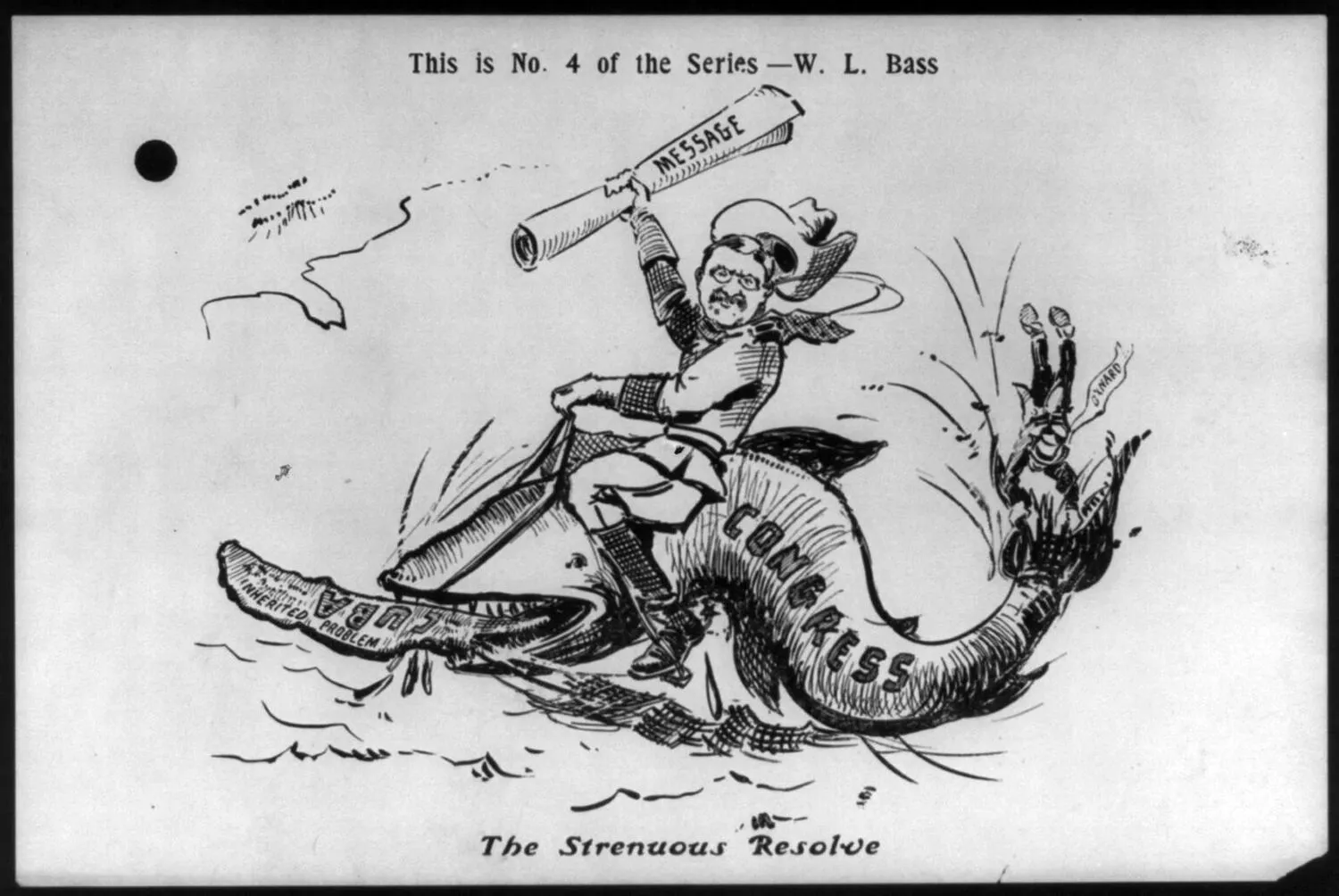
“The Strenuous Resolve” — a cartoon captures Roosevelt's restless energy as he drives his agenda through Congress. (Library of Congress)

Roosevelt sets out on horseback; riding was part of the daily regimen of exercise he kept even as president. (Harvard College Library, Theodore Roosevelt Collection)
Tennis, Horseback Riding, and the Daily Regimen
TR's day began early and involved rigorous physical activity before the formal business of the presidency commenced. Tennis was his preferred sport. The White House had a court, installed in 1902, and the President used it with fervor, often recruiting younger men from his staff to serve as opponents. These men quickly learned that playing tennis with the President was an endurance test. Roosevelt played with fierce concentration and competitive intensity. He did not play for recreation; he played to win. He played to challenge his body. He played, in some sense, to prove something to himself about vigor and power.
Horseback riding occupied much of his time as well. Every morning, weather permitting, the President would mount a horse and ride through Washington's parks and neighborhoods. These were not leisurely rides. They were fast-paced journeys that TR used to clear his mind, to observe the city, and to maintain the physical condition that he believed essential to any man—let alone the President. The Secret Service, tasked with protecting him, quickly learned that they needed to be exceptional riders. Roosevelt would not slow his pace for security concerns. If they could not keep up, they simply fell behind.
The Rock Creek Park Swim and Winter Courage
The most famous of Roosevelt's athletic exploits as president involved a winter plunge into Rock Creek. On a cold day, TR led a small party that included the French ambassador, Jules Jusserand, on one of his famous point-to-point tramps through Rock Creek Park. Jusserand, expecting a genteel stroll through the city's green spaces, found himself led directly to the water. Roosevelt stripped off his clothes and dove in. The shock of the frigid water seemed to invigorate rather than discourage him. He swam across. Jusserand, unwilling to acknowledge that he could not match the President's vigor, followed—keeping his gloves on, he later recalled, in case they should meet ladies. The encounter became instantly legendary—a story that illustrated something essential about how Roosevelt understood the presidency. It was not an office for the soft or the comfortable. It required physical courage. And if you could not keep up, you simply needed to work harder.

Roosevelt and companions scramble through Rock Creek Park on one of his famous “point-to-point” walks, which went straight over every obstacle. (Harvard College Library, Theodore Roosevelt Collection)

“The strenuous life has its drawbacks” — a cartoon on the hazards of Roosevelt's relentless vigor; a White House boxing bout left him blind in one eye. (Library of Congress)
Boxing and the Accidental Blinding
Roosevelt regularly engaged in boxing at the White House, a practice that his advisors found alarming and his physicians found medically inadvisable. But the President had never been one to be dissuaded by reasonable caution. He boxed with professional boxers, with military men, with anyone willing to put on gloves and spar. The encounters were serious business—this was not play-fighting, but genuine boxing with genuine power behind the blows.
During one of these sparring sessions with a military aide, Roosevelt took a blow to his left eye that caused internal bleeding. The damage was significant. In time, the eye would lose much of its vision, effectively blinding him on one side. Roosevelt kept the injury secret. He maintained his public image as a man of undiminished vigor. Only those closest to him knew that the President's vision was compromised. He continued to box. He continued to ride. He continued to engage in athletics as though the injury had not occurred. The strenuous life admitted no exceptions, even for injury.
Jiu-Jitsu with Yoshiaki Yamashita
Roosevelt's physical activities extended beyond American sports. In 1904, he began studying jiu-jitsu with Yoshiaki Yamashita, a legendary Japanese master who had come to America to teach the martial art. The lessons took place in the White House. Roosevelt, in his mid-forties, approached the study of jiu-jitsu with the seriousness of a younger man. Yamashita subjected the President to grueling training. They grappled on the mat. Roosevelt learned throws, holds, and defensive techniques. The President worked with the intensity that characterized everything he did. This was not casual exercise. This was mastery—the pursuit of knowledge through the body, the integration of Eastern martial philosophy into an American president's daily life.

“Now for a strenuous one” — Roosevelt takes on a stubborn task; in the White House he trained in jiu-jitsu with the Japanese master Yoshiaki Yamashita. (Library of Congress)

Roosevelt rides across the Badlands; to prove army officers could meet his fitness standard, he once rode 100 miles in a single day. (Harvard College Library, Theodore Roosevelt Collection)
The 90-Mile Horseback Ride Test
Roosevelt instituted a test for military officers: they must be able to ride a horse 90 miles in three days. The test was designed, he believed, to ensure that the nation's military leadership maintained physical fitness and capacity. It was a grueling standard, and many officers found it nearly impossible to complete. But Roosevelt, who had instituted the test, was not content to watch others struggle. He went beyond the test himself. At an age when most men were content to observe from a comfortable seat, the President of the United States mounted a horse on January 13, 1909, and rode roughly 100 miles in a single day—to Warrenton, Virginia, and back—proving that he could meet any standard he imposed on others.
Swimming and Other Aquatic Pursuits
The President also swam regularly in the waters of the Potomac and Rock Creek. He approached swimming with the same competitive intensity he brought to all physical activity. Reporters who observed the President swimming noted his speed, his endurance, his apparent enjoyment of the water. For Roosevelt, the water was simply another arena in which to test himself.

Roosevelt with his sons; the president who preached the strenuous life raised his children to ride, swim, and box. (Harvard College Library, Theodore Roosevelt Collection)
Physical Activity as Presidential Philosophy
All of this physical activity was not simply personal preference or constitutional happenstance. It was deliberate philosophy. Roosevelt believed that the President should model physical vigor for the nation. He believed that a soft body indicated a soft mind. He believed that Americans, in their comfort and prosperity, were in danger of losing the hardness and strength that had made the nation great. By maintaining this relentless physical regimen, by pushing his body to extremes, by refusing to yield to age or injury, Roosevelt was making a statement: the leader of the nation should be strong. And strength came through constant testing, constant challenge, constant refusal to accept comfortable limitations.
By modern standards, much of this seems reckless—boxing that could cause permanent injury, athletic competitions that risked actual damage, a complete disregard for the advice of physicians and security experts. But to Roosevelt, it was essential. A president who could not ride, who could not swim, who could not box and wrestle and climb mountains was not fit to lead. And so the President of the United States, every day, proved his fitness to those who observed him.
Explore Theodore Roosevelt's philosophy of the strenuous life
Continue Reading
- The Strenuous Life — Roosevelt's philosophy and the man who lived it
- The Bully Pulpit — Roosevelt's mastery of public communication
- Executive Power and the Stewardship Theory — How Roosevelt expanded presidential authority
- Understanding Roosevelt's Complex Legacy — Examining the man behind the myth
Primary Sources at the TR Center
Explore original documents and resources related to this topic in the Theodore Roosevelt Center Digital Library.
- The Strenuous Life — Essays on Roosevelt's philosophy of physical vigor and action
- Politics and Government — Roosevelt as President and model of leadership
From the Archives
Explore original photographs, documents, and illustrations related to this topic in the Theodore Roosevelt Center Digital Library.
Recommended Reading
- Theodore Roosevelt: A Life, Nathan Miller, 2011, ISBN 978-0062078543
- The Rise of Theodore Roosevelt, Edmund Morris, 1979, ISBN 978-0812976205