
White House Pets: The Roosevelt Menagerie
A President's House Became a Zoo
The Roosevelt White House was not quiet. It was not orderly. And it was certainly not empty of animals. TR's children, encouraged by a father who believed in bringing nature into daily life, turned the President's House into what one contemporary observer called a "walking zoological garden." The Secret Service, already stretched thin keeping track of six children, now had to contend with bears, badgers, roosters, snakes, and other creatures that appeared with increasing frequency in the hallways, on the stairs, and occasionally in the bedrooms of the Executive Mansion. The staff learned to expect the unexpected. What they did not learn was how to remain unflappable about it.
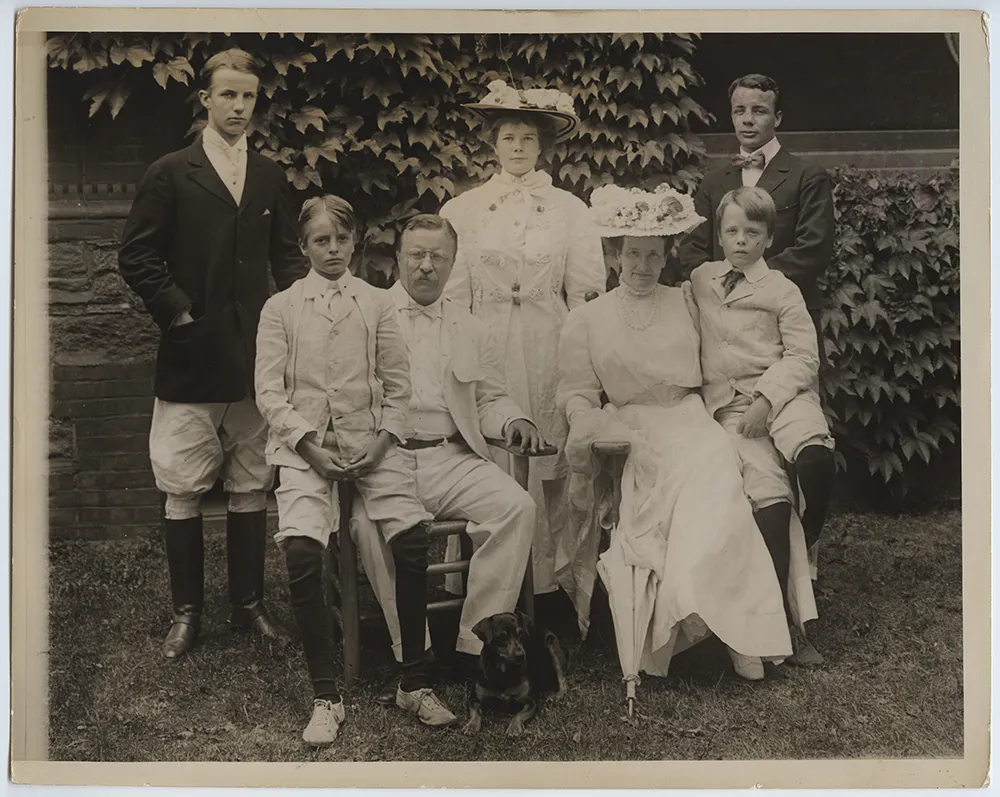
President Roosevelt with Edith and their six children. Wherever the family went, animals followed — and the White House filled with the largest, liveliest menagerie it has ever known. (SMU Libraries)

The children kept a small bear named Jonathan Edwards and a badger named Josiah, who, Roosevelt wrote, was “fond of being scratched.” (An American badger; no photograph of Josiah survives.) (Gary M. Stolz / U.S. Fish & Wildlife Service)
The Big Beasts: Jonathan Edwards and Josiah
The crown jewels of the Roosevelt menagerie were Jonathan Edwards, a black bear given to the family from Mississippi, and Josiah, a particularly disagreeable badger. Jonathan Edwards (named for the eighteenth-century theologian—partly, Roosevelt explained, because Edith's family claimed descent from Edwards, and partly because of the bear's temper) was large, powerful, and completely accustomed to being the center of attention. He represented the exotic menagerie that transformed the President's House into something far removed from traditional formal ceremony. He was not vicious—the family trusted him around the children—but he was unpredictable. Visitors to the White House never quite knew if they would encounter the President of the United States or a large bear lounging in one of the state rooms. Josiah the badger was smaller but, if anything, more temperamental. Badgers are not naturally docile creatures, and Josiah was determined to remind everyone who encountered him of this fact. He was famous among the staff for his ability to bite, scratch, and otherwise make life difficult for anyone foolish enough to get within striking distance.
Birds of Many Feathers
The Roosevelt bird collection was substantial and varied. Eli Yale, a blue macaw of considerable personality, held court in one of the parlors. Macaws are loud, intelligent, and long-lived—Eli Yale was all three. His screeches could be heard throughout the residence at irregular intervals, much to the delight of the children and the dismay of official visitors engaged in serious diplomatic negotiations. Then there was the one-legged rooster, a bird that seemed improbable even for the Roosevelt White House. How it lost its leg is not recorded. That it continued to crow is beyond doubt. In a household accustomed to the extraordinary, a one-legged rooster was simply another presence in the morning chaos.

Among the birds was a one-legged rooster, kept and cherished by the Roosevelt children alongside parrots, a macaw named Eli Yale, and an owl. (Library of Congress)

The Roosevelt boys kept guinea pigs with grand names — Admiral Dewey, Bishop Doane, Dr. Johnson, and Father G. Grady among them. (Library of Congress)
Guinea Pigs with Important Names
If Jonathan Edwards and Josiah represented the exotic, the Roosevelt guinea pigs represented something else entirely: civic virtue through rodent nomenclature. The children maintained a collection of guinea pigs that they had named with apparent seriousness after prominent American figures. There was Dr. Johnson—a name generally understood as a nod to Dr. Samuel Johnson—and Bishop Doane, named for an actual bishop. Fighting Bob Evans honored an admiral. Father G. Grady seemed to reference an Irish priest. And Admiral Dewey—the name of an actual naval hero from the Spanish-American War—was given to yet another guinea pig. Whether this collection represented the children's understanding of American history or their sense of humor remains a matter of speculation. What is certain is that the White House contained guinea pigs solemnly named after national celebrities.
Emily Spinach and the Snake That Conquered Washington
Among the reptiles in the Roosevelt White House was a garter snake named Emily Spinach. Alice herself explained the name: the snake was as green as spinach and as thin as her Aunt Emily—Edith's sister, Emily Carow. Emily Spinach lived in the White House with apparent contentment, moving through the residence with the stealth that snakes are famous for, which meant that visitors could never be entirely certain whether they were about to encounter a snake. The psychological effect on the presidential household was substantial.

Alice, the president's spirited eldest daughter, kept a green garter snake she named Emily Spinach and delighted in producing it at receptions. (Library of Congress)
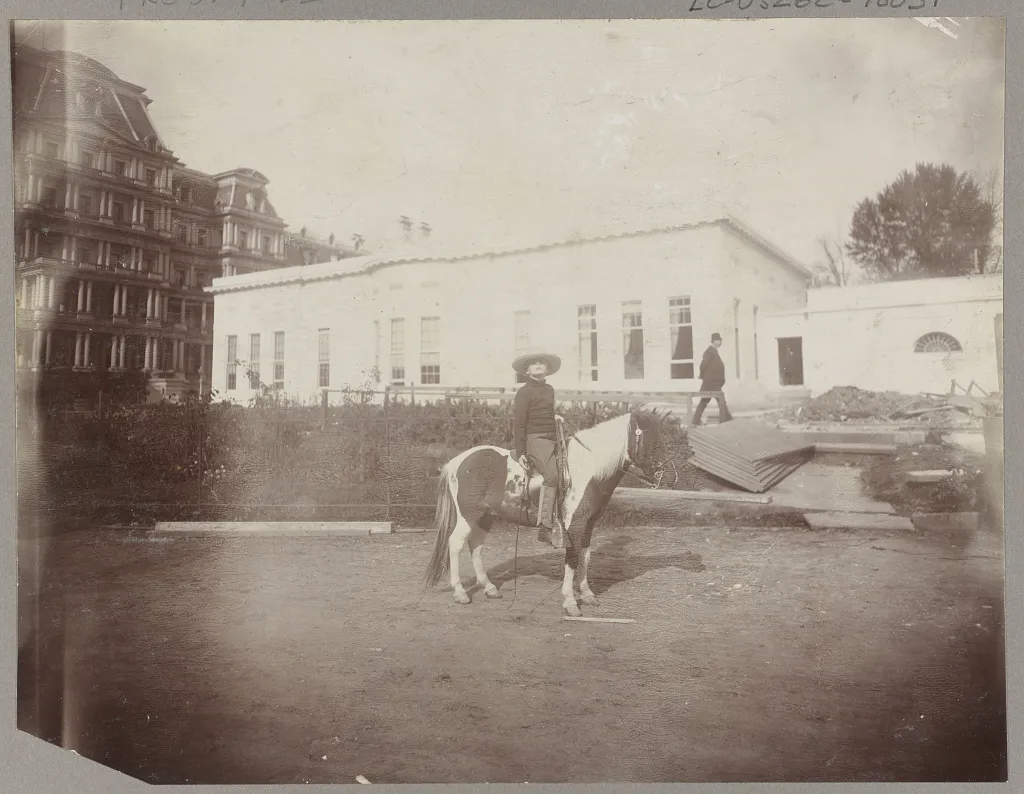
Archie's calico pony, Algonquin, was once smuggled up in the White House elevator to cheer Archie while he was sick in bed. (Library of Congress)
Algonquin: The Pony in the Elevator
The most famous animal in the Roosevelt White House menagerie was arguably Algonquin, a calico pony. Algonquin would not have been unusual—many White House residents had ridden horses—except for what happened to Algonquin when young Archie Roosevelt fell ill. The children were devoted to their animal companions, and Archie, sick and confined to bed, was desperately unhappy. His siblings, with the creative problem-solving that characterized the Roosevelt children, had an idea: why not bring Algonquin to visit him? The feat required smuggling a pony into the White House, up a flight of stairs, and into the elevator. Whether this involved cooperation from the staff or clever deception remains unclear. What is certain is that Algonquin did, in fact, make it into the elevator and to Archie's room, where the sight of a pony appeared to have precisely the therapeutic effect the children had anticipated. Archie recovered. Algonquin became an instant legend.
The Dogs: Jack, Skip, and Sailor Boy
The Roosevelt dogs were numerous and included Jack the terrier, Skip the mongrel, and Sailor Boy, each with distinct personality and status in the household hierarchy. Dogs were perhaps the most conventional of the Roosevelt animal collection, yet even they seemed to capture something of the Roosevelt spirit: energetic, sometimes unpredictable, and utterly confident in their right to occupy whatever space they chose. The White House staff learned to work around them.
Peter the rabbit and numerous other creatures rounded out the menagerie. Each animal, no matter how improbable its presence in the President's House, was treated with the seriousness that the Roosevelt children brought to everything they undertook. This was not a collection gathered carelessly. This was a collection maintained with purpose and attended to with devotion. The White House was an ark, and the Roosevelt children were its keepers.

Kermit with Jack, one of the family dogs. The Roosevelt pack included Jack, a small black terrier; Skip, a mongrel adopted on a bear hunt; and Sailor Boy, a Chesapeake retriever. (Library of Congress)
Continue Reading
- The White House Gang — The boys who turned the Executive Mansion into a playground
- The Roosevelt Children — The remarkable siblings who filled the White House with life and energy
- The Strenuous Life — Roosevelt's philosophy that valued vigor, activity, and engagement with nature
Primary Sources at the TR Center
Explore letters, photographs, and documents related to Roosevelt family life and the White House menagerie in the Theodore Roosevelt Center Digital Library.
- Roosevelt Family Encyclopedia — Essays and primary sources on Roosevelt family life, including stories about the White House pets
- The Roosevelt White House — Comprehensive resources on daily life during the Roosevelt presidency
From the Archives
Explore original photographs, documents, and illustrations related to this topic in the Theodore Roosevelt Center Digital Library.
Recommended Reading
- The White House Gang by Earle Looker (1929)
- Theodore Roosevelt: A Life by Nathan Miller (2011). ISBN: 978-0061340382
- The Roosevelt Family of Sagamore Hill by Hermann Hagedorn (1954)