
Sagamore Hill: Theodore Roosevelt's Beloved Home
The House Built for Grief, Transformed by Love
Construction of Sagamore Hill began in 1884 and was completed in 1885, during one of the darkest periods of Theodore's life. He had designed the house with his first wife Alice Lee in mind—it was to be their family home, the center of their life together. Then Alice died, and Theodore went west to the Dakota Badlands to escape his grief. When he returned and married Edith Kermit Carow in 1886, Sagamore Hill took on a different meaning. It became not a monument to a lost love, but a home where a new life could be built, where children could grow, where the future could unfold.
The house is built in the Queen Anne style—a substantial structure of 23 rooms, but not ostentatious. It sits on approximately 155 acres of carefully maintained grounds. The architecture is sensible: wide porches for outdoor living, large windows for light, rooms proportioned for real life rather than for show. For a man who spent so much of his childhood indoors overcoming asthma, fighting for breath, the house reflects a conscious choice to bring the outside in, to create spaces where air and light and natural beauty could be experienced from within the home itself.
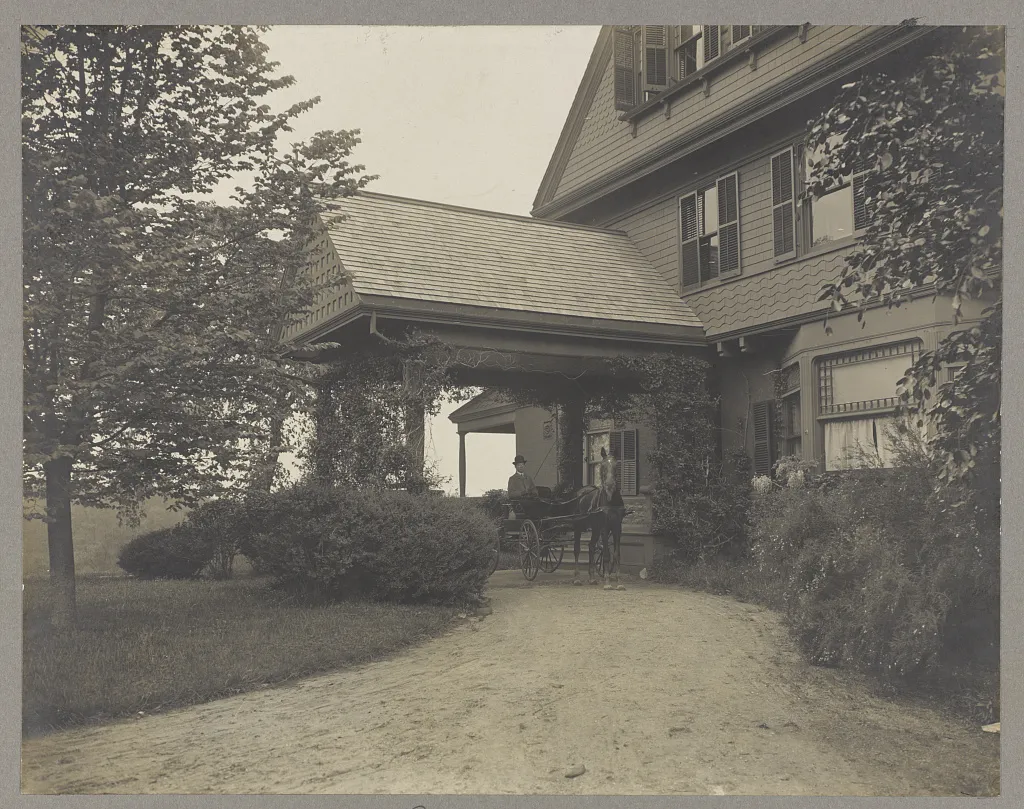
The tree-lined driveway leading to Sagamore Hill, Theodore Roosevelt's home above Oyster Bay, New York, built in 1884-85. (Library of Congress)
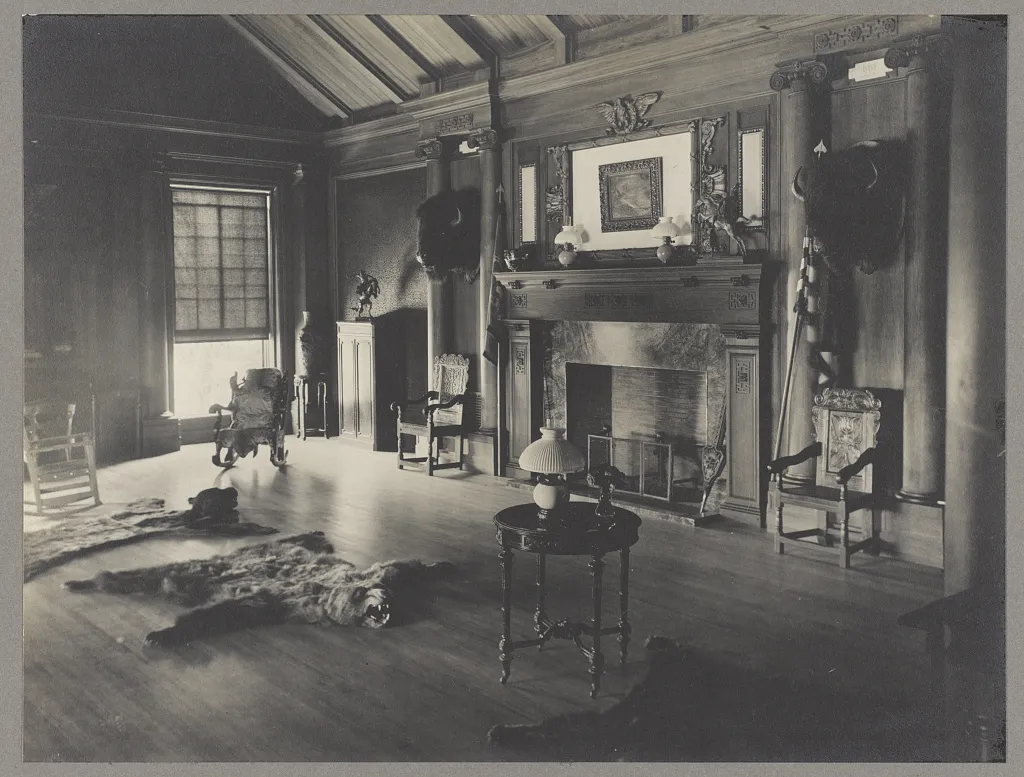
The North Room at Sagamore Hill, added in 1905, displayed Roosevelt's hunting trophies, books, and mementos of a lifetime. (Library of Congress)
The North Room: Heart of the House
At the center of Sagamore Hill is the North Room—a great hall that visitors never forgot. The walls are hung with animal heads and weapons from Theodore's hunting expeditions across three continents. Elephant tusks, moose racks, the skins of big cats—the room is a museum of conquest and adventure. But it is also a library and a study, lined with books, with comfortable chairs arranged for conversation. Theodore would sit in this room, surrounded by the evidence of a life lived fully, and receive visitors, conduct business, or simply think. The room captures the essence of Theodore Roosevelt: a man equally at home with ideas and with action, who saw no contradiction between intellectual achievement and physical challenge.
Theodore Designs His Own Home
What many visitors to Sagamore Hill did not realize was that Theodore had been intimately involved in designing the house. This was no hired architect's creation imposed upon him. Theodore had specific ideas about what his home should be. He understood what he wanted: a house that would be functional for family life, comfortable but not ostentatious, designed to bring the outdoors inside, built to facilitate the kind of vigorous, active life he envisioned for himself and his family. The result was the Queen Anne-style structure that stands today—a substantial house with 22 rooms spread across roughly 8,000 square feet, but organized around principles of comfort and livability rather than grand display.
The piazza—the broad wraparound porch—was essential to Theodore's vision. This was where the family spent time in warm weather, where conversations happened, where the boundary between inside and outside dissolved. The rooms themselves were proportioned for use, not for impressing visitors. The library was designed to hold the thousands of books that Theodore owned and read. The North Room was conceived as a gathering place—a space where ideas could be discussed and where the trophies of his adventures could be displayed.
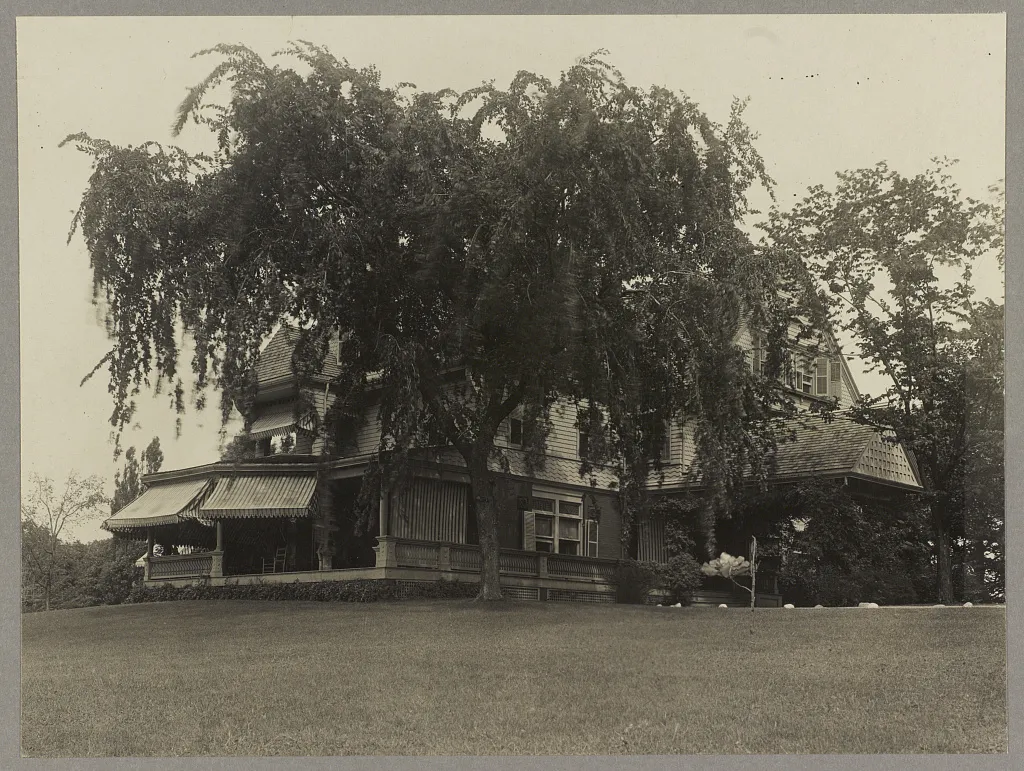
Sagamore Hill, the rambling Queen Anne house Theodore Roosevelt designed for his family, seen behind the great weeping beech on the front lawn. (Library of Congress)
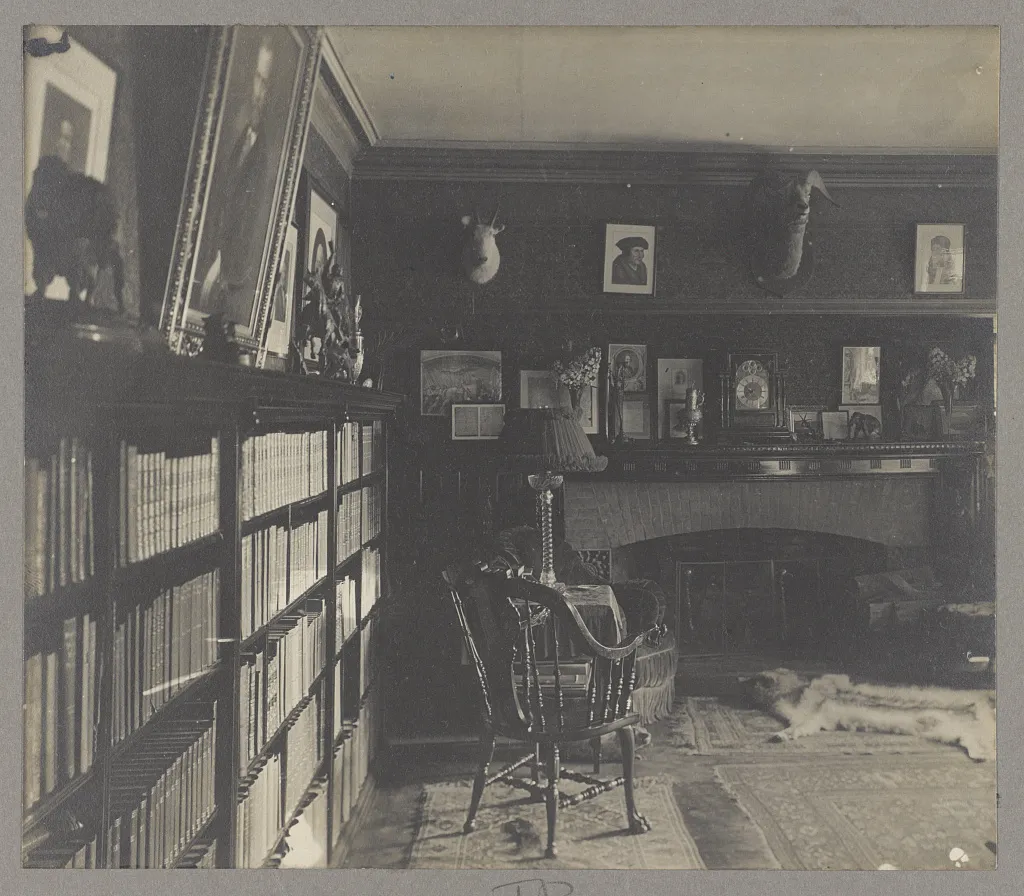
The library at Sagamore Hill, Roosevelt's book-lined study on the first floor, where he read and wrote surrounded by mementos. (Library of Congress)
The Library: Center of Intellectual Life
Throughout Sagamore Hill, but particularly in the library, one encountered Theodore's intellectual life made physical. The walls were lined with books—biography, history, literature, natural science, political philosophy. Theodore read constantly and remembered what he read. He could quote passages from books he had read years earlier. Visitors to Sagamore Hill learned quickly that conversations with Theodore were not casual social exchanges; they were vigorous intellectual engagements where he expected people to hold their own. The library was where these conversations happened, surrounded by the evidence of reading and thinking that had occupied his life.
A Home for Growing Children
Sagamore Hill was not a quiet place. Theodore and Edith raised six children there—Alice from Theodore's first marriage, and Theodore Jr., Kermit, Ethel, Archibald, and Quentin with Edith. The household was boisterous, physically active, filled with competition and games. Theodore insisted on outdoor life for his children. He organized hikes and hunting trips through the woods and along the shores of Oyster Bay. He taught them to ride horses, to shoot, to understand animals and plants. He read to them—history, natural science, adventure stories—educating their minds while their bodies grew strong. Neighbors heard the noise of the Roosevelt household and understood that something unusual was happening behind those gates.
The children were expected to excel both physically and morally. Theodore held high expectations. He believed that a soft life produced soft people. He believed that struggle built character. He believed that the greatest gift a parent could give was the knowledge that life could be lived fully, with joy and intensity and purpose. Sagamore Hill was the laboratory where he tested these beliefs on his own children. The house was full of the sounds of children running, shouting, engaging in the vigorous outdoor play that Theodore considered essential to their development.
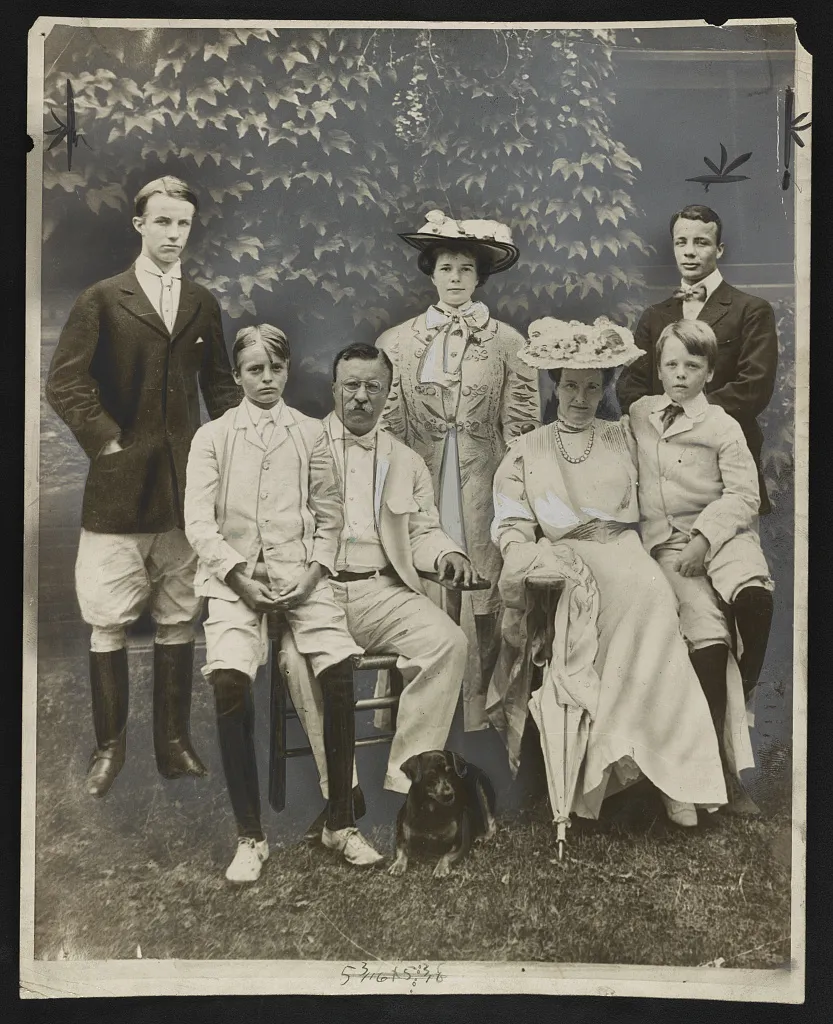
Theodore and Edith Roosevelt with their children at Sagamore Hill, the Oyster Bay home where the family grew up. (Library of Congress)
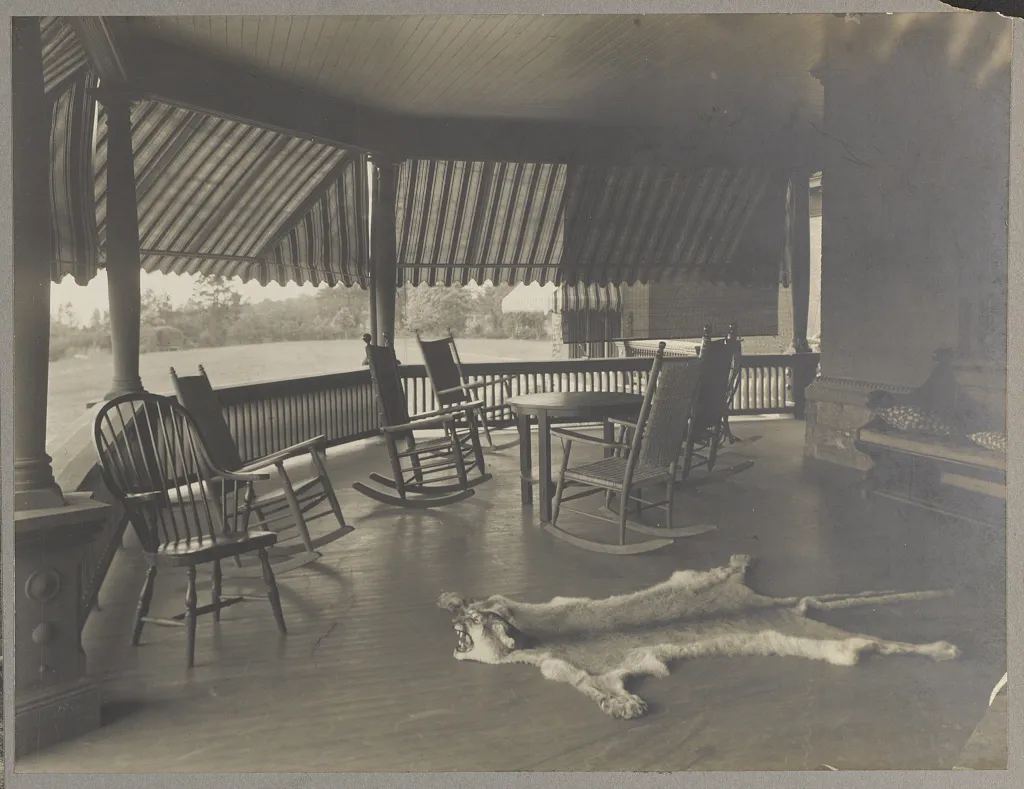
The broad piazza at Sagamore Hill, with its rocking chairs and sweeping view toward the water, where Roosevelt received guests and reporters. (Library of Congress)
The Summer White House: Presidency at Home
During Theodore's presidency (1901-1909), Sagamore Hill became known as the "Summer White House." Theodore never stayed in Washington during the hot months if he could help it. He would retreat to Long Island, where the ocean breezes cooled the air and the rhythm of life seemed to slow. But even at Sagamore Hill, the presidency intruded. Journalists followed him. Politicians came to see him. Important decisions were made under the same roof where his children played. Theodore received distinguished visitors—foreign dignitaries, cabinet officers, reformers, writers—at Sagamore Hill. The house became a center of political power, even though it remained fundamentally a home.
Theodore's working day at Sagamore Hill during his presidency followed a pattern that reflected his belief in the "strenuous life." He would rise early, often taking a vigorous walk or swim before breakfast. He would conduct business—meeting with advisors, reading reports, drafting decisions—in the morning hours. But he always insisted on time for physical activity. He would go riding in the afternoon, sometimes accompanied by visitors who were expected to keep up with his pace. He would wrestle with his sons—literally wrestling, part of his physical engagement with them. He would hike through the 155 acres of the estate, often lost in conversation with a visiting dignitary or member of his cabinet. In the evenings, there were readings aloud, conversations that ranged across history, literature, and politics. Sagamore Hill was where Theodore lived out his philosophy that the President was not a desk-bound executive but a vigorous man engaged fully with the world.
The End of an Era: Theodore's Death at Home
Theodore Roosevelt died at Sagamore Hill on January 6, 1919, surrounded by the home and the people he loved. He had lived there longer than anywhere else in his adult life, longer than any other house he had ever inhabited. For 34 years, Sagamore Hill had been the center of his private world—the place where he had raised his children, written his books, thought through the great questions that consumed him. He died as he had lived there: fully engaged, his mind still sharp, his convictions still clear, even as his body finally surrendered to age and illness.
Edith remained at Sagamore Hill for another 29 years, maintaining the house as a living memorial to the man she had married. She kept his study exactly as he had left it, with papers still on his desk, books still on the shelves. She corresponded with world leaders, defended her husband's legacy, and ensured that Sagamore Hill remained a place where serious people could gather to discuss serious ideas. After her death in 1948 at age 87, the house was purchased and opened to visitors by the Theodore Roosevelt Memorial Association; Congress designated it a National Historic Site in 1962, and the National Park Service took over its care the following year. The furnishings were returned to their original positions based on photographs from Theodore's lifetime. The house was opened to the public, but always with a sense that it was a living memorial, not a museum in the traditional sense.
"I wonder if you will ever know how I love Sagamore Hill."
— Theodore Roosevelt to Edith, January 5, 1919, the evening before his death
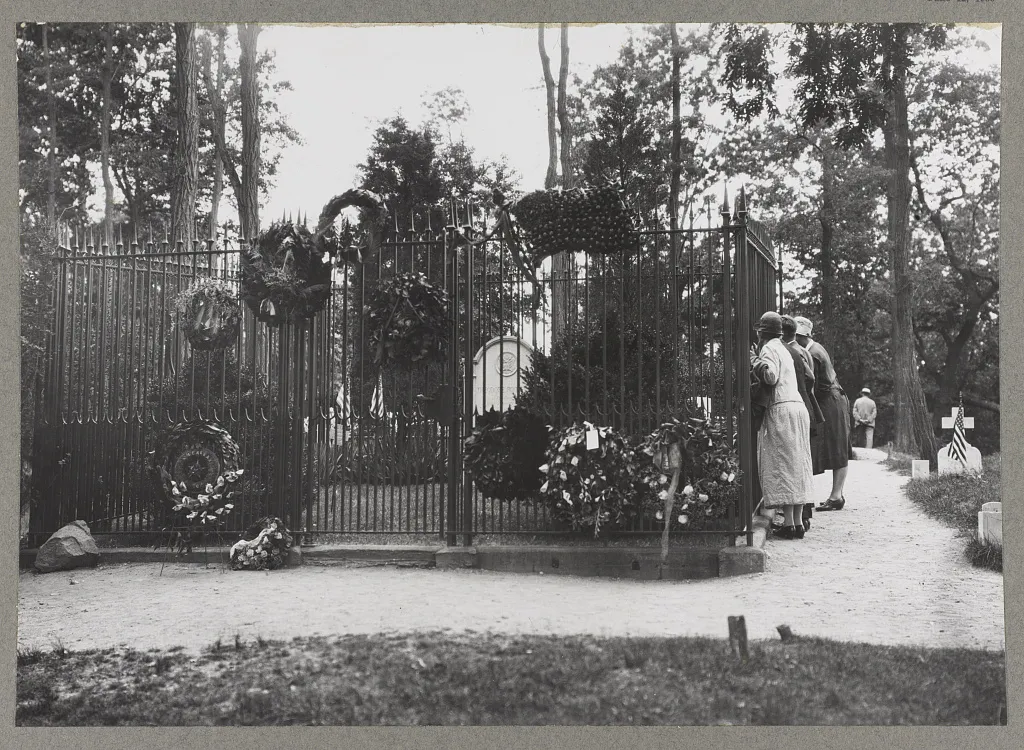
Theodore Roosevelt's grave at Youngs Memorial Cemetery in Oyster Bay, near the home where he died in January 1919. (Library of Congress)
A House That Still Speaks
Today, visitors to Sagamore Hill walk through rooms that feel like they might be occupied at any moment. The books are still on the shelves. The animal heads still gaze down from the walls. The furniture still bears the wear of use. It is one of the most intimate portraits of a great American leader that exists—not the public man of monuments and presidential imagery, but the private man in his home, surrounded by the people he loved and the interests that consumed his mind and heart.
For anyone who wants to understand Theodore Roosevelt, Sagamore Hill is essential. Here is where he became himself. Here is where he built the life that sustained him through the strains of the presidency. Here is where he returned, again and again, to remember who he was beyond the roles he played. Sagamore Hill is not just a house; it is the key to understanding the man.
Continue Reading
- Edith Kermit Roosevelt — His devoted wife and partner in life
- Alice Lee Roosevelt — His first wife, whose memory shaped Sagamore Hill
- The Double Tragedy — The loss that drove him westward
- The Presidency — Where he governed from Sagamore Hill's Summer White House
Primary Sources at the TR Center
Explore original documents and resources related to this topic in the Theodore Roosevelt Center Digital Library.
- Sagamore Hill Encyclopedia — Detailed history of the home and its inhabitants
- Theodore Roosevelt Inaugural National Historic Site — Museum preserving Roosevelt history
- Theodore Roosevelt Biography — Comprehensive overview of his life and legacy
From the Archives
Explore original photographs, documents, and illustrations related to this topic in the Theodore Roosevelt Center Digital Library.
Recommended Reading
- The Rise of Theodore Roosevelt by Edmund Morris (1979). ISBN: 978-0-307-77782-9
- Theodore Roosevelt: A Life by Nathan Miller (1992). ISBN: 978-0-688-04693-2
- Edith Kermit Roosevelt: American First Lady by Kristie Miller (2022). ISBN: 978-0-8032-2725-0