
Edith Kermit Carow Roosevelt
A Childhood Bond on Union Square
Edith Kermit Carow and Theodore grew up together on Union Square in Manhattan during the 1860s and early 1870s—neighbors in one of New York's most exclusive neighborhoods. They were inseparable from infancy. As Edith later wrote, she and Theodore’s sister Corinne "had been wheeled side by side in Union Square" as babies. Their families moved in similar circles—families of means and social standing, people who valued intellectual engagement and cultivated minds. Edith’s father, Charles Carow, struggled with business failures and drinking, which reduced the family’s fortunes considerably, but Edith carried herself with the quiet dignity of her distinguished heritage—through her mother, Gertrude Tyler Carow, she descended from a distinguished New England line that included the theologian Jonathan Edwards.
Edith became a girl of books and ideas, thoughtful beyond her years. Theodore, always intense and restless, could paradoxically sit quietly for hours with Edith, discussing literature and philosophy, sharing observations about the world. When Theodore departed for Europe with his family in October 1872, he was devastated to leave. He wrote in his diary, with the misspellings of childhood emotion: "It was verry hard parting from our friend." From Paris that November, homesick and fevered in a hotel room, he recorded: "In the evening mamma showed me the portrait of Eidieth Carow and her face stirred up in me homesickness and longings for the past which will come again never, alack never." He told Edith she was his "most faithful correspondent," and two of her childhood letters to him—written on minute hand-lined notepaper embossed with red initials—survived as proof of a bond that ran deeper than mere childhood friendship.
As they grew older, that friendship ripened into something deeper. But the timing was wrong. Theodore went away to Harvard. There he met Alice Hathaway Lee, a beautiful Boston girl with a disposition that made everyone call her "Sunshine." He fell in love with intensity that consumed him, married her, and built a life that seemed complete. There was no room in that life for Edith Carow.
Then Alice died on February 14, 1884—two days after giving birth to their daughter.

Edith Carow grew up beside the Roosevelts on Union Square and was Theodore's closest childhood companion, pictured here among the young Roosevelts around 1875. (Wikimedia Commons)

After a falling-out and Theodore's marriage to Alice Lee, the two drifted apart. When Alice died in 1884, Edith and Theodore quietly rekindled their bond. (Frances Benjamin Johnston / Library of Congress)
Grief, Exile, and the Return
After Alice’s death on February 14, 1884, Theodore Roosevelt was shattered in a way that alarmed his family and friends. He was a man who loved with complete and overwhelming intensity, and grief consumed him wholly. He could barely function. His diary entry that day reads only: "The light has gone out of my life." He left his infant daughter, Alice, in the devoted care of his eldest sister, Bamie, and fled to the Dakota badlands in the spring of 1884—determined to lose himself in the demanding, physical work of ranching. The West became his medicine. He rode hard, hunted, worked cattle, endured the scorching heat and bitter cold of frontier life. The exhaustion allowed his body to tire completely, leaving no energy for his mind to dwell on loss. In the open spaces, grief seemed proportionate to the vastness of the landscape. He was healing, but slowly.
Edith Carow watched from New York. The family had settled into reduced circumstances—Charles Carow’s business failures had taken their toll—but Edith remained unmarried. She had declined other suitors. There were whispers, later denied but never entirely convincing in their denial, that she had waited for Theodore. Those who knew her best understood that she had never forgotten him. She was still the woman who as a baby had been wheeled through Union Square alongside his sister Corinne, still the girl who had received his heartfelt letters from Europe, still the intelligent and steady presence he had known as a boy.
In the autumn of 1885, Theodore returned to New York and slowly began to resume social life. By November, he had begun attending operas, plays, dinner parties. In the social whirl of New York’s elite, he encountered Edith again. On November 17, 1885—less than two years after Alice’s death—Theodore proposed marriage to Edith. Her answer was yes. They exchanged rings and a watch, a pearl necklace, but kept their engagement entirely secret. Theodore, constrained by Victorian propriety and genuine grief, did not yet wish the world to know. Edith accepted this discretion. She understood that she was marrying a man still bearing the wounds of devastating loss, a man whose heart held the memory of another woman. She accepted this not with jealousy or resentment, but with genuine grace, because she understood something deeply important: that we do not erase the past—we build upon it, honor it, and move forward together.
A Marriage of Discretion and Depth
They were married on December 2, 1886, in London—a quiet ceremony in a small church, far from the glare and spectacle of American society. The choice was perfect for Edith, who had never sought the limelight and preferred privacy and discretion to theatrical display. There were none of the grand celebrations that might have been arranged for a man of Theodore’s rising prominence. Instead, it was simple, dignified, and entirely private—the way Edith wanted it.
From London, Edith wrote to Theodore with a depth of feeling carefully controlled on paper but evident between the lines: "You know I love you very much and would do anything in the world to please you. I wish I could be sure my letters sound as much like myself as yours do like you; or that they are what you like. You know all about me darling. I never could have loved anyone else." She was a woman of reserve, but her reserve could not hide the authenticity of what she felt.
Edith was never jealous of Alice Lee’s memory—that would have been small and petty, unworthy of a woman of her caliber. Instead, she honored it. She took the infant Alice Roosevelt, now a precocious child, and raised her with genuine affection. She was never her mother, but she became something equally important: a steady, loving, intelligent presence that made a motherless child feel cherished. She built a life with Theodore that included his past, honored it, did not deny it, but held it in proper perspective. She was, in every sense, a woman secure enough to love a man who had loved another before her, and mature enough to help that man build something new from the ashes of tragedy.

They married in 1886. Reserved where Theodore was exuberant, Edith brought steadiness, sharp judgment, and a private depth to a very public marriage. (Library of Congress)

As First Lady she oversaw the 1902 renovation that created the West Wing — separating the family's living quarters from the president's offices and shaping the modern White House. (White House / Wikimedia Commons)
The First Lady Who Modernized the White House
When Theodore Roosevelt became President in September 1901 following McKinley's assassination, Edith stepped into the role of First Lady with neither hesitation nor fanfare. She was 40 years old, educated, intelligent, refined, and absolutely prepared. She had spent years managing Sagamore Hill with a precision that was legendary among those who worked for her. She had strong ideas about how things should be done, and she implemented them with quiet authority that came from absolute certainty about her own judgment.
She undertook a systematic renovation of the White House—a residence that had become shabby, outdated, and inadequate to its purposes. She brought in the architectural firm McKim, Mead & White to oversee the modernization. But more importantly, she drove the vision. She understood that the President's House was no mere private residence—it was a symbol of American culture and achievement, and it should reflect the best of what the nation could produce. She furnished the public rooms with beautiful pieces selected with impeccable taste. She organized state dinners with ceremonial precision. She modernized the executive offices, improving their function as workplace. She made the White House a place of dignity and beauty, carefully balancing the need for formality with genuine comfort. Every room reflected her conviction that beauty and function need not be in conflict.
More importantly, she was an active political counselor to her husband—something almost unprecedented for a woman of her era. She read foreign newspapers in multiple languages. She kept abreast of political developments with the intensity of a scholar. She had informed, thoughtful opinions on matters of policy, and Theodore not only allowed her to express them, he actively sought them out. He respected her judgment profoundly. He listened to her advice on conservation policy, on foreign relations, on domestic reform. Cabinet members and diplomats learned quickly that if they wanted to understand the President's thinking on a sensitive matter, they could not afford to ignore his wife. She was not merely a listener; she was a genuine adviser, a partner in the deliberations of power.
The Protector and the Household Manager
Edith was also fiercely protective of her family's privacy—a stance that put her in direct and constant conflict with the press, which was increasingly obsessed with the President and his family. Newspapers competed to report on every detail of the Roosevelt children's lives. Journalists camped outside the White House seeking photographs, anecdotes, and gossip. Edith drew a firm line. She created explicit rules about when journalists could photograph the children, what information could be released, and how access would be managed. She was polite but immovable in enforcing these boundaries. She believed—and modern psychologists would validate her wisdom—that children deserved privacy and protection from the relentless gaze of public attention.
She was a mother to all of Theodore's children, including the adult Alice, and she managed the chaos of a large, active household with a competence that was extraordinary. She supervised the education of five young children. She managed a staff of servants and secretaries. She kept the household accounts. She balanced the needs of Theodore's public life with the family's private needs. When Theodore was consumed with business of state, Edith created a sanctuary at home. She did this work with such quiet effectiveness that it never made headlines. But those close to her understood that without her, the household would have descended into chaos within weeks. She was the infrastructure that allowed Theodore Roosevelt to be President.

Edith ran the household, managed the family finances, and shielded her husband and six children from the relentless press — the calm center of a boisterous clan. (Wikimedia Commons)
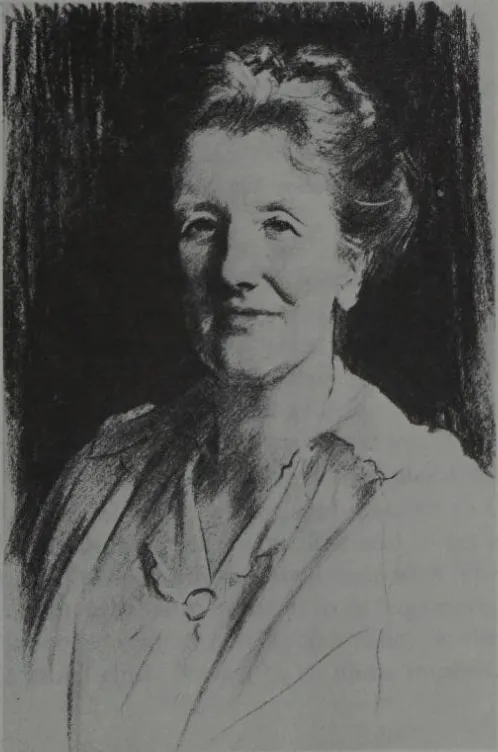
Widowed in 1919, Edith lived nearly three more decades at Sagamore Hill, guarding her husband's memory. John Singer Sargent painted her in 1921. (John Singer Sargent, 1921)
The Later Years: Matriarch and Widow
After Theodore left the presidency in 1909, Edith continued to be the center of family life—not through dominance, but through the simple fact that everyone in the Roosevelt circle gravitated toward her. She was grandmother to Theodore's grandchildren. She was consulted on family matters, on property, on the great and small decisions that families face. She outlived her husband by 29 years, dying in 1948 at the age of 87, one of the last living links to the extraordinary era she had helped to shape.
She never sought the limelight in her later years. She was happiest at Sagamore Hill, surrounded by books and grandchildren, maintaining correspondence with family members and friends, managing estates and the practical affairs of her life. She traveled less as she aged, preferring the familiar comfort of her home on Long Island Sound. Yet her influence on the presidency and on American public life had been profound. She had helped Theodore rebuild his life after devastating loss. She had supported him through the most consequential presidency of the early twentieth century. She had raised his children, including the stepdaughter she had never biologically borne but loved as genuinely as if she had. She had been, in every meaningful way, a full partner in one of the most remarkable American lives. When she died, she left behind not a record of headlines or grand gestures, but something far more valuable: a family that was whole, and a legacy of quiet, enduring strength.
A Love Built to Last
Theodore Roosevelt and Edith Kermit Carow were married for 32 years. Their marriage was built on friendship that predated their romance, on shared values, on genuine respect. When Theodore died in 1919, Edith grieved, but she had no regrets. She had built a life worth living with a man worth loving. She had done it with style, with intelligence, and with complete fidelity to both duty and love.
Continue Reading
Explore more about Theodore Roosevelt's family and his remarkable marriage:
- Theodore Roosevelt — Edith's husband and America's dynamic president.
- Alice Hathaway Lee Roosevelt — Theodore's first wife and mother of Alice Roosevelt Longworth.
- Alice Roosevelt Longworth — TR's eldest daughter and political figure.
- Theodore Roosevelt's Presidency — Edith's role as First Lady and political partner.
Primary Sources at the TR Center
Explore original documents and resources related to Edith Roosevelt in the Theodore Roosevelt Center Digital Library.
- Edith Kermit Carow Roosevelt Encyclopedia Entry — Comprehensive overview of her life, marriage, and role as First Lady.
- Roosevelt Family Encyclopedia Entry — Information on the Roosevelt family dynamics and relationships.
From the Archives
Explore original photographs, documents, and illustrations related to this topic in the Theodore Roosevelt Center Digital Library.
Recommended Reading
- The Roosevelt Women by Betty Boyd Caroli (1998).
Historical Note: Edith Kermit Carow Roosevelt was born August 6, 1861, and died September 30, 1948. She married Theodore Roosevelt on December 2, 1886, in London. She had known him since childhood in New York. During her time as First Lady (1901–1909), she modernized the White House and served as an informal political adviser to her husband. She was fluent in multiple languages and well-informed on international affairs. Information comes from family papers and biographies including Sylvia Morris's Edith Kermit Roosevelt: Portrait of a First Lady (1980).