
Alice Roosevelt Longworth
Born into Darkness and Light
Alice was born on February 12, 1884, to tremendous joy. Two days later, her mother—Alice Hathaway Lee—died. Her grandmother Mittie died the same day, only hours earlier. She was the daughter of a man whose diary read only "The light has gone out of my life," yet somehow, Alice herself became a beacon of that light.
She was raised by her stepmother, Edith Kermit Carow Roosevelt, who loved her as her own. She had five half-siblings—a household full of energy and noise and intellectual engagement. She was Theodore Roosevelt's daughter in the truest sense: headstrong, clever, fearless, and possessed of an irrepressible sense of humor.

Alice Roosevelt's mother died two days after her birth in 1884, and her father rarely spoke of it. She grew up willful, brilliant, and hungry for attention. (Library of Congress)
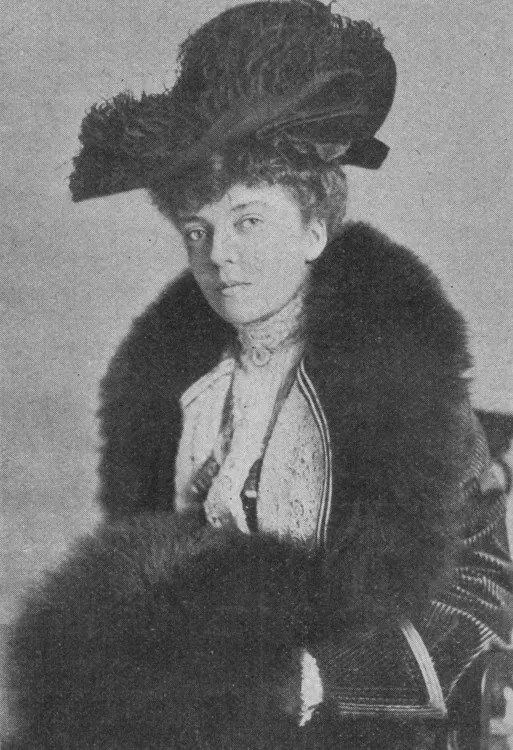
As the president's daughter, 'Princess Alice' became the era's biggest celebrity — smoking, betting, and setting fashion in her signature 'Alice blue.' (Library of Congress)
The White House Years: Princess Alice and "Alice Blue"
When Theodore Roosevelt became President in September 1901, Alice was 17 years old—beautiful, sharp-tongued, intellectually gifted, and utterly indifferent to the conventional expectations for a First Daughter. Born in tragedy to a mother she would never know and raised by a stepmother who genuinely loved her, Alice had developed a temperament that was pure Roosevelt: fierce, independent, witty, and utterly unmoved by the opinions of those she did not respect. She had learned early in life not to depend on adults, and that self-reliance had crystallized into a defiant independence that would define her entire public life.
Living in the White House during her formative years, Alice became something entirely new in American public life: the first celebrity daughter of the twentieth century. She was utterly indifferent to the conventional restrictions placed on women of her class, and society found this both shocking and irresistible. She wore daring fashions that scandalized conservative Washington dowagers—gowns that were slimmer, more modern, less adorned than tradition dictated. She smoked cigarettes in public—a behavior so shocking for a respectable woman that observers were genuinely scandalized. She drove motorcars when few women did. She spoke her mind freely on politics, fashion, religion, and the foibles of Washington and American society, with a sharp wit that could cut like a knife. She was irreverent, completely uninterested in pretense, and immune to social pressure. The press adored her. Newspaper editors found that stories about "Princess Alice" sold papers. They competed fiercely to cover her activities, photograph her, report her remarks. Young women across America tried to copy her clothes, her hairstyles, her confident bearing. She was, quite simply, the most famous young woman in America.
There was even a color named for her—the distinctive pale blue-gray of her eyes that became known as "Alice blue." The shade became fashionable almost overnight because Alice wore it with such style and frequency that women across the country wanted to copy it. Songs were written about Alice blue. It was featured in sheet music. It became a marketing phenomenon. Merchants sold "Alice blue" gowns, ribbons, and accessories. The color became inseparable from her identity—a public symbol of a private preference that somehow defined the era. She represented a new kind of American woman—modern, independent, witty, unafraid to break social conventions, and utterly confident in her own right to do so. She was her father's daughter in temperament and intelligence, but she used those formidable gifts in ways Theodore could not always control and frequently could not predict.
The Diplomat, the Celebrity, and the Scandal
During her father's presidency, Alice was sent on diplomatic missions that few young women of her era could have imagined. In 1905, when Theodore was mediating peace between Russia and Japan following their war, he dispatched Alice as a goodwill ambassador to East Asia. She traveled with a congressional delegation, charming world leaders and journalists alike. She was received by emperors and kings. She attended state ceremonies and formal dinners. The press followed her every movement. Here was a young American woman, unmarried and unchaperoned, traveling the world, engaging in diplomacy, meeting with the most powerful men on earth, and doing so with complete confidence and perfect grace. No one before her had done such a thing. She was redefining what was possible for a woman.
The trip to Asia also cemented her engagement to Nicholas Longworth, a congressman from Ohio who had been chosen for the diplomatic delegation. By all accounts, it was during this journey that their affections deepened. There was genuine, authentic connection between them, though what began as romantic gradually transformed into something more complicated as Alice's fame and her need for independence became increasingly apparent to both of them.
Yet the White House years were not without controversy. Alice was accused of violating propriety in ways both real and imagined. There was a famous incident when she demonstrated the turkey trot—a new, scandalously close dance—at a Washington ball, reportedly lighting a cigarette beforehand to give zest to the performance. Conservative society was horrified. Alice appeared not to notice. She lived precisely as she pleased, and if society disapproved, that only seemed to confirm her in her choices. She understood, with uncanny precision, how far she could push without being socially destroyed. She had seen what happened to girls who genuinely crossed the line—she had a friend whose reputation was shattered by a single rumor. Alice knew the boundaries. She simply chose when to respect them and when to deliberately blur them, always with perfect calculation.

In 1905 Alice joined a diplomatic mission across Asia, drawing headlines at every stop — part goodwill ambassador, part international sensation. (Wikimedia Commons)

In 1906 Alice married Congressman Nicholas Longworth in a White House wedding that captivated the nation. (Smithsonian National Portrait Gallery)
Marriage, Cincinnati, and the Politics of Wit
On February 17, 1906, Alice married Nicholas Longworth in the White House itself—the wedding of "Princess Alice" and a congressman from Ohio. The ceremony was a national event. The nation held its breath. Gifts poured in from governments, foreign potentates, and well-wishers across America and around the world. A Gobelin tapestry from France. A mosaic from Pope Pius X. A bracelet with a diamond-ringed miniature of Kaiser Wilhelm II. An invaluable jade ornament from China. A string of pearls from Cuba worth twenty-five thousand dollars—the pearls she would wear for the rest of her life. No bride in American history had ever received such treasures. It was, Alice would later reflect with dry humor, wonderful material for opening a museum.
But Alice had absolutely no intention of spending her life in Cincinnati, Ohio, where her new husband maintained his residence and his congressional seat. She had told Nick as much before they married. She divided her time between Cincinnati and Washington, but Cincinnati was never truly home. Washington was where she belonged—where the political action was, where power resided, where wit was sharpened against the stone of policy and politics, where a woman with intelligence and humor could matter. She spent weeks and months in Washington, visiting Sagamore Hill, attending political receptions, maintaining her salon. Nick accepted this arrangement without seeming entirely comfortable with it. He was said to joke that his role was to bask in the rays of her reflected glory—a remark that suggested both genuine affection and a certain resignation to his subordinate role in their marriage.
The marriage lasted twenty-five years, until Nick’s death in 1931. By most accounts it was, in its complicated way, successful. They had a daughter together, Paulina, born in 1925, though Alice never seemed particularly focused on motherhood. But the marriage was always fundamentally unequal. Alice was the larger personality, the greater wit, the more formidable intellect. Nick was a decent, respectable man, but he was not in her league. And Alice knew it.
The Oracle of Washington
Alice Roosevelt Longworth lived from 1884 to 1980—96 years that spanned American history from the Gilded Age to the modern era. She knew every president from Theodore Roosevelt, whom she lived with, to Jimmy Carter, whom she observed from her legendary salon. She advised them (whether they asked or not), criticized them with devastating wit, entertained them, and shaped the landscape of Washington society for generations in ways both seen and unseen.
After her marriage, Alice reinvented herself as Washington's premier political wit. When the New Deal began under Franklin Roosevelt and Eleanor Roosevelt, Alice was the voice of witty, articulate Republican opposition. Her one-liners became legendary. They were repeated in drawing rooms and dinner parties, quoted in newspapers, passed along as examples of devastating political commentary. She had a gift for the cutting remark, the perfectly timed quip that reduced complex political questions to their absurd essence. But beneath the wit was a serious intellect. She understood policy, understood legislation, understood the machinery of government. The wit was not mere entertainment—it was the vehicle for serious political thought.
Visitors to Washington who wanted to understand American politics visited Alice Longworth. Her drawing room became a kind of unofficial salon where power brokers and artists, politicians and journalists, wit and ambition all gathered. She had opinions on everything—sharp, often hilarious, sometimes bitterly cutting. She became famous for her needlepoint pillow, whose embroidered motto—quoted in several slightly different versions—ran: "If you can't say anything good about anyone, come sit here by me." She smoked cigarettes in her eighties when smoking was increasingly unfashionable. She wore diamonds and drank martinis. She lived exactly as she pleased, seemingly immune to the judgments of those she did not respect. At seventy, by the account of those who knew her, she remained commanding, magnetic, utterly herself. She did not apologize, did not explain, did not conform. She was Alice.

As Nicholas rose to Speaker of the House, Alice reigned over Washington society — her tart wit and shrewd read on politics made her a power in her own right. (Library of Congress)
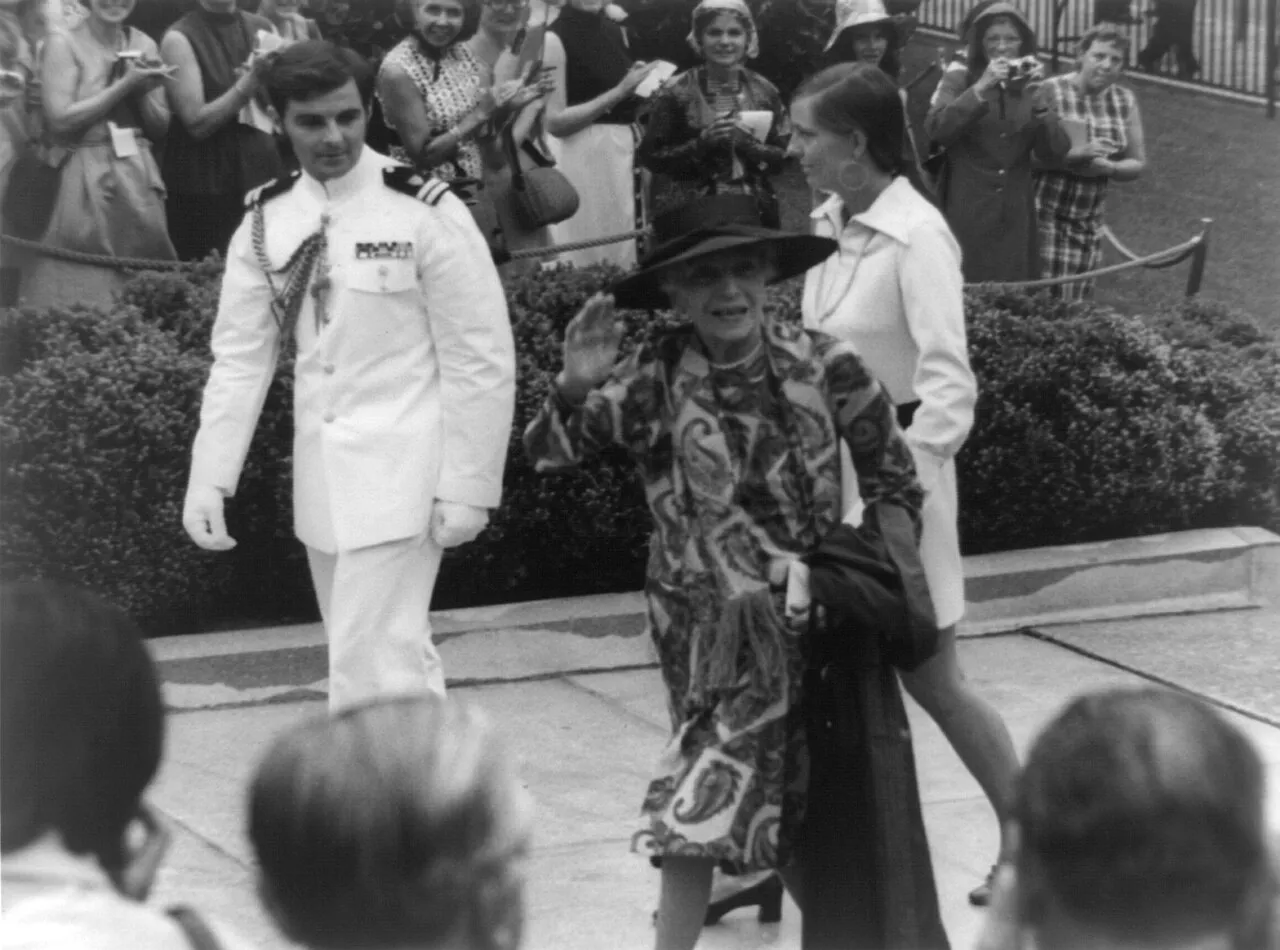
Alice held court in Washington for six decades, outliving nearly everyone she skewered. She died in 1980 at ninety-six. (Wikimedia Commons)
The Living Monument
As the years passed and the Roosevelt era receded into history, Alice became the last living link to those vivid, consequential days. Journalists, historians, and ordinary Americans sought her out. What was Theodore Roosevelt really like? What had the White House been like? How had it felt to grow up in that whirlwind of energy and power? She answered with humor, with penetrating insight, and with the absolute authority that comes from having lived every moment of it. She had sat in the White House when Theodore Roosevelt was president. She had known every president since. She had watched American politics unfold from a vantage point of unparalleled privilege and access. And she had opinions—acid, funny, often prophetic opinions—about all of it.
She outlived her father by 61 years. She outlived her siblings. She outlived most of her generation. Yet as age accumulated, as she moved into her seventies and eighties and nineties, she seemed not to diminish but to crystallize into herself. She became sharper, more herself, more formidable. She remained rigorously engaged with current events. She read voraciously. She maintained a salon. She smoked. She drank martinis. She said exactly what she thought, filtered through a wit that became more devastating as her years accumulated. At eighty-five, she was still the most fascinating conversationalist in Washington. At ninety, she was still willing to tell uncomfortable truths. Age had not made her any less dangerous. It had only sharpened her edge.
Born in Tragedy, Lived in Triumph
Alice Roosevelt Longworth was born into darkness and somehow became a beacon of light. She was born on February 12, 1884—a moment of joy that became tragedy two days later when her mother, Alice Hathaway Lee, died. Her father recorded in his diary a single anguished line: "The light has gone out of my life." She was named for a mother she would never know, for a ghost, for an absence that would haunt her father forever. She should not have thrived. Children of tragedy do not always survive it intact. But Alice had an extraordinary gift: the ability to construct herself independently of the circumstances of her birth.
She was raised by Edith Kermit Carow Roosevelt, a stepmother who loved her genuinely but could never quite replace the mother she had lost. Yet Edith’s love was real and sustaining. The Roosevelt household was chaotic, noisy, intellectually intense, filled with energy and debate and passionate engagement with the world. In that household, surrounded by half-siblings and nannies and the swirling demands of Theodore’s extraordinary life, Alice became herself: witty, independent, intelligent, entirely unbowed by the tragedy of her birth or the expectations of society.
She did not apologize for being unusual. She did not conform to expectations about what a woman should be or should do. She lived 96 years in the public eye, every one of them on her own terms. She pursued her own political interests, maintained her own friendships, made her own choices. She was imperious, sometimes cruel, frequently hilarious. She was irreplaceable, inimitable, unforgettable. And she made all of us—her contemporaries, historians, ordinary Americans interested in history—richer for having lived.
Continue Reading
- Alice Hathaway Lee Roosevelt — The mother Alice never knew
- Edith Kermit Carow Roosevelt — Alice Longworth's stepmother and confidante
- White House Family — Alice's life as First Daughter
- Roosevelt Siblings — Her half-brothers and half-sister
- Theodore Roosevelt's Presidency — The era that defined Alice
- Anna "Bamie" Roosevelt Cowles — Her aunt and early maternal figure
Primary Sources at the TR Center
Discover photographs, documents, and correspondence that illuminate Alice Roosevelt Longworth's remarkable life. The TR Center Digital Library offers rich resources about this celebrated American figure.
- Alice Roosevelt Longworth — Comprehensive encyclopedia entry
- Photographs of Alice and the Roosevelt White House — Visual history from her era
- Family and Friends — Explore relationships in the Roosevelt circle
- Roosevelt Genealogy — Understand Alice's family connections
- Theodore Roosevelt Biography — Understand Alice's father and his world
Historical Note: Alice Roosevelt Longworth was born February 12, 1884, and died February 20, 1980. She was the eldest daughter of Theodore Roosevelt and Alice Hathaway Lee Roosevelt. She was raised by her stepmother Edith Kermit Carow Roosevelt. She married Nicholas Longworth on February 17, 1906. The quote about running the country or attending to Alice is frequently attributed to Theodore Roosevelt but may be apocryphal; it was widely circulated in newspapers of the era. Alice published her memoir Crowded Hours in 1933. Information comes from that memoir, contemporary newspaper accounts, and works including Shelley Fraser Mickle's White House Wild Child (2023) and various biographies.
From the Archives
Explore original photographs, documents, and illustrations related to this topic in the Theodore Roosevelt Center Digital Library.
Recommended Reading
- White House Wild Child: The Improbable Life of Alice Roosevelt Longworth by Shelley Fraser Mickle (2023).
- Alice: Alice Roosevelt Longworth, from White House Princess to Washington Power Broker by Stacy A. Cordery (2007).