
Alice Roosevelt Longworth: A Complicated Legacy
The Colonel of the Battalion of Death
Her father died in January 1919. Within months, Alice was fighting the biggest political battle of her life.
President Woodrow Wilson had come home from the Paris peace talks with a treaty that would bring the United States into a new League of Nations. Supporters saw a path to lasting peace. Opponents feared the League would tie the country to Europe's quarrels and chip away at its independence. Alice stood firmly with the opponents. Watching Wilson's motorcade pass, she crossed her fingers, made the sign of the evil eye, and called down "a murrain" on him, an old word for a plague.
Her real work happened indoors. The senators who opposed the treaty in any form, known as the irreconcilables and led by Idaho's William E. Borah, gathered at the Longworth home. They joked that their hostess was the colonel of the Battalion of Death, their own nickname for the group. She and her friend Ruth McCormick spent hours in the Senate gallery listening to the debate.
In March 1920 the treaty failed in the Senate, and the United States never joined the League. Thirteen years later, in her memoir, she still described her "irreconcilable heart."
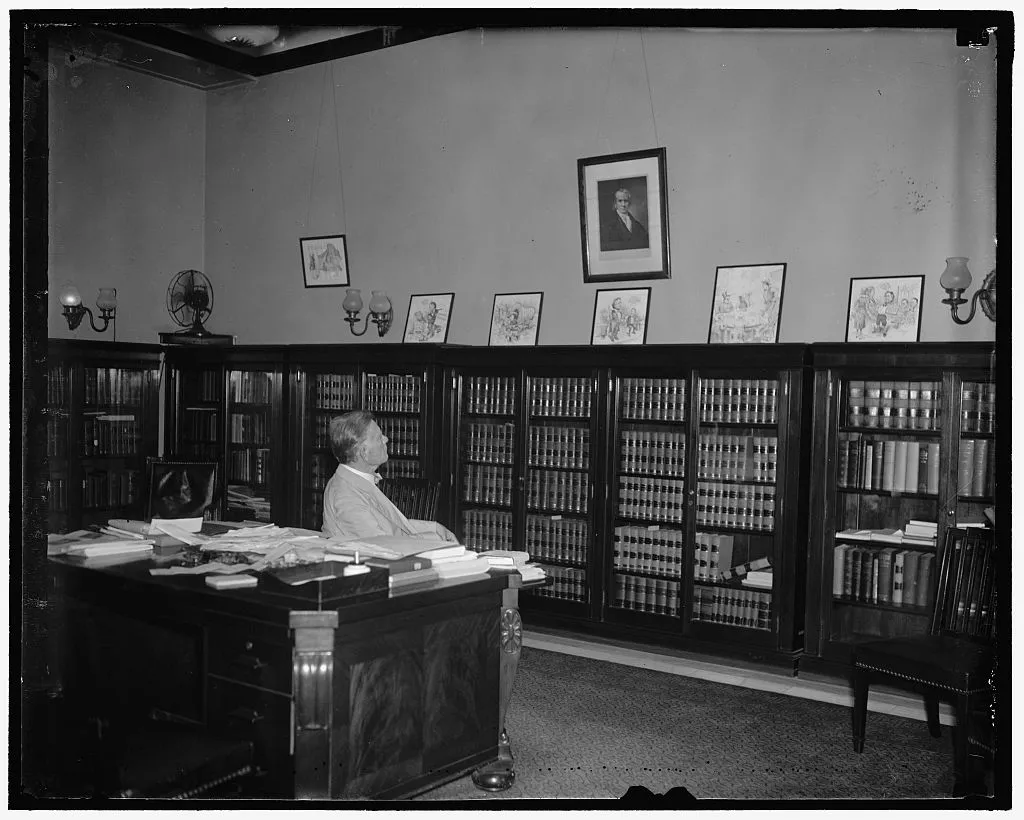
Senator William E. Borah of Idaho in his office, 1937. Borah led the irreconcilables in the fight over the League of Nations. (Harris & Ewing / Library of Congress)
Cousins at Odds
Alice and Eleanor Roosevelt were first cousins who knew each other from childhood. Franklin was a more distant cousin. By the 1920s the branches of the family had split, politically and personally.
In 1924 Alice's brother Ted ran for governor of New York. Eleanor, campaigning for the Democrats, helped send a car topped with a giant steaming teapot to follow his campaign around the state. It was a jab meant to tie Ted to the Teapot Dome oil-lease scandal, although he was not implicated in the scandal. Eleanor herself later called it "a rough stunt."
When Franklin became President, Alice became one of the sharpest critics of his New Deal, in her syndicated newspaper column and at her own dinner table. Guests there also saw her famous imitation of Eleanor, voice and all. Washington laughed. Not everyone in the family did.
America First, 1940–41
As war spread across Europe in 1940, Alice opposed American entry. That September a group of students and business leaders organized the America First Committee to keep the United States out of the war. Alice was a charter member of its national board of directors. The committee drew a wide range of Americans, among them a young Gerald Ford.
On September 11, 1941, the committee's best-known speaker, the aviator Charles Lindbergh, told a rally in Des Moines that "the British, the Jewish and the Roosevelt administration" were the groups pressing the country toward war. The backlash was immediate, and the speech was condemned across the political spectrum.
Days after the attack on Pearl Harbor, the committee disbanded.
A Tongue Like a Blade
Washington loved Alice's wit, and feared it. Her targets ran from presidents to her own relatives. Marc Peyser and Timothy Dwyer, who chronicled her rivalry with Eleanor, describe a game of "spite and malice" that could turn genuinely ugly.
She aimed the knife at herself, too, joking openly about her second mastectomy in 1970, when breast cancer was rarely discussed in public. And many of the cruelest lines credited to her were not hers at all. For the sorting of what she said from what she didn't, see In Her Own Words.
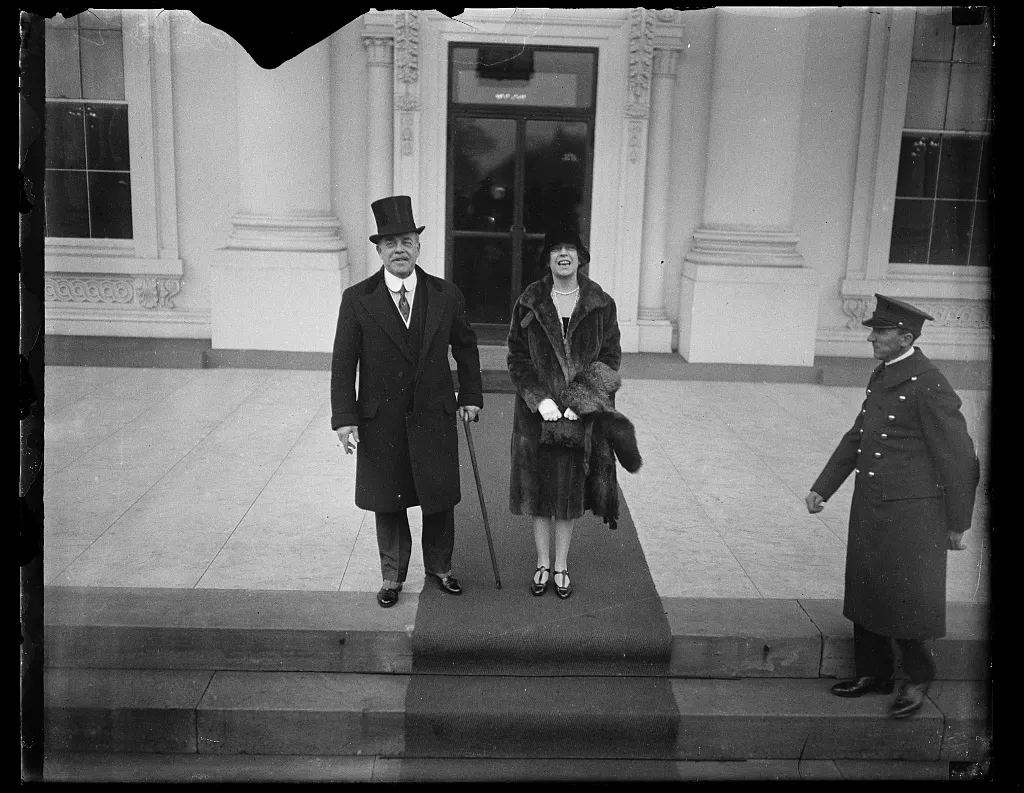
Nicholas and Alice Roosevelt Longworth at the White House, about 1927. (Harris & Ewing / Library of Congress)
Paulina
On February 14, 1925, forty-one years to the day after her mother's death, Alice gave birth to her only child, Paulina. Alice was forty-one. Washington gossip held that the father was not her husband but Senator Borah, her closest ally from the League fight.
Alice never publicly confirmed it. In 2007 her biographer Stacy Cordery, given access to private family letters, published notes in which Borah, writing in a private code, called himself Paulina's "M.P.," which Cordery reads as "Male Parent." Many historians now accept that Borah was Paulina's father. Nick Longworth raised her as his daughter.
Paulina's life was hard. She married Alexander Sturm, who died in 1951, leaving her with a young daughter. On January 27, 1957, Paulina died at thirty-one. The coroner found that she had taken sleeping drugs, and the death was officially ruled accidental, as Alice always maintained. Some biographers have called it suicide.
A Second Chance
Paulina left behind a ten-year-old daughter, Joanna. Alice, then seventy-three, took on raising Joanna herself.
Grandmother and granddaughter became very close. Joanna Sturm grew up in her grandmother's house and was with her through her last years. She later became the keeper of the family papers that historians still use to tell Alice's story.
Alice Roosevelt Longworth died on February 20, 1980, at ninety-six.
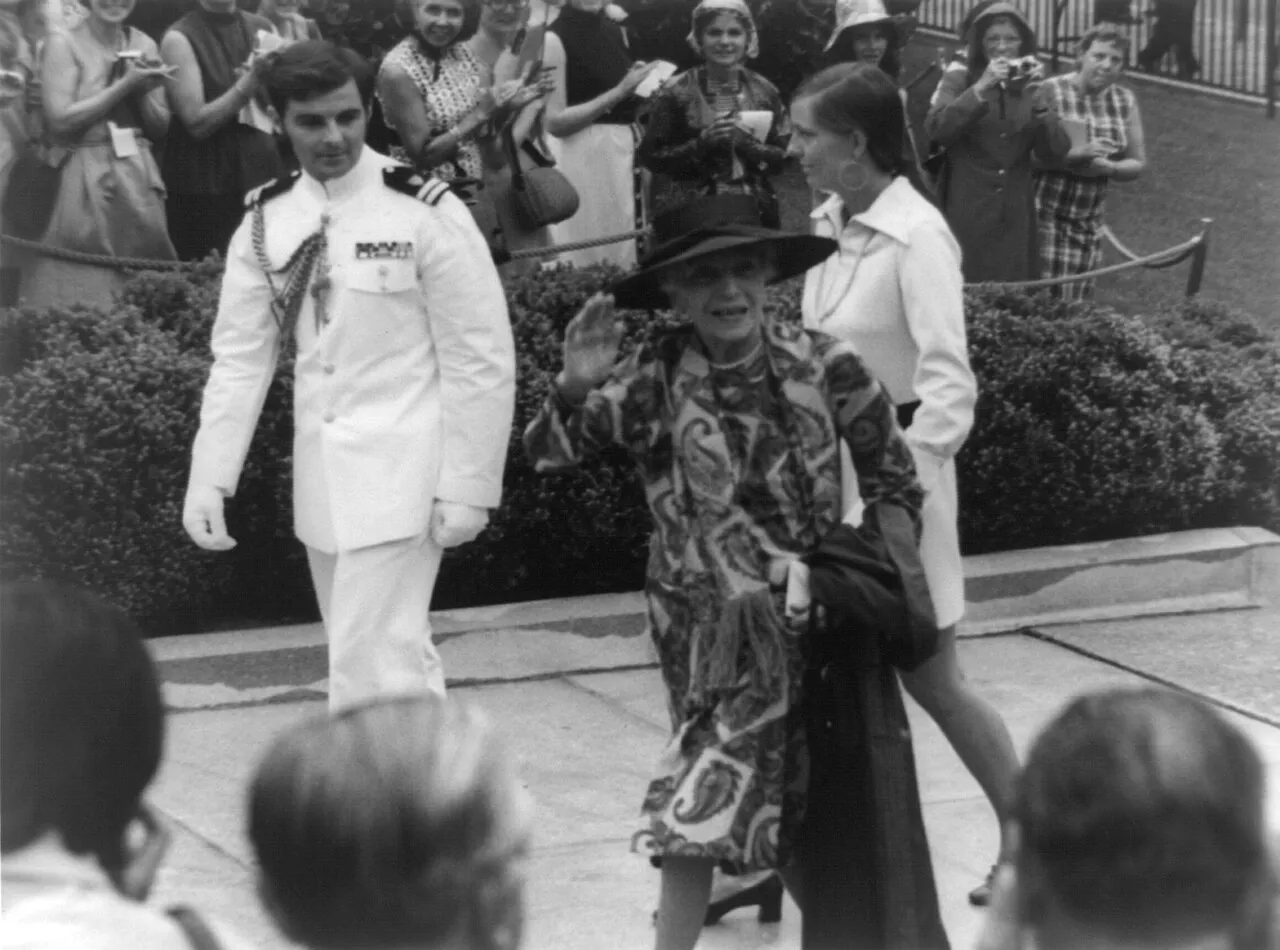
Alice Roosevelt Longworth, 87, arrives at the White House with her granddaughter Joanna Sturm for the wedding of Tricia Nixon, June 12, 1971. (Official White House photograph / Library of Congress)
From the Archives
Explore original photographs, documents, and illustrations in the Theodore Roosevelt Center Digital Library.
Recommended Reading
- Stacy A. Cordery, Alice: Alice Roosevelt Longworth, from White House Princess to Washington Power Broker (Viking, 2007). ISBN 978-0-670-01833-8
- Marc Peyser and Timothy Dwyer, Hissing Cousins: The Untold Story of Eleanor Roosevelt and Alice Roosevelt Longworth (Nan A. Talese/Doubleday, 2015). ISBN 978-0-385-53601-1
- Linda Donn, The Roosevelt Cousins: Growing Up Together, 1882–1924 (Knopf, 2001). ISBN 978-0-679-44637-8