
Edith Roosevelt After the White House
A Gold Star at Sagamore Hill
In 1917 and 1918 all four Roosevelt sons went to war, and the house at Oyster Bay went quiet. The youngest, Quentin, was flying for the Army in France. On July 14, 1918, he was shot down and killed over German lines. He was 20.
The first reports reached Sagamore Hill on July 17. T.R. gave the press a single sentence: he and Quentin's mother were glad their son had reached the front and shown the stuff that was in him. The Germans buried him with military honors near where he fell.
Edith's grief ran deep. Several biographers credit her with a saying from those years: that you cannot raise boys to be eagles and expect them to turn out sparrows. The exact words differ from book to book, so the Library gives the idea rather than a quotation.
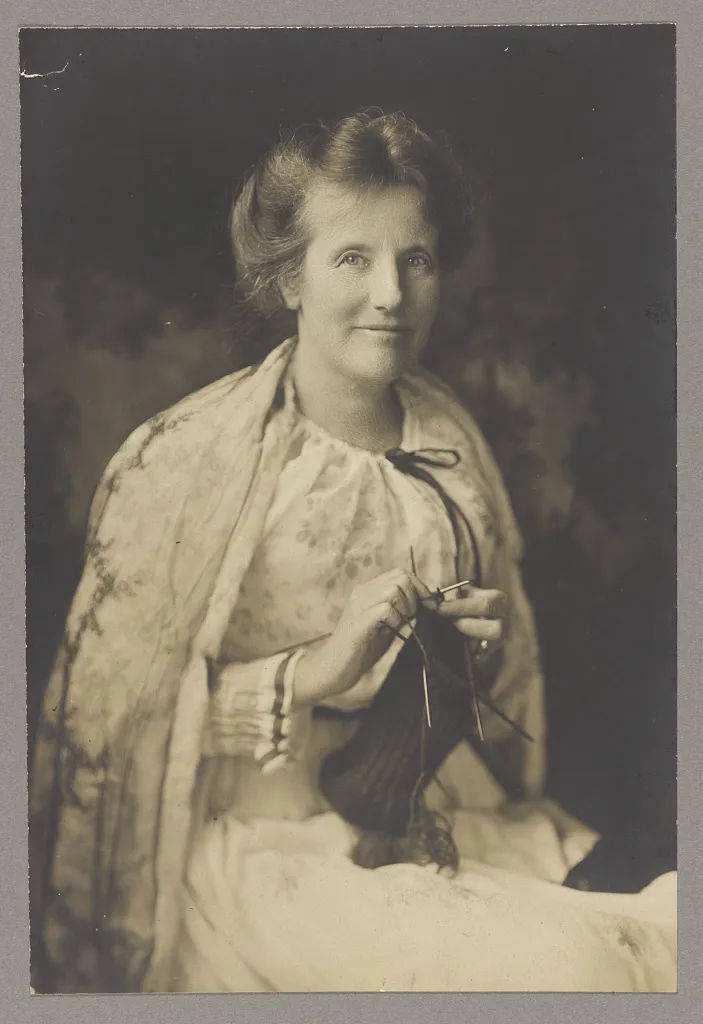
Edith Roosevelt, photographed knitting in October 1917. (Library of Congress)
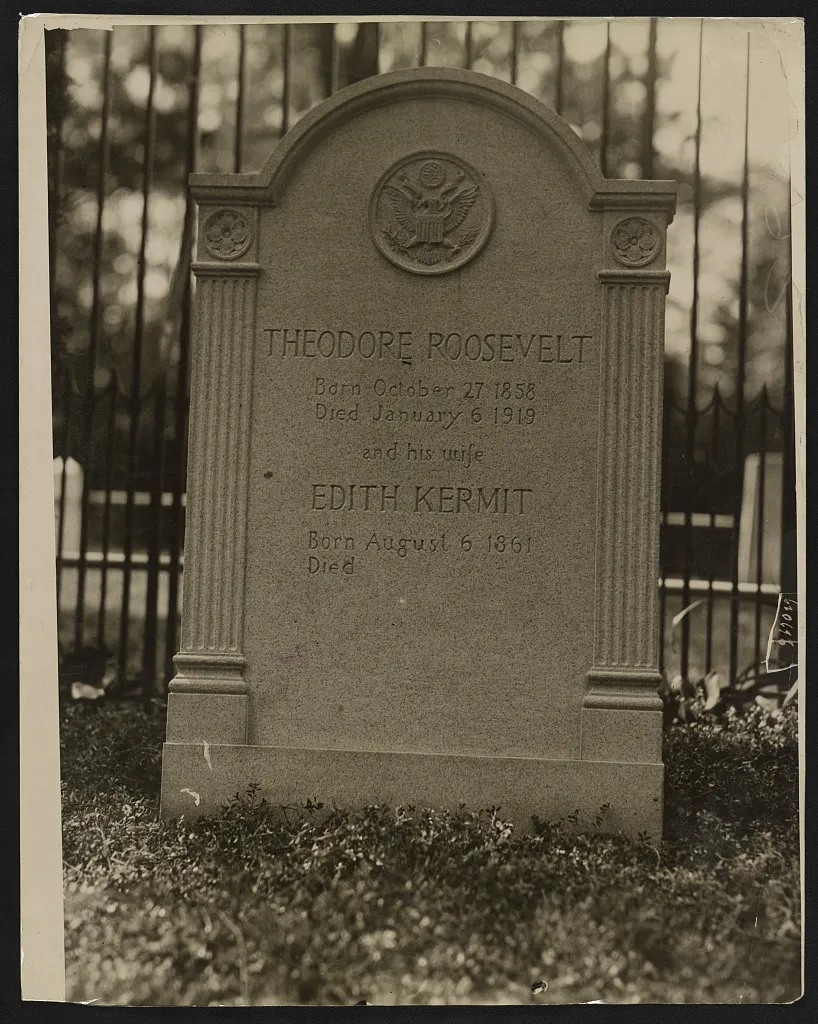
T.R.'s grave at Youngs Memorial Cemetery, Oyster Bay, 1919. Edith was buried beside him in 1948. (Underwood & Underwood / Library of Congress)
January 6, 1919
Less than six months later, on January 6, 1919, Theodore Roosevelt died at Sagamore Hill. He was 60. Edith was 57, and they had been married 32 years.
The funeral two days later at Christ Church in Oyster Bay was as plain as T.R. had wanted: no music and no eulogy. Edith did not go; she stayed at Sagamore Hill. T.R. was buried in Youngs Memorial Cemetery, on a wooded hillside a short drive from the house.
She kept Sagamore Hill as her home for the rest of her life, but she did not stay put for long.
Cleared for Strange Ports
Edith's widowhood took her to Europe, Asia, Africa and South America.
One journey took her around the world with her son Kermit and his wife, Belle, through Japan and China and then across Siberia by train to Moscow. Later she sailed to Puerto Rico to visit her son Ted, then the island's governor.
She explained the pull herself in 1927, writing that for a woman whose children had grown, "at the feet of the knitters in the sun lies the wide world." The full passage is on the In Her Own Words page.
Two Books in Two Years
Edith never wrote her memoirs, but she did put her name on two books, both published by Charles Scribner's Sons.
Cleared for Strange Ports (1927) is a family travel book. Kermit, his wife Belle and Edith's son-in-law Richard Derby wrote chapters about their own journeys. Edith's chapter, "The Odyssey of a Grandmother," is the story of a woman setting out to see the world once her own nest was empty.
American Backlogs: The Story of Gertrude Tyler and Her Family, 1660–1860 (1928), compiled with Kermit, turns to her mother's family. At its heart are the letters young Gertrude Tyler wrote home from a Paris finishing school in the 1850s, set among stories of the Tylers, seafaring ancestors and the Carows of New York. It is family history made from family papers, the kind of record Edith spent her later years protecting.
Into the Arena, 1932
In the summer of 1932 the Democrats nominated Franklin D. Roosevelt, a distant cousin, for President. Some three hundred congratulatory messages soon reached Edith from people who believed Franklin was her son.
Edith decided to make her own position plain by campaigning for President Herbert Hoover. On August 11 she flew to Washington with her daughter Ethel and son-in-law Richard Derby, attended the White House garden party, and took a seat at Hoover's notification ceremony at Constitution Hall. The crowd gave her an ovation. Asked by reporters for a statement, she said she had not talked to the press in 71 years and it was too late to begin now.
On October 31, eight days before the election, the 71-year-old widow stepped forward at Madison Square Garden and introduced the President, a rare public speech. On November 8 Franklin Roosevelt won the presidency.
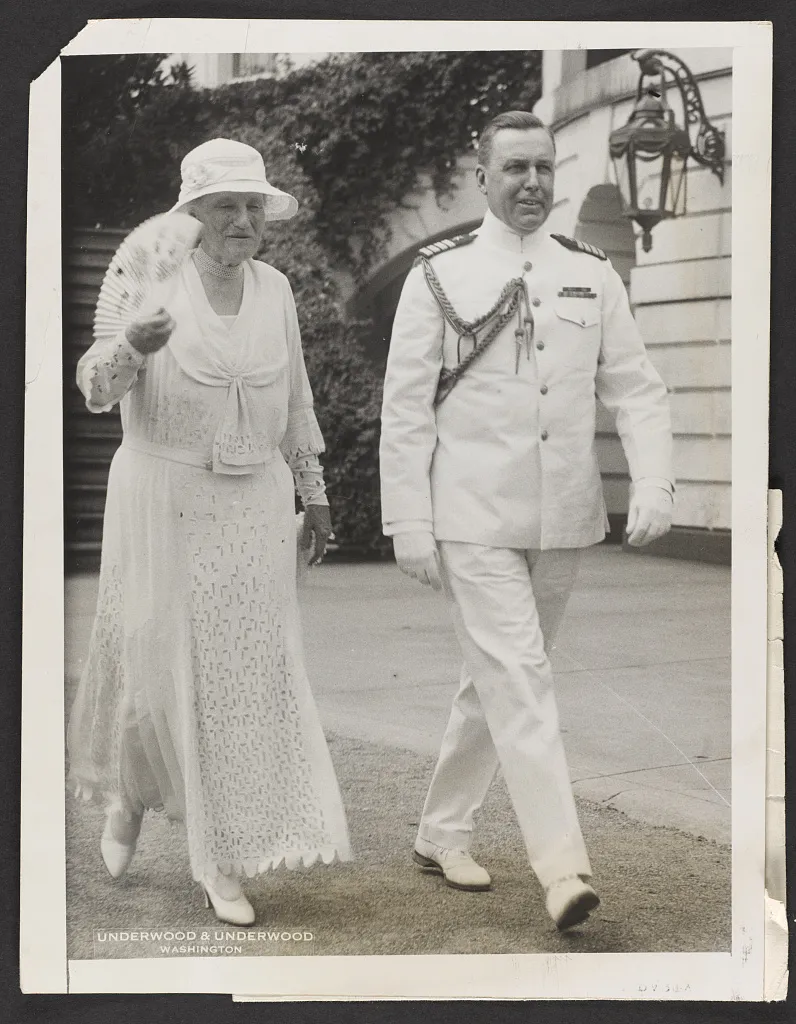
Edith Roosevelt at the White House garden party held before President Hoover's notification ceremony, August 11, 1932. (Underwood & Underwood / Library of Congress)
Mortlake, the Needle, and the Last Years
In 1927 Edith bought Mortlake Manor in Brooklyn, Connecticut, a house built for her ancestor Daniel Tyler III, as a summer retreat. Her quieter work went on too. As national honorary president of the Needlework Guild she raised new garments and linens for the poor and the sick. To protect her family's privacy she destroyed nearly all of T.R.'s letters to her.
The Second World War took two more sons: Kermit died in Alaska in 1943, and Ted died in Normandy in July 1944, weeks after landing with the first wave on D-Day.
Edith died at Sagamore Hill on September 30, 1948, at 87. She was buried beside Theodore in Youngs Memorial Cemetery. She asked that her tombstone read, "Everything she did was for the happiness of others."
Primary Sources
- American Backlogs (Scribner's, 1928), full text at the Internet Archive
- Cleared for Strange Ports (Scribner's, 1927), full view at HathiTrust
- Evening Star, Aug. 11, 1932, p. 2, Edith Roosevelt arrives in Washington (Library of Congress, Chronicling America)
- Evening Star, Nov. 1, 1932, p. 3, "Mrs. Theodore Roosevelt Faces Big Throng Welcoming Hoover" (LOC)
- New-York Tribune, July 18, 1918, p. 4, news of Quentin's death (LOC)
From the Archives
Explore original photographs, documents, and illustrations in the Theodore Roosevelt Center Digital Library.
Recommended Reading
- Sylvia Jukes Morris, Edith Kermit Roosevelt: Portrait of a First Lady (Coward, McCann & Geoghegan, 1980)
- Lewis L. Gould, Edith Kermit Roosevelt: Creating the Modern First Lady (University Press of Kansas, 2013).
- Betty Boyd Caroli, The Roosevelt Women (Basic Books, 1998).