
Edith Roosevelt, First Lady
That Was Bully!
In January 1904 the baritone David Bispham came to sing at the White House. His hostess had one request: please leave out "Danny Deever," a grim soldiers' ballad Edith Roosevelt found too harrowing. The guests had other ideas and called for it. Bispham sang it, and the President leapt to his feet. "By Jove, Mr. Bispham, that was bully!" T.R. said. "With such a song as that you could lead a nation into battle!"
The moment captures the Roosevelt White House. Theodore supplied the noise. Edith supplied the plan: the guest lists, the programs, the staff and the calendar that made the noise possible. She came to the job in September 1901, at 40, after President McKinley's assassination, with six children and almost no warning. Over the next seven and a half years she gave a loosely defined role much of its modern shape.

First Lady Edith Roosevelt, photographed in 1902 by Frances Benjamin Johnston. (Frances Benjamin Johnston / Library of Congress)
A Staff of Her Own
Within weeks of moving in, Edith hired Isabella "Belle" Hagner, a Washington woman who had made a living writing invitations for society hostesses and working as a War Department clerk. Hagner became the first White House social secretary. She answered the mail, screened requests, kept the guest lists and planned receptions, dinners and musicales.
She was paid as a government clerk. For the first term she was formally on loan from the War Department. In March 1906 Representative Thomas Hardwick of Georgia tried to bar federal money from paying a social secretary to the President's wife. Colleagues rose to defend the arrangement, and the amendment failed. As the Evening Star reported, Hardwick "seemed to be the only one voting in favor of his proposition."
Edith also brought order to official society. Every Tuesday morning in the season she gathered the wives of the Cabinet in the White House library, often over knitting or embroidery. The custom lasted until 1909, when Helen Taft did away with it.
The household got the same attention. As longtime usher Ike Hoover remembered, "While an abundance of help was always at hand, still she looked after every detail of the household herself."
Music in the East Room
Under the Roosevelts, musicales became a regular, scheduled part of White House life. Edith took a close hand in the programs. Pianist Ignacy Paderewski played for the Roosevelts. So did a young Spanish cellist named Pablo Casals, on January 15, 1904; he returned to play for the Kennedys in 1961. The contralto Ernestine Schumann-Heink and the pianist Ferruccio Busoni came too. In 1903 the White House received a gilded Steinway grand for the East Room.
The piano was a gift from Steinway & Sons. It stayed in the East Room until a new one replaced it in 1938, and the old piano went to the Smithsonian. Its painted lid is the work of the artist Thomas Wilmer Dewing.
The performers were not paid. As Lewis Gould notes, they might receive a presidential souvenir, such as a signed photograph, instead. By Gould's count, Edith hosted more than thirty musicales. The last was on Friday, February 19, 1909, less than two weeks before the family left the White House.
Historian Lewis Gould credits Edith with giving the Roosevelt White House the feel of a salon, where music and books mattered as much as politics.
History on the Walls and on the Table
Edith thought the White House should tell its own story. During the 1902 renovation she arranged for portraits of the First Ladies, herself included, to hang along the new Ground Floor corridor where guests arrived.
She also took on the presidential china. Caroline Harrison had already begun saving historic presidential china, and an inventory was taken in 1901. Edith backed the search for missing pieces from collectors and presidential families, preferred gifts and loans over purchases, and had two cabinets built to display the collection for visitors.
The oak cabinets went into the ground-floor corridor about 1904. Abby Gunn Baker, a Washington journalist who had been studying the china since the summer of 1901, chose the first pieces to go inside. Edith also had the collection declared government property, and in her last winter in the house she refused to let chipped state china be sold at auction.
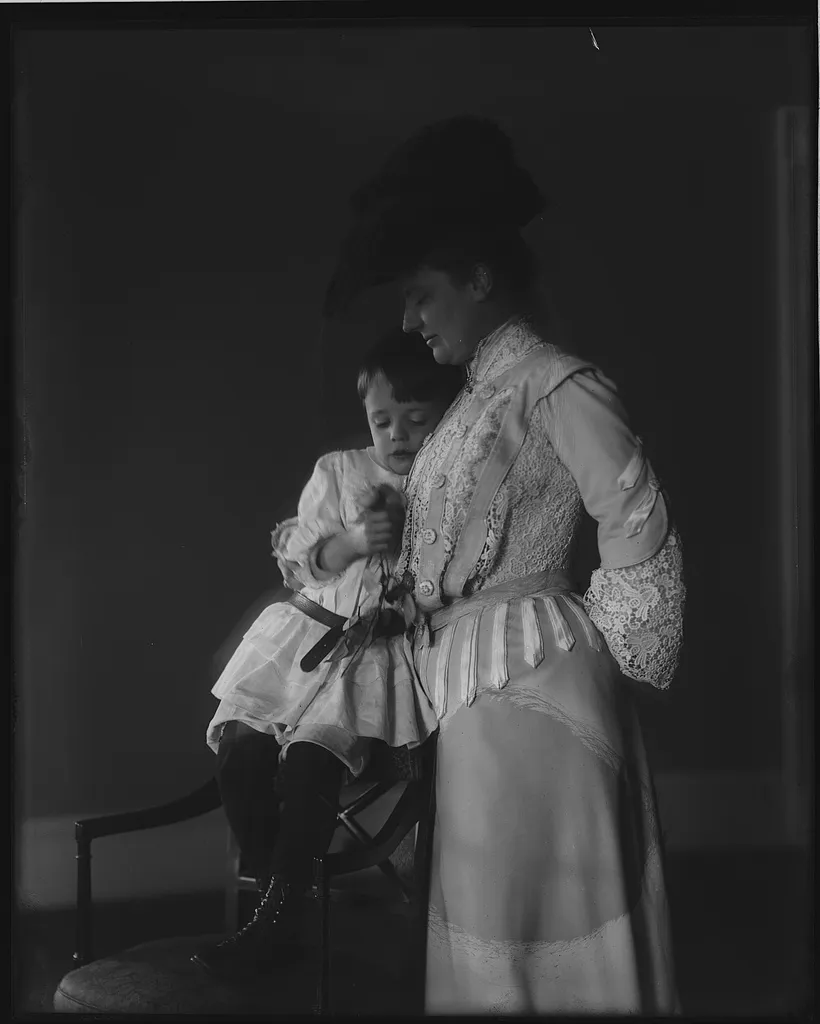
Edith Roosevelt with her youngest son, Quentin, about 1902. (Frances Benjamin Johnston / Library of Congress)
Picture Perfect, on Her Terms
The Roosevelt children were front-page news, and Edith meant to manage that. She kept reporters at a distance and gave the press posed family portraits instead, many of them taken by Frances Benjamin Johnston.
The approach began before the presidency. Biographer Lewis Gould writes that the couple had refused press requests for family pictures, and in early 1901 had formal portraits taken and released them first to Harper's Weekly, then to the rest of the press.
Johnston's 1902 portraits of Edith and Quentin are among the best known.
The Quiet Adviser
Edith kept her political opinions out of public view. Privately, she was T.R.'s closest counselor. Most mornings the two had time alone together; the Theodore Roosevelt Center describes about an hour a day spent talking over affairs of state.
She also ran a back channel. Cecil Spring Rice, the British diplomat who had been best man at their 1886 wedding, wrote her long political letters, knowing the President would hear every word. The American ambassador in London, Whitelaw Reid, did the same. When Britain needed a new ambassador to Washington in 1906, Edith pushed hard for Spring Rice. London sent James Bryce instead, and she told Spring Rice how hard she had tried.
A Wedding in the East Room
The biggest social event of the Roosevelt years was a family one. Alice Roosevelt's engagement to Congressman Nicholas Longworth was announced in December 1905, and the wedding was set for February 17, 1906, in the East Room. Planning it meant invitations, seating, flowers, music and a flood of gifts from around the world. Nearly a thousand guests filled the East Room, and thousands more gathered outside the gates.
Edith hosted one more family milestone before the Roosevelts left. On December 28, 1908, Ethel Roosevelt made her debut into society at the White House.

Flowers banked in the White House for Alice Roosevelt's wedding, 1906. (Frances Benjamin Johnston / Library of Congress)
How Historians See Her
For decades Edith was remembered as the woman in the background. Lewis Gould's 2013 biography, subtitled Creating the Modern First Lady, argues that she did far more than that image allows. Working with a social secretary and pursuing a broad cultural agenda, Gould writes, she helped "lay the foundation for the modern development of the institution." Gould also documents racial prejudice in her private letters.
Her successors inherited what she built: a social secretary, a portrait gallery, a china display and a White House that worked as both a home and a stage.
Continue Reading
- Edith Roosevelt
- Remaking the White House, 1902
- Running the White House: How Edith Roosevelt took stock of the house, fixed its social calendar and opened a new door for guests.
- Edith Roosevelt and the Presidential China: Presidential dinnerware goes on view for visitors, and Edith refuses to let the chipped state china be auctioned.
- Edith Roosevelt’s Colonial Gardens: The fight over the greenhouses, and the old-fashioned flowers that grew where the Rose Garden is today.
- Edith Roosevelt After the White House
- Edith Roosevelt in Her Own Words
- The White House Family
- Alice Roosevelt Longworth
Primary Sources
- Theodore Roosevelt Center, Isabella Hagner letter to John Wallace Riddle (Arizona Historical Society)
- White House Historical Association, Memoirs of Isabella Hagner, 1901–1905
- Evening Star (Washington), March 23, 1906, p. 17, "Faint Interest Excited" (the social-secretary debate)
- Library of Congress, Frances Benjamin Johnston, "Mrs. Roosevelt, Quentin" (1902)
From the Archives
Explore original photographs, documents, and illustrations in the Theodore Roosevelt Center Digital Library.
Recommended Reading
- Lewis L. Gould, Edith Kermit Roosevelt: Creating the Modern First Lady (University Press of Kansas, 2013). ISBN 978-0-7006-1902-3
- Sylvia Jukes Morris, Edith Kermit Roosevelt: Portrait of a First Lady (Coward, McCann & Geoghegan, 1980)
- Betty Boyd Caroli, The Roosevelt Women (Basic Books, 1998). ISBN 978-0-465-07133-3