
Running the White House
Edith Roosevelt became First Lady in September 1901 with six children to settle and a house that belonged, in a real sense, to the whole country. She ran it that way. She counted what was in it, set rules for keeping it, gave its social season a calendar and changed how guests came through the door.
Starting With the Mail
The first job was paperwork. Within weeks Edith hired Isabella "Belle" Hagner as her social secretary. Hagner later recalled why: notes to Mrs. McKinley had gone unanswered, "a lack of system which Mrs. Roosevelt could not countenance."
Hagner started out at the end of Edith's own desk. "This little corner in Mrs. Roosevelt's bedroom now became my daily workshop," she wrote. Her memoir, a typescript kept today by the White House Office of the Curator, tells much of the story below.

Edith Roosevelt at her desk in the White House, about 1903. (Underwood & Underwood / Library of Congress)
Who Pays for Dinner?
Edith went through the household arrangements one by one. As Hagner described them, the President paid for all the food, and for "all liquid refreshments for official and private entertaining," state dinners included. He also paid his own servants, and Edith brought her maids and cook from Oyster Bay. The government covered coal, ice, cleaning supplies, extra servants, decorations and flowers.
Hagner noted that when President Taft came in, the government took over paying the servants. Another old rule also lasted until Taft: every new President had to buy his own carriages.
Counting Everything
Before the Roosevelts, Hagner wrote, there seemed to have been no complete inventory of the house. "When Mrs. Roosevelt discovered this, she had the officer in charge of Public Buildings and Grounds compile complete lists of everything": furniture, linens, glass, china, silver and ornaments. A new rule followed. Nothing was to be replaced until the original had been formally condemned. Biographer Sylvia Jukes Morris sums up the result: "Thereafter it was the rule not to dispose of objects of historic value at any President's whim."
The 1902 renovation tested that rule. Architect Charles McKim's crews cleared out much of the old Victorian furniture, and in January 1903 newspapers reported "White House relics" sold at auction. Among them, according to the White House Historical Association, were the pieces of Louis Comfort Tiffany's glass screen from the Entrance Hall. Edith did not let everything go. Historian William Seale writes that on several occasions she stopped antique furniture as it was leaving the house on McKim's orders.
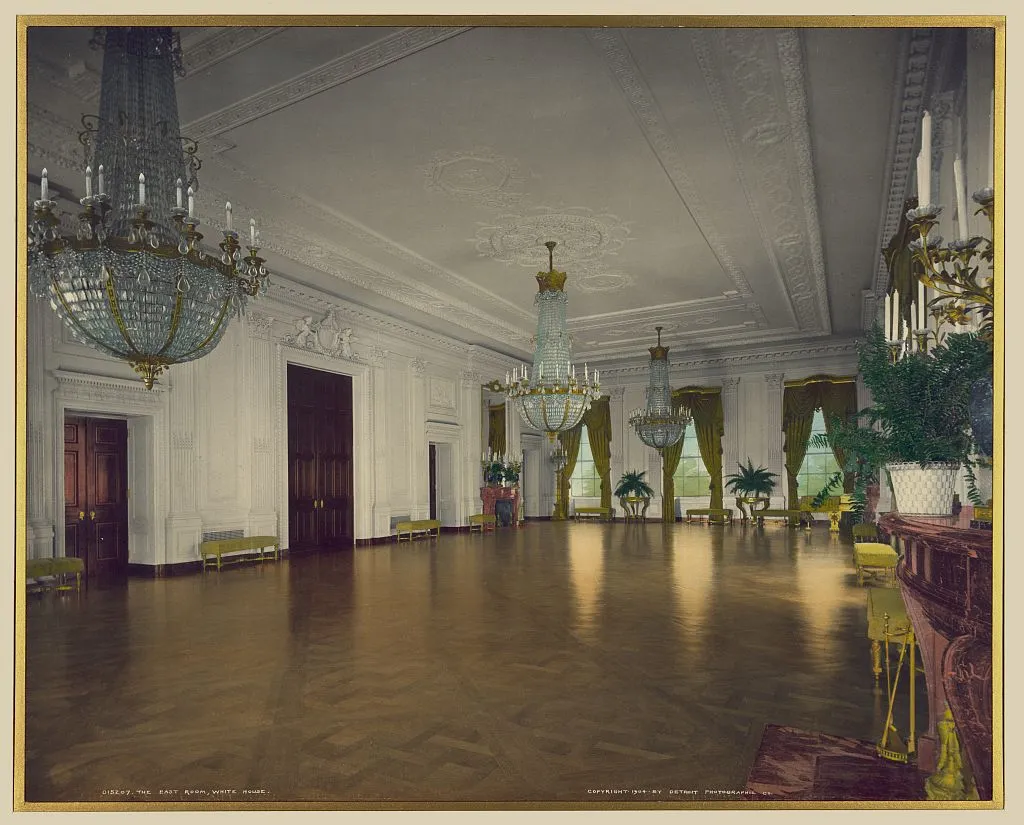
The East Room about 1904, the setting for receptions and musicales through the social season. (Detroit Photographic Co. / Library of Congress)
A Calendar Washington Could Count On
The official season kept its traditional lineup: the Cabinet Dinner, the New Year's Day Reception, the Diplomatic Reception and Diplomatic Dinner, the Judicial Reception, the dinner for the Supreme Court, the Congressional Reception, and the Army and Navy Reception. What changed was that Washington could now plan around it.
The nights of the week had jobs, too. As Hagner set it down, Cabinet members gave their dinners for the Roosevelts on Tuesdays, official receptions and state dinners fell on Thursdays, and Fridays belonged to smaller dinners and musicales. To thin the crowds, invitations went out for each reception separately instead of one card for all of them.
Not every experiment stuck. Hagner recalled that Edith had planned Saturday afternoon receptions for the general public and informal Friday afternoons at home. Word of the Fridays spread so fast that so many people came the affairs "became unmanageable," and both ideas were dropped.
A Better Way In
Before 1902, guests at big receptions left their hats and coats in heaps in the corridors and dining rooms. For the crowds, a platform ran from the pavement into a window near the East Room. Hagner called both "unsightly."
The renovation ended that. McKim rebuilt the East Terrace with a covered carriage entrance and coatrooms with boxes for 2,500 wraps. The architects' report noted that "on January 1, 1903, the East Terrace was used for the first time, a full month in advance of the date set for the completion of this portion of the work."
"It had now become possible to plan the entertainments to insure more comfort and dignity," Hagner wrote. Guests waited in the new ground-floor corridor, which the report described as "decorated with portraits and plants, and furnished with sofas and large chairs." Upstairs, new doors were cut in the Blue Room so the line could pass the President, Mrs. Roosevelt and the receiving party, who stood in a single line in front of the windows. Specially invited guests in the room now faced the President instead of standing at his back.
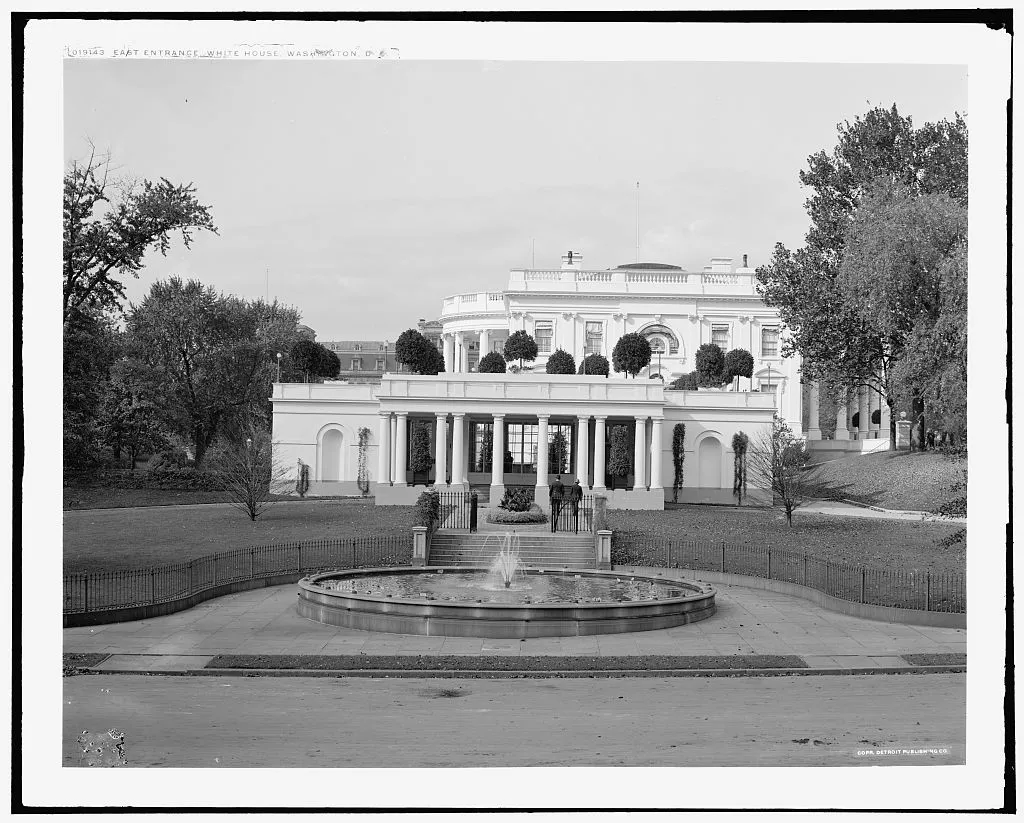
The East Entrance about 1906, where guests stepped from their carriages straight into the coatrooms and the ground-floor corridor. (Detroit Publishing Co. / Library of Congress)
The Whole Diplomatic Corps at Once
In the autumn of 1903, Hagner recalled, Edith decided to receive the Diplomatic Corps "en Masse" at a single tea instead of separately, so that junior diplomats could be presented too. On the first occasion, by Hagner's count, 106 guests came.

Guests stroll the South Lawn, with the Washington Monument beyond, at one of the Roosevelts’ garden parties, about 1905. (Underwood & Underwood / Library of Congress)
Spring on the South Lawn
Each season, Hagner wrote, Mrs. Roosevelt gave "several large teas; three or four musicales, preceded by dinners; as well as garden parties in the spring."
Before the family left, the house hosted one more milestone. On December 28, 1908, Ethel Roosevelt made her debut into society at the White House.
A House That Keeps Its History
No one at the time called this preservation. The pattern is plain all the same: a full inventory, a rule against casual disposal, the presidential china made government property and put on view, portraits of First Ladies hung for arriving guests, and old furniture kept from leaving the house. The White House Historical Association describes Edith as seeing the White House as a home deeply rooted in the nation's history. She treated its contents as a public trust, decades before the White House had its first curator in 1961.
Continue Reading
- Edith Roosevelt and the Presidential China: Presidential dinnerware goes on view for visitors, and Edith refuses to let the chipped state china be auctioned.
- Edith Roosevelt's Colonial Gardens: The fight over the greenhouses, and the old-fashioned flowers that grew where the Rose Garden is today.
- Edith Roosevelt, First Lady: Belle Hagner's story, East Room musicales and a quiet hand in politics.
- Remaking the White House, 1902: Edith calls in architect Charles McKim, and four months of work rebuild the house.
- The White House Family: What life in the White House was like for the six Roosevelt children.
- Edith Roosevelt: An overview of her life, family and legacy.
Primary Sources
- White House Historical Association, Memoirs of Isabella Hagner, 1901–1905
- McKim, Mead & White, Restoration of the White House (Government Printing Office, 1903)
- St. Louis Republic, Jan. 22, 1903, p. 14, White House Relics Sold at Auction (Chronicling America)
- William Seale, Theodore Roosevelt's White House, White House History No. 11
From the Archives
Explore original photographs, documents, and illustrations in the Theodore Roosevelt Center Digital Library.
Recommended Reading
- Lewis L. Gould, Edith Kermit Roosevelt: Creating the Modern First Lady (Lawrence: University Press of Kansas, 2013). ISBN 978-0-7006-1902-3
- Sylvia Jukes Morris, Edith Kermit Roosevelt: Portrait of a First Lady (New York: Coward, McCann & Geoghegan, 1980). ISBN 978-0-698-10994-0
- William Seale, The President's House: A History, vol. 2 (Washington: White House Historical Association, 1986).