
Edith Roosevelt and the Presidential China
When the Roosevelts came to the White House in September 1901, only scattered pieces were left of a century of presidential dinnerware, and no one had ever written its history. Edith Roosevelt helped turn what survived into a collection visitors could see, set rules to protect it, and gave the house a new state service built for bigger dinners.
A Reporter in the Pantries
The work started before the Roosevelts arrived. In the summer of 1901, Colonel Theodore Bingham, the Army officer in charge of public buildings and grounds in Washington, asked journalist Abby Gunn Baker to study the White House china and write its first history. She began studying what was left, along with the old government records. By the White House Historical Association's account, Mrs. McKinley gave her permission, and Baker spent four months in the house while the family was away.
That September, President William McKinley was assassinated and Theodore Roosevelt took office. The assassination cut Baker's research short, but she had gathered enough for an article. According to the White House Historical Association, Baker stayed with the china until her death in 1923, working with Helen Taft and Ellen Wilson after Edith.

Edith Roosevelt at her desk in the White House, about 1903. (Underwood & Underwood / Library of Congress)
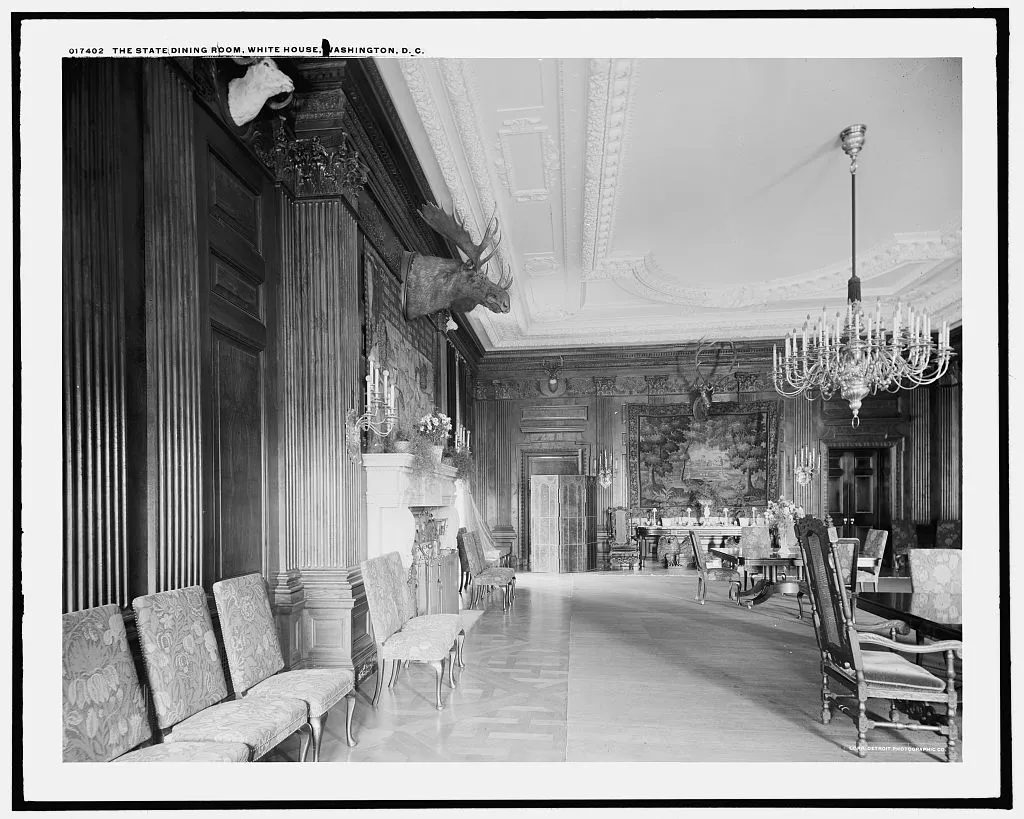
The enlarged State Dining Room about 1904. According to the White House Historical Association, the game heads came from a New York dealer, not T.R.’s hunts. (Detroit Publishing Co. / Library of Congress)
Dinner for 120
The 1902 renovation enlarged the State Dining Room, and the house needed china to match. Edith ordered a new state service big enough to serve 120 guests.
The Roosevelts wanted it made in America. Belle Hagner, Edith's social secretary, later recalled that after much searching by an old Albany firm, "it was found no china of sufficiently fine quality was then made in this country." The White House Historical Association adds that an Ohio pottery, Knowles, Taylor & Knowles of East Liverpool, turned the order down. In the end Wedgwood made the set in England, and it was ordered through the Van Heusen Charles Co. of Albany.
The service arrived in 1903: more than 1,300 pieces, decorated with the Great Seal of the United States and bands of gilt. Hagner remembered that the design was "patented for the White House only to prevent pieces being sold elsewhere." The set stayed in use after the Roosevelts left. Helen Taft, Lewis Gould notes, saw no reason to replace it.
Two Cabinets in the Corridor
Baker's first article, "The China of the Presidents," ran in Munsey's Magazine in December 1903. According to the White House Historical Association, the commissioner of public buildings and grounds showed it to Edith, and she acted on it.
She had two cabinets made for the ground-floor corridor, where guests now arrived, so visitors could see the china. They were in place by about 1904. The cabinets were oak, made by Gustav Stickley's workshop, according to the White House Historical Association.
Baker came back to choose what went inside. By the Association's account, she picked pieces of the new Roosevelt service, nine pieces of the Hayes china including its turkey platter, and six pieces of Lincoln's. Hagner wrote: "I feel all of us owe a vote of thanks to Mrs. Baker for her conception and carrying out of this plan, under Mrs. Roosevelt's interested patronage."
T.R. liked what he saw. The Association says he told Baker and the commissioner to keep collecting until every administration was represented. By the time the Roosevelts left, biographer Sylvia Jukes Morris writes, the display held pieces from almost all of the earlier administrations.
Gifts, Loans and Government Property
Where would the missing pieces come from? Edith asked for gifts and loans rather than purchases, and presidential families and collectors answered. A few pieces were bought anyway: Archie Butt, T.R.'s aide, mentioned others "she has purchased at very high prices."
She also made sure the collection belonged to the public. Edith had it designated official government property and placed in the care of the commissioner of public buildings and grounds, with the rest of the White House furnishings.
"It Cheapens the White House"
Protecting the china also meant deciding what to do with the pieces that were past saving. In December 1908, during the Roosevelts' last winter in the house, a quantity of chipped and cracked state china had to go. Edith would not allow a sale.
"Mrs. Roosevelt does not want it sold at auction, for she thinks this method cheapens the White House," Archie Butt wrote to his sister-in-law, Clara Butt, on December 11, 1908. His answer: "I convinced all concerned that it should be broken up and scattered in the river, which will be done."
From Cabinets to the China Room
The collection kept growing after the Roosevelts left. By the start of the Wilson years it filled four small cabinets in the downstairs corridor. In 1917 First Lady Edith Wilson moved it into a room of its own, the China Room.
Edith Roosevelt did not come up with the idea. Caroline Harrison, wife of President Benjamin Harrison, had it first. What Edith added was a place to show the china, rules to protect it and an audience to see it, decades before the White House had its first curator in 1961.
Continue Reading
- Running the White House: How Edith Roosevelt took stock of the house, fixed its social calendar and opened a new door for guests.
- Edith Roosevelt's Colonial Gardens: The fight over the greenhouses, and the old-fashioned flowers that grew where the Rose Garden is today.
- Remaking the White House, 1902: Edith calls in architect Charles McKim, and four months of work rebuild the house.
- Edith Roosevelt, First Lady: A social secretary, East Room musicales and a quiet hand in politics.
- Edith Roosevelt: An overview of her life, family and legacy.
- The White House: The house T.R. called home from 1901 to 1909.
Primary Sources
- White House Historical Association, Official White House China, from the 18th to the 21st Centuries (excerpt, with Archie Butt's letter of Dec. 11, 1908)
- White House Historical Association, White House China Service (timeline)
- White House Historical Association, Memoirs of Isabella Hagner, 1901–1905
- White House Historical Association, The White House Collection, Research Sources in the Office of the Curator
- The Letters of Archie Butt (Doubleday, 1924), letter of Dec. 11, 1908, pp. 237–38
From the Archives
Explore original photographs, documents, and illustrations in the Theodore Roosevelt Center Digital Library.
Recommended Reading
- Lewis L. Gould, Edith Kermit Roosevelt: Creating the Modern First Lady (Lawrence: University Press of Kansas, 2013). ISBN 978-0-7006-1902-3
- Sylvia Jukes Morris, Edith Kermit Roosevelt: Portrait of a First Lady (New York: Coward, McCann & Geoghegan, 1980). ISBN 978-0-698-10994-0
- William Seale, The President's House: A History, vol. 2 (Washington: White House Historical Association, 1986).