
The Reluctant Vice President: An Office Theodore Roosevelt Despised
An Office Fundamentally Powerless
The Vice Presidency has often been described as one of the most useless offices in American government. The Vice President presides over the Senate but has minimal actual power in that body. The Vice President has no executive responsibilities. The Vice President has no departmental authority. The only real function is to be ready to become President if the President dies. But in the normal course of American politics, the Vice President is essentially sidelined from power. Roosevelt said as much himself, in his own words, in a letter to Senator Thomas C. Platt on February 1, 1900: "I would a great deal rather be anything, say professor of history, than Vice-President."
Roosevelt was a man of extraordinary energy, ambition, and appetite for action. He was accustomed to wielding real power—as Police Commissioner, as Governor. The Vice Presidency offered none of that. It was a position suited to a man seeking rest or preparing for retirement. It was not suited to a 42-year-old man whose energy and ambition showed no signs of waning.

Theodore Roosevelt around 1901, when he took the vice presidency he would soon find powerless and confining. (Library of Congress)

Roosevelt works a crowd from the rear platform of his campaign train during the energetic 1900 whistle-stop tour. (Harvard College Library)
A Reluctant Nominee, a Tireless Campaigner
Roosevelt had not wanted the nomination, but once on the McKinley-Roosevelt ticket he campaigned with characteristic fury — traveling more than 21,000 miles by rail and delivering hundreds of speeches across some two dozen states in support of McKinley’s policies, particularly American expansion in the Philippines. The energy was real; the office was another matter. Privately he was frustrated about his situation.
In private communications with friends, Roosevelt expressed his frustration. He spoke of studying law after his time in office. He talked about practicing law and building a legal career. He seemed to view the Vice Presidency as a temporary interruption in a career that would ultimately lead to the practice of law and life outside politics. He could not have imagined that within months he would be President of the United States.
McKinley and Roosevelt: Different Men, Shared Ticket
President William McKinley and Vice President Theodore Roosevelt were different kinds of men. McKinley was cautious, deliberative, comfortable working within party structures. Roosevelt was aggressive, impatient, determined to challenge established authorities and reshape institutions. McKinley believed in letting party structures operate; Roosevelt believed in confronting and reforming those structures. Yet they shared enough political ground—both were Republicans, both were expansionists, both believed in American greatness—to make a workable ticket.
McKinley's relationship with Roosevelt was polite but distant. McKinley did not fully trust Roosevelt's judgment on some issues. McKinley felt that Roosevelt could be impulsive and reckless. But McKinley also understood that Roosevelt was an attractive figure to the American public. Roosevelt's war record, his energy, his vivid personality made him a valuable asset on the ticket. So McKinley accepted Roosevelt as Vice President without enthusiasm but without strong opposition either.

The 1900 Republican ticket poster pairing President McKinley with running mate Roosevelt under the slogan "We Stand For The Gold Standard." (Library of Congress)

President William McKinley, under whom Roosevelt served in the vice presidency in 1901. (Harvard College Library)
The Duties of Vice President: A Ceremonial Prison
In March 1901, Roosevelt was inaugurated as Vice President of the United States. His official duties were minimal. He presided over the Senate, but with little actual authority. The Senate could function without him, and often did. He attended official ceremonies and functions. He received visitors. He existed, primarily, as a ceremonial figure. For a man accustomed to real authority—as Police Commissioner, as Governor—the position felt like a punishment. He had wielded real power. He had been able to implement his vision. Now he was being asked to sit on the sidelines and watch others govern.
To fill his time and channel his energy, Roosevelt made occasional public appearances — including an address at the Minnesota State Fair in September 1901 — and used them to maintain his visibility and his connection to the American people. He presided over the Senate with proper formality during its brief special session in March 1901, but the Senate sat for only about a week of his entire vice presidency, and the position offered him little real influence. He attended state dinners and official functions, where he was treated with the deference due to a Vice President but little else. For a man who had craved action and authority, the position was torture. But there seemed no alternative. Roosevelt was locked in the Vice Presidency for what he assumed would be four years—a political lifetime exile.
"I am as strong as a bull moose and you can use me to the limit."
— Letter to Senator Mark Hanna, June 1900, pledging his energy to the McKinley ticket
A Nation Unaware of Its Luck
The American public and most political observers had no idea how much Roosevelt hated his position or how temporary it was likely to be. To the outside world, he seemed to be a Vice President in the traditional sense—a man who had been lifted out of active politics and placed in an honorable but powerless position. The newspapers reported on his speeches. They noted his appearances at state functions. No one suspected that he was actively planning a future outside of politics, that he saw the Vice Presidency as an interruption in what he imagined would be a legal career.

Party boss Mark Hanna, who fumed that "that damned cowboy" was now only a heartbeat from the presidency. (Harvard College Library)
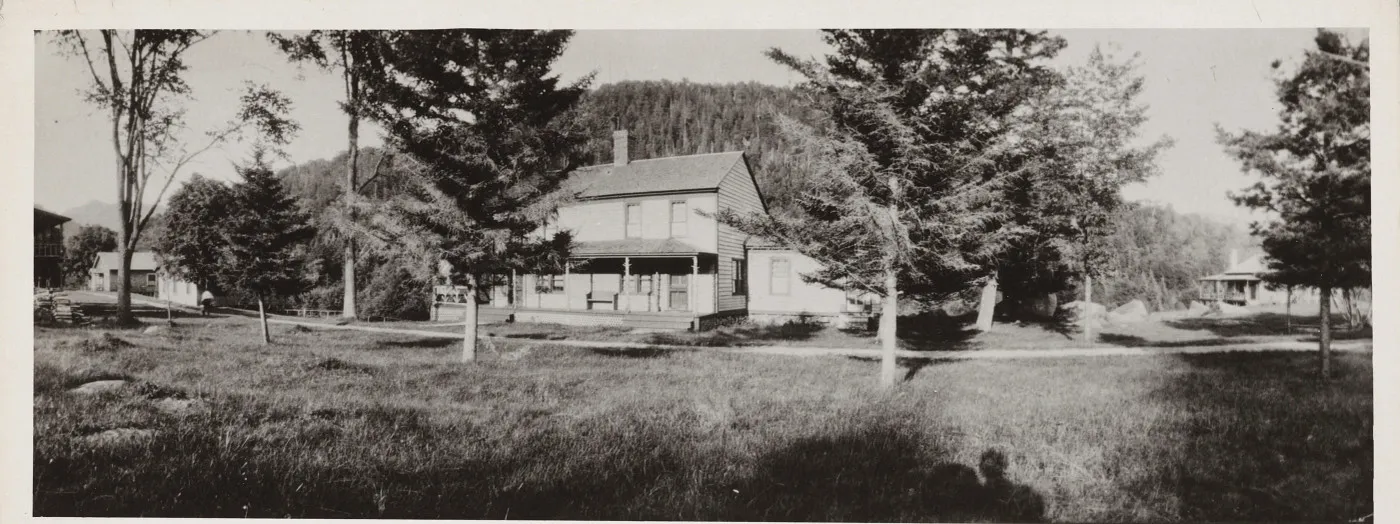
The MacNaughton Cottage at Tahawus, where the Roosevelt family vacationed in the Adirondacks in the summer of 1901. (Harvard College Library)
The Adirondacks Vacation: Summer 1901
By the summer of 1901, as the heat of Washington became oppressive, Roosevelt sought relief in the Adirondack Mountains of upstate New York. He and his family stayed at the Tahawus Club’s MacNaughton Cottage, in the shadow of Mount Marcy, the highest peak in New York, for a vacation from the tedious ceremonial duties of the Vice Presidency. He was hiking, hunting, enjoying the mountains that he loved—doing anything to escape the boredom and frustration of his office. He had no way of knowing that this vacation would change his entire life.
The Vice Presidency seemed to Roosevelt like a political exile—a place where he was removed from real power and real influence. Party leaders, particularly Thomas Platt, had engineered the situation deliberately. They wanted to remove the independent, unpredictable Roosevelt from the Governor's office where he had real authority. The Vice Presidency was the solution. Roosevelt was removed from effective power. He was placed in an office where he could do little damage to party interests or party machines. He was, in effect, neutralized.
But the Vice Presidency turned out to be an even more temporary position than anyone had anticipated. Roosevelt would serve as Vice President for only 194 days. On September 6, 1901, President McKinley was shot by anarchist Leon Czolgosz at the Pan-American Exposition in Buffalo, New York. McKinley was wounded but initially seemed to be recovering. Roosevelt was summoned to Buffalo to be near the President. Then, after days of apparent recovery, McKinley's condition deteriorated dramatically. On September 14, 1901, McKinley died. Theodore Roosevelt, the reluctant Vice President, became the President of the United States. Mark Hanna's worst fears had been realized. The "madman" he had feared would become President was now, in fact, the Chief Executive of the United States.
From Exile to the Highest Office
Roosevelt's brief time as Vice President demonstrated the unpredictability of politics. An office that seemed like a political dead end had led to the presidency. A man who thought he would never hold real power again found himself with more power than any other person in America. Roosevelt would later say that he had been reluctant to become President—that he had never aspired to the office in the conventional sense. But once he became President, he wielded the office with the same energy, ambition, and determination that had characterized everything he had done before. The Vice Presidency, though Roosevelt hated it, was the necessary stepping stone to the presidency. Without the unpredictable and tragic assassination of McKinley, Roosevelt would have remained Vice President, would have served out his term, and his political career would have taken a very different path. But McKinley's assassination changed everything. The reluctant Vice President became the active, energetic, reform-minded President who would shape American politics for the next seven and a half years.
Continue Reading
- Governor of New York — The position that made him Vice President
- The Rough Riders — The military fame that elevated him
- The Battle of San Juan Hill — His most famous moment in combat
- The Presidency — The office McKinley's assassination gave him
- Rise to Power Timeline — Complete chronology of his ascent
Primary Sources at the TR Center
Explore original documents and resources related to this topic in the Theodore Roosevelt Center Digital Library.
- Life of Theodore Roosevelt Timeline — Key dates from his entire life
- Theodore Roosevelt Biography — Comprehensive biographical overview
- Politics and Government Encyclopedia — His political career and achievements
- Chronology 1899-1902 — Events during his Vice Presidency and early presidency
From the Archives
Explore original photographs, documents, and illustrations related to this topic in the Theodore Roosevelt Center Digital Library.
Recommended Reading
- The Rise of Theodore Roosevelt by Edmund Morris (1979). ISBN: 978-0-307-77782-9
- The McKinley Assassination by Scott Miller (2011). ISBN: 978-0-06-187607-1
- Theodore Roosevelt: A Life by Nathan Miller (1992). ISBN: 978-0-688-04693-2