
A Day in the Life of a Dakota Rancher
Before the Light: Rising into the Badlands Dark
The day begins before the sky shows any hint of color—three or four in the morning, sometimes earlier when the work requires it, when the stars still blaze overhead with fierce brilliance. Roosevelt is awake by instinct and habit. The Badlands recognize no mercy toward those who oversleep. The cattle must be checked. The day's work waits for no man. He dresses in the dark cabin, pulling on heavy woolen long underwear despite the season (wool holds warmth even when damp), then his working clothes: flannel shirt that has been worn countless times, worn denim trousers stained with prairie dust and work, leather chaps to protect his legs from brush, thorns, and the edges of a horse's body, broad Stetson hat that has become shaped to his head and pulled low to shield against the wind. Everything is functional, nothing fancy. This is a uniform that speaks not of wealth or eastern style but of work and practicality.
The cold air hits him as he steps outside—even in summer, dawn in Dakota can be sharp as broken glass. The cottonwoods along the Little Missouri are barely visible as dark shapes against the slightly lighter sky. His breath steams in the chill air. Around him, the landscape is a study in shadow and silence and vast emptiness. The cook is already stirring the fire in the kitchen cabin, the smoke rising dark against the lightening eastern sky. Lantern light spills across the bare ground where the ranch hands move. The smell of coffee and bacon will draw the men from their bunkhouse soon enough, but first there is water to splash on the face, tasks to organize, the mental preparation for the day's labor.

Roosevelt in the fringed buckskin outfit he wore as a Dakota Badlands rancher in the 1880s. (Theodore Roosevelt Collection, Harvard College Library)

A roundup chuck wagon and outfit on the Little Missouri range, the hub of a cowboy’s working day. (Theodore Roosevelt Collection, Harvard College Library)
Morning: Breakfast, Saddling Up, and the Day's Work
Breakfast is hearty and quick and consumed standing up or sitting on whatever surface is at hand: biscuits made from flour and sourdough starter, bacon fried in its own grease, beans cooked the night before and heated on the stove, strong coffee black as river mud. Roosevelt eats with the hunger of a man who knows he will be in the saddle for twelve to eighteen hours or more, the kind of hunger that eastern dinner parties never produce. On the roundup, Roosevelt recalled in his Autobiography, the day began when "at three in the morning or thereabouts, at a yell from the cook, all hands would turn hurriedly out" — and work commenced immediately thereafter. Bill Sewall or Dow (his ranch managers from Maine) sit across from him, discussing the day ahead in low voices while the hands eat. Cattle to check in the north pasture where the water may be running low in a dry summer. A section of fence down near the ravine—likely the work of weather or wandering elk. A horse to be broken, or more precisely, a wild animal to be gradually taught to tolerate a rider. The endless work of keeping thousands of head of cattle fed, accounted for, and protected on open range where weather, predators, and their own stupidity constantly threaten survival.
By the time the sun cracks the horizon, Roosevelt is already mounted. His horse is a sturdy, half-wild creature bred for the Badlands—not beautiful, not trained in any formal sense, but tough and responsive to a rider who has learned to communicate through pressure and position. He's learned to ride with the competence of a man who spends more time in the saddle than on the ground, though his horsemanship remains more dogged than graceful. The other hands follow, and together they head out to where the work waits: checking on herds spread across the valley, spotting signs of disease or trouble, looking for any animals that have wandered away during the night or into the badlands and gotten stuck in a draw or caught by some predator.
The work is not dramatic or quick or particularly interesting to recount. It's deliberate, methodical, repetitive, and absolutely essential. Roosevelt has learned this in his years of ranching—the difference between the eastern notion of "cowboys" as romantic figures and the actual business of managing cattle across rough country. There's no galloping for the sake of it. A good rancher preserves his horse, moving at a steady pace all day, never running the animal unless necessity demands it. There's constant watching for the danger hidden in every coulee, every rocky slope, every unexpected drop in terrain.
Midday: The Hard Work of the Ranch
By mid-morning, the full heat of summer has arrived—the sun beating down on the grassland with relentless intensity—or the bitter cold of winter reveals its teeth and tries to kill anything exposed. Either way, there's no escape from it. If it's roundup season, the real work begins: roping cattle, branding those that haven't been marked with the ranch's brand, cutting out the animals destined for market or for breeding. Roosevelt has learned to rope—not with the showy skill of a Wild West showman, but with the competent efficiency that gets the job done. He's never become adept with the lasso because his eyesight is poor, but he's learned other tasks well: he's learned to brand without cruelty, to ride toward a panicking steer with calm authority rather than wild aggression, to work cattle in ways that don't injure them more than necessary. In the spring roundup of 1885, he participated for 32 straight days, riding, by his own reckoning, close to a thousand miles up and down the Little Missouri with dozens of other cowboys, hundreds of horses, and thousands of cattle.
His hands blister despite the calluses he's developed. His back aches from sixteen hours in the saddle. The dust gets into his eyes and throat and stays there. If it's winter, the cold burns his face until it feels like leather, and breathing becomes painful because the air freezes the inside of your lungs. If it's spring, the mud from the thaw slicks the ground and makes every step treacherous; Roosevelt's descriptions of this season speak of "ankle-deep gumbo" that made walking nearly impossible. The work doesn't care about his discomfort. The work simply continues, hour after hour, day after day, and he continues with it because quitting means failure.
This is the part of ranching that never makes it into stories or newspapers: the sheer, grinding, repetitive, almost unbearable labor. Hour after hour in the saddle. The knowledge that if he doesn't do this work—if he doesn't check every canyon and know the whereabouts and condition of every animal in his herds—then his investment slowly bleeds away through loss and poor management. He's already lost money in Dakota, thousands of dollars in bad luck and miscalculation and the harsh realities of open-range ranching. The Badlands are teaching him hard lessons about the real economics of ranching in country where weather is murderous and markets are unpredictable. But he won't quit. Quitting is not something Theodore Roosevelt does, not when his reputation is on the line, not when he's told people he could do this work.

Roosevelt’s cow outfit on the roundup, the hard communal work of gathering and branding cattle across the open range. (Theodore Roosevelt Collection, Harvard College Library)

Roosevelt outfitted as a Western hunter, rifle in hand, during his Dakota Badlands years. (Theodore Roosevelt Collection, Harvard College Library)
Afternoon: The Hunter Takes Over
Around three or four in the afternoon, if the day's ranch work allows it and the seasons permit, Roosevelt often breaks away with his rifle. This is not idleness or personal indulgence—it's sustenance. The ranch needs meat. Hunting is part of the ranch economy; the mainstay of meals is game of their own killing: antelope, deer, sometimes grouse or ducks, occasionally buffalo or elk in the earlier days. Hunting also serves another purpose equally important: it feeds something in him that the steady, methodical work of ranching doesn't quite reach. The frontier, he believes, is supposed to test a man's courage and skill in acute moments of action, not just his patience and determination over long hours.
He might spend two or three hours stalking elk or mule deer through the Badlands canyons, moving quietly across the scree slopes, constantly reading the wind to keep his scent away from the animals' sensitive noses. The landscape teaches him lessons: how to move silently, how to use broken terrain for cover, how to approach a prey animal without panicking it. When he finds a target, the shot must be good—one clean kill is the mark of a skilled hunter and a respectful one. He has learned that killing for sport alone, wounding animals and leaving them to suffer, feels to him like a betrayal of the privilege of being in wild country.
Sometimes he returns to the ranch as darkness falls with an elk or a large deer. Sometimes he returns empty-handed. Either way, the hunting keeps him sharp, keeps him honest, keeps him connected to the wild. Out there in the canyons and coulees, his wealth from his eastern inheritance means nothing. His previous position in the New York Assembly means nothing. The Badlands recognize no rank or family name. All that matters is whether his eyes are good enough to spot movement at distance, whether his wind holds out for the climb and the stalk, whether he can read the land and the animals and the subtle signs that mean the difference between success and failure, dinner and hunger.
Evening: Return, Dinner, and the Lamplight Hours
Back at the ranch as darkness falls, there's still work to be done—caring for horses, checking that no animals are in distress, making sure everything is secure against the night. Dinner comes late, after full dark. It's substantial: roasted meat (elk or venison if the day's hunt was successful, beef otherwise), bread, canned vegetables, always more coffee. The ranch hands eat and talk little—they're too tired for conversation.
But Roosevelt doesn't stop when the physical work ends. While the hands retire to the bunkhouse, he settles himself by lamplight. This is where the eastern intellectual in him emerges, the part of him that seems almost like a different person. On the rough wooden table, he spreads out his writing—often multiple books at once, a habit of his since childhood. He might be working on Ranch Life and the Hunting-Trail or Hunting Trips of a Ranchman, the books that are turning his frontier experience into literature.
He writes about the animals he's hunted. He writes about the landscape. He writes about the men he's working alongside and what their lives reveal about American character. He's also reading—history, biography, natural history—books brought up from the East by post or ordered from New York and arriving weeks late. "Black care rarely sits behind a rider whose pace is fast enough," he wrote, but the black care finds him again in the lamplight, and he meets it with writing and thought.
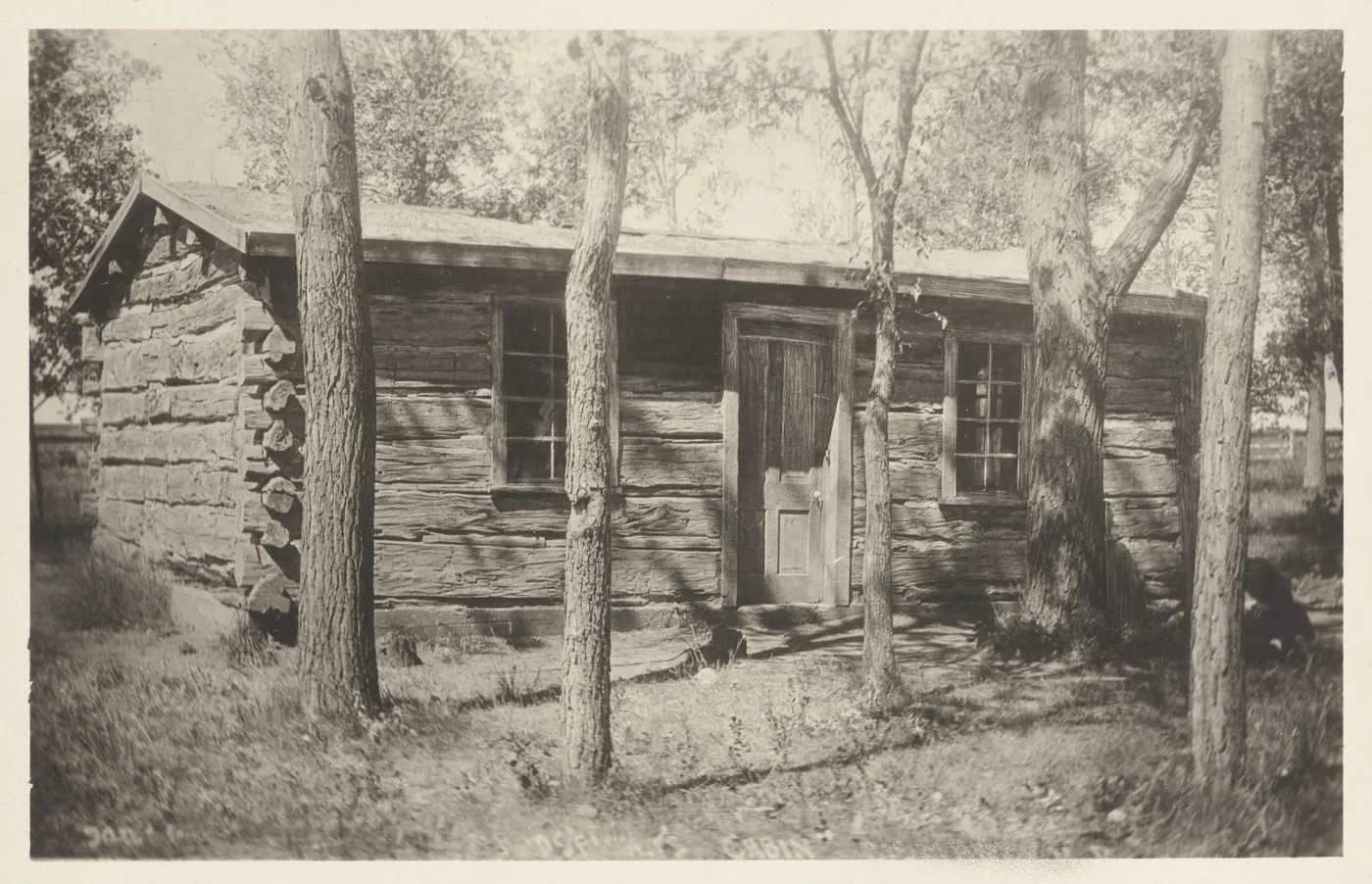
Roosevelt’s log ranch cabin in the Badlands, where the day ended by lamplight with books and writing. (Theodore Roosevelt Collection, Harvard College Library)

The Little Missouri near Roosevelt’s ranch, the still country that fell silent after dark. (Theodore Roosevelt Collection, Harvard College Library)
Night: The Badlands Silence
Long after midnight, Roosevelt finally surrenders to sleep. The cabin is dark and cold. The silence outside is profound—not the silence of a city at night, which is never truly silent, but the actual silence of open country far from any town or road. Stars blaze overhead with a brilliance that seems almost violent. The Little Missouri flows past, its banks lined with cottonwoods. Somewhere out in the darkness, coyotes call to each other. The Badlands never sleep, but men must.
As he lies in his bunk, Roosevelt knows that tomorrow will be the same—the same work, the same demands, the same testing of body and will. The life he lives here is not comfortable. It's not safe. It's not guaranteed to make him wealthy or famous. But it's real in a way that Assembly politics and New York society could never be. Out here, a man discovers who he actually is, stripped of position and wealth and family name.
This is why he came. This is why he stays. And when he leaves the Badlands—as he knows he must eventually—this is what he will carry with him: the knowledge that he tested himself against the frontier and did not break.
A Tested Man
This daily rhythm would repeat for four years, from 1883 to 1887. The work wore on Roosevelt, but it also built him. The "four-eyed dude" who stepped off the train at Little Missouri in 1883—thin, spectacled, fragile—was being transformed into something tougher, something more genuine. The Badlands demanded authenticity. They tolerated no pretense. And Theodore Roosevelt, for all his flaws and his Eastern education, responded by becoming more fully himself: a man of action and thought, a man capable of hard work and harder thinking, a man who understood that character is built not through comfort but through striving.
Continue Reading
- Frontier Life in the Badlands—The social and economic context of ranch work
- Elkhorn Ranch—The home and headquarters of his ranching operation
- Roosevelt the Western Writer—How his ranch experience became literature
- The Boat Thieves Episode—A dramatic moment from his frontier years
Primary Sources at the TR Center
Explore original documents and photographs from Roosevelt's ranching years in the Theodore Roosevelt Center Digital Library.
- Roosevelt in the Badlands Timeline—Detailed chronology of events during his western years
- Dakota and Ranching Encyclopedia—Comprehensive reference on his frontier experience
- Chronology 1884–1891—Detailed timeline of his Dakota period
From the Archives
Explore original photographs, documents, and illustrations related to this topic in the Theodore Roosevelt Center Digital Library.
Recommended Reading
- Ranch Life and the Hunting-Trail by Theodore Roosevelt (1888)
- Theodore Roosevelt in the Dakota Badlands: An Historical Guide by Clay Jenkinson (2006). ISBN: 0-9786267-0-2
- Roosevelt in the Bad Lands by Hermann Hagedorn (1921)
- That Damned Cowboy: Theodore Roosevelt and the American West, 1883–1898 by Michael L. Collins (1989). ISBN: 0-8204-1004-7